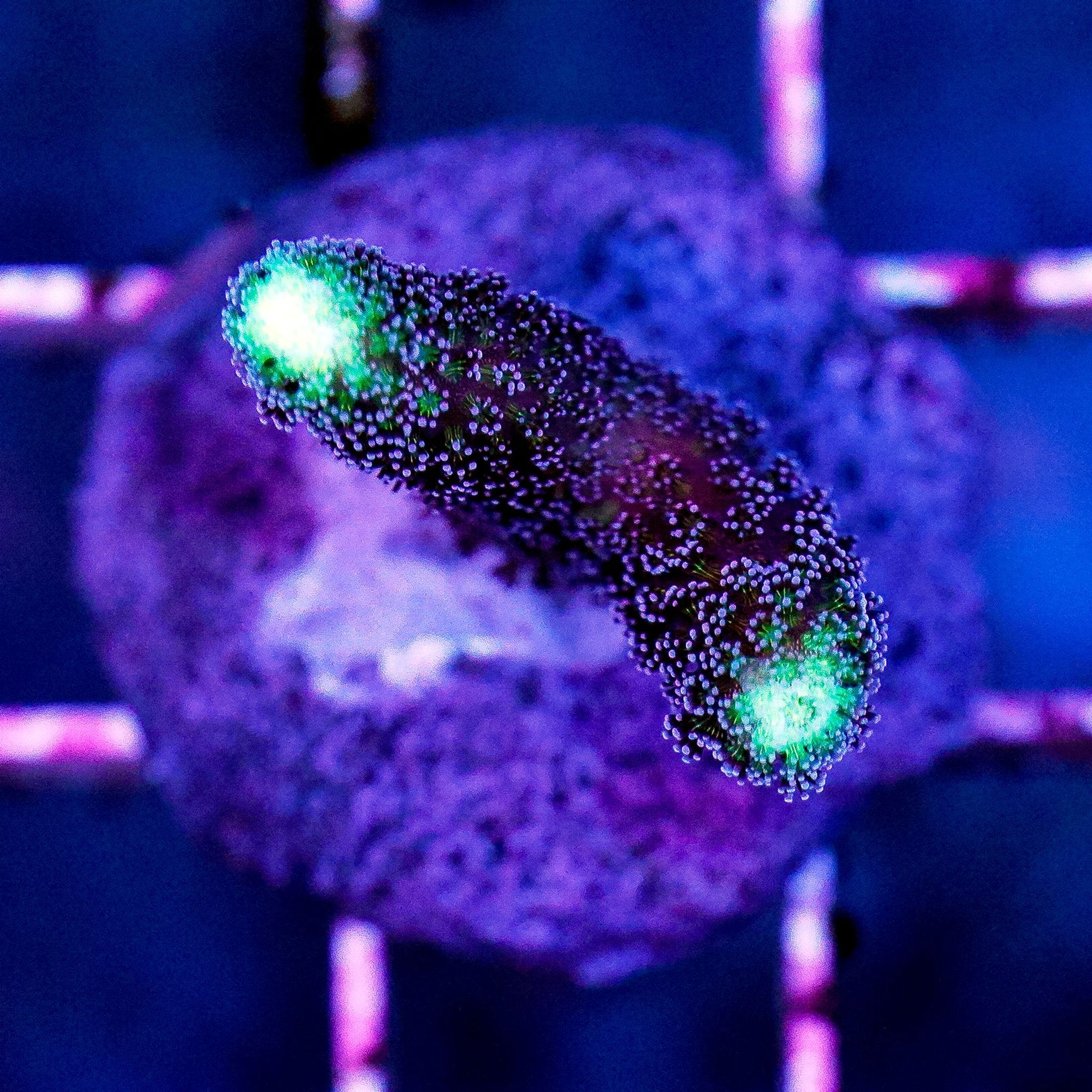

Best Placement for Stylophora: PAR, Flow and Space Requirements
Stylophora is one of the more forgiving small-polyp stony (SPS) corals, which makes it a common first step for reefers moving up from softies and LPS. Getting the placement right still matters: this guide covers the PAR range, flow style, mounting method and spacing that let a Stylophora colony color up and grow instead of stalling or bleaching.
Why Stylophora Is a Good "First SPS"
Stylophora, sometimes called cat's paw or compared to a compact birdsnest coral, is a branching Scleractinian (true stony) coral. That growth form is the key to understanding its needs: unlike a plating or massive/boulder-shaped coral, Stylophora builds upward and outward in dense branches, which means light and water have to reach not just the outer surface but the interior of the colony as it fills in. That single fact drives most of the placement, flow and spacing advice below.
Compared with many other SPS genera, Stylophora tolerates a wider range of light and flow conditions and adapts reasonably well to modest mistakes, which is why it's often recommended as an entry point into SPS keeping.
PAR Target: How Much Light Does Stylophora Need?
Sources disagree on the exact number, with recommendations ranging anywhere from 100–250 on the low end to 300–450 on the high end. In practice:
- 200–350 PAR is a reliable core target for good growth and coloration.
- The genus can tolerate as low as ~150 PAR or 400+ PAR at the high end, but only when a colony has been acclimated to that level gradually.
- Spectrum, depth in the tank, and how the coral was raised before you got it all shift where in that range a given colony does best.
Rather than chasing one "correct" number, treat 200–350 PAR as your starting zone and use the coral's own response — polyp extension and color — as the real feedback signal.
Measuring PAR at Your Rock Height
Most of the confusion around PAR targets comes from not knowing what your fixture is actually delivering at the coral's mounting point, not from the target itself. Two practical options:
- A PAR meter held at the exact rock height and horizontal position you're considering gives you a real number, and is worth the investment once you're running multiple SPS colonies.
- Manufacturer PAR charts for your specific fixture, cross-referenced against your tank depth and the fixture's mounting height above the water, get you a reasonable estimate if you don't have a meter yet.
Either way, re-check PAR any time you change fixture height, add a lid or clip-on shade, or move a colony to a new spot.
Light Ramping
Whether you're increasing fixture intensity or introducing a new frag to a brighter system, ramp gradually:
- Start around 30% of the target intensity.
- Increase roughly 10% per week.
- Watch for pale or bleaching tips, which signal you're moving too fast.
Sudden PAR jumps are one of the most common, and most avoidable, causes of stress in newly placed Stylophora.
Spectrum
Full-spectrum LED, T5, and metal halide lighting all work for Stylophora. A bluer spectrum, roughly in the 14,000–20,000K-equivalent range, tends to intensify pigmentation, but spectrum is a secondary lever compared with getting PAR and flow right first.
Flow: Turbulent, Not Direct
Stylophora wants strong flow, but the style of flow matters as much as the strength. In the wild, this genus grows in high-surge zones where water moves from multiple directions in short, irregular bursts — not as a steady, one-way current.
Aim for turbulent, alternating, multidirectional flow — random or wave-pump-style movement — rather than a single powerhead aimed directly at the colony.
Why Alternating Flow Matters for a Branching Coral
Because Stylophora grows as a dense mass of branches, flow direction affects the whole colony differently depending on where it's aimed:
| Flow pattern | Effect on the colony |
|---|---|
| Constant one-direction jet | Scours tissue on the exposed face; causes recession or necrosis on the shaded side |
| Flow reaching only the outer branches | Detritus settles inside the colony as it grows outward, fueling algae and tissue loss in the center |
| Alternating / gyre-style flow | Flushes the entire colony, including interior branches, as it fills in |
A single fixed powerhead pointed at the coral is a common mistake for exactly this reason — it produces one-sided polyp extension on the side facing the flow and a dead, poorly flushed zone on the far side.
Where to Place Stylophora in the Tank
Stylophora belongs on upper-to-mid rockwork, ideally on an exposed ledge or peak that gets direct light and flow from more than one direction.
Avoid:
- Caves, overhangs, or low crevices where light and flow are both weaker.
- The sand bed — Stylophora should never be mounted directly on or buried in sand.
- Any spot that only receives flow from one angle (tucked against a rock face works against you here).
Mounting
Frag Stylophora onto a bare, cured rock surface, never directly on sand, using reef-safe cyanoacrylate gel or two-part epoxy putty. Choose a mounting point that gets clean flow around all sides of the eventual colony, not just from the front, since the branches will grow outward in every direction.
Acclimating a New Frag's Position
New frags, especially ones sourced from a different system's lighting, should start lower and dimmer, with gentler flow, than your eventual target spot. Migrate the frag upward over 2–4 weeks as it shows healthy polyp extension and begins coloring up. This mirrors general SPS acclimation practice and avoids treating "high light, strong flow" as something to apply on day one.
Rockwork and Aquascaping for SPS Placement
The rock you build with affects how many good Stylophora spots you actually have.
- Dry rock vs. live rock: dry rock is cheaper, arrives pest-free, and fully cycles biologically within about 4–8 weeks. Live rock seeds beneficial bacteria faster but carries a higher risk of hitchhiker pests. Either is a fine base once fully cured — the difference is cost and cycling time, not coral compatibility.
- Open, minimalist aquascapes — using shelf or pedestal-style rock with more negative space — create more usable elevated ledges and better flow paths than a dense rock pile, which directly translates into more good Stylophora placement options.
- Sand vs. bare-bottom: sand beds support cleanup crews and biofiltration and look natural, but can cloud or blow around under the strong flow Stylophora needs. Bare-bottom setups handle high flow better and export nutrients more easily but suit more experienced keepers. Either works as long as flow isn't constantly sandblasting the colony.
Spacing From Other Corals
Stylophora carries a short, low-sting polyp and is comparatively peaceful compared with aggressive LPS. That said, still leave a buffer:
- A few inches minimum from other peaceful corals.
- More distance from Euphyllia-type or other long-tentacled LPS, whose sweeper tentacles reach further than expected and can damage Stylophora tissue overnight.
The real spacing driver isn't Stylophora's own sting — it's mild and short-range — it's the coral's branching growth rate. Contact from overgrowth, not stinging, is the more common conflict once a colony matures.
Plan for the Mature Colony, Not the Frag
Under good conditions with stable water chemistry and feeding, Stylophora grows roughly 2–4 inches (5–10 cm) per year. A frag placed with "enough" space at purchase can crowd its neighbors within a year. When laying out an SPS-dominant tank, plan spacing for several branching colonies' full-grown footprints in advance, not just the frag sizes you're starting with.
Supporting Water Parameters
Correct placement only pays off if the water chemistry backs it up.
- Alkalinity: keep it stable, roughly 8–14 dKH (3–5 meq/L), with calcium and magnesium in balance. Unstable alkalinity undermines even perfectly placed, well-lit, well-flowed colonies because the coral can't reliably build skeleton.
- Dissolved organics: elevated total organic carbon dulls coloration and stresses SPS even at correct PAR and flow. Routine nutrient export — skimming, carbon media, and regular water changes — supports your placement choices rather than replacing them.
- Protein skimming in small tanks: not strictly mandatory in a lightly stocked nano system, but strongly recommended once SPS like Stylophora are added, since stable water quality is part of what makes correct placement actually work.
- Auto top-off and a dedicated RODI reservoir make it easier to hold salinity and alkalinity steady, since evaporation swings otherwise shift parameters and stress a newly placed frag before it's had a chance to settle in.
Reef-focused equipment, lighting and additives are available to browse in FishyHub's Lighting and Filters categories if you're building out this supporting setup.
Reading Your Coral After Placement
Coloration and polyp behavior are better placement diagnostics than any single PAR number. Check a newly placed colony every few days for the first few weeks:
| Sign | Likely cause |
|---|---|
| Pale or bleached tips | Too much light too fast, or PAR too high for current acclimation |
| Brown, dull color with poor polyp extension | Too little light or insufficient flow |
| Tissue recession or algae in the colony's center | Flow isn't reaching interior branches |
| Polyps open on only one face | Flow is laminar or one-directional |
| Reduced nighttime tentacle extension | Additional sign flow or light isn't reaching the whole colony, worth checking alongside daytime color |
Nighttime polyp and tentacle extension is worth checking as a second data point — a colony that extends well after dark but looks flat and closed during the day often has a light issue rather than a flow issue, and vice versa.
Common Placement Mistakes
- Jumping a new frag straight to full target PAR and flow instead of ramping — causes bleaching or tissue loss within days to weeks.
- Aiming a single powerhead directly at the colony instead of using alternating or multidirectional flow.
- Burying the base in sand or placing the frag low in the tank where both light and flow are weaker.
- Placing too close to Euphyllia-type LPS, whose sweeper tentacles reach further than expected.
- Spacing for the frag's current size and ignoring how fast it will grow into that gap.
- Fixating on hitting one "ideal" PAR number instead of watching polyp extension and color as the real feedback signal.
Frequently Asked Questions
What PAR does Stylophora need?
A reliable core target is 200–350 PAR, with tolerance down to about 150 PAR and up to 400+ PAR when the colony has been properly acclimated to that level.
Does Stylophora need direct flow or indirect flow?
It wants strong flow, but turbulent and alternating rather than a direct laminar blast. Random or wave-pump-style movement flushes the whole colony, including interior branches, better than a single fixed jet.
Where should I put Stylophora in my tank?
On upper-to-mid rockwork, on an open, elevated ledge or peak with unobstructed light and flow reaching it from multiple directions — not in a cave, low crevice, or on the sand.
How close can I place Stylophora to other corals?
Leave a few inches minimum from peaceful neighbors and more from long-tentacled LPS like Euphyllia-type corals. Always account for Stylophora's branching growth rate over the next year, not just its current frag size.
Can Stylophora go on sand?
No. Mount it on solid, cured rock instead — sand placement risks burial, tissue irritation, and reduced flow and light exposure at the base.
Why is my Stylophora losing color or bleaching?
Usually too much light introduced too quickly, or a PAR/flow mismatch for where it's sitting. Check your ramp schedule and consider repositioning the colony to a less intense spot temporarily.
Is Stylophora reef-safe to place near LPS?
Stylophora's own sting is mild and short-range, so it's relatively peaceful toward neighbors. But it can be stung by more aggressive LPS, and its own branches will overgrow close neighbors as it grows, so spacing matters in both directions.
How fast does Stylophora grow, and how does that affect placement?
Roughly 2–4 inches (5–10 cm) per year under good conditions, so initial spacing should account for the coral's mature footprint, not just its size as a frag.
Once you've settled on PAR, flow and spacing, browse FishyHub's SPS Corals selection to find a Stylophora frag or colony suited to your setup.


