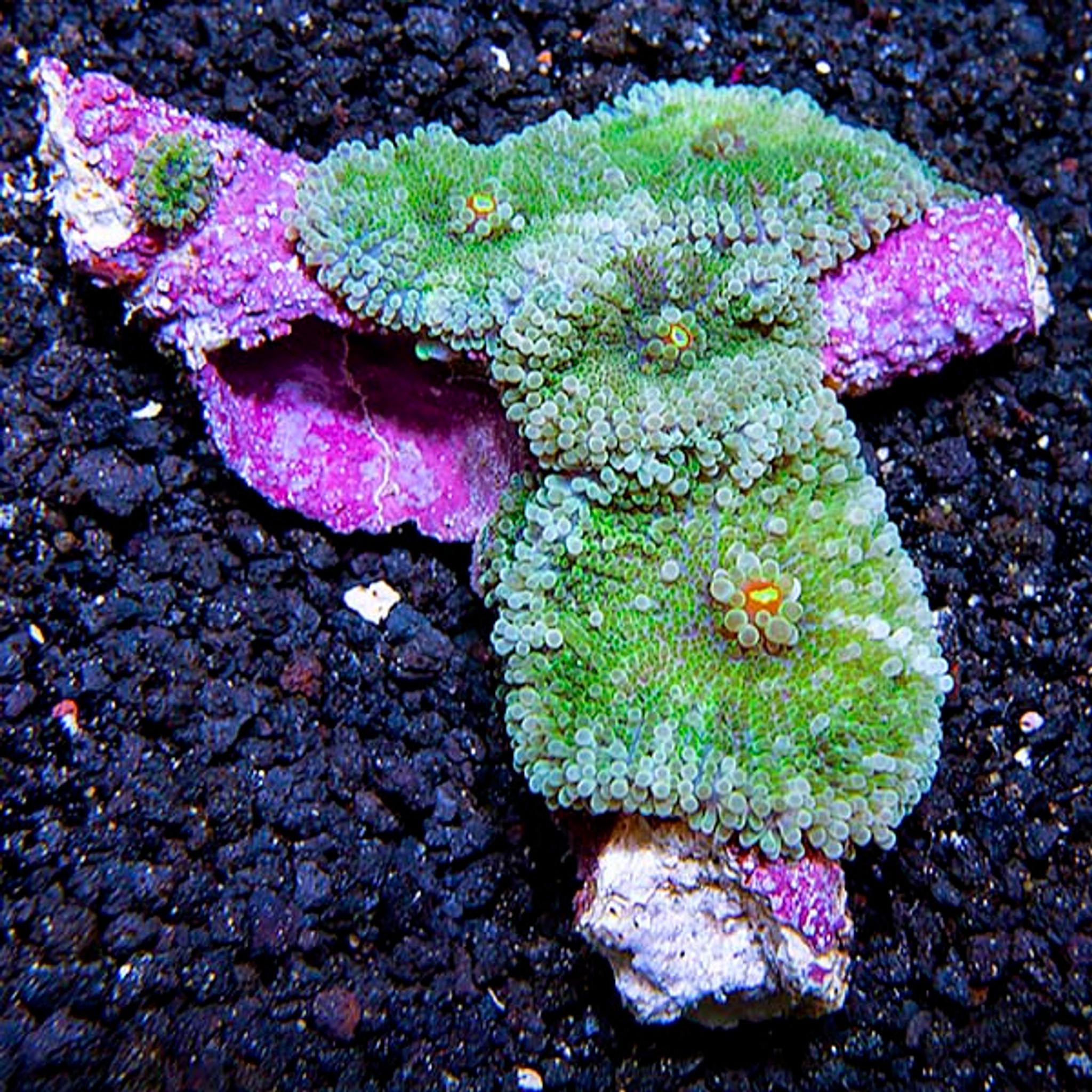

Best Placement for Ricordea: PAR, Flow and Space Requirements
Ricordea mushrooms color up beautifully with the right light and flow, but the wrong spot on the rockwork can leave them shriveled, bleached, or detached within days. This guide gives you the PAR range, flow level, and spacing math to place Ricordea correctly the first time, whether you're working with a full reef tank or a nano cube.
What Ricordea Actually Are (and Why That Matters for Placement)
Ricordea are corallimorphs, often called mushroom corals, not true stony corals. They have no calcium carbonate skeleton, so they don't carry the strict calcium and alkalinity demands of SPS or LPS corals. That simplifies dosing, but it doesn't mean water quality is optional — stable parameters still matter for long-term color and health.
Two species dominate the hobby:
- Ricordea florida — Caribbean/Atlantic origin, generally hardier and more forgiving, a solid choice for newer reef keepers.
- Ricordea yuma — Pacific origin, showier and more saturated in color, but more sensitive to swings in water quality. Yuma isn't dramatically harder to keep, but it does best in a mature, well-cycled tank with stable nutrients rather than a brand-new setup.
PAR and Lighting: Finding the Sweet Spot
Ricordea live in shallow, sun-exposed water in the wild, which is why they color up well under moderate-to-fairly-bright light rather than deep shade. In the aquarium, the target range is:
- 50–150 PAR — the reliable sweet spot for both species under medium light.
- Up to 150–200 PAR — tolerable for colonies that have been acclimated slowly, once color and extension prove stable.
- Very intense, close-range lighting (strong metal halides or high-output LEDs aimed directly at the polyp) can bleach the tissue or cause it to stay tightly closed.
Because sources disagree on how high Ricordea can safely go, the sensible approach is to acclimate gradually rather than commit to a number on day one:
- Start new frags at 50–100 PAR.
- Observe for one to two weeks, watching for bleaching, browning, or retraction.
- If color and extension hold up, move the colony higher in small steps, up to roughly 150–200 PAR for established colonies.
If your fixture runs hot, place Ricordea lower in the water column or angle it on rockwork out of direct glare — in the "shadow" of an overhang or ledge still lets in enough moderated light while protecting the tissue from direct-beam intensity.
Re-checking Placement After a Lighting Upgrade
A common nano-tank scenario: you swap a stock LED for a stronger fixture, and PAR at the same rock position jumps significantly. Existing Ricordea colonies need to be re-acclimated as if they were new frags — shade them temporarily, or move them lower for a week or two, then reintroduce them to their old spot gradually. Skipping this step after an upgrade is one of the more common causes of sudden bleaching in tanks that were previously stable.
Flow: Low to Medium, Never Direct
Ricordea want gentle, indirect water movement. Strong or turbulent flow:
- Prevents the oral disc from fully extending, so the polyp looks shriveled or stays closed.
- Can physically dislodge the weak pedal disc that anchors the animal to rock.
- Puts detached polyps at risk of drifting into a powerhead intake, where they can be shredded.
Never aim a powerhead directly at a Ricordea colony. Angle circulation so it washes past the rock structure rather than blasting it head-on.
Diagnosing Too Little vs. Too Much Flow
| Symptom | Likely cause | Fix |
|---|---|---|
| Detritus or film buildup sitting on the oral disc | Flow too low | Redirect a pump slightly toward the area, or reposition on higher rock |
| Algae fuzz accumulating at the base | Flow too low | Improve general circulation in that zone |
| Disc stays closed or retracted most of the day | Flow too high | Move the colony out of direct current or reduce pump output |
| Polyp repeatedly detaches from the same spot | Flow too high or physical bumping | Relocate to a calmer area with more shelter |
Where on the Rock to Place Ricordea
The ideal zone is lower-to-mid rockwork, positioned in the moderated light and flow created by an overhang or angled ledge. This gives you softened light and gentler current in the same spot, which matches both requirements at once.
A few placement rules to follow:
- Avoid the sandbed. Ricordea attaches to hard surfaces and won't do well sitting loose on substrate.
- Avoid a direct line with any powerhead, even if the flow seems moderate from a distance — turbulence intensifies close to the outlet.
- Give it a ledge or crevice, not the most exposed point on the rock. This naturally moderates both light and current without you needing to guess exact numbers.
If a Polyp Detaches
Detachment happens occasionally even at moderate flow while a new frag is settling in. If you find a polyp loose in the tank:
- Move it to a calm spot with a loose rubble pile so it can reattach on its own.
- Don't glue it down immediately — forcing a re-attachment before the polyp is ready can damage tissue and delay recovery.
- Give it days to weeks to find its own footing; this is normal behavior, not necessarily a sign of a bad tank.
Space Requirements and the Spreading Colony Problem
Ricordea reproduces primarily through longitudinal fission — a single polyp splits down the middle into two mouths, which then separate into two individuals. Over time, one frag becomes a spreading carpet.
Adult polyp sizes vary by species:
- Ricordea florida: roughly 1.5–2 inches (4–5 cm) across.
- Large Ricordea yuma: up to 3–6 inches (7.5–15 cm) across.
Because of this fission growth, a frag that looks small today can crowd its neighbors within a year. Budget space accordingly rather than placing new frags tight against existing coral.
A Practical Spacing Rule of Thumb
Most placement guidance stops at "leave a few inches," which isn't specific enough for a fast-spreading carpet. A more useful planning rule: leave a clear radius equal to roughly 3–4 times the frag's current diameter to accommodate a year of fission growth. A 1-inch frag, for example, should have a clear radius of about 3–4 inches (7.5–10 cm) before you hit rock occupied by another coral.
Same-species contact is generally tolerated — Ricordea florida polyps in particular can touch and even overlap each other without harm as the colony fills in. The spacing concern is mainly about other coral genera.
Spacing From Other Corals: Why the Buffer Matters
Ricordea can sting or be stung on direct contact with LPS corals, zoanthids, or other corallimorphs. Beyond simple contact, a few aggression mechanisms make wider buffers worth planning for:
- Sweeper tentacles — some LPS corals can extend stinging tentacles up to roughly 12 inches (30 cm), well beyond their visible base.
- Mesenterial filament attacks — some corals extrude digestive filaments at night, stinging neighbors with no obvious daytime warning sign.
- Mucus-coat irritation — physical proximity alone can cause chemical irritation between different coral types.
- Allelopathic (chemical) warfare — soft corals, leathers especially, release compounds into the water that can stress or damage nearby coral tissue even without direct contact.
Treat these as a reason to keep meaningful distance between Ricordea and any aggressive stony or soft coral, not just other mushrooms. If you're shopping for LPS to place nearby, check expected polyp extension and sweeper reach before deciding on final placement — browse options in LPS hard corals to compare typical sizes before you commit to a layout.
Nano Tank Placement
Ricordea's modest light and flow needs make it a frequent recommendation as a first coral for nano and all-in-one tanks. That said, small systems concentrate both light and flow more than larger displays, so the same numbers require more caution:
- Place the colony on lower-to-mid rock structure, a few inches below the built-in LED.
- Angle it away from the return or circulation pump's direct outflow — nano pumps often push more turbulent flow at close range than their flow-rate spec suggests.
- Err toward the lower end of both the PAR and flow ranges given the tank's small water volume and tight equipment placement.
- Re-check placement any time you change equipment — a new light, an added powerhead, or a bigger return pump can shift both PAR and flow at the same rock spot significantly.
If you're stocking a compact cube, browse mushroom corals for Ricordea frags sized appropriately for smaller footprints, and check LED lighting options with adjustable intensity so you can start low and step up gradually.
Feeding and Placement
Ricordea gets most of its energy from photosynthesis through its zooxanthellae, which is part of why light placement matters so much. That said, occasional meaty feedings support growth and color:
- Offer chunks roughly half the size of a mysis shrimp, or a pellet/amino-acid supplement.
- Ricordea largely ignores fine particulate foods — expect the polyp to probe and reject very small particles rather than absorb any benefit from them.
- Overfeeding fine foods that get rejected just fouls the water without helping the coral, so stick to larger pieces fed occasionally rather than frequent small doses.
Reef Photography: A Placement Bonus
A Ricordea placed well for color under moderate light also tends to photograph best — the two goals aren't separate. A few tips for capturing the reflective, patterned oral disc accurately:
- Dim the actinic/blue channel slightly and emphasize white light to show true color.
- Shoot straight-on rather than at an angle to avoid glare off the polyp's glossy surface.
- Use a macro lens or phone macro clip to capture fine patterning.
- Turn off room lights and shoot under tank lighting only, avoiding flash and stray reflections off the glass.
Common Mistakes to Avoid
- Placing frags directly under high-output LEDs or halides without acclimation — leads to bleaching or a polyp that stays closed.
- Aiming a powerhead directly at the colony — the polyp won't open, or it detaches and drifts toward equipment.
- Crowding frags too close to zoanthids, LPS, or leather corals — night-time filament stings or chemical irritation can cause unexplained recession with no obvious daytime symptom.
- Gluing a detached polyp back down immediately instead of resting it in a calm rubble pile to reattach on its own schedule.
- Assuming Ricordea needs reef-grade calcium/alkalinity dosing — unnecessary since it has no calcareous skeleton; focus on stable general water quality instead.
- Overfeeding fine foods the polyp visibly rejects, which fouls the water for no benefit.
Frequently Asked Questions
What PAR do Ricordea mushrooms need?
Roughly 50–150 PAR is the reliable range for most Ricordea. Start new frags at the lower end, around 50–100 PAR, and only move established, healthy colonies higher — up to about 150–200 PAR — after a gradual acclimation period.
Do Ricordea need high flow?
No. Low-to-medium flow is best. Strong or turbulent flow prevents the oral disc from fully extending and can dislodge the polyp from the rock.
Can Ricordea touch each other?
Same-species contact is generally tolerated, and Ricordea florida in particular can touch or even overlap without harm as a colony spreads. Contact with other coral species, however, should be avoided due to stinging and chemical irritation risks.
How much space should I leave around a Ricordea frag?
Leave a clear rock radius of roughly 3–4 times the frag's current diameter to account for a year of growth through fission. Ricordea reproduces by splitting into two individuals, so a small frag becomes a spreading colony over time.
Why did my Ricordea detach from the rock?
Usually too much flow, or being bumped or crowded by a neighboring coral. Move the detached polyp to a calm spot with loose rubble so it can reattach naturally — don't glue it down right away.
Is Ricordea yuma harder to keep than Ricordea florida?
Yes, generally. Yuma is more sensitive to water quality swings and does best in a mature, well-cycled tank with stable nutrients, while florida is more forgiving for newer reef keepers. The placement logic for both is similar, just with more cautious light and flow acclimation for yuma.
Can I put Ricordea in a nano tank?
Yes — its modest light and flow needs make it a popular nano and beginner coral. Place it on lower-to-mid rock a few inches below the light, and keep it clear of the return pump's direct flow, since nano systems concentrate both light and flow more than larger tanks.
Ready to add Ricordea to your setup? Browse current frags and colonies in marine corals on FishyHub to find sizes and species that match your tank's light and flow.


