
Best Placement for Porites: PAR, Flow and Space Requirements
Porites often gets lumped into a single "easy stony coral" category, but massive boulder forms and branching finger coral want different light, flow and spacing. This guide breaks placement down by growth form so you can pick a spot, set a PAR target, and leave room before your colony outgrows it.
Know Your Porites Form First
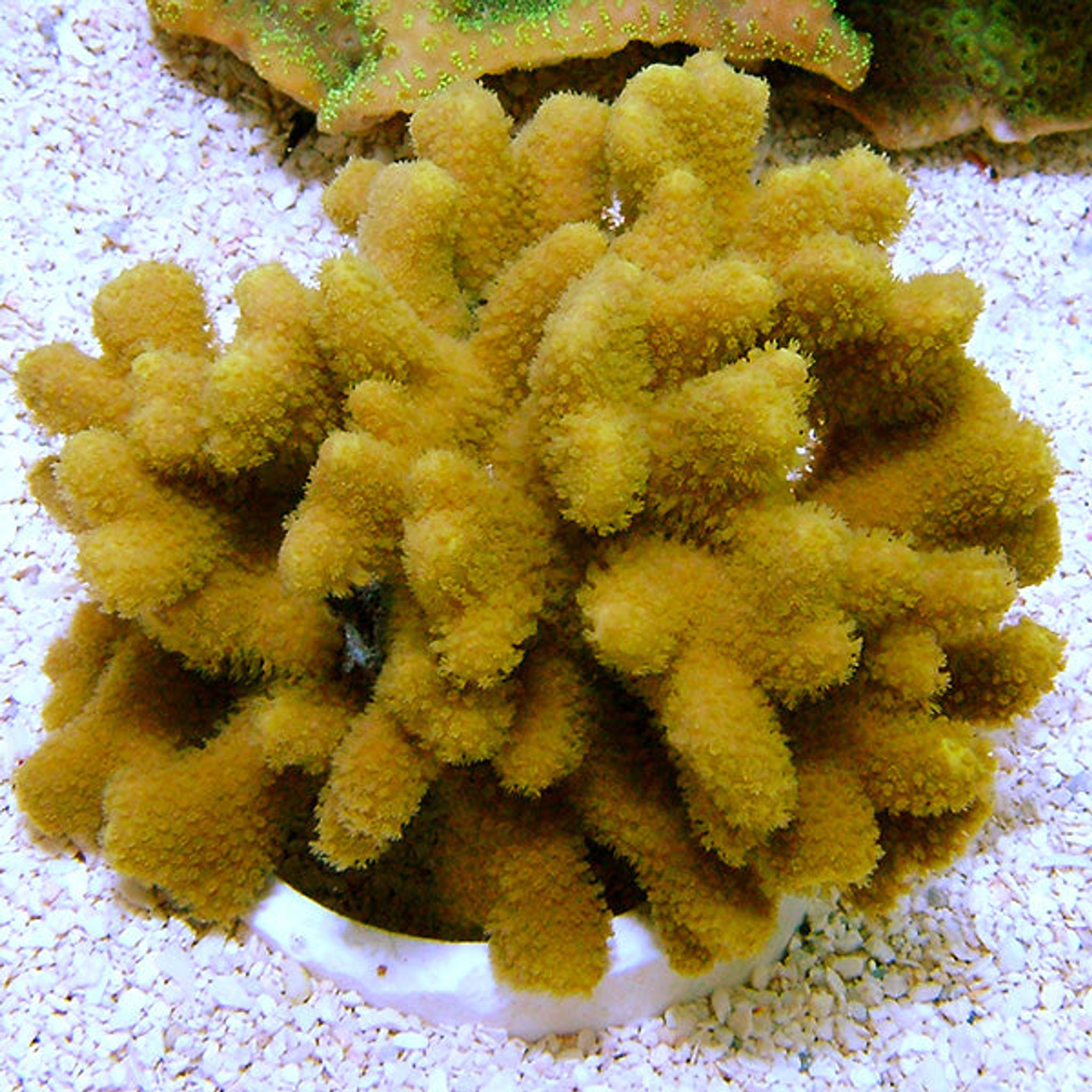
Porites is a genus, not a single coral. The aquarium trade sells two distinct growth habits: massive/encrusting ("boulder") forms that spread as low domes or crusts over rock, and branching forms, sold as finger coral, that grow upright fingers reaching toward the light. Both share similar tissue and skeletal structure, but their light and growth-rate profiles diverge enough that "best placement" isn't one answer — treat the form you own as the starting point below.
PAR Requirements by Growth Form
Porites falls in the moderate-to-high PAR range, but where in that range depends on form:
| Growth form | PAR target (µmol/m²/s) | Notes |
|---|---|---|
| Massive/encrusting (boulder) | 150–250 | Tolerates the lower half comfortably; behaves more like an easy LPS |
| Branching (finger coral) | 250–350 | Colors up and grows fastest near the upper end, similar to a tougher SPS |
Some care sheets lump all Porites into a flat "100–150 PAR, easy coral" bucket, while others treat branching finger coral like a full SPS piece needing 300+ PAR. Neither blanket number is reliable on its own — identify your growth form first, then start in the lower-middle of its range and adjust based on how the coral actually responds.
Where to Place It in the Tank
For most home reef tanks, mid-to-upper rockwork is the default zone for either form — high enough for adequate PAR without being buried in rock shadow, but not jammed at the very peak under an unshaded, high-output fixture on day one. That combination is the single most common cause of new-colony bleaching. Favor a spot you can adjust a few inches up or down as the colony's response tells you what it wants.
Flow: Turbulent, Not a Single Blast
Porites wants moderate-to-strong, turbulent or randomized flow rather than one steady, laminar current aimed directly at the colony.
Turbulence keeps detritus and film algae from settling on the coenosteum (the fine skeletal surface between polyps) and supports gas exchange across the tissue. A single fixed-direction blast, by contrast, tends to cause tissue recession on the flow-facing side, even when total flow volume is adequate. Too little flow shows up as dull tissue, retracted polyps, and a film of algae or detritus. Multiple smaller powerheads angled differently, or a wavemaker running a randomized pulse, generally outperform one strong pump aimed straight at the colony.
Spacing: Plan for the Coral It Will Become, Not the Frag It Is Now
Porites grows comparatively fast for a stony coral, which is why placement mistakes tend to show up later rather than immediately. Leave at least 4–6 inches (10–15 cm) between a new frag or colony and its nearest coral neighbors, and give branching finger coral more than the minimum, since it spreads both outward and upward and will shade anything below within months. Measure against the coral's eventual overgrowth footprint, not its current frag size — a 2-inch (5 cm) frag today can become a fist-sized colony in a year.
Porites isn't particularly aggressive chemically or with sweeper tentacles compared to many LPS corals. The real risk to neighbors is physical contact and shading from fast growth, so keep slower-growing or light-hungry corals out of the space it will eventually occupy, not just the space it occupies on day one.
A Step-by-Step Light and Flow Acclimation Timeline
New frags and colonies should never go straight into their target PAR and flow zone. A gradual acclimation over 1 to 3 weeks avoids bleaching or tissue recession from a sudden jump in intensity:
- Days 1–4: Place the frag low on the rockwork or under a diffuser reducing intensity by roughly 50%, with gentle, indirect flow.
- Days 5–10: Move it slightly higher, or remove the diffuser, watching for polyp extension and stable color.
- Days 11–21: Step the coral toward its target position in small increments, holding each spot a few days.
- After week 3: The coral should be at its intended placement, showing consistent polyp extension and no paling.
If a colony shows stress — pale patches or retracted polyps for more than a day — hold that position longer or step back.
Using a PAR Meter to Map Your Tank
Rather than relying on a fixture's generic "high/medium/low shelf" labels, measure your actual rockwork. A dedicated PAR meter gives readings in the standard µmol/m²/s (PPFD) unit; a phone light meter app can serve as a rough relative proxy for comparing spots, though not for an exact number. Take readings at several points before placing the coral, so the spot is chosen from measured light rather than a guess about which shelf "looks brighter."
The Metal Halide vs. LED Question
Older guidance favored metal halide lighting — a mercury-vapor bulb and ballast setup — for high-PAR corals in deep tanks, prized for strong point-source shimmer and raw output. The tradeoffs are real: high heat, significant electricity draw, and bulbs that degrade over time and need periodic replacement.
Modern LED fixtures now match or exceed halide PAR output at a fraction of the heat and power cost, and they dominate new tank builds for good reason. Halide still has a legacy niche in very deep tanks, but for most home reef tanks LED is the practical choice — and it comfortably covers the full Porites PAR range on either growth form. You can browse LED lighting options sized for shallow to deep tanks.
Reading a PAR Spec: Peak Output Isn't the Whole Story
Two fixtures with the same peak PAR number can behave differently on your tank. Spread — how evenly light covers the footprint — matters as much as peak PAR: multiple diodes and a wide lens spread intensity evenly, while a narrow, focused lens creates a hot spot with weak PAR at the edges. Spectrum also matters — a blue-shifted spectrum, roughly 400–460 nm, supports both photosynthesis and the fluorescent pigments behind visible coloration.
Building the Aquascape With Porites in Mind
Placement planning should start before any coral goes in the tank. Dry rock — porous, pest-free, mined or lab-cultured aragonite-based — is the standard aquascape base, and needs to cure and cycle before livestock is added. Leave open flow channels so turbulent water reaches mid-and-upper rockwork instead of dead-ending behind solid rock, and leave extra space around any spot earmarked for Porites, sized for the future colony rather than the starting frag. Most aquascaping advice focuses on structure and cycling; for a fast-growing genus, planning the footprint at build time saves a rescape later. Browse LPS hard corals and SPS corals on FishyHub to plan neighboring placements around a Porites centerpiece.
Water Parameters and Feeding
Porites sits in the overlap zone between standard LPS and SPS parameters: alkalinity roughly 8–11 dKH, calcium 380–450 ppm, magnesium 1250–1350 ppm, and temperature 76–80°F (24–27°C). Stability across these ranges matters more than hitting an exact number — a slow drift within range is far less stressful than a swing between two "correct" values.
Porites has small polyps that extend mostly at night and gets much of its nutrition from photosynthesis via its zooxanthellae. It benefits from broadcast feeding — a fine particulate or phytoplankton-type food — but is not a heavy target-feeder, so skip the daily direct-feeding routine that fussier LPS species need.
A Frag Tank Bridges Shop Lighting and Display Placement
A frag tank — a small dedicated system for growing out or quarantining coral frags — is a practical way to run the acclimation timeline above before a new Porites reaches the display. Run it off mature or display water where possible, keep flow gentle while a frag attaches to its plug, and add light feeding or nutrient dosing since a frag tank usually carries no fish load. Once it shows consistent growth there, it's a much safer candidate for the display's target zone.
Trace Elements: Two Schools of Thought
Additive product lines often recommend routine dosing of trace elements like iodine, manganese, strontium and iron as a standing regimen. A more skeptical school of reef chemistry research holds that most are needed in vanishingly small amounts, that water changes already replace what's used up, and that indiscriminate dosing is a bigger practical risk than deficiency — overdosing can trigger nuisance algae or other imbalances.
These elements support coral pigmentation and skeletal deposition at trace concentrations, and are depleted through skimming, coral and coralline uptake, and water changes. For most tanks, periodic water changes plus targeted testing cover ongoing needs; a large daily regimen isn't necessary unless testing shows an actual deficiency. Treat water changes as your baseline, and dose a specific additive only when a test confirms a real gap.
Common Placement Mistakes
- Skipping acclimation — placing a new colony straight at peak PAR and flow, causing bleaching or tissue recession within days.
- Treating all Porites the same — under-lighting a branching form (weak color, slow growth) or over-lighting a massive form (bleaching, pale "browned-out" reversal).
- Under-estimating flow needs — too little movement lets film algae and detritus build up, and polyps stay retracted.
- Tight initial spacing — fast branching growth overtakes or shades neighbors within months.
- Missing early pest signs — nibble marks or tiny worms and slugs on the skeleton, easy to mistake for a lighting or flow problem.
- Chasing an exact PAR number instead of watching polyp extension, color, and growth-tip activity — better real-world feedback than a single meter reading.
Porites-Specific Pests to Check For
Two pests specifically target Porites tissue and are easy to miss on a routine check: a coral-eating nudibranch (Phestilla-type) that camouflages against the skeleton, and a small pink or red flatworm that blends with the coral's coloration. Inspect any new colony under magnification for nibble marks or receding tissue before it goes near your display — a stint in a frag or quarantine tank is the safest first step.
Frequently Asked Questions
Is Porites a good coral for beginners?
It's moderate difficulty — easier than fussy SPS but needing more stable light and flow than the easiest LPS. It suits someone a few months into the hobby rather than a true first coral.
How much PAR does Porites need?
Roughly 150–350 µmol/m²/s depending on growth form: massive/encrusting types do well toward 150–250, while branching finger coral colors up best near 250–350. Start mid-range and adjust based on coloration and growth.
What flow does Porites prefer?
Moderate-to-strong, turbulent or randomized flow rather than one steady, direct current, which keeps the skeletal surface clean and supports gas exchange.
How far should Porites be placed from other corals?
At least 4–6 inches (10–15 cm) at placement, with more room for branching colonies, based on eventual overgrowth footprint rather than current frag size.
Why is my Porites turning pale or losing color?
Usually too much light introduced too quickly, insufficient flow causing tissue stress, or a parameter swing in alkalinity or temperature. Check acclimation and stability before blaming the fixture.
What pests attack Porites specifically?
A coral-eating nudibranch and a small pink or red flatworm are the classic Porites-specific pests. Inspect new frags under magnification before adding them to a shared display.
Can Porites be kept under LED-only lighting?
Yes. Modern LEDs comfortably cover its full PAR range with far less heat and power draw than legacy metal halide, which is now mostly a niche option for very deep tanks.
Does Porites need target feeding?
Not essential. It draws most nutrition from photosynthesis and broadcast or particulate feeding, since its polyps are small and mainly nocturnal.
Ready to plan your next coral addition? Browse the full range of marine corals on FishyHub to find a Porites suited to your tank's light and flow setup.


