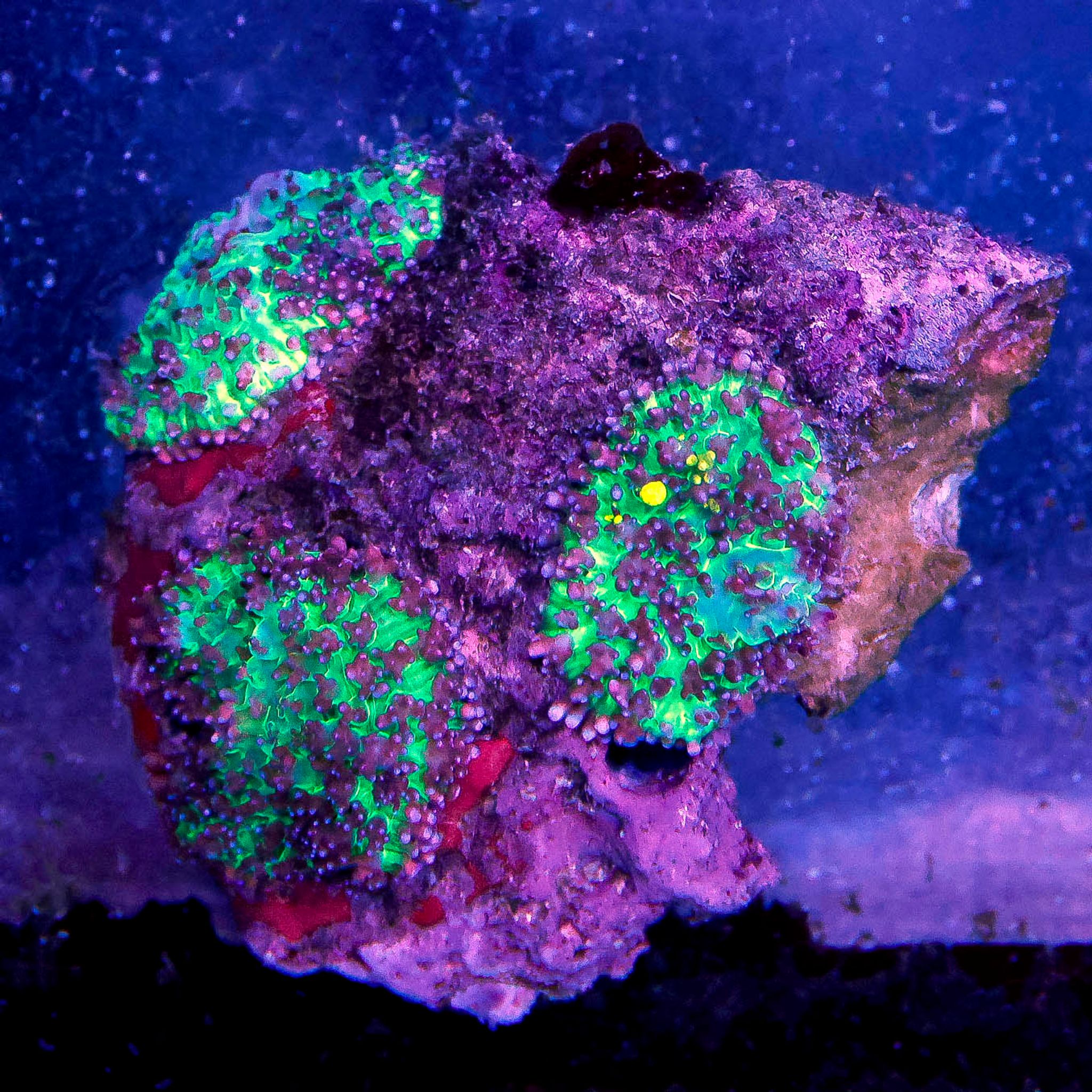

Best Placement for Mushroom Corals: PAR, Flow and Space Requirements
Mushroom corals are one of the most forgiving soft corals a reef keeper can add, but "easy" still has a wrong spot in the tank. This guide covers the PAR, flow, and spacing ranges that keep mushrooms full and colorful, and flags the one species that behaves nothing like the rest.
Why Mushroom Corals Are the Forgiving Choice
Corallimorpharians, commonly called mushroom corals, tolerate a wider swing in light and water quality than most small-polyp stony (SPS) or large-polyp stony (LPS) corals. They forgive placement mistakes that would stress a delicate Acropora, which makes them a common first coral for new reef keepers. That tolerance doesn't mean placement is irrelevant — it means the margin for error is bigger, not zero.
PAR Requirements by Type
Most mushrooms do best in 30-100 PAR, with a practical sweet spot of 50-80 PAR for steady coloration and expansion. Genus matters more than a single target number:
| Mushroom type | PAR range | Notes |
|---|---|---|
| Rhodactis | ~50-75 PAR | Tolerates the low end; often colors up best in shade |
| Discosoma | Up to ~100-150 PAR | Hardier of the common types, can handle brighter rock |
| General "safe zone" | 30-100 PAR | Good default when genus is unknown |
Sources disagree on the exact ceiling — some cap "ideal" mushroom light around 80 PAR, while others say hardier Discosoma types handle up to 150 PAR without issue. The practical takeaway: treat the number as a starting point and let the coral's behavior confirm it. Expansion, color, and retraction tell you more than a meter reading alone.
- Too much light (150+ PAR, common near the top of a strong reef fixture): mushrooms shrink, bleach, or detach and "walk" across the rock to find shade.
- Too little light: mushrooms lose color, stretch upward, and sometimes form a funnel or cup shape reaching toward the fixture.
Estimating Light Without a PAR Meter
A PAR meter gives exact numbers, but you can estimate placement using fixture height and tank depth as rough guides. On a standard LED reef fixture mounted 6-8 inches (15-20 cm) above the water, the lower third of the water column and shaded rock crevices generally land in the mushroom-friendly range, while the top few inches of rock under the fixture's center run much brighter. T5 fluorescent fixtures spread light more evenly top to bottom than point-source LEDs, so a mushroom sitting mid-tank under T5s may see more PAR than the same spot under LEDs. When in doubt, start low and watch the coral rather than guessing high.
Where to Place Mushrooms in the Tank
Put mushrooms on low-to-mid rockwork, in the lower third or middle of the water column — directly on the sandbed or on lower rock ledges rather than high rock peaks. Reserve the brightest, highest points of the aquascape for light-hungry SPS, and let mushrooms fill the shaded pockets below.
A few placement notes that affect long-term maintenance:
- Rock ledges vs. sandbed: rock placement is generally easier to maintain, since sand-dwelling mushrooms can get buried by sand-sifting animals or drifting detritus over time.
- Off the glass: keep colonies a few inches away from the aquarium glass so they don't spread onto the pane or block viewing.
- Away from flow paths: avoid spots directly in line with a powerhead, return nozzle, or overflow intake.
Flow: Gentle and Indirect Beats "Strong"
Mushrooms want low to medium flow that is gentle and turbulent, not a direct laminar jet. A useful rule of thumb: the oral disc should sway visibly without flattening against the rock, and no single stream of current should hit the coral head-on.
Strong, direct current keeps the oral disc from fully expanding and can tear tissue or cause a slow "meltdown" over time. Some sources describe the requirement as simply "low to moderate," while others emphasize flow quality over raw strength — in practice, quality wins. A gentle, randomized flow at moderate GPH suits mushrooms better than a strong but steady stream at lower GPH.
Do Wavemakers Benefit Mushroom Corals?
Yes, for the tank overall. A wavemaker or powerhead set to random or pulsing mode prevents dead spots, moves food particles and waste, and benefits most corals and fish in the system. The key is aim: point it to create general circulation around the tank rather than a direct current on the mushroom colony itself. Placing mushrooms in a flow shadow behind rockwork — where circulation still reaches them indirectly — gets the best of both.
Spacing and Allelopathy
Mushrooms reproduce quickly by budding or splitting and will carpet an area over time, so give a frag at least a few inches of buffer from neighboring corals when placing it. Leave more room in mixed reefs with SPS or LPS.
Mushrooms aren't aggressive in the sweeper-tentacle sense that some LPS are, but they release chemical defenses (allelopathy) into the water. In SPS-dominated tanks, a spreading mushroom colony can chemically irritate or "burn" nearby stony corals even without physical contact. Sensible practice:
- Keep mushrooms in a dedicated soft-coral zone when mixing with SPS or LPS.
- Never let different coral species grow into direct contact.
- Run carbon or a PolyFilter-type media and keep up with regular water changes in mixed reef systems to help control dissolved allelopathic compounds.
Can Mushroom Corals Touch Each Other?
Same-species mushrooms can grow into a continuous carpet without harming each other. Different coral species touching is a different story — that contact can trigger stinging or chemical competition, so keep species separated even as individual mushroom colonies spread.
Feeding Doesn't Change the Placement Math
Most mushrooms get the bulk of their nutrition from light through their zooxanthellae and by absorbing dissolved organics from the water column. They don't need to be hand-fed, and they generally respond well to nutrient-rich water paired with lower flow — another reason a gentle, slightly sheltered spot suits them better than a high-flow zone near a return.
Aquascaping Around Mushroom Placement
Build rockwork with open channels for flow rather than a solid wall of rock, so water can move around and under structures instead of stalling. A few principles that support good mushroom placement specifically:
- Plan for growth and spacing before placing frags, not after a colony has already spread.
- Keep structures off the glass and give colonies room to expand without hitting the pane.
- Use a rule-of-thirds approach for focal corals, and reserve low, shaded ledges and sandbed pockets for mushrooms while saving higher, brighter rock peaks for SPS.
- Stage a dedicated "mushroom garden" zone in an otherwise mixed reef — grouping different mushroom colors and genera together minimizes allelopathic exposure to stony corals while still showing off variety. Shoppers building out that zone can browse mushroom corals and other soft corals on FishyHub to plan color and spacing together.
The Exception: Amplexidiscus fenestrafer
Not every mushroom is a passive decoration. Amplexidiscus fenestrafer, sometimes called the elephant ear mushroom, can grow to 12-14 inches (30-36 cm) across and behaves very differently from typical Discosoma or Rhodactis mushrooms. It actively closes over and consumes small fish and shrimp that rest on its surface, especially at night.
Placement and stocking guidance specific to this species:
- Give it its own dedicated space — its size alone crowds out smaller neighbors.
- Provide medium light and gentle flow, similar to other mushrooms.
- Do not house it with small or slow-swimming fish, sleeping fish, or shrimp, including cleaner shrimp.
- If it refuses food or looks unhealthy, the cause is usually light intensity or water flow and quality issues rather than disease — relocating it to a different spot in the tank often resolves the problem.
Is It True a Mushroom Coral Can Eat Fish?
Yes, specifically Amplexidiscus fenestrafer. It can close over and consume small fish and shrimp that come into contact with it, particularly overnight. Typical decorative mushrooms — Discosoma, Rhodactis, and Ricordea-type species — cannot do this and pose no threat to tankmates.
Acclimating New Mushrooms
Introduce a new mushroom frag at the lower end of the tank's light range, even if the target display spot is brighter. If the plan is to move it higher for more color or growth, do so gradually over 2-3 weeks rather than all at once — shock can occur even within an otherwise acceptable PAR range if the change happens too fast.
Common Placement Mistakes
- Placing mushrooms high in the tank under strong lighting, causing bleaching, shrinking, or the coral detaching to "walk" toward shade.
- Aiming a powerhead directly at a mushroom colony, which prevents full expansion and can damage tissue over time.
- Crowding mushrooms edge-to-edge with other coral species, leading to stinging or allelopathic irritation, or mushrooms simply overgrowing slower-growing neighbors.
- Treating all mushrooms as identical — a fast-spreading Rhodactis or a large Amplexidiscus needs very different space planning than a small, slow Ricordea-type mushroom.
- Keeping small fish, shrimp, or cleaner shrimp in a tank with a large Amplexidiscus fenestrafer without accounting for its predatory habit.
- Skipping gradual acclimation when moving a mushroom to a brighter spot, even within a generally safe PAR range.
Frequently Asked Questions
Do mushroom corals need high light?
No. Mushroom corals thrive in low to medium light and often prefer shade, particularly Rhodactis species. Too much light causes shrinking, bleaching, or the coral detaching to find a dimmer spot.
Where's the best spot for mushroom corals in a reef tank?
Lower to middle rockwork or the sandbed works best, positioned out of direct flow and away from the most intense light in the tank. Shaded ledges beneath brighter SPS zones are ideal.
Can mushroom corals touch each other?
Same-species mushrooms can grow into a carpet together without issue. Different coral species should not be allowed to touch, since contact can cause stinging or chemical competition.
Do mushroom corals need a wavemaker?
The tank as a whole benefits from a wavemaker for general circulation, but the mushroom colony itself should sit in a gentle, low-flow pocket rather than in direct current.
Is it true a mushroom coral can eat fish?
Yes, specifically Amplexidiscus fenestrafer, the elephant ear mushroom, which can close over and consume small fish and shrimp. Typical decorative mushrooms like Discosoma, Rhodactis, and Ricordea cannot do this.
How much space should I leave between mushroom corals and other corals?
Leave a few inches of buffer at minimum, and more in mixed SPS or LPS tanks. Mushrooms spread over time and can chemically irritate neighboring corals even without direct contact.
Why is my mushroom coral shrinking or not opening?
This is usually caused by too much light or too much direct flow. Try relocating it to a lower, shadier spot or out of a powerhead's direct path.
Why is my mushroom coral stretching or pale?
This points to too little light. Move the coral slightly higher in the water column or closer to the light source, adjusting gradually rather than all at once.
Ready to plan your mushroom garden? Browse current mushroom corals on FishyHub and pair them with a suitable LED fixture to dial in the right PAR for your setup.


