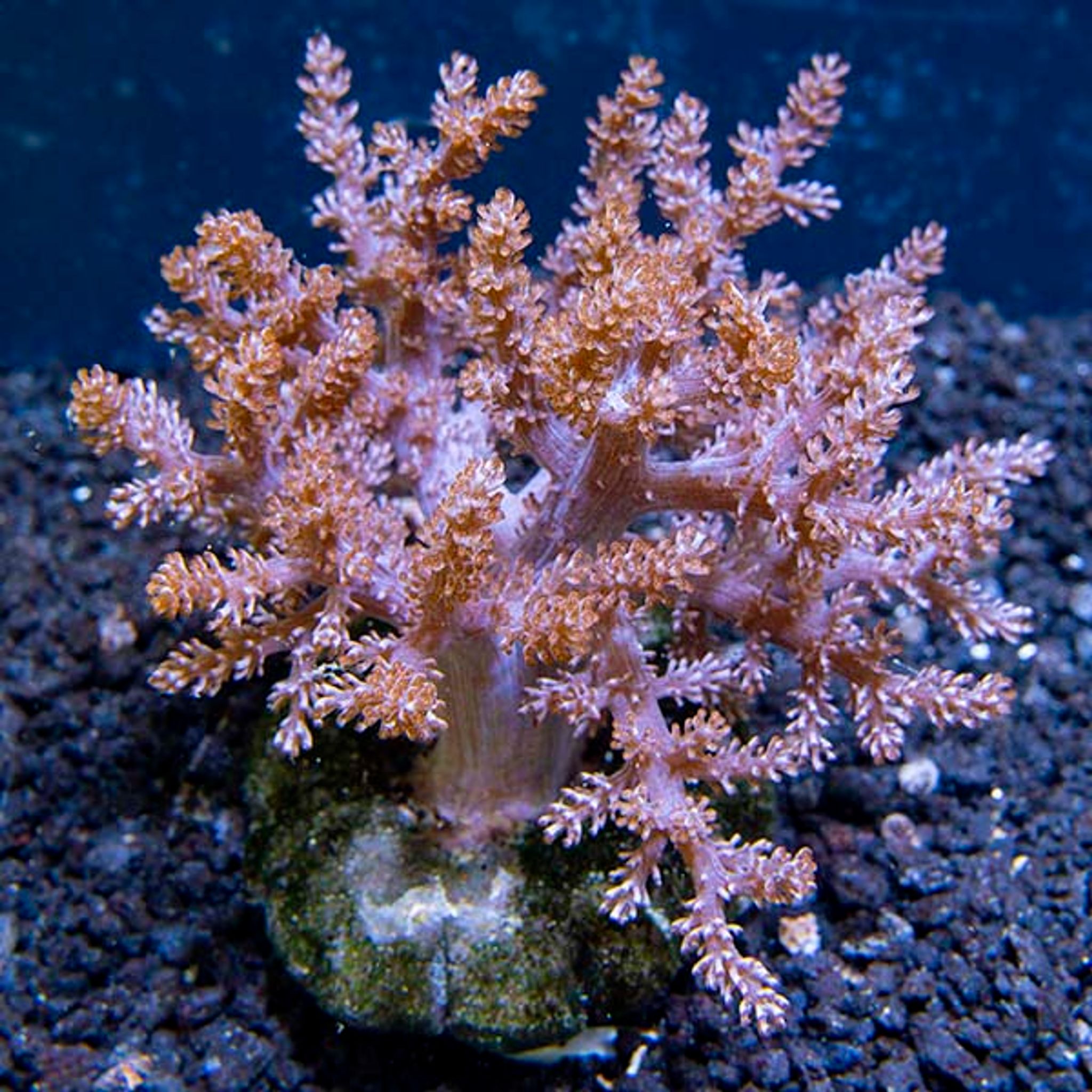

Best Placement for Kenya Tree Coral: PAR, Flow and Space Requirements
Kenya tree coral does best in the middle-to-lower third of the tank, on solid rock, with 75–100 PAR and moderate-to-high turbulent flow. It is a fast-growing, semi-aggressive soft coral, so the placement question is really two questions: what light and current it wants today, and how much room it will need once it triples in size.
Why Kenya Tree Coral Needs a Different Approach
Kenya tree coral (Capnella spp.) is a soft, leather-type coral with no rigid calcium skeleton. Like most soft corals it hosts photosynthetic zooxanthellae, but it also actively captures suspended food particles from the water column with its polyps. That second feeding strategy is the key placement detail: it rewards more current and more particulate food than a purely photosynthetic soft coral, which is why generic "soft corals want gentle flow" advice undersells what this species actually wants.
It's also one of the fastest-growing and easiest-to-frag soft corals in the hobby. A single colony can expand to fill significant real estate within about a year in a smaller aquarium. That growth rate should shape where you put the frag on day one, not just how it looks today.
Reading the Reef to Set Placement Logic
Natural reef zones give a useful mental model for translating "light" and "flow" into an actual spot in your tank:
- Fringing reef/reef crest: shallow, high light, high flow — where SPS corals dominate.
- Fore-reef slope: strong current continues, but light intensity drops as depth increases.
- Lagoon: calm, warmer water, much lower flow and softer light.
Kenya tree coral behaves most like a reef-slope or back-reef dweller: it wants the strong current of a shallower zone without the blazing surface light. That combination — moderate light, brisk water movement — is exactly what should guide where you mount it relative to your light fixture and return pumps.
PAR Target: What Light Level to Aim For
The workable PAR range for Kenya tree coral is roughly 50–150, with most guidance converging on 75–100 PAR as the sweet spot. It's a tolerant coral that adapts down toward 50 PAR reasonably well, and some sources report it handling 150–250 PAR without harm.
Sources disagree on the ceiling. Some cap the ideal range around 100–120 PAR; others say it tolerates up to 250 PAR. The safer approach is to treat 150+ as an upper tolerance limit rather than a target: start new placements at 75–100 PAR and only push higher gradually while watching how the polyps respond. Excessive PAR triggers polyp retraction as a protective response (photoinhibition) — a closed-up colony under bright light is not "adjusting," it's telling you the light is too strong for that spot.
A PAR meter or a hobbyist light-meter app is the most reliable way to confirm a placement is actually in range, rather than guessing from fixture height or a generic intensity percentage. If a spot tests too hot or too dim, it's often easier to adjust your LED's channel intensity or preset than to keep moving the frag around the tank.
Photoperiod and Total Light Dose
PAR intensity and photoperiod length trade off against each other. A tank running a shorter, higher-intensity photoperiod and one running a longer, lower-intensity photoperiod can both work for Kenya tree coral, provided the total daily light dose is similar — it's the light energy delivered over the day that matters, not just the instantaneous PAR reading. A standard reef photoperiod of about 8–12 hours is fine as a starting point. Dark recovery periods matter too: darkness isn't wasted time, it's when coral tissue recovers from the day's photosynthetic load.
If you're relocating a colony or introducing a new one, a fixture with sunrise/sunset ramping reduces shock compared to flipping straight from darkness to full intensity — worth using if your LED supports it.
Flow: Moderate-to-High, Not a Direct Blast
Kenya tree coral relies on flow for two jobs: delivering suspended food to its polyps, and sweeping waste and detritus off its lobed surface. Too little flow leads to detritus buildup and dull coloration. Too much direct flow causes constant polyp retraction and can physically tear the soft tissue.
There's a real disagreement worth flagging here. Generic soft-coral-family guidance often says "low-to-medium flow," treating Kenya tree the same as slower-moving leathers. But species-specific guidance for Kenya tree points to moderate-to-high indirect flow, precisely because it feeds from the water column more than typical soft corals do. Kenya tree is something of an outlier within its own family — favor the species-specific recommendation over the generic soft-coral rule of thumb.
The key word is indirect. Aim for broad, turbulent movement — flow bouncing off rockwork or crossing from multiple pumps — rather than pointing a powerhead straight at the colony. A spot that's low in the tank or tucked behind taller rockwork may need a powerhead aimed to supplement flow, even if the tank's overall water movement is strong, since aquascape height blocks a surprising amount of current at floor level.
Vertical Placement and Mounting
Place Kenya tree coral in the middle-to-lower third of the tank, on exposed rockwork — not jammed at the very top under the light, and not tucked into a dead-flow corner near the substrate. This mirrors its natural reef-slope habitat: strong current, moderate rather than blazing light.
Mounting matters as much as position:
- Attach frags with coral-safe cyanoacrylate gel glue or reef putty onto solid, exposed rock or a ledge.
- Avoid mounting directly in sand. Loose substrate traps detritus underneath the base and can shift with current, toppling or partly burying the frag.
- Either live rock (arrives pre-colonized with beneficial bacteria and fauna) or dry/aquacultured rock (inert until it cycles) works as a mounting base. If you're using freshly cured dry rock, let it finish cycling fully before adding coral — parameter swings during cycling are hard on a newly placed frag.
You can browse live rock-ready stock and frags in FishyHub's soft corals category when planning a placement.
Spacing: Plan for the Mature Colony, Not the Frag
This is where Kenya tree coral surprises new keepers. It's semi-aggressive, even though general profiles sometimes describe it as peaceful. It releases terpenoid chemical defenses into the water that can suppress neighboring corals — especially stony corals like LPS — and it will sting directly on contact. Among soft corals, it's one of the more chemically active species, which is exactly why the spacing advice below leans cautious rather than casual.
Spacing guidelines:
| Factor | Recommendation |
|---|---|
| Initial clearance from other corals | 4–6+ inches (10–15+ cm) minimum on all sides |
| Mature colony clearance | Plan for a foot (30 cm) or more of eventual space |
| Stony coral (LPS/SPS) proximity | Extra caution — keep well outside sting/chemical range |
| Chemical control | Active carbon or a protein skimmer helps manage terpenoids in mixed tanks |
| Tank size for mixed reef systems | Generally not below roughly 30 gallons (114 L) if kept with other space-needing corals |
Because it's fast-growing, treat spacing as a moving target: what looks like generous clearance for a small frag can become contact within months. Expect it to eventually overtop and shade slower-growing neighbors, and be ready to prune or frag it back on a regular schedule rather than letting it run unchecked.
Common Mistakes to Avoid
- Placing the frag too close to the light or to other corals, causing bleaching/retraction or chemical conflict as it grows into neighboring space.
- Mounting in sand or loose rubble instead of stable rock, leading to toppling or burial.
- Mistaking normal periodic shrinking for illness. Give a newly placed colony 24–48 hours to reopen before assuming a problem.
- Underestimating growth rate and packing the aquascape too tightly at initial setup.
- Blasting it with direct powerhead flow, causing constant closure and tissue damage, instead of providing broader turbulent movement.
- Overlooking hitchhikers. A newly added frag or rock piece can carry pests like aiptasia that go unnoticed while attention is focused on the coral itself.
Acclimation: What's Normal vs. What's a Warning Sign
Expect brief closing or shrinking for the first few days after placement while the colony settles — that's normal. Periodic pulsing or shrinking afterward is also normal cleaning behavior, flushing stale water from tissue, as long as it reopens within a day or two.
Not opening at all for several days is a different situation and usually points to a bigger issue: poor acclimation, incompatible water parameters, an aggressive tankmate stinging it, or a placement spot that's simply wrong for it. At that point, check parameters and consider relocating the colony rather than waiting indefinitely for it to recover on its own.
Frequently Asked Questions
What PAR does Kenya tree coral need?
Roughly 50–150 PAR, with 75–100 PAR as the ideal target. It's adaptable and tolerates lower light better than most SPS corals, so it's a reasonable choice for tanks that can't push high-intensity lighting everywhere.
How much flow does Kenya tree coral need?
Moderate to moderately-high flow, delivered as broad, turbulent movement rather than a direct powerhead blast. It uses flow both to capture suspended food and to keep its surface clear of debris.
Where should I place Kenya tree coral in my tank?
In the middle-to-lower rockwork region, mounted on solid rock — not directly under intense light and not in a low-flow dead zone near the substrate.
Is Kenya tree coral aggressive toward other corals?
Yes, treat it as semi-aggressive by default. It releases chemical (terpenoid) defenses that can suppress neighboring corals, particularly stony ones, and grows quickly enough to eventually contact and sting nearby colonies.
Why is my Kenya tree coral not opening?
Brief shrinking in the first days after placement, or occasional short-term pulsing afterward, is normal. Prolonged closure over several days usually signals too much light, poor flow, an aggressive tankmate, or acclimation stress, and warrants checking parameters or relocating it.
How much space does Kenya tree coral need from other corals?
Leave at least 4–6 inches (10–15 cm) of clearance at placement, and plan for a foot or more of eventual space as it matures — it's one of the faster-growing soft corals in the hobby.
Can Kenya tree coral go on sand, or must it be on rock?
It should be glued with coral-safe cyanoacrylate gel glue or reef putty onto solid rock or a ledge, not left loose in sand, which can trap detritus underneath it or let it shift and topple.
How fast does Kenya tree coral grow, and does that affect placement?
Very fast — a colony can cover significant space within about a year. Placement decisions should account for the coral's mature footprint and a regular pruning or fragging schedule, not just the size of the frag you're starting with.
Ready to start your own colony? Browse available frags and colonies in FishyHub's corals category to find a Kenya tree coral suited to your tank's light and flow setup.


