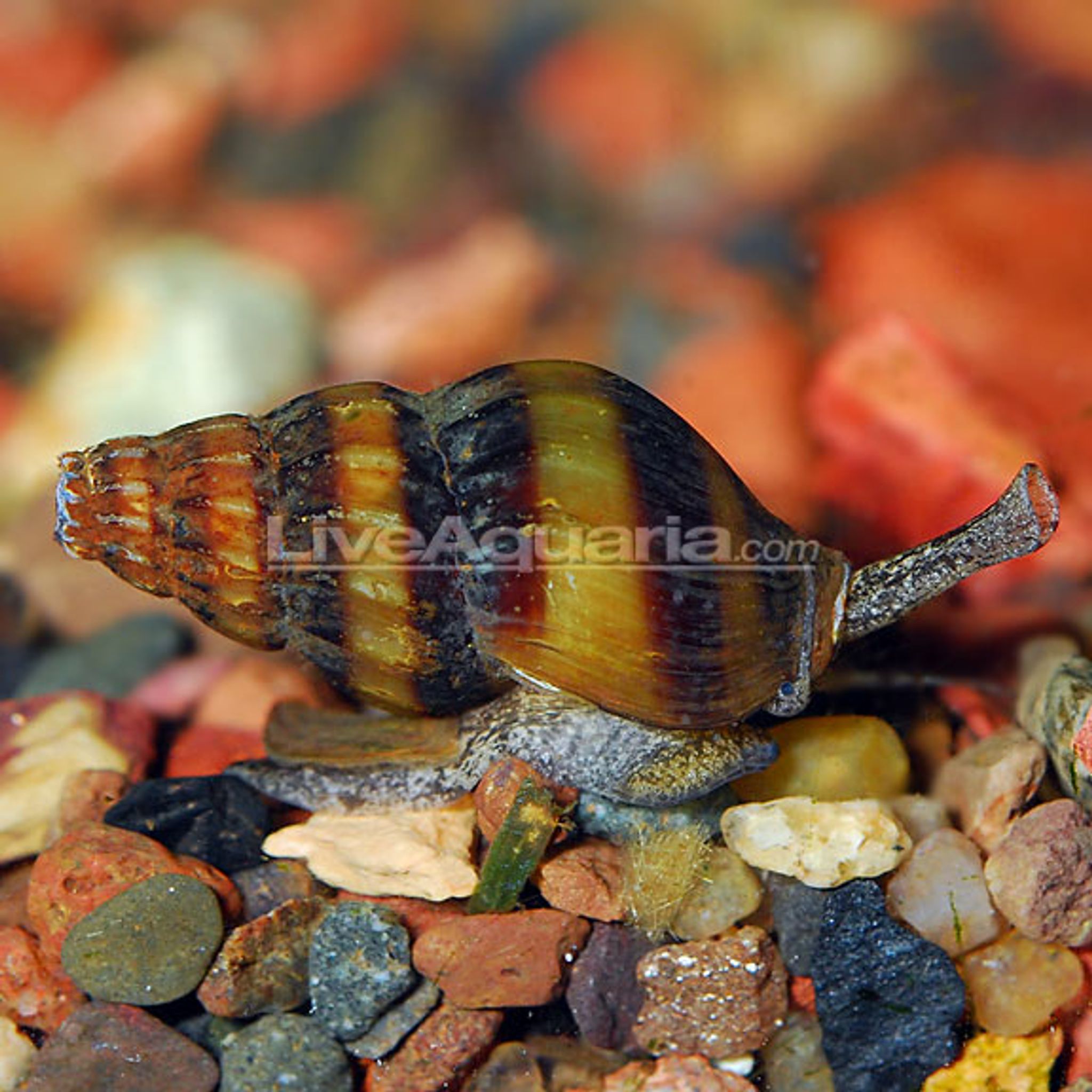

Assassin Snail Problems: Common Causes of Stress, Death and Poor Growth
Assassin snails (Clea helena) are usually added to a tank for one job — eating pest snails — but new owners are often thrown off when the snails burrow for days, stop breeding, or start dying without warning. Most of these "problems" trace back to a small list of causes: water chemistry, missing food, copper exposure, or shell damage. This guide walks through how to tell a real emergency from normal behavior and how to fix each cause.
Quick Species Context
Clea helena, sold as the assassin snail, is a predatory freshwater snail native to Southeast Asia. It hunts other snails — pond snails, ramshorn snails, bladder snails — and will also take worms and detritus. It is not a pure scavenger: once it runs out of prey, it needs supplemental food or it will slowly starve. Unlike most aquarium snails, assassin snails are dioecious (separate male and female individuals), so breeding requires more than one snail and takes patience.
Is My Assassin Snail Actually Dead? A Quick Diagnostic
Assassin snails burrow into substrate during the day and come out to hunt at night, so a snail that hasn't been seen in two or three days is often just resting, not sick. Before assuming the worst, run through this checklist:
| Sign | Alive / Normal | Dead |
|---|---|---|
| Smell | No odor when substrate is disturbed | Strong, foul odor |
| Shell | Closed, body visible or retracted | Empty, gaping, or floating |
| Touch response | Retracts into shell within seconds | No movement when gently lifted or touched |
| Behavior pattern | Buried during day, active at night | Not moving at any time of day |
If the shell is empty and smells bad, or the snail doesn't retract at all when handled, it's dead and should be removed. If it retracts, even slowly, leave it alone — digging up a resting snail just adds stress.
Core Water Parameters for Shell and Overall Health
Assassin snails are more parameter-sensitive than many freshwater keepers expect, mainly because their shells are built from calcium carbonate and dissolve in soft, acidic water. Sources vary slightly on the "ideal" range — some recommend hard, alkaline water only, while others note the species tolerates a broader range as long as it's stable. In practice, stability matters more than hitting an exact number, but these targets give the best shell health and longevity:
| Parameter | Target range |
|---|---|
| Temperature | 70–78°F (21–26°C) |
| pH | 7.0–8.0 |
| General hardness (GH) | 8+ dGH (moderate to high) |
| Carbonate hardness (KH) | Present and measurable |
| Ammonia / Nitrite | 0 ppm |
| Nitrate | Under 20–40 ppm |
Soft, acidic setups — blackwater tanks, some shrimp-only tanks — will slowly pit and erode assassin snail shells unless hardness or calcium is added separately. If you're stocking a new tank, checking a freshwater livestock supplier's care notes for compatible tankmates before adding snails can save a lot of trial and error later.
The Main Causes of Stress and Death
Most die-offs come down to one of these, roughly in order of how often they actually happen in home aquariums:
- Unstable or wrong water parameters. Temperature swings, low pH, or an ammonia/nitrite spike from an uncycled or overstocked tank are the single biggest killer.
- Copper toxicity. Copper-based ich medications and some liquid fertilizers are lethal to snails at very low doses. Copper must be avoided entirely or stripped out with activated carbon before snails go back in.
- Starvation. Once the pest-snail population is wiped out, assassins have nothing left to eat unless the owner steps in with supplemental food.
- Calcium/hardness deficiency. Causes shell pitting, thinning, and deformed new growth at the shell's leading edge.
- Poor acclimation. Sudden pH or temperature shock during transport, or skipping drip acclimation, stresses snails right out of the bag.
- Overcrowding and weak biofiltration. Too much bioload for the filter causes cloudy water and ammonia stress (see the cloudy water section below).
- Incompatible tankmates. Loaches, larger cichlids, crayfish, and pufferfish will pick at or eat assassin snails, and some fish nip at the exposed foot.
- Substrate that's too coarse or too shallow. Assassin snails prefer to burrow in fine sand; sharp gravel can injure the foot, and shallow substrate limits normal burrowing behavior.
Fix Hierarchy: What to Check First
When snails start dying, test before you guess:
- Test ammonia, nitrite, nitrate, pH, GH, and KH immediately.
- Correct any spike with a water change (don't overcorrect — see the cloudy water section).
- Check whether any copper-based medication or fertilizer has been used recently.
- Confirm food is actually available — check for leftover pest snails or supplemental food.
- Verify temperature has been stable, not just "in range" at the moment you check it.
- Inspect tankmates for aggression or foot-nipping behavior.
Feeding After the Pest Snails Run Out
Assassin snails are often bought specifically to clear out a pond, ramshorn, or bladder snail infestation — and they're good at it. The problem shows up a few weeks later: the pest snails are gone, and the assassins have nothing left to eat. Slow starvation over several weeks is one of the most common — and most preventable — causes of decline reported after a successful cleanup.
Once the visible pest-snail population is noticeably thinning, start supplementing with:
- Sinking pellets or algae wafers
- Blanched vegetables (zucchini, cucumber)
- Occasional protein: bloodworms or shrimp pellets, including a freeze-dried food as an easy-to-store option
There's no need to feed extra while pest snails are still plentiful — let the assassins hunt. But as soon as the cleanup job is essentially done, supplemental feeding should become routine, not an afterthought.
Shell Damage: Cracks, Erosion, and Deformed Growth
A healthy assassin snail shell is smooth and intact along its spiral. Problems show up as pitting, chalky thin patches, cracking, or a rough, deformed edge where new shell material has been laid down. Almost always, this points to low pH, soft water, or insufficient calcium — not disease. Raising GH/KH into the moderate-to-high range and adding a calcium supplement to the water or diet usually stops further damage, though existing damage won't reverse itself.
Growth and Breeding: What's Actually Normal
Assassin snails grow slowly, taking several months to reach roughly 1 inch (2.5 cm), and breeding is a similarly gradual process. Because the species is dioecious, a single snail — or a group that happens to be all one sex — will never produce eggs no matter how good the conditions are. Eggs are laid singly in small, clear gelatinous capsules on hard surfaces like glass or decor.
Don't mistake this natural pace for a sign of an unhealthy tank:
- Slow growth is expected — rapid, unexplained shrinkage or thinning at the shell's growing edge is the actual warning sign (calcium deficiency), not slow growth itself.
- No visible babies for months, even in a healthy tank, is normal if you only have one or two snails, or snails of the same sex.
- Occasional buried inactivity in a group is normal daytime behavior, not a population crash.
Quarantine New Arrivals
Assassin snails are frequently shipped alongside a batch of pest snails meant to serve as their food supply. That means new arrivals can bring in more than just assassins — hitchhiker pests or pathogens can ride along in the same bag. Quarantining new snails (and any new plants or decor) for a couple of weeks before adding them to an established tank reduces the risk of introducing problems that affect the whole tank, not just the snails.
Hydra in the Tank
Hydra are tiny stinging cnidarians that show up on glass, plants, and decor, usually as small white or brown stalks. They proliferate when a tank is overfed or under-maintained, since they feed on excess organic matter and small live foods. Hydra aren't directly dangerous to assassin snails, but their presence is a signal of excess waste buildup. Don't count on assassin snails to control a hydra outbreak — unlike pest snails, hydra aren't reliable prey for them, and the population usually keeps growing regardless.
Dealing with Planaria and Hydra Without Harming Your Snails
Planaria (flatworms) and hydra outbreaks are usually handled with the same basic process:
- Identify the pest. Planaria are flat, worm-like, and glide along glass; hydra are stationary with tentacled stalks.
- Reduce feeding and organic waste. Both pests thrive on leftover food and detritus — cutting back starves them out over time.
- Manually remove what you can. Siphon out visible worms or hydra colonies, and use tweezers on stubborn spots.
- Use a targeted treatment cautiously, if needed. Some chemical dewormer and planaria treatments — including fenbendazole-based products — can also harm or kill snails. Read labels carefully and consider removing snails before treating, or research invertebrate-safe alternatives first.
- Quarantine affected plants and decor before moving them into a main display tank.
- Increase water changes and gravel-vac frequency during treatment to remove dying organisms and excess waste.
This connection matters specifically for assassin snail keepers: a treatment that clears hydra or planaria but also kills the snails you're trying to protect isn't a win.
Fixing Cloudy Aquarium Water (and Why It Matters for Snails)
Cloudy water isn't just cosmetic — for assassin snails, some causes are a direct stress or death risk. The color of the cloudiness usually tells you the cause:
| Cloudiness color | Likely cause | Fix |
|---|---|---|
| White / hazy | Bacterial bloom (new tank cycling, overfeeding, overcleaning filter media) | Reduce feeding, avoid overcleaning media, be patient |
| Green | Algae bloom from excess light/nutrients | Shorten photoperiod, consider a UV sterilizer, do water changes |
| Yellow / brown tint | Tannins or dissolved organics | Activated carbon, routine water changes |
A few practical notes:
- Don't overreact with a large, sudden water change — it can disrupt the biological filter further and worsen instability.
- Test ammonia and nitrite first. Cloudy water combined with sudden snail stress often means an ammonia or nitrite spike, not just a harmless bloom.
- Running mechanical and chemical filtration (filter floss, carbon) speeds up clearing once the underlying cause is addressed.
For assassin snails specifically: bacterial-bloom cloudiness is usually harmless in the short term, but cloudiness tied to an ammonia or nitrite spike is a genuine emergency and should be tested for immediately, not waited out.
Common Mistakes to Avoid
- Adding assassin snails to a tank before ammonia and nitrite both read zero.
- Using copper-containing medications or fertilizers in a tank that houses snails.
- Assuming a buried snail is dead and disturbing or removing it unnecessarily.
- Skipping water tests when snails start dying and blaming the source instead.
- Forgetting to feed once the pest-snail population is cleared out.
- Keeping assassin snails with loaches, aggressive cichlids, crayfish, or pufferfish.
- Running a soft, acidic water setup without added hardness or calcium.
- Treating slow growth or infrequent breeding as illness rather than the species' normal pace.
Frequently Asked Questions
Why is my assassin snail not moving?
This is usually normal daytime burrowing or resting behavior, since assassin snails are more active at night. Check for a foul smell or an empty, gaping shell to rule out death — a live snail will retract into its shell within seconds of being gently touched.
Why do assassin snail shells look cracked or eroded?
This is typically caused by low pH, soft water, or a calcium/GH deficiency. Raising GH and KH into the moderate-to-high range and adding calcium supplementation usually stops further erosion.
Can I use copper medication with assassin snails in the tank?
No. Copper is toxic to all snails, including assassins, even at low doses used to treat fish diseases like ich. Remove snails before any copper-based treatment, or choose an invertebrate-safe alternative instead.
What do assassin snails eat once pest snails are gone?
Sinking pellets, algae wafers, blanched vegetables, and occasional protein like bloodworms or shrimp pellets. Start supplementing as soon as the pest-snail population is noticeably reduced, not after snails have already started declining.
Why aren't my assassin snails breeding?
Assassin snails are dioecious, meaning you need both a male and a female present, and growth and breeding are naturally slow. Low or absent breeding activity over a few months doesn't necessarily mean the tank is unhealthy — stable warm water and time are usually all that's needed.
Is cloudy water dangerous to my assassin snails?
Bacterial-bloom cloudiness (typically white and hazy) is usually harmless in the short term. Cloudiness linked to an ammonia or nitrite spike is genuinely dangerous to snails and should be tested for and addressed right away.
Will assassin snails get rid of hydra or planaria in my tank?
Not reliably. Assassin snails target other snails far more consistently than hydra or planaria, so manual removal, reduced feeding, and targeted treatment are more effective ways to deal with those pests.
What temperature and water hardness do assassin snails need?
Roughly 70–78°F (21–26°C), pH 7.0–8.0, and moderate-to-high GH/KH for good shell health. Stability within that range matters more than hitting an exact number.
If you're building out a tank for pest control or adding assassin snails to an existing setup, you can browse compatible options and supplies under freshwater livestock to find stock suited to your current water parameters and tankmates.


