Apistogramma Care Guide: Tank Size, Diet, Water Parameters and Temperament
Apistogramma isn't one fish — it's a genus of 90 or more South American dwarf cichlid species, and care needs shift depending on which one you're looking at. This guide breaks down realistic tank sizes, water parameters, diet, temperament and breeding basics for US hobbyists, and points beginners toward species that actually tolerate typical tap water.
What Is an Apistogramma?
Apistogramma are small cichlids native to slow, shallow, leaf-littered streams and pools throughout the Amazon and Orinoco basins, often in blackwater conditions. In the wild they hide among roots, leaf litter and submerged wood rather than swimming in open water.
- Size: Most males run 2–3 inches; females are noticeably smaller, often half to two-thirds the male's length. A. steindachneri is an outlier, with males reaching around 4 inches.
- Lifespan: About 5 years typically, though 8–10 years is possible with stable water and good nutrition.
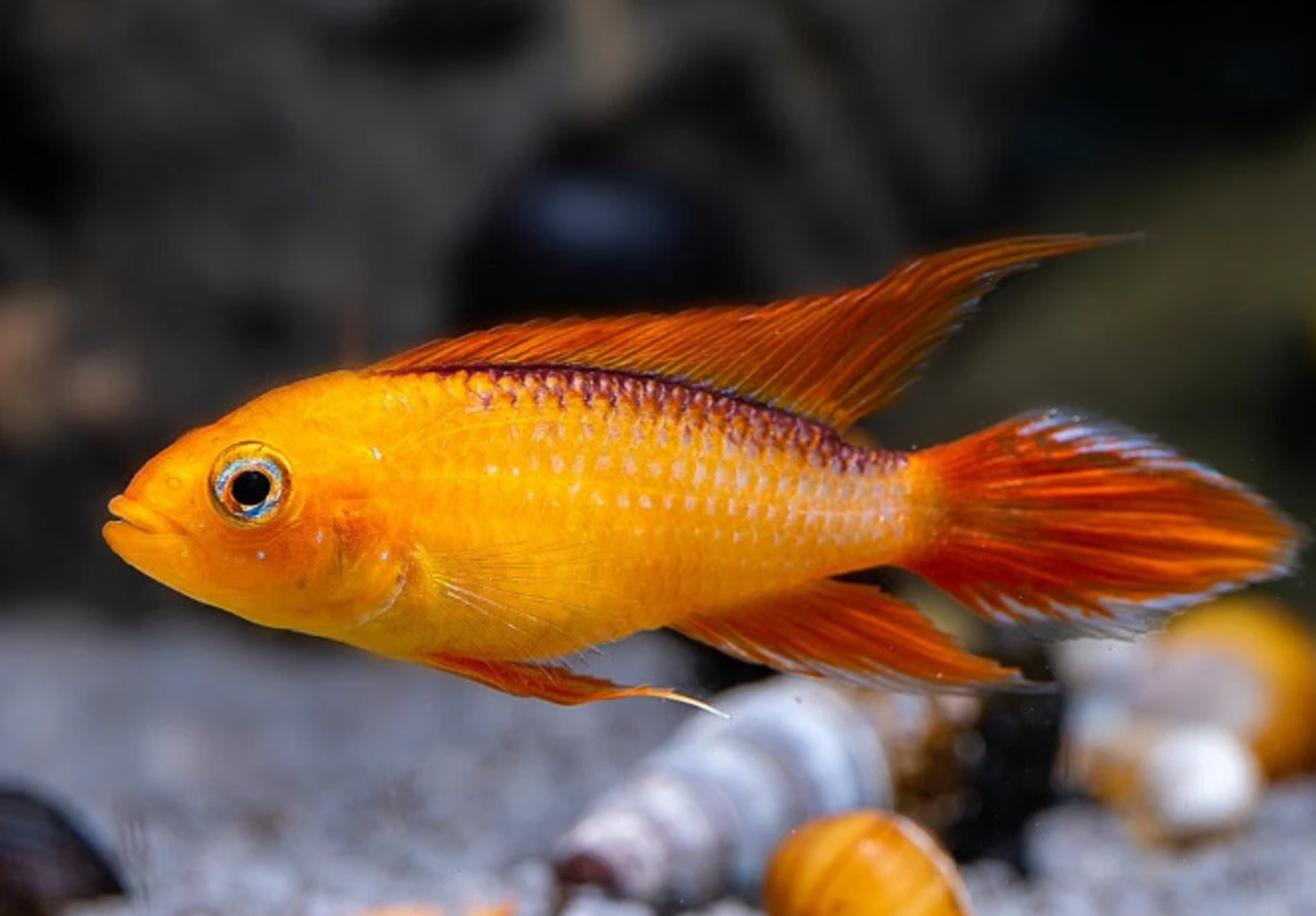
- Body plan: Compact, laterally flattened, with pointed dorsal and anal fin extensions on males that grow more dramatic with age.
Because the genus spans so many species, "apistogramma care" really means "care for the species you're buying" — ask for the scientific name at the store, not just "apisto."
Tank Size and Setup
How Big a Tank Does an Apistogramma Need?
A 20-gallon tank (75 L), ideally a 20-long with more floor space than height, is the practical minimum for a pair or trio in a community setting. A 10-gallon (38 L) tank works only as a dedicated breeding setup for a single pair, not a long-term home. For one male with several females, step up to a 30–40 gallon breeder tank.
| Setup | Minimum Tank Size | Notes |
|---|---|---|
| Single male, no females | 10–15 gal (38–57 L) | Fine alone; shows best color and finnage |
| One pair | 20 gal long (75 L) | Give each fish a cave and sightline breaks |
| One male + 2–3 females (harem) | 30–40 gal (114–151 L) | Each female needs her own territory/cave |
| A. steindachneri (male + 2 females) | 40 inches (100+ cm) length | Larger-bodied species needs more floor space |
Apistogramma are bottom-oriented, so footprint matters more than height — a shallow, wide tank beats a tall, narrow one of the same volume.
Substrate, Decor and Flow
- Substrate: Fine sand, since apistos naturally sift it looking for food.
- Hardscape: Driftwood plus multiple caves — coconut shell halves, small clay pots or purpose-made cichlid caves — so every fish, especially each female, has a defensible spot.
- Planting: Dense planting and leaf litter (catappa or oak leaves) break sightlines and reduce stress; leaf litter also grows a biofilm layer fry and adults graze on.
- Light: Dim to moderate, with floating plants to diffuse it.
- Flow: Gentle — these fish come from nearly still water, so a sponge filter or a baffled hang-on-back or canister filter beats strong output. Browse sponge filters and other low-flow options in FishyHub's filters category.
Water Parameters
Temperature
Sources disagree on the exact range — some cite 72–86°F, others narrow it to 75–81°F. A reasonable working range is 75–84°F (24–29°C), with most keepers targeting 78–82°F (26–28°C) day to day and 80–82°F (27–28°C) when breeding. Cockatoo-type apistos (A. cacatuoides) tolerate the cooler end better than most. In cool US winters, a properly sized heater matters more than the exact target — a tank swinging several degrees overnight stresses fish more than sitting a degree outside the "ideal" range.
pH and Hardness
Most Apistogramma do well at pH 6.0–7.0. Soft-water specialists need pH 5.0–6.5, while hardy species like cacatuoides tolerate up to roughly 7.5.
Hardness recommendations vary between care sheets — one allows up to 15 dKH, others insist on near-zero. The practical, species-specific answer: GH 2–8 dGH (roughly 35–140 ppm) is workable for general keeping with hardy species, while blackwater species and egg viability need GH under 5 dGH and TDS under about 50–100 ppm.
Testing Your Tap Water First
Most US municipal water supplies run moderately hard, often pH 7.5 or higher — exactly why a species-first approach matters. Test your GH, KH and TDS at home before buying. If tap water is already soft and slightly acidic, hardy species thrive straight from the tap. If it's hard:
- Blend RO or distilled water with tap water. A 50/50 blend roughly halves both hardness and TDS. Never run straight RO with no remineralization; it lacks minerals fish need.
- Add tannins. Driftwood, catappa leaves or peat moss lower pH mildly, mimicking blackwater conditions without the swings chemical pH adjusters cause. Avoid "pH down" products as a primary tool — they cause crashes and rebounds.
Water Quality and Maintenance
Keep ammonia and nitrite at zero and nitrate under roughly 20 ppm — apistos are sensitive to buildup. Weekly water changes of 25–35%, matched to the tank's existing temperature and chemistry, are more practical than small daily changes and achieve the same stability. Never introduce a large, sudden shift in temperature or pH during a change; that swing is harder on the fish than a slightly imperfect but stable parameter.
Diet
Apistogramma are best thought of as carnivore-leaning omnivores — micropredators that hunt small invertebrates in the wild. Sources disagree on how central live food is: some call them omnivores that graze algae, others treat live food as essential. The realistic middle ground: tank-bred fish do fine on a varied prepared diet, while live food is a helpful bonus, especially for conditioning breeders.
Staples: quality small sinking pellets or granules, frozen bloodworms, brine shrimp, daphnia and mysis shrimp, plus live blackworms, baby brine shrimp and microworms — prized foods that often trigger spawning.
Feed small amounts 2–3 times daily rather than one large feeding, and vary the menu to prevent bloat and color loss — an all-bloodworm diet is a common cause of digestive problems.
Temperament and Tank Mates
Apistogramma are semi-aggressive, but mostly toward the bottom zone and their own kind. Toward calm, mid- or upper-water fish, they're generally solid community citizens. Males are territorial with each other, and aggression spikes during breeding when a female guards eggs or fry. Keep one male per 2–3+ females (a harem) or a single pair — never multiple males in a small tank — and give each female her own cave and defensible territory, or she'll be bullied.
Good and Bad Tank Mates
| Good Tank Mates | Why | Avoid | Why |
|---|---|---|---|
| Pencilfish, hatchetfish | Peaceful, upper-water | Buenos Aires or serpae tetras | Nippy, fin-chasers |
| Cardinal, ember or neon tetras | Calm, mid-water | Other bottom-dwelling cichlids (small tanks) | Compete for the same territory |
| Rasboras | Peaceful schoolers | Bettas | Mixed results, case by case |
| Otocinclus | Peaceful algae grazers | Dwarf shrimp (if breeding shrimp) | Apistos eat shrimplets |
| Bristlenose pleco, pygmy corydoras | OK in larger footprints | — | — |
Adult cherry shrimp usually survive alongside apistos in a well-planted tank, but shrimplets are fair game. For a mixed setup, FishyHub's small community fishes category is a good place to browse compatible tetras, rasboras and danios.
Sexing Apistogramma
Males are larger, with longer, more pointed fins and brighter color. Females are smaller and, when guarding eggs or fry, turn a distinctive bright yellow with black markings.
Beginner-Friendly Species
Not every Apistogramma is equally forgiving. Here's an honest difficulty breakdown:
| Species | Difficulty | Notes |
|---|---|---|
| A. cacatuoides (cockatoo) | Easiest | Tolerates neutral to slightly alkaline water; best true beginner species |
| A. agassizii | Easy | ~2 in, flexible harem spawner, gold/fire red/blue forms |
| A. borellii | Easy | Hardy, calm temperament |
| A. trifasciata / A. hongsloi | Easy–Moderate | Slightly more particular about water quality |
| A. macmasteri | Moderate | Needs stable parameters |
| A. steindachneri | Moderate | Hardy but needs more space due to size |
| A. panduro (Blue Panda) | Advanced | Soft, acidic water only; not for beginners |
| A. nijsseni (Panda) | Advanced | Similar demands to panduro |
| A. elizabethae, A. baenschi | Advanced | Narrow parameter tolerance |
Cockatoo dwarf cichlid (A. cacatuoides): The best starter apisto by a wide margin. Males reach about 3.5 inches with a crest-like dorsal fin, and line-bred color forms like "double red" or "orange flag" are widely available. They tolerate pH up to roughly 7.5 and a broad temperature range, and a single female can lay 80–125+ eggs per spawn.
A. agassizii: Around 2 inches, found across much of the Amazon basin, with gold, fire red and blue color forms in the trade. A flexible harem spawner that adapts well to a range of home aquarium conditions.
A. steindachneri: The "giant" of the genus at roughly 4 inches for males. Hardy and tolerant of neutral pH up to about 10 dGH, but its size means a male plus two females needs a tank around 40 inches long rather than a standard 20-gallon.
Blue Panda and Panda apistos (not for beginners): A. panduro and A. nijsseni need genuinely soft, acidic water — pH 5.5–7 and under roughly 5 dGH for panduro — plus sand and ample caves. Rewarding for an experienced keeper with a soft-water setup already running, but a poor first choice.
Breeding Basics
Apistogramma are cave spawners. A dedicated 10–20 gallon breeding tank with a sponge filter, soft acidic water and a stable 80–82°F is standard practice, with the pair conditioned beforehand on live and frozen foods.
The female lays eggs inside a cave and guards them alone while the male patrols the wider territory. Eggs hatch in about 2–3 days, fry become free-swimming roughly 5–7 days later, and the female guards them for about 3–4 weeks. Feed fry infusoria or vinegar eels first, then microworms, then baby brine shrimp as they grow.
One overlooked factor: temperature and pH can skew the sex ratio in many species, with warmer, more acidic conditions tending to produce more males — keep parameters toward the moderate end of the range if you want a balanced spawn.
An egg tumbler (an aerated tube that keeps pulled eggs moving to prevent fungus) is optional, since mothers usually guard well on their own; it's mainly useful if a pair repeatedly eats their eggs. Remove any white or fuzzy eggs promptly.
Comparing Apistogramma to Other Dwarf Cichlids
If Apistogramma's water requirements feel too fussy, several other dwarf cichlids fill a similar niche with different tradeoffs:
- Nannacara: Easy, tolerant, a good alternative for harder water.
- Laetacara curviceps (flag acara): Peaceful, about 3 inches, easygoing in community tanks.
- German blue ram: Needs warmer water (82–86°F) and soft conditions — arguably fussier than a hardy apisto. Bolivian ram is hardier and tolerates cooler water.
- Kribensis (Pelvicachromis): West African, generally the hardiest dwarf cichlid, tolerating pH 6–8 and 72–82°F in a 20–30 gallon tank. Don't mix kribs with apistos in a small tank — both compete hard for the same bottom territory. P. taeniatus prefers softer water than standard kribensis.
- African butterfly cichlid (Anomalochromis thomasi): A calmer West African pair-former that can even breed in a community tank — a gentler alternative if apisto aggression worries you.
- Rainbow cichlid (Herotilapia multispinosa): Central American, prefers pH 7–8 in a 30-gallon tank for a pair — a solid choice if your tap water is hard.
- Dwarf pike cichlids (Crenicichla compressiceps and relatives): Very soft water, 30 gallons or more, genuinely predatory — they'll eat small tankmates and are not an apisto companion.
Common Mistakes and Troubleshooting
- Adding apistos to a new, uncycled tank. They need a mature, stable system, not one still cycling.
- Two males in a 20-gallon tank. Expect bullying, hiding and torn fins — remove one, or add more females and territories.
- Chasing low pH with chemical additives. Causes crashes and swings; use RO blending and natural tannins instead.
- Eggs turning white or fuzzy. Water too hard, an infertile male, or high TDS — soften the water and try again.
- Parents eating eggs or fry. Usually disturbance, a young pair, or visible tankmates — add cover, minimize disturbance, and retry.
- Pale, hiding fish. Excess light or flow, too few caves, or bullying from tankmates.
- Bloat or stringy white feces. Overfeeding bloodworms or internal parasites — vary the diet, treat, and quarantine new arrivals.
- Buying an unlabeled "apisto." Always ask for the scientific name, since care needs differ between species.
Buying Apistogramma: What to Look For
Buy tank-bred fish whenever possible. Tank-bred stock adapts to a wider range of water chemistry than wild-caught imports, which are adapted to specific blackwater conditions and stress more easily during shipping.
At the store, check for a flat, rounded belly (a hollow-looking belly can signal poor feeding or illness), active and alert behavior rather than fish hiding motionless, and clear eyes with intact fins free of ragged edges or white spots.
Quarantine new arrivals for 2–4 weeks, especially wild-caught fish, before adding them to an established tank. Apistogramma are prone to ich, internal parasites, bloat, and hole-in-the-head type symptoms when water quality is poor or fish are stressed — quarantine catches most of these before they reach your main display.
Frequently Asked Questions
Are Apistogramma good for beginners?
Hardy species like A. cacatuoides, A. agassizii and A. borellii are genuinely beginner-friendly with an already-cycled tank. Skip blackwater specialists like panduro or nijsseni until you have more soft-water experience.
Can I keep just one Apistogramma?
Yes. A single male does perfectly well alone and often shows his best color without competition for territory. A pair or small harem is more interesting to watch but isn't required.
Can Apistogramma live in hard tap water?
Tank-bred cacatuoides, agassizii and borellii generally adapt well to moderately hard, neutral-to-slightly-alkaline tap water for day-to-day keeping. Breeding usually still needs softer, more acidic conditions.
Will Apistogramma eat shrimp?
Adults eat shrimplets, so a dedicated breeding colony probably won't survive alongside them. Adult cherry shrimp are usually large enough to hold their own in a well-planted tank.
Can I keep different Apistogramma species together?
Only in large tanks with plenty of territory. In smaller setups, mixed species risk both territorial fighting and hybridization.
How many Apistogramma fit in a 20-gallon tank?
One male plus one or two females is the realistic stocking level for a 20-gallon long — pushing beyond that risks territorial stress.
Can Apistogramma live with rams or kribs?
German or Bolivian rams can work in a 30-gallon-plus tank with room to separate territories. Kribensis are usually too pushy toward apistos over bottom territory and are better kept apart.
Why is my female Apistogramma turning yellow?
Bright yellow with black markings is breeding coloration — she's guarding eggs or fry, or signaling she's ready to spawn. It's a normal, healthy change, not illness.
Ready to start your own Apistogramma setup? Browse tank-bred dwarf cichlids and compatible tankmates in FishyHub's Angelfish, Discus, Rams & Cichlids category.


