
African Butterfly Fish Care Guide: Tank Size, Diet, Water Parameters and Temperament
The African butterfly fish (Pantodon buchholzi) is a flat-topped, surface-gliding predator that most beginner guides skip over because it doesn't behave like a typical community fish. This guide covers the tank footprint, water parameters, diet and tankmate choices that actually matter, plus the lid and feeding mistakes that cause most losses.
Species Snapshot
African butterfly fish come from slow-moving swamps, floodplains and blackwater rivers across West and Central Africa. That native habitat — warm, soft, tannin-stained, calm-surfaced water under dense overhead cover — explains almost every care requirement below: dim lighting, gentle flow, and a strong preference for staying at the top of the water column.
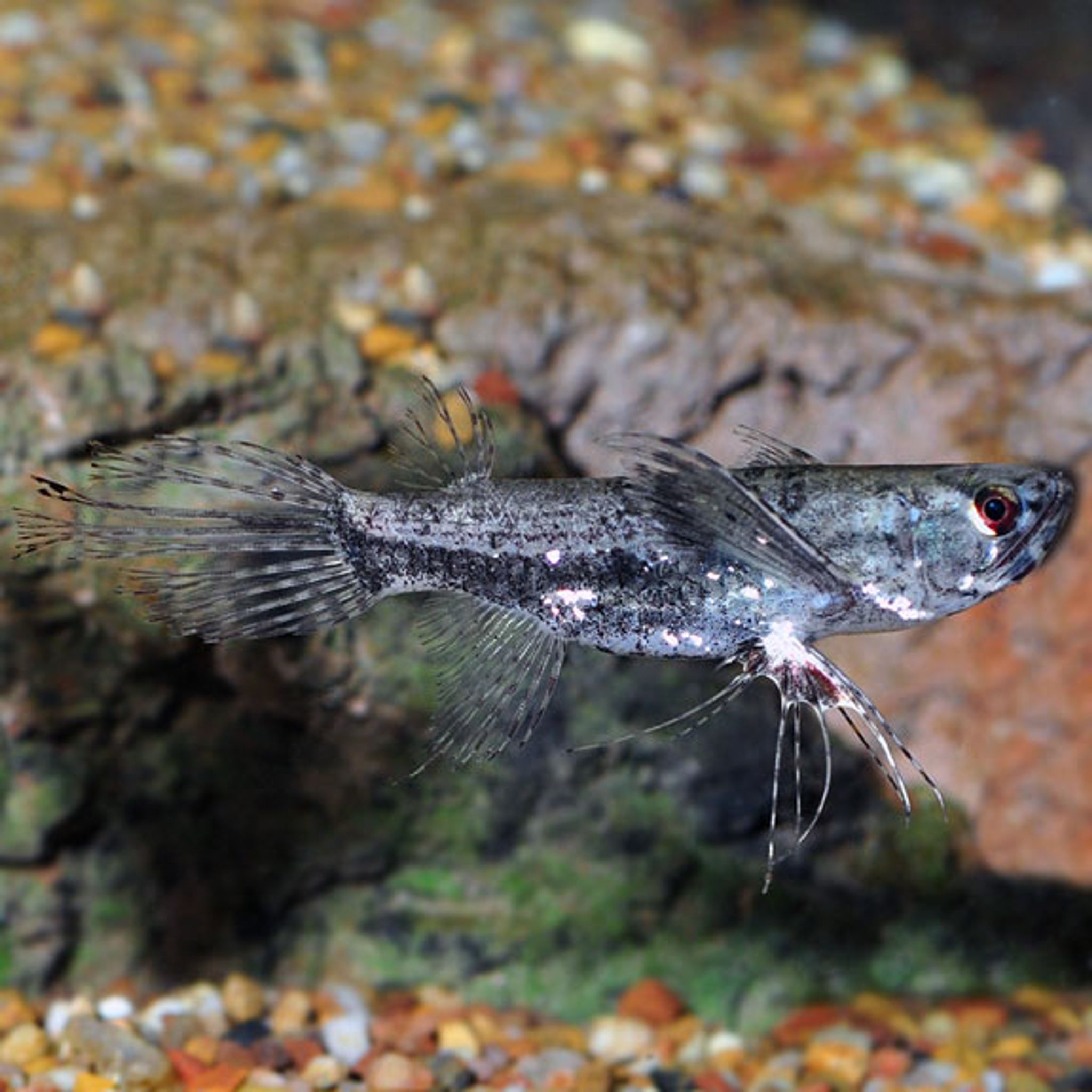
Adults reach about 4-5 inches (10-13 cm), with a flattened, upturned body and oversized, wing-like pectoral fins that let them glide just above the surface to ambush insects. In the aquarium, they spend nearly all of their time in the top few inches of water, rarely venturing to mid-water or the substrate.
Lifespan is typically 5-8 years with stable water quality and consistent feeding.
Tank Size: Think Footprint, Not Gallons
Because this species is a surface specialist, standard "gallons per inch" thinking doesn't map well onto it. A tall, narrow tank with the "right" volume can still be a poor fit if it doesn't offer enough open surface.
- Minimum for one or a pair: a 20-30 gallon "long" style tank, prioritizing length and width (12+ inches of width) over height.
- For a small group, or a butterfly fish plus a community below: 40 gallons or more.
- Key rule: stocking decisions should be based on surface area (length × width), not total volume — two tanks with identical gallons can offer very different amounts of usable top-layer real estate.
A tight-fitting, heavy lid is not optional. African butterfly fish are among the strongest jumpers in the freshwater hobby, and an open tank or a lid with gaps is the single most common cause of loss. Leave a few inches of airspace between the water line and the lid, and check that every seam, cord cutout, and filter opening is sealed or screened.
Water Parameters
| Parameter | Recommended Range | Notes |
|---|---|---|
| Temperature | 75-86°F (24-30°C) | Tropical range; a heater is required |
| pH | 6.0-7.0 (tolerates up to ~7.8) | Slightly acidic to neutral is safest long-term |
| General/Carbonate hardness | 1-15 dGH/dKH | Softer, blackwater-style water favors breeding |
| Water changes | 20-25% every 1-2 weeks | Test ammonia, nitrite and nitrate routinely |
Sources disagree on exactly how narrow the "safe" pH band is — some call 6.5-7.0 critical, others say the fish tolerates up to 7.5-7.8. In practice, stability matters more than hitting an exact number: aim for 6.0-7.0 for the best long-term health and breeding results, but don't panic if long-established water sits a bit higher.
Filtration: gentle surface flow is preferred over strong current. This fish evolved to sit motionless on still water, and a powerhead or filter outlet aimed across the top will stress it. A sponge filter or an adjustable-flow filter aimed downward or diffused works better than a high-output hang-on-back pointed straight across the surface.
Aquascaping for a Surface Dweller
- Lighting: dim rather than bright — mimics the shaded swamp canopy of its native range.
- Floating plants: essential. They break harsh light, provide ambush cover, and later serve as the substrate for egg-laying.
- Substrate and decor: dark substrate and driftwood suit the species aesthetically; keep tall or emergent decor toward the edges so the center of the surface stays open for the fish to patrol.
- Airspace: leave several inches of clearance under the lid, both for the fish's comfort and as a buffer against jumping.
Think of the tank less as "decorated" and more as "zoned" — open water on top for the butterfly fish, structure below for everything else.
Diet and Feeding
In the wild, African butterfly fish are ambush predators that feed almost exclusively on insects that fall onto the water surface. In captivity, a varied approach works best:
- Live insects: crickets, flightless fruit flies, and mealworms are excellent staples and useful for conditioning fish before breeding.
- Live or frozen aquatic foods: bloodworms, brine shrimp, and daphnia make solid everyday staples and are often easier to source consistently than insects.
- Small feeder fish: sometimes used, but carry real disease and parasite risk along with nutritional gaps — a gut-loaded insect or a frozen aquatic food is a safer live-food substitute.
- Floating pellets or sticks: many individuals, especially those started young, can be trained onto these with patience; wild-caught adults are often slower to convert and may need weeks of live/frozen feeding first.
Feed small portions once or twice daily (very small feeds can go up to 3-4 times daily). Avoid dropping in more live insects than can be eaten within a few minutes — uneaten insects that drown and rot foul the water quickly.
Temperament and Compatibility
African butterfly fish are best described as peaceful toward the rest of the tank but territorial at the surface. Reconciling the "aggressive" versus "peaceful" descriptions found in different sources comes down to separating two behaviors:
- Toward similarly shaped, same-layer fish (other butterfly fish, hatchetfish): real, predictable territorial disputes over surface space.
- Toward mid-water and bottom fish: generally indifferent, provided those fish aren't small enough to eat.
That second caveat matters — this species will eat any fish small enough to fit in its mouth, including fry, tiny tetras, and shrimp.
A Simple Compatibility Framework: Surface / Midwater / Bottom
A useful way to plan any tank built around a surface specialist is to sort every candidate species by the water layer it actually occupies:
- Surface (avoid doubling up): other butterfly fish, hatchetfish, and other top-huggers compete directly for the same real estate.
- Midwater (generally safe if too large to eat): larger tetras, barbs, rainbowfish, peaceful cichlids.
- Bottom (generally safe): corydoras, kuhli loaches, plecos, bichirs and rope fish.
Also avoid fin-nippers, since the butterfly fish's long trailing fins are an easy target.
Silver Hatchetfish: A Cautionary Pairing
Silver hatchetfish are another surface-dwelling schooling fish (minimum ~20 gallons, 72-81°F, pH 6.0-7.5) and, like the butterfly fish, are exceptional jumpers that need a tight lid. Because both species patrol the same top layer, they compete for the same space and aren't an ideal pairing. It's sometimes attempted in larger, well-covered tanks, but the shared jumping risk and surface competition make it a pairing to plan carefully rather than default to.
Keeping Numbers
African butterfly fish can be kept singly or in small groups. A group needs proportionally more surface area, not more depth — expect mild territorial posturing between males, which is normal and usually manageable with enough open surface rather than a sign that a fish needs to be removed.
You can browse compatible bottom-dwelling tankmates for a butterfly fish build in Plecos, Corys & Bottom Dwellers, and gentle-flow filtration options in Filters.
Framing It as a Centerpiece Species
Rather than dropping an African butterfly fish into an existing, busy community tank, it works best as the centerpiece species a tank is planned around. Its surface-only lifestyle, jumping risk, and live-food needs mean tankmates, lid, and aquascape decisions should all follow from its requirements — not the other way around.
Breeding at Home
Breeding is realistic for a patient hobbyist. A cooler, soft water change that mimics a rainy-season shift is a commonly reported trigger. Eggs are laid at the surface, often among floating plants; they float, darken after about 24 hours, and hatch in roughly a week. Adults will eat their own eggs and fry, so separate or remove parents after spawning. Fry need infusoria-type foods first, moving on to baby brine shrimp or daphnia; sibling cannibalism among fry is common and expected.
Sourcing, Quarantine and Common Health Issues
Wild-caught imports are common in the trade, and availability can be intermittent compared with mainstream community fish — plan sourcing and pricing expectations accordingly rather than assuming year-round stock.
A Practical Acclimation Checklist
- Check body condition before purchase: alert posture, intact fins, and a rounded (not sunken) belly.
- Quarantine every new butterfly fish for 2-4 weeks in a dedicated tank before adding it to a display, since many are wild-caught and may carry parasites.
- Use the quarantine period to get the fish confidently feeding on live or frozen foods before attempting any transition to pellets.
Ich (White Spot)
Ich shows up as small white, grain-like spots on the body and fins, often triggered by stress from shipping or unstable water. Standard treatment combines a gradual temperature increase with an appropriate medication; prevention comes down to quarantine and stable water quality, which matters even more for a stressed, newly imported fish like this one.
Pop-Eye
Pop-eye — a visibly bulging eye — is usually a symptom of poor water quality, physical injury, or bacterial infection rather than something specific to this species. Test water parameters and perform a water change as the first response before assuming a more serious illness.
General Maintenance Habits That Matter Most Here
- Regular partial water changes and routine ammonia/nitrite/nitrate testing.
- Avoiding overstocking, especially at the surface layer.
- Gradual acclimation of every new fish, not just the butterfly fish.
- Feeding measured portions rather than overfeeding live insects.
These habits are standard aquarium advice, but they carry extra weight for a sensitive, often wild-caught species that's already adjusting to captive life.
Common Mistakes to Avoid
- No lid or a gapped lid — the leading cause of preventable loss.
- Starting with pellets only — many wild-caught fish won't recognize them and can starve without live or frozen food first.
- Housing with other surface fish or nippy long-finned species — creates stress, fin damage, and feeding competition.
- Strong surface current from an oversized filter or powerhead — stresses a fish built for still water.
- Adding small tankmates expecting them to be safe — fry, tiny tetras, and shrimp will likely be eaten.
- Skipping quarantine on wild-caught stock — raises the risk of introducing ich or parasites.
- Overreacting to normal male-to-male posturing — mild territorial disputes are typically manageable with adequate surface area, not a reason to immediately remove a fish.
Frequently Asked Questions
Can African butterfly fish jump out of an open tank?
Yes, readily and often fatally. Always use a full, tight-fitting, heavy lid with minimal gaps, since this species is one of the strongest jumpers in the freshwater hobby.
What do African butterfly fish eat if they won't take pellets?
Start with live insects such as crickets and fruit flies, or live/frozen bloodworms and brine shrimp. Once the fish is feeding confidently, gradually introduce floating pellets alongside its established foods.
How many African butterfly fish can I keep together?
Small groups are possible if surface area is generous. Expect mild territorial disputes between males, which are usually manageable with enough open surface rather than a sign of a problem.
Will African butterfly fish eat my other fish?
They can and will eat anything small enough to swallow whole, including fry, tiny tetras, and shrimp. Choose tankmates that are both too large to be prey and that live outside the surface layer.
Do African butterfly fish need a heater and filter?
Yes. They need tropical temperatures in the mid-70s to mid-80s°F and gentle filtration; avoid strong surface agitation from the filter output since it stresses a fish adapted to still water.
Can African butterfly fish live with bettas or gouramis?
Generally not recommended, since both bettas and gouramis occupy and defend the same surface layer as the butterfly fish, which raises the risk of ongoing conflict.
How long do African butterfly fish live?
Typically 5-8 years, given stable water quality and appropriate feeding.
Is breeding African butterfly fish at home realistic for hobbyists?
Yes. A soft, slightly acidic water change often acts as a spawning trigger, and floating plants give the fish a place to lay eggs. Separating fry from adults and feeding infusoria followed by baby brine shrimp are the key steps to raising a batch successfully.
Ready to plan a surface-specialist tank? Browse available stock in Other Tropical Fishes on FishyHub to find an African butterfly fish and suitable tankmates for your setup.


