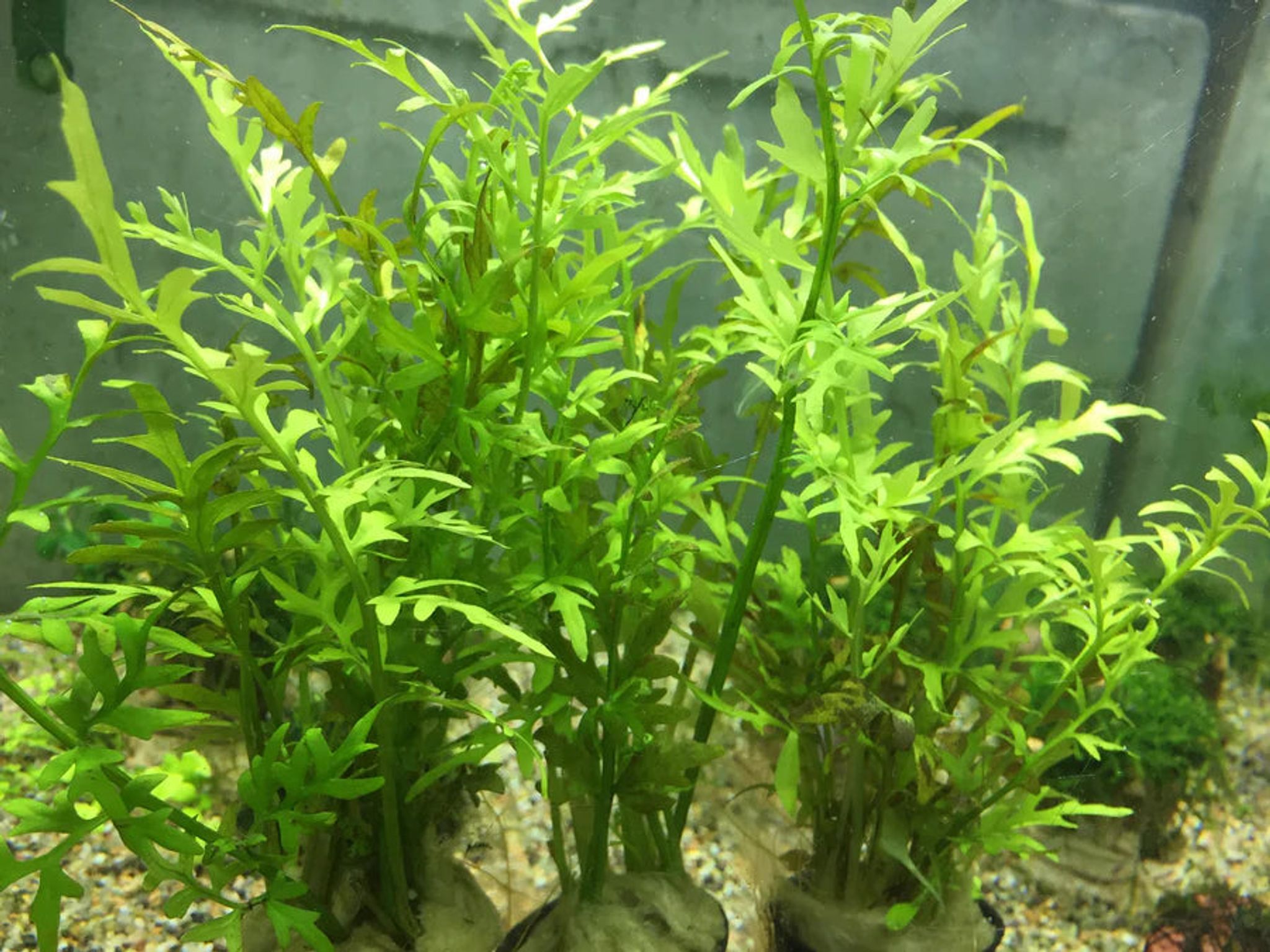
Why Is My Water Sprite Melting or Turning Brown? Causes and Fixes
Water sprite (Ceratopteris thalictroides, cornuta, or siliquosa) often melts or browns within days to weeks of being added to a tank, and in most cases that's a normal adjustment, not a dying plant. This guide walks through how to tell expected melt from a real water quality or nutrient problem, and exactly what to do about each one.
Why New Water Sprite Melts After Planting
Most water sprite sold to hobbyists is farm-grown emersed, meaning it was raised out of water in humid, air-exposed conditions. Emersed leaves have a different structure than aquatic leaves — thicker cuticle, broader lobes, built to exchange gas with air rather than water.
When that plant goes underwater, those original leaves simply cannot function in a submerged environment. They yellow, turn translucent or brown, and disintegrate over roughly a few days to 1–2 weeks. This is called "melt," and it's expected — not disease, not poisoning, not something you did wrong.
What Recovery Actually Looks Like
The reassuring sign to watch for is new growth. Leaves that emerge underwater after the old ones melt look distinctly different: more finely divided, feathery, and delicate than the broad emersed leaves. That feathery new growth is the true aquatic form of the plant, and it means the conversion succeeded.
Don't judge the plant by its original leaves. Judge it by whether new leaves are appearing at all, and whether those new leaves look healthy.
Emersed vs. Submersed Leaves at a Glance
| Feature | Emersed (farm-grown) leaf | Submersed (aquatic) leaf |
|---|---|---|
| Shape | Broader, more solid lobes | Thin, finely divided, feathery |
| Texture | Slightly leathery | Soft, delicate |
| Color when healthy | Medium to dark green | Bright to medium green |
| Fate underwater | Yellows, browns, melts within 1–2 weeks | Persists and grows |
| What it tells you | Original nursery growth — expected to die back | Confirmation the plant has adapted |
Ideal Conditions for Water Sprite
Getting the basics right shortens the melt period and speeds up new growth. Water sprite tolerates a wide range but does best within these targets:
- Temperature: 68–82°F (20–28°C)
- pH: 6.0–7.5
- Water hardness: soft to moderately hard, roughly KH 3–8
- Flow: gentle to low — strong current tears the delicate feathery fronds
- Lighting: low to medium light keeps it alive, but medium-high light (roughly 20–40+ PAR) produces sturdier, faster, less melt-prone growth
On lighting specifically, hobbyists disagree on how much water sprite actually needs. Some describe it as tolerant of quite low light; others insist it only thrives under stronger output. In practice, both are partly right: it survives at low-medium light, but if you're troubleshooting weak, pale, slow growth, bumping toward medium-high light is usually the fix rather than a red flag. Ease into brighter light gradually rather than switching a dim tank straight to a high-output fixture, since a sudden jump in intensity can bleach or stress leaves that haven't acclimated. A LED lamp with adjustable intensity makes that ramp-up easy to manage.
Flow placement matters too. Strong filter outflow or a powerhead aimed directly at the plant will shred and brown leaf edges even in otherwise perfect water — this is physical damage, not a nutrient or water quality issue, and the fix is simply repositioning the plant or filter output.
Feeding a Fast, Hungry Plant
Water sprite is a fast grower and a heavy feeder on nitrogen, potassium, and phosphorus. Its roots are weak and sparse, so it absorbs most of what it needs directly through its leaves from the water column rather than from substrate.
That distinction matters for how you fertilize:
- Floating or lightly-rooted plants: prioritize liquid, water-column fertilizer. Root tabs do almost nothing for a plant that isn't anchored in substrate.
- Planted/rooted specimens: liquid fertilizer still comes first, with monthly root tabs as a supplement, not the main source.
- A reasonable baseline routine is weekly liquid fertilizer dosed at water changes, plus monthly root tabs if planted.
Aim for nitrate in the 20–50 ppm range to avoid deficiency-driven yellowing. Because water sprite grows and feeds so fast, it can strip nutrients out of an otherwise well-fertilized tank and effectively starve itself — a scenario worth keeping in mind before assuming your dosing schedule is wrong.
Reading Deficiency Symptoms
| Symptom pattern | Likely cause |
|---|---|
| New/young leaves yellowing or whitening, veins stay green | Iron or micronutrient deficiency |
| Overall pale yellowing across new growth | Low nitrogen or potassium |
| Older leaves yellow first, new leaves stay green | Phosphorus or potassium mobility issue |
| Browning independent of leaf age, tank recently set up | Water quality stress (see below), not nutrients |
A quick note on iron: dose it sparingly and never combine it in the same dose as a phosphate-based fertilizer. Iron and phosphate bind together into iron phosphate, which the plant can't use — a classic case of accidental nutrient lockout. Iron works better added in small amounts between your main fertilizer doses than as one large dose.
Does Water Sprite Need CO2?
No — water sprite grows without supplemental CO2. But adding it noticeably boosts growth rate and vigor, and can reduce the kind of browning or melt that comes from slow, weak growth rather than an active water problem. If you're already fertilizing correctly and still seeing lackluster growth under decent light, CO2 is the next lever to pull, not a requirement to get started.
Water Quality Problems That Mimic a "Bad Plant"
Not all browning is nutritional. Elevated ammonia or nitrite — common in an uncycled or overstocked tank — stresses plant tissue and browns leaves regardless of how well you're fertilizing. So can extreme pH swings or long-neglected, chemically stale water.
If you're seeing browning in a newly set-up tank, check the nitrogen cycle status before anything else. A plant added to fix water quality can itself become a casualty of the very cycling spike it's meant to help absorb.
Sudden temperature swings — not just being outside the 68–82°F range, but a sharp jump or drop within that range — are another overlooked trigger. Rapid changes stress plant tissue in a way that steady conditions at a slightly less-ideal temperature don't. A reliable water conditioner and stable heating routine go a long way toward ruling this out; browsing water conditioning and additive products is a reasonable starting point if you suspect unstable water chemistry.
Transit and Acclimation Stress
Melt caused by shipping is often confused with melt caused by tank conditions. A plant that spent days in a dark bag experiencing temperature shock will show stress on top of normal emersed-to-submersed melt. Before assuming your tank is the problem:
- Temperature-match the bag or bare-root package to your tank water gradually
- Rinse the plant before adding it
- Avoid dropping it straight into unfamiliar water without any acclimation period
This won't eliminate normal melt, but it prevents adding an extra layer of avoidable stress on top of it.
Floating vs. Planted Setups
How you grow water sprite changes both its needs and its problems.
Floating water sprite gets direct access to light and atmospheric CO2, grows faster, and often recovers from melt more quickly than a rooted specimen. The tradeoff is that it shades whatever is growing beneath it, so a heavily floated surface can starve lower plants of light.
Planted/rooted specimens need more deliberate attention: place them mid-ground or background, away from filter outflow, and don't expect the same growth rate as a floating plant under the same light unless you're also compensating with stronger fertilizer dosing.
If a specimen is badly melted and struggling, floating it temporarily — even if you intend to plant it eventually — is a solid rescue strategy. It reduces root stress while giving the plant maximum light and CO2 access to push new aquatic growth.
Using Water Sprite as a Nutrient Sponge
Because it grows and feeds so aggressively, many hobbyists deliberately grow water sprite specifically to export excess nitrate, trimming and removing handfuls of it periodically rather than treating it as permanent decor. This is worth knowing if you're troubleshooting: a water sprite mass that looks starved even though you're dosing "enough" fertilizer may simply be out-competing your other plants and consuming nutrients faster than you're replacing them. If that's the case, the fix is increasing dosing frequency or amount to match the plant's actual consumption, not assuming something is wrong with your water.
Buying and Inspecting Water Sprite
At purchase, look for:
- Vibrant green coloration with no yellow or brown patches
- Firm stems and leaf bases, not mushy or slimy
- No visible rot at the crown or base
A specimen that already shows brown patches at purchase is more likely to melt extensively and may take longer to recover than one that's fully healthy going in. Some melt after purchase is still normal even from a healthy-looking plant — it's about the transition, not necessarily the starting condition.
One identification note: water sprite is frequently confused with water wisteria in search results and forum photos. Water wisteria has broader, more rounded lobes and a different growth habit; if the plant you're troubleshooting doesn't match water sprite's finely divided, fern-like aquatic leaves, double-check you're not applying water sprite advice to a different species.
Recovery Timeline and When to Worry
With adequate light and nutrients, new healthy aquatic growth typically appears within 2–4 weeks. Give the plant that full window, watching specifically for new leaf emergence, before concluding it's failing.
Trim off leaves that are fully brown or mushy promptly — decaying plant matter fouls the water, spikes ammonia, and can trigger algae growth, compounding the original problem. Leave leaves that are still partly green if the stem or base attaching them is firm; they may continue contributing until fully spent.
Common Mistakes to Avoid
- Discarding a melting plant within the first week instead of waiting out the 2–4 week window
- Adding it to an uncycled tank and blaming the plant for what's actually an ammonia/nitrite spike
- Over-dosing iron or combining it with phosphate fertilizers, causing lockout
- Placing it directly in strong filter outflow or powerhead current
- Under-lighting a planted specimen and expecting floating-plant growth rates
- Leaving melted debris to decay instead of trimming it out
- Mistaking new yellow growth for normal aging instead of a deficiency signal worth investigating
Frequently Asked Questions
Is it normal for all the leaves to melt when I first add water sprite?
Yes, if it was farm-grown emersed, which most commercially available water sprite is. Watch for new aquatic-form leaves — thinner and more feathery — appearing within a few weeks, since that's the real signal of successful recovery.
How long does water sprite take to recover from melt?
Typically 2–4 weeks with adequate light and fertilizer, sometimes faster if the plant is floated rather than planted, since floating gives it more direct access to light and CO2.
Should I remove the melting or browning leaves or leave them?
Trim off leaves that are fully brown or mushy promptly, since decaying tissue fouls the water and can spike ammonia or feed algae. Leave partially green leaves in place if the stem or base is still firm.
Does water sprite need CO2 to stop melting?
No, CO2 isn't required, but supplemental CO2 does speed recovery and reduce stress-related browning tied to slow, weak growth.
Can too much light cause browning?
Extremely intense, unacclimated light can bleach or stress leaves, but browning from too little light or insufficient nutrients is far more common. Increase light intensity gradually rather than jumping straight to a high-output fixture.
Why do my water sprite leaves turn yellow even though I fertilize?
It's usually a specific deficiency — iron or micronutrients if new leaves yellow with green veins, or nitrogen/potassium if new growth is uniformly pale — or an imbalance from dosing iron alongside phosphate. It can also simply be the plant's fast growth outpacing your dosing frequency.
Is floating or planting better for a struggling water sprite?
Floating often speeds recovery because it gives the plant more direct light and CO2 access with less root stress, making it a good rescue strategy for a badly melted specimen before replanting it later.
Can water quality issues alone cause browning without any nutrient problem?
Yes. Ammonia or nitrite spikes, large pH swings, or old untested water can brown leaves even when fertilizer dosing is correct, so always rule out the nitrogen cycle status first, especially in a newer tank.
Ready to add or refresh your planted setup? Browse substrate options and other planted-tank essentials on FishyHub to give your water sprite — and everything else in the tank — a stable base to grow from.

