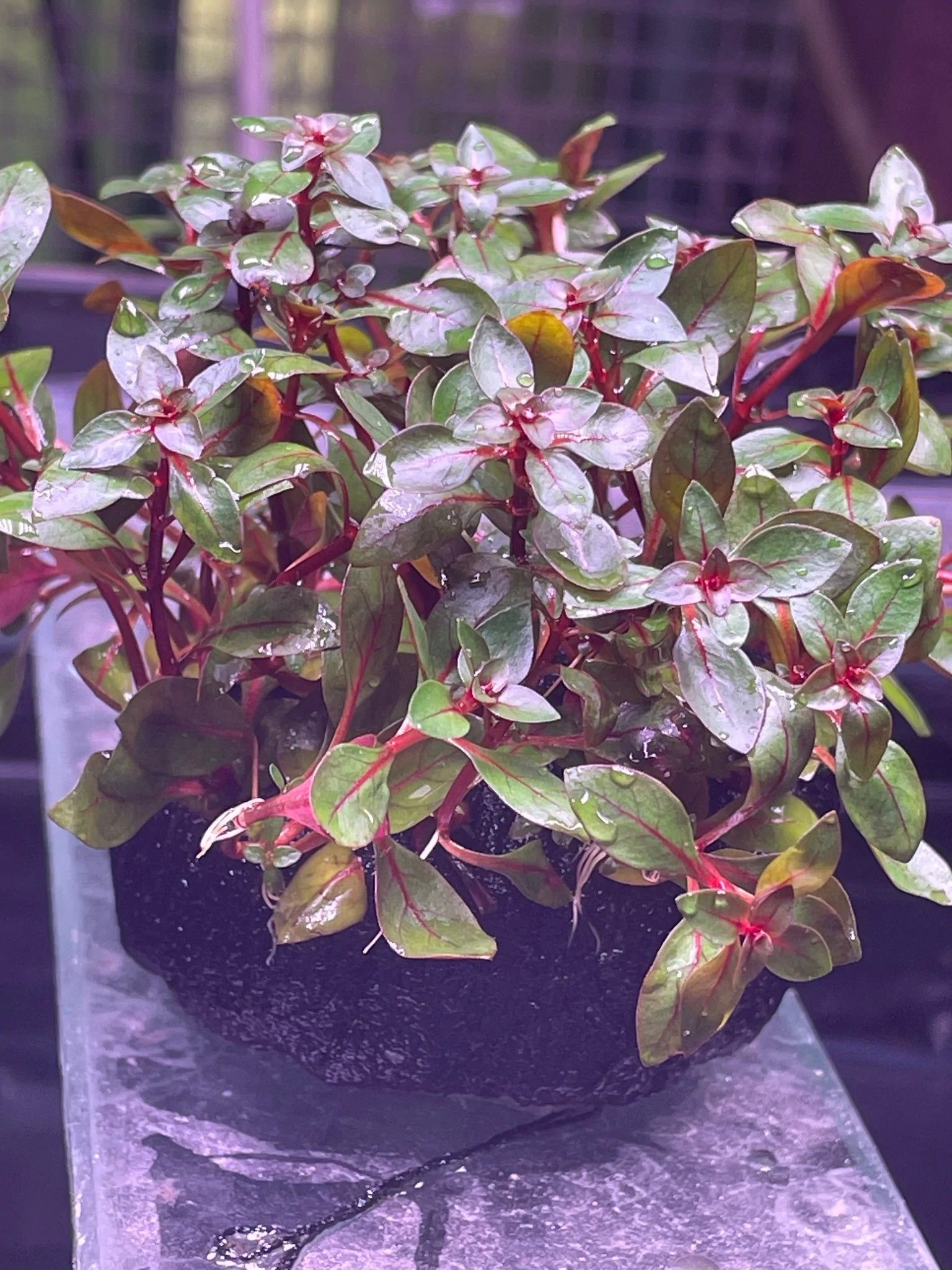
Why Is My Ludwigia Super Red Melting or Turning Brown? Causes and Fixes
New Ludwigia Super Red stems often lose leaves, go translucent, or drop lower foliage within days of planting, and that alone doesn't mean the plant is dying. This guide walks through how to tell normal post-planting melt from a real lighting, CO2, or nutrient problem, and gives a step-by-step fix for each cause.
Is This Normal Melt or a Real Problem?
Ludwigia Super Red (sold under names like Ludwigia repens or Ludwigia palustris "Super Red"/"Rubin") is grown emersed — above water — at most farms. Its emersed leaves are built for air, not submersion, so when the stems go underwater they typically shed those original leaves within 1–2 weeks as the plant converts to submersed growth. This is a normal metabolic switch, not disease.
The key is watching where the melt happens and *what follows it.
| Sign | Normal transition melt | Real problem |
|---|---|---|
| Which leaves are affected | Older, lower, or original emersed leaves | Whole stem, including new growth |
| Texture | Leaves turn translucent/mushy, then drop | Stem itself turns black or mushy (rot) |
| New growth | Fresh leaves emerge from tips/nodes within 1–3 weeks | New leaves also melt or emerge deformed |
| Timing | Concentrated in the first 1–2 weeks after planting | Continues or reappears weeks after planting |
| Cause | Emersed-to-submersed conversion, transport stress | Ongoing lighting, CO2, or nutrient deficit |
If only the bottom leaves are melting while the growing tip stays firm and green (or reddish), give it time. If the stem is going soft all the way up, or new leaves are melting too, treat it as a chronic issue and work through the causes below.
Plants shipped bare-root or dry often shed their entire original leaf set within days of arrival — this reflects the shipping method, not your tank, and doesn't predict how the plant will grow once it's settled.
Lighting: The Biggest Driver of Color and Melt
Light intensity and duration affect both browning and the plant's signature red color more than any other single factor.
- Too little light: leaves stay green or pale, lower leaves yellow and drop, and stems stretch thin (legginess) as they reach for light, with the shaded lower leaves browning and dying off.
- Enough light for color: Ludwigia Super Red generally needs medium-high to high light — roughly the equivalent of 2–3+ watts per gallon on older fixtures, or about 30–50+ PAR at the substrate — run for 8–10 hours a day to develop deep red pigmentation.
- High light without matching CO2/nutrients: this is a classic melt trigger. The plant is being pushed to photosynthesize faster than it can supply carbon and nutrients, so leaves curl, develop pinholes or brown patches, and eventually melt.
It will survive on lower light, but it will stay mostly green rather than red — color intensity is a light (plus CO2/nutrient) problem, not a survival one. If your current fixture is dim or aging, a dedicated planted-tank light is worth checking in the lighting category.
CO2 and Carbon: Matching Supply to Light
Ludwigia Super Red does best with injected CO2 in the 20–30 ppm range, or at minimum a liquid carbon supplement. Without enough carbon relative to the light it's receiving, the plant can't keep pace with its own photosynthetic demand, and leaves melt, curl, or develop brown patches even when nutrients are otherwise fine.
Sources disagree on how essential this is. Beginner-friendly guidance treats Ludwigia as an easy plant that can grow without CO2 or heavy fertilizing, just more slowly and with less red. Higher-light, planted-tank guidance treats CO2 and regular iron/micronutrient dosing as close to mandatory for holding deep red color and preventing melt. Both are right for different setups:
- Low-tech, no-CO2 tanks: the plant will live and grow under good light alone, but expect it to stay mostly green rather than deep red.
- Medium-to-high light tanks: raising light without also raising CO2/liquid carbon is the single most common way hobbyists trigger melt and algae at the same time. If you increase light, increase carbon and fertilizer alongside it.
Reading Nutrient Deficiencies by Symptom
Ludwigia's leaf symptoms are a fairly reliable diagnostic tool once you know what to look for.
| Symptom | Likely deficiency | What to do |
|---|---|---|
| Pale, yellow, or white new growth (chlorosis), sometimes with greener veins | Iron/micronutrients | Dose a complete micro fertilizer with chelated iron |
| Pinholes or speckled, holey older leaves; marginal browning | Potassium | Add a potassium supplement or switch to an all-in-one fert |
| Overall yellowing starting on older leaves; stunted growth | Nitrogen | Increase nitrate dosing or fish load/feeding |
| Dark green but stunted growth | Phosphate | Add a phosphate source; usually a slower-acting cause |
| Weak, translucent new leaves coated in algae film | Excess light vs. nutrients | Rebalance light duration/intensity with fertilizer dosing |
Because Ludwigia is a heavy root feeder as well as a water-column feeder, nutrient-poor inert gravel with no root tabs or enriched substrate often shows up as slow growth and steady lower-leaf decline over months, even when water-column dosing looks adequate. If your substrate is plain gravel or sand, root tabs or switching part of the bed to an enriched substrate can resolve deficiencies that liquid fertilizer alone won't fix — browse options in the substrate category.
Water Parameters and New Tank Syndrome
Stable water conditions matter as much as any nutrient. Target:
- Temperature: 72–82°F (22–28°C)
- pH: roughly 6.0–7.5
- Hardness: soft to moderately hard
Sudden swings in any of these during acclimation — especially right after adding new stems — stress the plant and worsen melt. In a newly cycled tank, ammonia and nitrite spikes from new tank syndrome can also brown and melt leaves independent of lighting or fertilizer issues. If you've recently added a batch of fish or plants, check your parameters before assuming the plant itself is the problem; a reliable water conditioner or stability additive can help buffer acclimation swings.
Planting Technique and Maintenance Habits
Physical setup causes browning just as often as water chemistry:
- Planting too deep or too dense blocks light from reaching lower leaves, which yellow, brown, and drop from self-shading. Plant stems with only the roots buried, spaced enough that each stem gets direct light.
- Leaving melted debris in the tank lets it foul the water locally and can spread rot up the stem — remove mushy leaves and stem sections promptly.
- Letting stems grow long and leggy without trimming creates bare, browning lower sections over time.
How to Replant a Melting Stem
Rather than trying to nurse a melted lower section back, cut the stem just above a healthy, firm node — ideally where new leaves are already forming — and replant the healthy top. Discard the melted lower portion. This redirects the plant's energy into new growth instead of propping up dying tissue, and it's a habit worth repeating every few weeks as stems mature and the lower sections naturally thin out.
The PPS-Pro Dosing Method, and Other Options
One fertilizing approach worth knowing about is PPS-Pro (Perpetual Preservation System, "Pro" variant), a daily dosing method rather than a periodic one. It typically uses two prepared solutions — one with nitrate, phosphate, and potassium (macronutrients), one with a trace/iron mix (micronutrients) — dosed in small amounts daily, scaled to tank volume. The goal is to keep nutrient levels steady and low rather than swinging between a big weekly dose and near-depletion, which suits a plant like Ludwigia that relies on consistent iron and micronutrient availability for red coloration.
PPS-Pro is one option among several, not the only path:
- All-in-one liquid fertilizers dosed a few times a week are simpler and work well for most low-to-medium-tech tanks.
- Estimative Index (EI) dosing uses larger, less frequent doses paired with a weekly water change to reset levels — better suited to higher-light, CO2-injected tanks that can use the excess.
- Root tabs address root-zone nutrition directly and pair well with either dosing style if your substrate is inert.
Match the method to your setup: daily dosing systems like PPS-Pro reward stable, matched light/CO2 setups, while EI suits tanks already doing regular water changes for other reasons.
Common Mistakes to Avoid
- Discarding the whole plant after initial post-planting melt instead of waiting 1–3 weeks for new growth.
- Leaving decaying leaves in the substrate, where they can spike ammonia locally.
- Raising light intensity without raising CO2 or fertilizer to match — a common trigger for both melt and algae.
- Planting stems too deep or too thick, starving lower leaves of light.
- Dosing only water-column fertilizer while ignoring root-zone nutrition.
- Making large water changes or temperature shifts right after introducing new stems.
- Skipping regular trimming, letting stems get long and leggy with bare, browning bases.
Frequently Asked Questions
Is it normal for Ludwigia Super Red to lose all its leaves after planting?
Yes, especially if it was grown emersed. Expect the original leaves to melt within 1–2 weeks, followed by new submersed growth from the nodes and stem tips within 1–3 weeks if light, CO2, and nutrients are adequate.
How do I know if it's melting from transition vs. a real problem?
Transition melt affects only the older or original leaves while the new tip growth stays firm and healthy. Ongoing whole-stem rot, or repeated melting of newly formed leaves, points to a lighting, CO2, or nutrient issue that needs addressing.
Why is my Ludwigia green instead of red?
Usually insufficient light intensity or duration, or a lack of iron and other micronutrients. Increasing light to medium-high levels for 8–10 hours a day and dosing a complete fertilizer with chelated iron are the two most effective fixes.
Does Ludwigia Super Red need CO2?
Not strictly to survive — it will grow under good light alone in a low-tech tank, just more slowly and mostly green. CO2 or liquid carbon becomes important once you raise light intensity, both to sustain red color and to prevent melt from unmet photosynthetic demand.
What fertilizer nutrients matter most for this plant?
Iron and other micronutrients drive red coloration, while potassium and nitrogen support overall leaf health and prevent pinholes or yellowing. A balanced all-in-one fertilizer or a daily dosing method like PPS-Pro can cover all of these.
Should I trim off brown or mushy leaves?
Yes. Remove them promptly with clean scissors, cutting the stem just above a healthy node, to stop rot from spreading and to redirect the plant's energy into new growth.
Can bad water parameters cause melting?
Yes. Ammonia or nitrite spikes from an uncycled tank, unstable temperature, or large pH and hardness swings during acclimation are all common triggers for sudden leaf loss, separate from any lighting or nutrient issue.
How much light and what temperature does Ludwigia Super Red need?
Aim for 72–82°F (22–28°C), a pH around 6.0–7.5, and medium-to-high intensity lighting for 8–10 hours daily. These conditions support both healthy growth and strong red coloration.
Once your lighting, CO2, and dosing routine are dialed in, replanting a trimmed, healthy Ludwigia top into a nutrient-rich bed makes the biggest difference in how quickly it colors up — browse enriched options in the substrate category to give new stems a stronger start.

