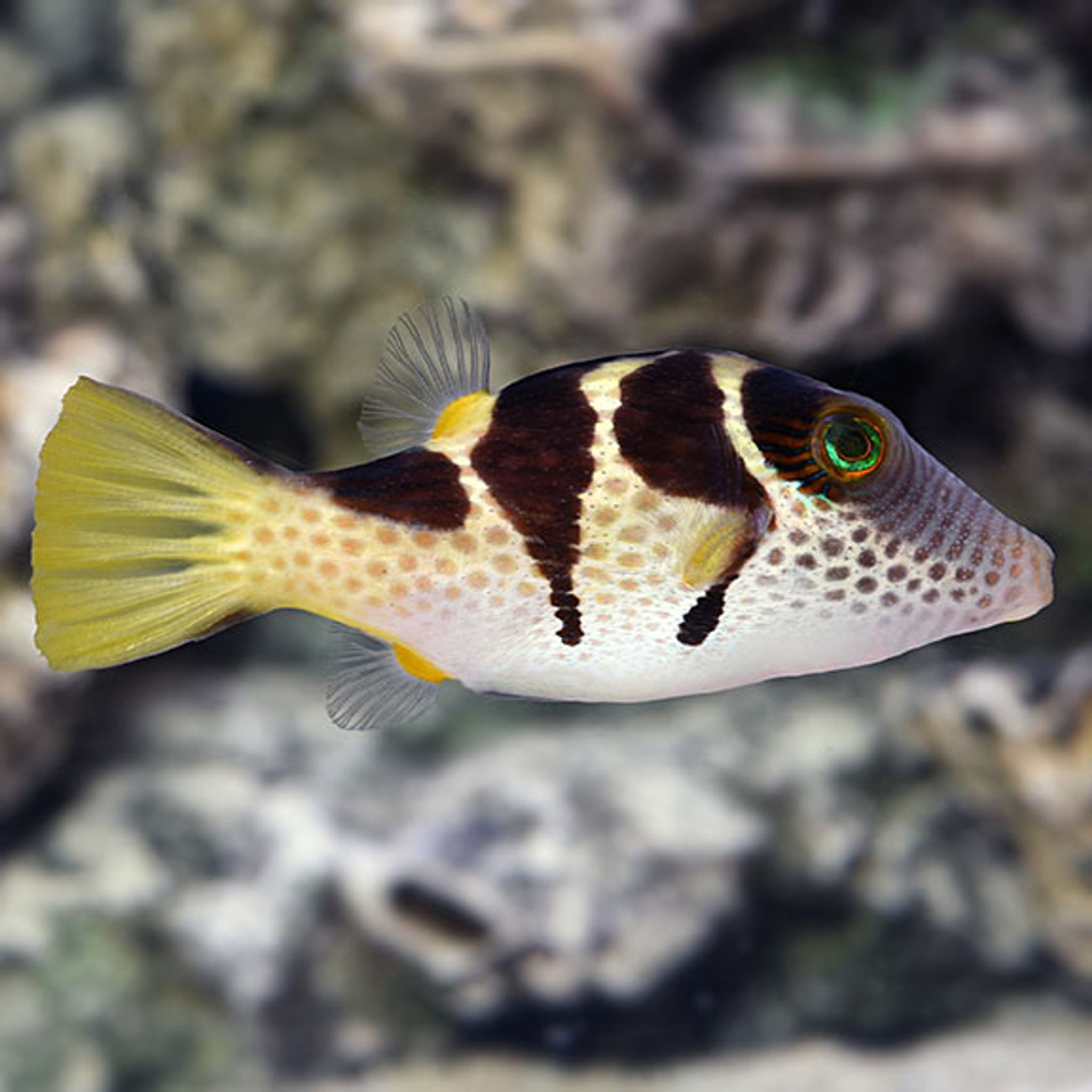
Valentini Puffer Care Guide: Tank Size, Diet, Compatibility and Reef Safety
The Valentini puffer is one of the strangest-looking fish in the saltwater hobby, and also one of the more approachable saltwater puffers for a modest tank. This guide covers exactly what it needs — tank size, water parameters, feeding, tankmates — and answers the question every buyer eventually asks: is it actually reef safe?
Species Snapshot
The Valentini puffer (Canthigaster valentini) is also sold as the saddled toby, saddleback puffer, or black-saddled puffer. Its identifying feature is a set of dark, saddle-shaped bands across the back and sides, which separates it from lookalike tobies such as Canthigaster papua. Adults reach roughly 4–5 inches (10–13 cm), with many individuals settling closer to 4 inches, making it one of the smallest members of the puffer family sold for home aquariums.
Like all pufferfish, it has a beak-like set of fused teeth that never stops growing, a rounded body that can inflate defensively, and the ability to produce tetrodotoxin — a point covered in detail below.
Tank Size and Setup
A single Valentini puffer needs a minimum of 30 gallons (114 L). Treat that as a floor, not a target: it's a workable footprint for one puffer with no other fish, but puffers are heavy waste producers, and a bare-minimum tank fills with nitrate quickly.
- Solo puffer, no tankmates: 30 gallons minimum
- Puffer plus a modest community: 40–55 gallons or more recommended
- Puffer in a larger mixed FOWLR setup: 75+ gallons gives the most stable water quality and room to avoid territorial flare-ups
Because the fish is a strong bioload contributor, filtration matters more than tank size alone. Run strong biological filtration plus a protein skimmer, and stay on a routine of frequent partial water changes rather than relying on the filter to keep pace on its own.
Water Parameters
| Parameter | Target range | Notes |
|---|---|---|
| Temperature | 74–78°F (23–26°C) | Some sources cite 72–78°F; general marine guidance runs slightly warmer (76–80°F). Consistency matters more than hitting one exact number. |
| pH | 8.1–8.4 | Standard reef/FOWLR range |
| Specific gravity | 1.020–1.025 | Reef tanks often run 1.024–1.026; FOWLR-only setups can sit a touch lower |
| Ammonia / Nitrite | 0 ppm | No detectable reading, ever |
| Nitrate | Under 20 ppm | Lower is better given the fish's waste output |
Salinity measurement: a refractometer is more accurate than a swing-arm hydrometer and is worth the upgrade for any saltwater tank. Whatever tool you use, always top off evaporated water with fresh water only — never saltwater — or salinity will creep upward over time as only water, not salt, leaves the tank through evaporation.
Heating and Flow
Size a submersible heater at roughly 3–5 watts per gallon, and consider splitting that wattage across two smaller heaters instead of one large one — redundancy matters, since a stuck heater can crash the tank fast. Verify heater accuracy with an independent digital thermometer, and if you ever need to correct a temperature drift, do it gradually: no more than 1–2°F per day.
For a 30–75 gallon puffer tank, size a return pump to turn the display over roughly 5–10 times per hour, accounting for head height and plumbing losses. A mid-tier pump in a manufacturer's lineup is usually the safer pick over the smallest or largest model, unless the tank is unusually small or feeding a larger multi-tank system.
Diet and Dental Care
Valentini puffers are strict carnivores. A varied rotation works best:
- Frozen mysis and brine shrimp
- Krill
- Squid
- Mussel and clam meat
- Small pieces of table shrimp
Feed small portions once or twice daily — little and often beats one large feeding.
The non-negotiable part: hard-shelled food
A puffer's beak-like teeth grow continuously, and soft foods alone do nothing to wear them down. Skip hard-shelled items and the teeth overgrow to the point the fish can no longer eat — a problem that then requires manual trimming. Offer whole shell-on shrimp, snails, or clams/mussels on the half shell 2–3 times a week specifically for this purpose, separate from the regular feeding rotation. Live snails from the marine invertebrates selection can double as both enrichment and dental maintenance for a FOWLR tank that isn't stocked with ornamental inverts you want to protect.
Temperament and Tankmates
Valentini puffers are bold and curious — many owners find theirs recognizes them and swims up to the glass at feeding time. That same confidence comes with a fin-nipping streak toward slower or long-finned tankmates.
Good tankmate categories:
- Tangs and surgeonfish
- Larger, robust gobies
- Wrasses
- Angelfish
Avoid pairing with:
- Slow-moving or heavily flowing-finned fish, which invite nipping
- Ornamental shrimp, hermit crabs, and snails — the puffer will eat them
- A second puffer or similar-looking toby species in anything short of a very large, heavily aquascaped tank
One Puffer Per Tank
This is close to a hard rule. Valentinis and other tobies are intolerant of their own kind and of similarly shaped puffers. Keeping two in a typical home tank under roughly 75–100 gallons leads to chasing, torn fins, and stress-related illness — even a second toby species that merely resembles a Valentini can trigger the same aggression. Browse the marine fish puffer selection with the plan of stocking exactly one per system.
Is a Valentini Puffer Reef Safe?
Short answer: not for a true reef with invertebrates. It's best described as "reef safe with caution" — workable in a fish-only or lightly stocked system, but a real risk in a display built around ornamental crustaceans, snails, or fleshy corals.
- It will pick at ornamental shrimp, crabs, and snails on sight
- It may nip at fleshy LPS corals, and the risk rises when the fish is underfed or fed a narrow diet
- Softer corals and fish-only setups carry lower risk than a mixed reef with prized LPS hard corals
If the goal is a true reef tank stocked with inverts and LPS, a Valentini puffer isn't the right fit. If the goal is a FOWLR tank or a reef built around hardier soft corals with no delicate invertebrates, it's a workable and genuinely entertaining choice.
Want reef-compatible instead? Consider a filefish
Filefish are a related, similarly oddball-looking alternative, and some species are genuinely reef-safe algae and pest eaters rather than invert predators. Worth a look for anyone drawn to the puffer's looks but committed to a full reef build.
Toxin Safety: What Tetrodotoxin Actually Means Day to Day
Like other puffers, boxfish, and cowfish, the Valentini can produce tetrodotoxin, a potent defensive toxin. In practice, this isn't a routine handling hazard — it becomes relevant mainly when the fish is severely stressed, injured, or dies in the tank, at which point toxin release can affect other tank inhabitants and water quality. The practical takeaway is to minimize stress during any handling and to net gently, or better, use a cup or container instead of a net for transfers, since netting can cause a puffer to gulp air or panic-inflate.
Lifespan
A well-cared-for Valentini puffer commonly lives 5–10 years in captivity — treat this as an estimate rather than a guarantee, consistent with the broader 5–10+ year range cited across the Canthigaster and wider puffer family in home aquariums. Stable parameters, low stress, and consistent dental maintenance all push toward the higher end of that range.
Puffer and Boxfish Family Context
The Valentini sits at the small end of a family that scales dramatically by species:
| Species type | Adult size | Minimum tank size | Experience level |
|---|---|---|---|
| Valentini / small tobies | 4–5 in | 30 gal | Beginner-friendly |
| Dogface puffer | Up to 12 in | 125+ gal | Intermediate/advanced |
| Guineafowl puffer | Up to 12+ in | 150–200+ gal | Advanced |
| Porcupine puffer | Up to 18+ in | 180+ gal | Advanced |
| Boxfish / cowfish | 6–20 in | 100–180+ gal | Advanced/expert |
Boxfish and Cowfish: Not for Everyone
Boxfish and cowfish are close relatives with rigid, box-shaped bodies. They're also toxin-producing, generally demand much larger tanks (100–180+ gallons), and are considered advanced to expert-level fish due to their sensitivity and space needs. Cowfish are commonly priced from roughly $40 to $150 or more depending on size and source, and can live 8–12 years, occasionally up to 15, given pristine water quality. The contrast is useful: it's exactly why the Valentini earns its reputation as the beginner-friendly entry point into keeping a member of this family. Browse the boxfish category to compare before committing to either path.
Valentini vs. Other Small Tobies
Shoppers often compare the Valentini against other similarly sized Canthigaster species before choosing.
| Species | Distinguishing marks | Reef caution level |
|---|---|---|
| Valentini (saddled toby) | Bold black saddle bands | Moderate — invert/LPS risk |
| Blue-spotted toby | Blue spots over a tan/green body | Moderate — similar invert risk |
| Hawaiian white-spotted toby | Fine white spots, darker base color | Moderate — similar invert risk |
Care requirements across these tobies are broadly similar — same tank size floor, same carnivorous diet, same "one puffer per tank" rule — so the deciding factor for most buyers comes down to color pattern preference rather than care difficulty.
Quarantine and Acclimation
Puffers are notably sensitive to rapid swings in water chemistry, so don't skip quarantine, even for an otherwise healthy-looking fish.
- Quarantine first. Run the new puffer through a dedicated quarantine tank before it ever touches the display, to catch parasites or illness before they spread.
- Drip acclimate, rather than a quick float-and-dump. Puffers handle a slow, gradual match to display parameters far better than an abrupt change.
- Match temperature and salinity closely between the transport water and the quarantine tank before starting the drip.
- Watch first feedings. A puffer that refuses food, shows clamped fins, or looks pale during quarantine needs more observation time before joining the display.
- Be cautious with quarantine medications. Scaleless, toxin-bearing fish like puffers can be more sensitive to certain ich treatments and to copper-based medications than typical reef fish — check that any treatment is rated safe for puffers before dosing.
Recognizing Stress or Illness Early
Catch problems before they escalate by watching for:
- Color fading or a duller-than-usual saddle pattern
- Clamped fins held tight to the body
- Refusal of hard-shelled foods specifically, even if soft foods are still accepted — often an early sign of an already-overgrown beak
- General lethargy or hiding more than usual
Common Mistakes to Avoid
- Feeding only soft foods (pellets, flake, thawed shrimp meat) and skipping hard-shelled items, leading to an overgrown beak that eventually stops the fish from eating
- Keeping two puffers — even different toby species — in anything under roughly 75–100 gallons
- Adding delicate invertebrates like cleaner shrimp, hermit crabs, or snails and hoping the puffer leaves them alone
- Netting the fish for transfers, risking panic-inflation or air gulping — use a cup or container instead
- Rapid salinity or temperature swings during water changes or top-offs; always match new water to display parameters and top off with fresh water only
- Treating the 30-gallon minimum as generous rather than a bare floor, which leads to poor water quality and disease-prone fish
- Skipping quarantine before introducing a new puffer to an established display
Frequently Asked Questions
Is a Valentini puffer reef safe?
Generally no for a true reef stocked with invertebrates — it may nip at ornamental crustaceans, snails, and occasionally fleshy LPS corals. It's better suited to a FOWLR setup or a reef built without prized invertebrates.
What size tank does a Valentini puffer need?
Thirty gallons is the minimum for a single specimen. Once tankmates are added, 40–55 gallons or more is the more realistic target for stable water quality.
What do Valentini puffers eat?
A carnivorous diet of frozen mysis, brine shrimp, krill, squid, and clam meat, fed once or twice daily, plus hard-shelled foods like shell-on shrimp or clams on the half shell 2–3 times a week to keep the continuously growing teeth worn down.
Can you keep two Valentini puffers together?
Not in a typical home tank. They're intolerant of their own kind and of similar-looking tobies, and pairing them usually results in chasing and fin damage even in tanks well above the 30-gallon minimum.
Are Valentini puffers poisonous or dangerous to keep?
They carry tetrodotoxin as a defensive toxin, but this is mainly a concern if the fish is severely stressed, injured, or dies in the tank — it isn't a hazard from normal feeding or handling. Minimizing stress and using a cup rather than a net for transfers is the simplest precaution.
How long do Valentini puffers live?
Commonly cited around 5–10 years in captivity with consistent water quality and a proper diet, in line with lifespans reported across the wider puffer family.
What fish make good tankmates for a Valentini puffer?
Similarly robust, medium-activity fish such as tangs, wrasses, larger gobies, and angelfish tend to work well. Avoid slow-moving or long-finned fish that invite nipping, and skip ornamental shrimp, crabs, and snails entirely.
Ready to plan the rest of the stocking list? Browse FishyHub's marine fish selection to pair a Valentini puffer with tankmates suited to its temperament and tank size.

