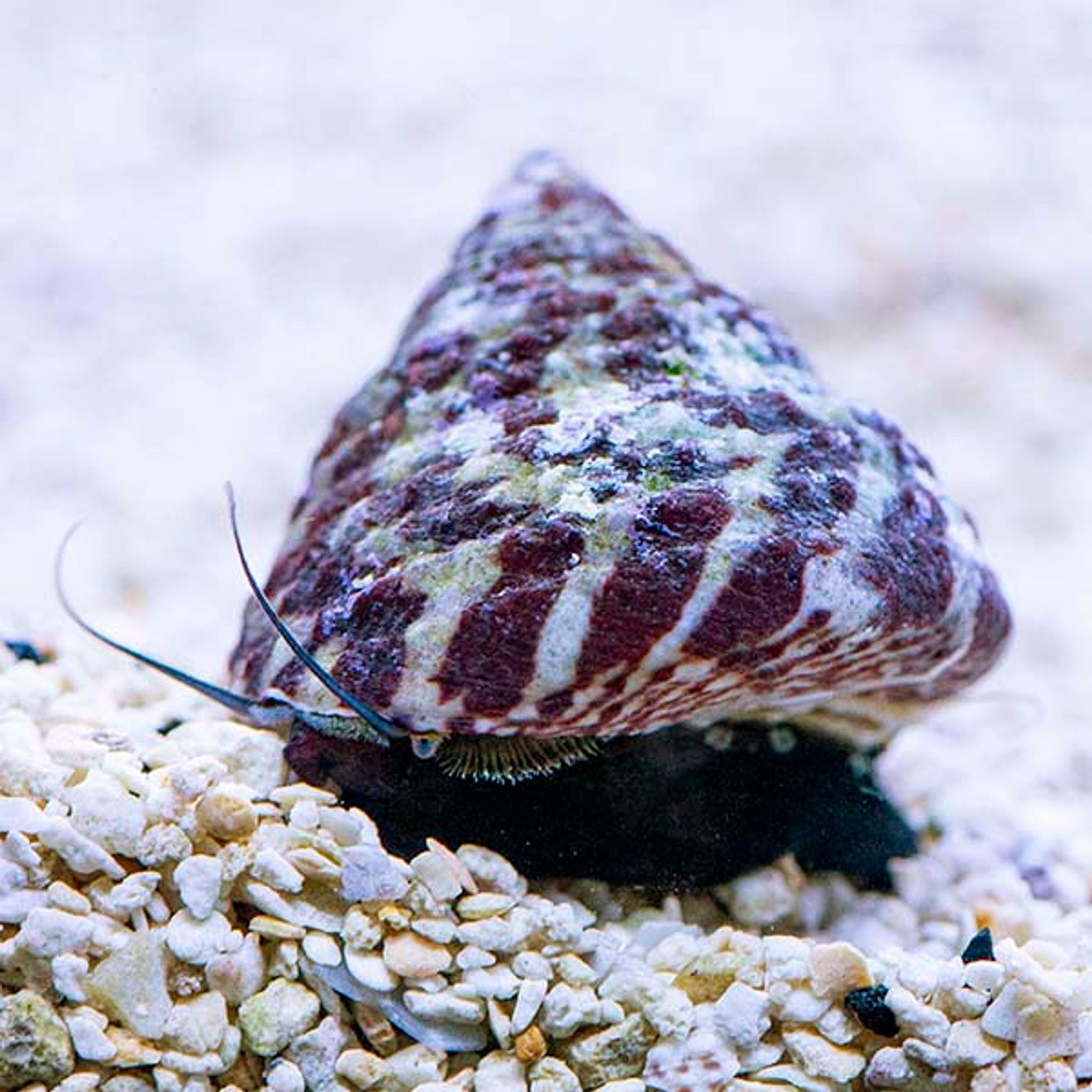
Trochus Snail Care Guide: Tank Requirements, Feeding and Compatibility
Trochus snails are among the most reliable algae-grazing invertebrates a saltwater hobbyist can add to a reef or fish-only tank. This guide covers the tank conditions, feeding routine, growth expectations, and tankmate compatibility you need to keep them healthy, plus how they compare to other cleanup crew snails.
What Is a Trochus Snail?
Trochus snails are cone-shelled marine gastropods that spend most of their time grazing diatoms, film algae, and cyanobacteria off glass, rock, and sand. They're usually sold as juveniles measuring 0.5 to 1 inch across and will grow to 1 to 2 inches with steady feeding. Their strong foot and operculum (a hard trapdoor that seals the shell) make them hardier and better at self-righting than many other cleanup crew snails, which is a big reason they're a favorite first invertebrate for new reef tanks.
Tank Requirements for Trochus Snails
Trochus snails aren't fussy compared to corals or fish, but they are sensitive to sudden swings and to running out of food. Match the parameters below before adding any.
| Parameter | Target Range |
|---|---|
| Tank size | 10+ gallons (38+ L) per snail, as part of a mixed crew |
| Temperature | 74–79°F (23–26°C) |
| pH | 8.1–8.4 |
| Specific gravity/salinity | 1.021–1.025 |
| Alkalinity (dKH) | 8–12 dKH |
| Calcium | 400–450 ppm |
| Magnesium | 1,250–1,350 ppm |
| Nitrate | Under 20 ppm |
Tank Size and Stocking Density
The "10 gallons per snail" figure is a reasonable baseline, but sources genuinely disagree on stocking ratios — some frame cleanup crews as roughly one snail per 2–3 gallons of total crew, others stick to one trochus per 10 gallons of tank volume. The safer approach is to treat both as loose starting points and let your algae growth rate set the real number. Nano and small tanks in particular can't sustain a large snail population because there simply isn't enough surface algae to go around, and starvation — not water quality — is the most common cause of death in trochus.
Water Chemistry and Shell Health
Calcium, alkalinity, and magnesium don't work in isolation — they interact to determine how well a snail can build and maintain its shell. If any one of the three drifts while the others stay "in range," you can still end up with pitted or eroding shells over time, since the snail can't lay down new calcium carbonate properly. Test all three together, not just whichever one you remember to check.
Magnesium deserves special attention: more is not better. Once magnesium climbs much above 1,500–1,600 ppm, trochus and other snails tend to become lethargic and stressed rather than benefiting from the extra buffer. Dose toward the target range, not past it.
Copper is an absolute no. Any copper-based medication or copper dosing anywhere near an invertebrate tank is lethal to trochus and every other snail — there's no safe low dose. If you need to treat fish for parasites, do it in a separate quarantine tank away from your cleanup crew.
Feeding Trochus Snails
Trochus are herbivorous grazers. In a tank with an established algae film, they'll spend their time working through:
- Diatoms on glass and rock
- Film and microalgae on hard surfaces
- Cyanobacteria growing on surfaces (though not reliably enough to control a bloom — more on that below)
They will not eat coralline algae; in fact, they help keep it clean by scraping competing algae off of it, which is one reason reef keepers value them.
The problem is that in a newer or particularly well-run reef tank, natural algae can run out faster than people expect. If you notice snails clustering near the waterline, wandering the glass without settling to graze, or losing weight/shell luster, supplement with an algae wafer, a sinking pellet, or a piece of blanched vegetable 1–2 times per week. Never add trochus to a brand-new, algae-free tank and expect them to find enough food — either wait until a visible film has developed first, or start supplemental feeding from day one.
Lifespan and Growth
Expect a realistic captive lifespan of 2–3 years with consistent water quality and feeding. You'll see claims of trochus living much longer in the wild or under "ideal" conditions, but most home aquariums don't replicate those conditions closely enough for that to be a fair expectation — plan around 2–3 years and treat anything beyond that as a bonus.
Trochus can occasionally spawn in a home tank, but it's worth being honest about the odds: larvae almost never survive the trip through filtration and protein skimmers, so breeding isn't a realistic project for most hobbyists. If you see a spawning event, enjoy it as a sign of good health rather than expecting offspring.
Reef Safety and Righting Ability
Trochus are considered fully reef safe — they won't touch coral tissue, fish, or other invertebrates. The one caveat: larger individuals near 2 inches can bump into and topple loose coral frags while cruising the rockwork, so cement or firmly wedge your frag placements rather than resting them loosely on rock.
Their operculum and strong foot generally make them better than astrea snails at self-righting if a current or a clumsy tankmate flips them over. That said, "better" isn't "perfect" — a trochus can still get stuck upside down, especially in a low-flow dead spot or wedged between rocks. Check on them periodically, particularly after doing tank maintenance, and gently flip any you find stuck. Left too long, an unrighted snail can die.
Acclimating New Trochus Snails
Snails are highly sensitive to rapid salinity, pH, or temperature changes during transport, and unlike fish, they often don't show obvious signs of distress before it's too late. Drip acclimate new arrivals over 30 to 60-plus minutes, matching your tank's temperature and salinity gradually rather than doing a quick bag-float-and-dump. You can browse trochus and other reef-safe snails to add to an established cleanup crew.
Trochus vs. Astrea vs. Turbo Snails
These three are the backbone of most saltwater cleanup crews, and none of them is objectively "the best" — they're complementary.
| Feature | Trochus | Astrea | Turbo |
|---|---|---|---|
| Size | 1–2 in | Smaller, tighter fit in crevices | Larger, more aggressive grazer |
| Righting ability | Good | Weaker than trochus | Good |
| Best at | Broad glass/rock coverage | Reaching tight crevices | Heavy algae loads |
| Water needs | Same general marine range | Same general marine range | Same general marine range |
A simple way to decide: if your tank has a lot of open glass and flat rockwork, trochus cover ground efficiently. If your rock is riddled with tight crevices and swim-throughs, astrea can access spots trochus can't fit into. Larger, more heavily-stocked tanks with strong algae growth often do well running turbo snails alongside the other two. Most experienced reefers run a mix rather than picking just one species.
Cleanup Crew Selection
A trochus snail is one piece of a balanced cleanup crew, not the whole solution. A well-rounded crew typically combines:
- Snails (trochus, astrea, or a mix) for algae film on glass and rock
- Hermit crabs for scavenging substrate and detritus
- A few small shrimp for general cleanup and activity
Size the crew to your tank's bioload and how fast algae actually grows, not just a flat number per gallon. Overstocking any single species — snails included — leads to a food shortage and a die-off, which then spikes ammonia as the dead animals decompose. If you're building out a crew, it's worth looking at marine invertebrates as a category rather than buying snails in isolation.
Best Invertebrates for a New Reef Tank
Trochus snails are frequently one of the first invertebrates added to a young reef tank, and for good reason: they're hardy, fully reef safe, and tolerate less mature water conditions better than more delicate shrimp or starfish. Pairing a modest number of trochus with a few hermit crabs and one or two other snail species gives a new tank algae control without asking too much of animals that need pristine, fully cycled water.
Tankmate Compatibility
Trochus snails are peaceful and get along with nearly everything reef safe, including shrimp, other snail species, gobies, and most community reef fish.
Avoid or watch closely with:
- Large or aggressive hermit crab species — some will evict or kill a snail outright to steal its shell; this isn't universal across hermit species, but it's common enough to monitor closely
- Pufferfish — will crush and eat snails
- Snail-eating wrasses — several wrasse species target snails specifically
- Large predatory crabs
Mechanical Cleaning and Algae Types Trochus Won't Handle
Robotic and Magnetic Glass Cleaners
A magnetic or robotic algae scrubber is a useful mechanical supplement, not a replacement for a snail crew. These tools handle large glass panels or hard-to-reach spots efficiently, but they don't consume detritus or diatoms and do nothing for substrate or rockwork — that's still a job for a living cleanup crew.
Cleaning Stubborn Algae Off Glass
For tough coralline buildup or hard green spot algae, a manual scraper or magnetic cleaner handles what snails can't scrape off efficiently. Let your trochus manage ongoing film and diatom growth between your manual cleanings.
Cyanobacteria (Blue-Green Algae)
Trochus and most other cleanup crew snails generally won't touch true cyanobacteria in any meaningful way. If you're seeing a cyano bloom, don't add more snails expecting them to fix it — that's a nutrient and flow problem. Address it with water changes, cutting nitrate and phosphate, improving circulation, reducing light duration or intensity, and manual siphoning of the mat.
Red or Purple Slime and Turf Algae
Nuisance red or purple slime algae behaves similarly to cyanobacteria — it's mostly a symptom of excess nutrients or poor flow rather than something a trochus will reliably graze down. Some hobbyists use a dedicated red-slime remover or step up flow and skimming; either way, don't count on your snail crew to solve it.
Vermetid Snails: Not a Cleanup Crew Member
Vermetid snails are an unrelated pest, easily confused with trochus or astrea because they live on the same rock and glass. The key difference: vermetids are sessile — they cement themselves permanently to a surface and cast sticky mucus nets to trap passing food, which can irritate coral tissue and clog flow paths. They don't move, don't graze algae, and won't respond to any feeding or water quality fix.
Because they can't be relocated like a trochus or astrea, vermetids have to be manually removed — crushed in place with a tool or carefully pulled with tweezers, taking care not to damage nearby coral or accidentally injure actual cleanup crew snails on the same rock. If you spot small, curling tube-like shells that never move between visits, that's your sign it's a vermetid, not part of your grazing crew.
Maintaining a Saltwater Tank Around Your Cleanup Crew
A trochus crew supports good husbandry, but it doesn't replace it. Keep up with:
- Weekly 10–15% water changes
- Regular testing of calcium, alkalinity, magnesium, and nitrate
- A balanced, appropriately sized cleanup crew rather than an oversized one
Common Mistakes and Troubleshooting
- Adding trochus to a brand-new tank with no algae film — they'll starve within weeks; wait for visible algae or start supplemental feeding immediately.
- Overstocking snails relative to tank size and algae supply, leading to die-offs and ammonia spikes.
- Using copper anywhere near invertebrates — instantly lethal, no exceptions.
- Skipping slow acclimation — rapid parameter swings kill snails quietly, often without visible warning signs.
- Mistaking a dead snail for an inactive one — a rotting snail fouls the water fast. If a snail hasn't moved in a while, do a smell check and gently nudge it; remove it immediately if it's dead.
- Expecting trochus to fix cyanobacteria or red slime — they won't meaningfully touch either, and relying on them wastes time chasing the wrong fix.
- Overdosing magnesium thinking more is protective — it actually stresses and can kill snails above roughly 1,500–1,600 ppm.
- Ignoring an upside-down snail for too long — especially in low-flow areas, a stuck snail can die if not righted.
Is My Trochus Dying, Stuck, or Just Dormant?
Run through this quick checklist before assuming the worst:
- Check position — flipped on its back or wedged in a gap? Gently right it and watch for foot movement.
- Check response — lightly touch the foot or tentacles; a healthy snail retracts or moves.
- Smell test — a strong, foul odor means it's dead and needs removal immediately.
- Watch for a day — some inactivity is normal dormancy, especially after a water change or during a molt-like rest period; true mortality shows no response and, eventually, a smell.
Frequently Asked Questions
Are trochus snails reef safe?
Yes. Trochus don't eat coral, fish, or other invertebrates. The only real risk is a larger individual bumping into and knocking over a loosely placed coral frag.
How many trochus snails per gallon?
A common guideline is roughly one trochus per 10 gallons as part of a broader, mixed cleanup crew rather than snails alone. When in doubt, stock fewer and watch how fast algae regrows before adding more.
What do trochus snails eat?
Diatoms, algae film, and some cyanobacteria on glass, rock, and sand. If your tank runs too clean, supplement with an algae wafer, sinking pellet, or blanched vegetable once or twice a week.
Do trochus snails eat cyanobacteria?
Not reliably. They may nibble at it occasionally, but you shouldn't count on them to clear a cyano bloom — that needs a nutrient and flow fix instead.
How long do trochus snails live?
Typically 2–3 years in a well-maintained tank. Longer lifespans are sometimes reported under ideal conditions, but 2–3 years is the realistic expectation for most home aquariums.
Can trochus snails right themselves if flipped?
Usually, yes — their operculum and strong foot make them better at this than astrea snails. Even so, check periodically, since they can still get stuck in low-flow areas or tight rockwork gaps.
What's the difference between trochus, astrea, and turbo snails?
All three need similar water parameters. Trochus self-right well and cover broad surfaces, astrea are smaller and can access tight crevices trochus can't fit into, and turbo snails are larger and more aggressive grazers for heavier algae loads. Many hobbyists run a mix of all three rather than choosing just one.
Are trochus snails safe with hermit crabs?
Not always. Some hermit crab species will evict or kill a snail to take over its shell, so monitor the relationship closely, especially with larger or more aggressive hermit species, and avoid known problem species where possible.
Ready to round out your cleanup crew? Browse marine invertebrates on FishyHub to compare trochus, astrea, and other reef-safe grazers for your tank size and rockwork.

