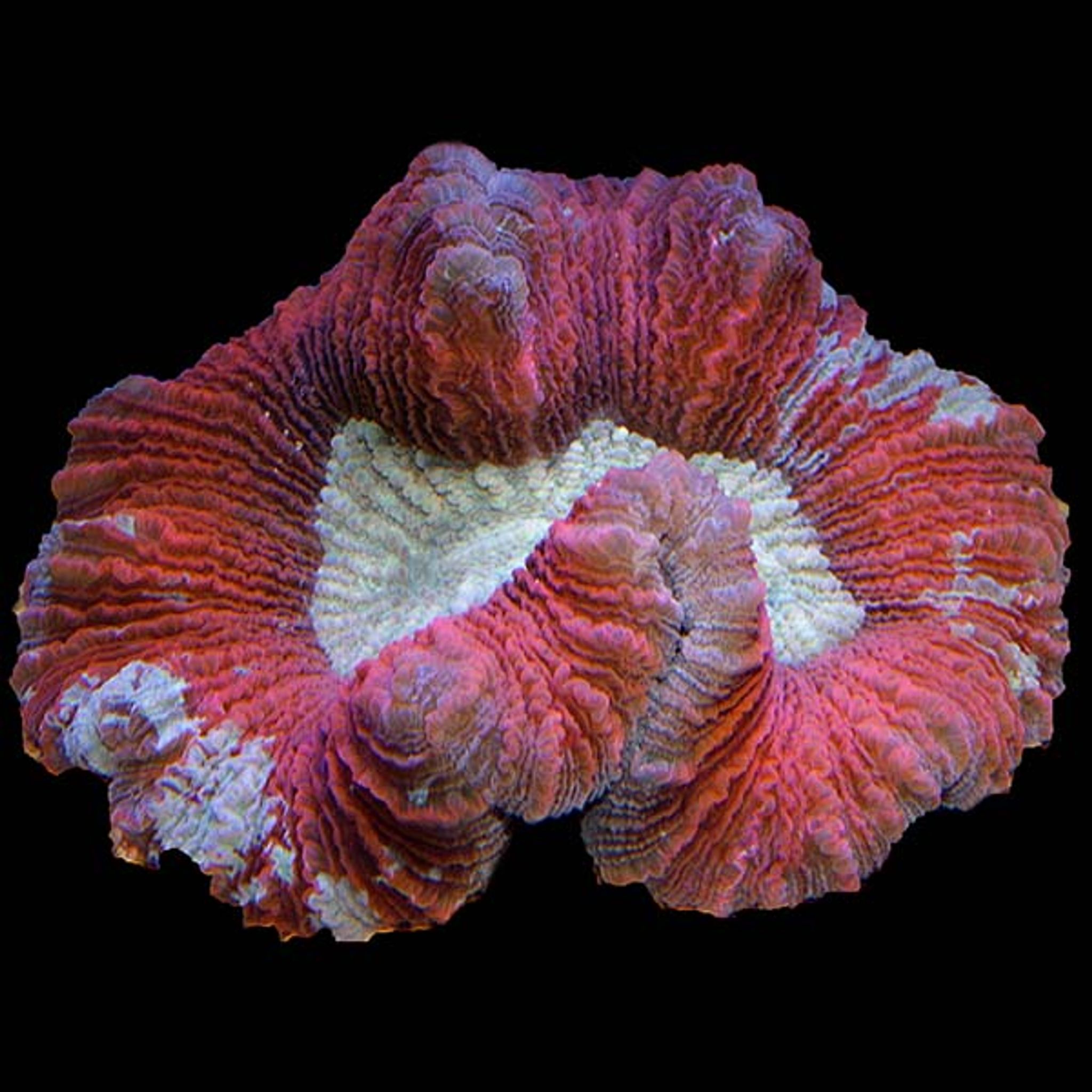

Trachyphyllia Care Guide: Lighting, Flow, Feeding and Placement
Trachyphyllia geoffroyi, the open brain coral, has a reputation for being finicky, but most losses trace back to just two mistakes: too much light and too much flow. This guide walks through the light, flow, feeding, and placement settings that keep this free-living LPS stable, plus how to spot trouble before it becomes tissue loss.
What Is Trachyphyllia?
Trachyphyllia is a large, fleshy, free-living large-polyp stony (LPS) coral. Unlike most corals, its skeleton is a loose, unattached "boat" or bowl shape that simply rests on the substrate rather than fusing to the rock. It's sold under color morphs including green, red, orange, and gray-brown, and it's commonly called the open brain coral.
A taxonomic note worth knowing: Wellsophyllia radiata, once sold as a distinct species, has been reclassified as a synonym or variant of Trachyphyllia geoffroyi. If you see "Wellsophyllia" at a shop, you're looking at the same care requirements described here.
Lighting: Aim Low, Not "Moderate to High"
The hobby has a long-running disagreement on light intensity for this genus. Older beginner guides suggested "moderate to high" light under metal halides, but current consensus — and the safer default — is 50–100 PAR at the coral's placement, favoring the lower end of that range.
Treat the "moderate-high" advice as outdated. Trachyphyllia's fleshy tissue bleaches, retracts, and pinches inward under excess light, and recovery is slow even after you correct the mistake. Rather than chasing an exact PAR number, watch the coral itself:
- Full, puffy tissue extension during the day = happy
- Pale, shrinking, or receding tissue edges = too much light
- Strong green or red fluorescence typically shows up under actinic-heavy spectrum, which also happens to sit in the lower-intensity range this coral prefers
If you're moving a new specimen from bright retail lighting, don't drop it straight into its final low-PAR spot — ramp it down gradually (see the acclimation section below).
Flow: Gentle and Indirect
Trachyphyllia wants low-to-medium, indirect or turbulent flow rather than a direct laminar jet. Enough movement to keep detritus and sand off the tissue is essential, but flow that's too strong keeps the coral balled up or leaves its edges ragged instead of fully inflated.
Some keepers reduce flow (or turn a pump off temporarily) during feeding so tentacles can extend fully to capture food — worth trying if your coral seems reluctant to feed under normal flow.
| Flow problem | What you'll see | Fix |
|---|---|---|
| Too strong / direct | Tissue never inflates, ragged or torn edges | Redirect pump, add a baffle, switch to random/turbulent flow |
| Too weak | Detritus and sand sit on the tissue, localized dead spots | Increase flow slightly; blow debris off with a turkey baster during water changes |
| Right amount | Full, rounded inflation most of the day | Maintain and monitor after any equipment changes |
Feeding
Trachyphyllia is photosynthetic and can survive on light alone, but growth and color are noticeably better with target feeding. Aim for 2–3 times per week; once-weekly is an acceptable minimum if the coral is otherwise well-lit and healthy.
Good foods include:
- Mysis shrimp
- Brine shrimp
- Chopped clam or krill
- Sinking LPS pellets or a gel food
Tentacles usually extend fully at night, or once lights dim and flow is reduced — that's the best window to feed. Use a turkey baster or a pipette to deliver food directly onto the extended tentacles rather than dropping it in the water column, where fast fish or shrimp can steal it before the coral closes around it. If tankmates are aggressive feeders, temporarily distracting them elsewhere (or feeding the display first) helps the coral actually get its share.
Placement: Sand Bed Only
This is the rule most commonly ignored by new keepers, and it's the one that causes the most damage. Trachyphyllia should always sit on an open sand bed, or a flat rock/frag plug resting on the sand — never wedged into rockwork or against a rough surface. The tissue abrades against hard surfaces as it inflates and deflates throughout the day, and that abrasion invites infection and tissue recession.
An older source allows placement near rock as long as clearance is generous, but the safer, simpler rule is: sand bed only, never against rock.
Because the tissue can inflate 2–3 times the size of the underlying skeleton, leave a full "wingspan" of open space on all sides — and keep it well clear of corals with sweeper tentacles or other aggressive stinging neighbors. If you're stocking a cleanup crew for the same tank, avoid heavy sand-sifting or burrowing species near a resting Trachyphyllia, since repeated disturbance can stress a coral that isn't built to be jostled.
Browse current specimens in LPS Hard Corals when you're ready to select one, and pair the tank with appropriate LED lighting that lets you dial intensity down for this genus rather than running it at full SPS-level output.
Acclimating a New Specimen: Light and Flow Ramp-Down
Retail tanks often run brighter than what Trachyphyllia prefers long-term. Rather than placing a new coral straight into its target 50–100 PAR spot, ramp down over 1–2 weeks:
- Days 1–3: Place on the sand bed in a lower, shadier area of the tank, well below full intensity.
- Days 4–7: If tissue is fully extending and holding color, move slightly closer to target light exposure, watching for any pinching.
- Week 2: Settle into the coral's permanent spot at 50–100 PAR, adjusting flow to low-to-medium turbulent rather than direct.
At every stage, judge by tissue extension and color, not the clock — if the coral looks stressed, hold at the current step longer before moving it.
Water Parameters: Stability Over Precision
Trachyphyllia tolerates a modest amount of nutrient — more than most SPS corals — but it still needs stable water more than it needs perfect numbers.
| Parameter | Target range |
|---|---|
| Temperature | 76–78°F (24–26°C) |
| Salinity | 1.025–1.026 SG |
| Alkalinity | 8–11 dKH |
| Calcium | 420–450 ppm |
| Magnesium | 1,300–1,350 ppm |
| Nitrate | ~5–10 ppm |
| Phosphate | ~0.05–0.1 ppm |
Favor small, frequent water changes over large infrequent ones. A sudden swing in any parameter — especially alkalinity or pH drifting alongside it — can cause the coral to retract for days and open the door to infection. Keep pH and alkalinity moving together rather than letting one shift while the other holds steady.
A properly sized protein skimmer helps hold nutrients in this stable, moderate range, particularly in a mixed reef with heavier feeding. Skimmers are typically rated by gallon range — compact models for roughly 40–125 gallons up through large units for 250–1,000+ gallons — and it's worth sizing above your actual tank volume for headroom rather than matching it exactly. You can compare options under Filters when planning equipment. A skimmer isn't strictly required in a well-maintained system, but it makes holding steady, moderate nutrients much easier.
Selecting a Healthy Specimen
Before buying, look for:
- Full tissue extension, not a pinched or deflated look
- No gaping "mouth" opening
- No bare patches of exposed skeleton
- A clean underside and mouth area, free of visible pests
Pests to Inspect For
- Flatworms — block light from reaching the tissue and cause irritation; a coral dip before adding to the display is the standard treatment.
- Gall crabs — burrow into the skeleton; usually just removed by hand during a thorough inspection, no dip required.
For a dip, follow the product's stated concentration and soak time (commonly a few minutes), swirl the coral gently to dislodge pests, and inspect the dip water and coral surface afterward for anything that fell off before moving it to quarantine or the display.
Fragging: Not Recommended
Trachyphyllia is an extremely slow grower, and a cut specimen can take years to regain its natural shape. Unlike branching SPS or many soft corals, fragging this species isn't a practical way to propagate it for a home hobbyist — it's best purchased and kept whole.
Growth and Long-Term Expectations
Because growth is slow, don't expect a Trachyphyllia to change shape quickly. Over months to years, a healthy specimen shows gradual skeleton elongation and can shift color intensity slightly with age or seasonal light changes — both are normal signs of a stable, thriving coral rather than something to fix.
Related Free-Living Corals
Several other LPS and fungiid-family corals share Trachyphyllia's sand-dwelling, low-light, low-flow lifestyle, which makes them worth knowing if you're drawn to this care style.
Fungiids: Cycloseris and Fungia scutaria
These free-living disc corals need similar low-to-moderate light and flow, live on sand, and grow slowly. Some species can actually "walk" short distances across the substrate over time. Feeding and placement rules largely mirror Trachyphyllia: open sand, generous clearance, and target feeding for best growth.
Heliofungia actiniformis (Long-Tentacle Plate Coral)
This species needs even more swimming room than a typical fungiid because its very long tentacles can sting neighboring corals well beyond its skeleton's footprint. It's also considered more sensitive overall, so it rewards the same conservative, low-light and low-flow approach — with extra clearance.
Herpolitha limax (Slipper/Tongue Coral)
An elongated free-living LPS that follows the same sand-bed placement logic as Trachyphyllia, with moderate light and flow needs. Target feeding benefits it in the same way — better growth and coloration compared to light alone.
Meandrina meandrites: A Different "Brain Coral"
Despite the shared "brain coral" nickname, Meandrina meandrites is a hard, attached coral rather than a free-living species. It can be mounted to rock and is generally less flow-sensitive than Trachyphyllia. If you see it in a "brain coral" search, don't apply the sand-bed, low-flow rules from this guide — its care is meaningfully different.
Common Mistakes and Troubleshooting
- Overlighting: bleaching, pale color, tissue shrinking from the skeleton edge — move to a lower shelf or the sand bed, or dim the fixture.
- Overly strong flow: tissue stays balled up or ragged — switch to indirect, turbulent flow.
- Placed on rock or wedged in a crevice: tissue tears and can become infected — relocate to open sand immediately.
- No feeding: the coral survives but stays small and dull — add 2–3 weekly meaty feedings.
- Detritus buildup on tissue: causes localized tissue death — increase flow slightly or clear debris with a turkey baster during water changes.
- Large, sudden water changes: trigger days-long retraction and infection risk — keep changes small and frequent.
- Skipping quarantine: flatworms and gall crabs go unnoticed until they've spread or damaged the skeleton — dip and inspect every new arrival.
Frequently Asked Questions
Is Trachyphyllia beginner-friendly?
Generally yes, in a stable, already-established tank. The most common risk for newer keepers is overlighting or running too much flow; it's actually more forgiving of moderate nutrients than SPS corals, but sensitive to sudden parameter swings.
Does Trachyphyllia need direct feeding to survive?
No — it gets baseline energy from its zooxanthellae like most photosynthetic corals. Growth and color are noticeably better with 2–3 weekly meaty feedings, though.
Can Trachyphyllia be glued to rock like other LPS?
No. It's a free-living species meant to rest loose on sand, and gluing or wedging it against rock risks abrasion and tissue damage.
Why did my Trachyphyllia's tissue shrink or bleach?
The most likely causes are too much light, too much flow, or a recent parameter swing. Dial back light and flow, stabilize water chemistry, and watch for gradual re-extension over days to weeks.
How much space does it need from other corals?
Give it a full clearance radius equal to its expanded size, since it can inflate several times its skeleton's diameter — plus extra distance from anything with sweeper tentacles.
Can you frag a Trachyphyllia?
Technically yes, but it's discouraged. Recovery is extremely slow, often taking years, and the coral's natural shape rarely returns to normal afterward.
What's the difference between Trachyphyllia and other "brain corals"?
True Trachyphyllia is a soft-fleshed, free-living LPS that rests on sand. Many other corals also called "brain coral," like Meandrina meandrites, are hard and attached with different flow and light tolerances — don't apply Trachyphyllia's care routine to them.
Does it need a protein skimmer?
Not strictly, in a well-maintained system. A properly sized skimmer makes it easier to hold nutrients in the stable, moderate range this coral prefers, especially in a mixed reef tank with heavier feeding.
Ready to add one to your system? Explore current specimens and other LPS options in FishyHub's Corals category.


