Torch Coral Care Guide: Lighting, Flow, Feeding and Placement
Torch coral is one of the most rewarding large-polyp stony (LPS) corals for a US reef tank, but the lighting and flow advice out there is all over the map. This guide sets one confident working range for PAR, flow, feeding, and placement, then covers spacing, troubleshooting, and how to tell a healthy "sleepy" torch from a stressed one.
What Is Torch Coral?
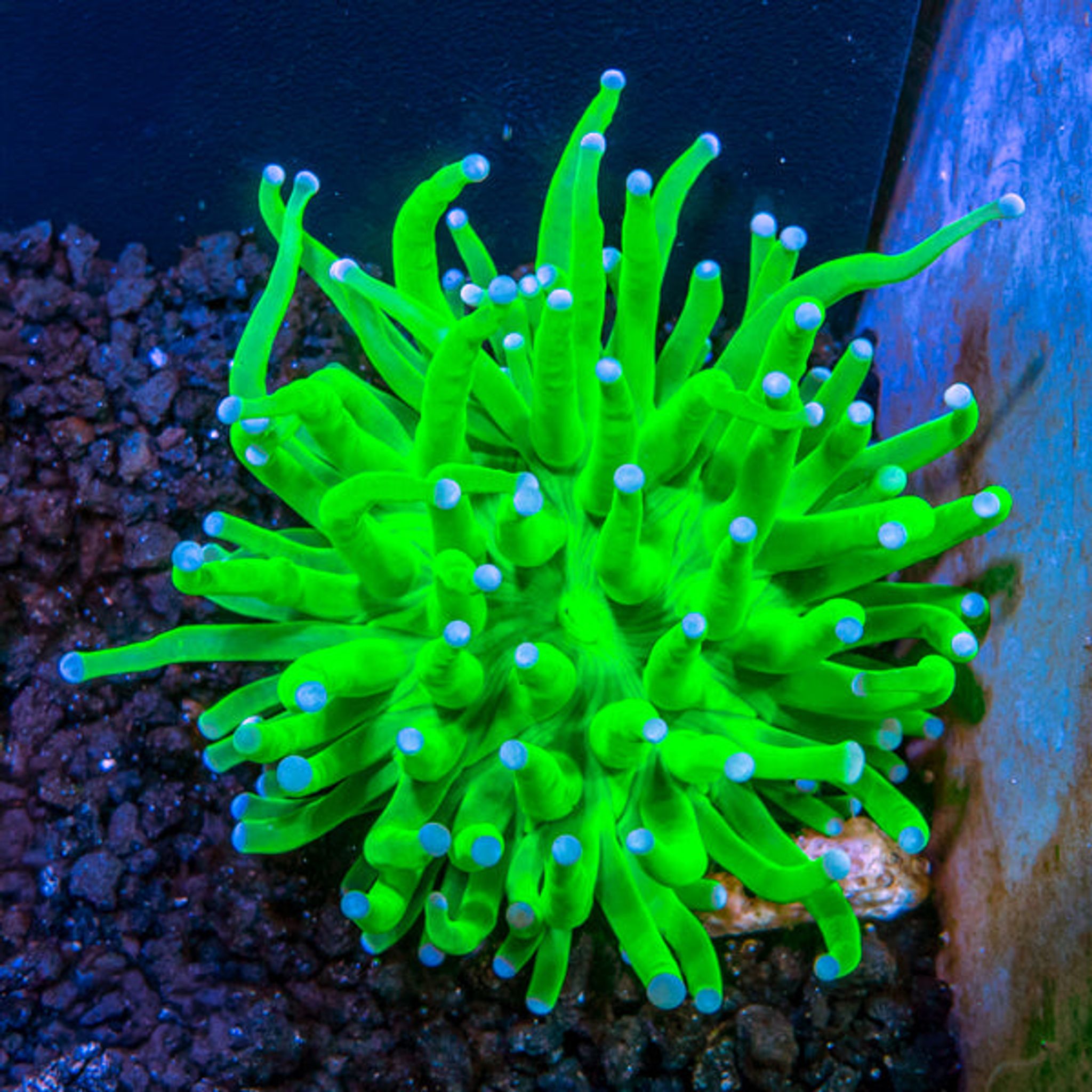
Torch coral belongs to the genus Euphyllia (some taxonomists place it under Fimbriaphyllia), a large-polyp stony coral known for long, fleshy tentacles that end in a rounded, glowing tip - the "torch." It's also commonly sold as trumpet coral or pom-pom coral, which causes some confusion: the true trumpet coral is actually a different genus, Caulastrea, with a distinct branching skeleton and shorter tentacles. If a listing calls something a "trumpet," check the photo and skeleton shape rather than relying on the name alone.
Torch coral is considered beginner-friendly LPS. Once acclimated, it tolerates a reasonable range of conditions, can live for decades in a stable system, and grows slowly to moderately through natural branching, adding new heads over time. You can browse live specimens in FishyHub's LPS Hard Corals selection when you're ready to buy.
Tank Size
A single head or small frag does fine in a nano tank of roughly 10-20 gallons (38-76 L). If you're planning ahead for colony growth, a 30-gallon (114 L) tank or larger gives you the room to maintain proper stinging distance from neighboring corals as the colony fills in.
Lighting: Finding the Right PAR
This is where sources disagree most - published PAR recommendations for torch coral range anywhere from about 30 to 200. Treat 75-150 PAR as the safe working range for most LED reef setups. Torches can survive lower light (common under T5 or fluorescent fixtures) or higher light above 200 PAR, but only when acclimated slowly - the number matters far less than the ramp-up speed.
Practical approach:
- Start a new frag at 75-100 PAR and hold it there for at least a week.
- Increase intensity gradually over 2-4 weeks, watching closely for tissue paling or bleaching, which signals you moved too fast.
- Under lower light, tentacles tend to extend more fully to capture available light and food particles.
- Under stronger light, coloration often intensifies, but full tentacle extension may be reduced.
- Both LED and T5/fluorescent lighting work well; a blue-shifted spectrum tends to bring out the coral's best fluorescent colors.
| Light Source | Typical PAR Range | Notes |
|---|---|---|
| T5/fluorescent | 30-80 | Gentler ramp, good for shaded placements |
| LED (moderate intensity) | 75-150 | Recommended default working range |
| LED (high intensity) | 150-200+ | Only for slow-acclimated, established colonies |
Flow: Quality Over Raw Strength
Flow intensity is another point of disagreement - some sources call for moderate-only flow, others push for moderate-to-strong. The resolution is to prioritize flow quality over sheer power. A moderate, randomized/turbulent flow is the safer default for beginners; experienced keepers can push stronger flow as long as tentacles still extend fully without folding or whipping around.
What good flow looks like in practice:
- Indirect and turbulent, not a single laminar jet aimed at the coral.
- Enough movement to gently sway tentacles, shed mucus and debris, and keep detritus from settling near the base.
- Never so strong that it folds the tentacles, whips them around, or keeps the polyp retracted.
To build a randomized pattern at home, run two small powerheads or wavemaker heads on alternating or pulsing modes pointed across each other (not directly at the coral) so the water column gets crisscrossing turbulence rather than one steady current. Avoid dead spots behind rockwork near the torch's base - stagnant water there invites brown jelly disease - and avoid blasting the polyp directly, which causes tissue damage and prolonged retraction.
Feeding
Torch coral gets most of its energy from photosynthetic zooxanthellae, so feeding is optional for survival - but supplemental feeding noticeably improves growth rate and coloration. Feed small meaty foods:
- Mysis shrimp
- Enriched brine shrimp
- Chopped krill or seafood
- Fine particulate or pellet LPS foods
1-3 times per week is a reasonable middle ground. Feeding more often accelerates growth but raises the risk of brown jelly disease and water-quality issues unless flow and skimming are strong enough to compensate. Target- or spot-feed using a turkey baster or pipette, releasing food gently onto or near the tentacles. A healthy, hungry torch will curl its tentacles inward around the food - a clear, visible feeding response. Never overfeed; uneaten food fouling the water is a leading trigger for brown jelly disease. You'll find suitable meaty and pellet options in FishyHub's Food & Supplements category.
Placement and Spacing
Mount torch coral on solid rock, not sand - sand contact can irritate the tissue. Position it in the lower to middle third of the tank, in a moderate light zone rather than the brightest top-shelf real estate, unless the coral is already well-acclimated to high light. Choose a stable rock ledge with open space around it for the colony to expand outward.
Spacing is critical because Euphyllia carry a strong sting and extend long sweeper tentacles - especially at night, well beyond their daytime reach - that can kill less aggressive neighboring corals. Leave a minimum of 6-8 inches (15-20 cm) from any neighbor, and up to 10+ inches (25+ cm) for larger colonies. Plan for future growth: a healthy frag can develop into a multi-head colony within 1-3+ years, so size your spacing for where the colony is headed, not just its current footprint.
A practical aquascaping trick sources rarely mention: build isolated rock towers or islands for aggressive LPS like torch coral, rather than relying on linear distance across a single connected rockscape. An isolated perch limits how far sweeper tentacles can reach nearby corals even if the horizontal distance looks tight on paper.
Water Parameters
Stability matters more than hitting an exact number. A parameter that's slightly off but steady is safer than one bouncing within the "ideal" range.
| Parameter | Target Range |
|---|---|
| Temperature | 76-80°F (24-27°C) |
| Salinity (specific gravity) | 1.023-1.026 |
| pH | 8.0-8.4 |
| Alkalinity | 8-11 dKH |
| Calcium | 400-450 ppm |
| Magnesium | 1300-1400 ppm |
| Nitrate | ~2-15 ppm |
| Phosphate | ~0.03-0.1 ppm |
On nitrate specifically, sources disagree: some push for near-zero, others specify a measurable range and warn that chasing zero nitrate can itself stress LPS corals. Aim for a low but non-zero nitrate level rather than eliminating it entirely. Across every parameter, sudden swings - especially in alkalinity - are more dangerous than a number that's a bit high or low but consistent day to day.
Acclimation Timeline
A single combined schedule for a new arrival:
- Day 1: Drip-acclimate over 30-60 minutes to match salinity and temperature gradually.
- Day 1-2: Dip the coral in a coral-safe dip solution to screen for pests before it touches your display or quarantine tank.
- Days 1-7: Hold in quarantine/observation at 75-100 PAR and moderate flow, watching for pests, tissue recession, or unusual behavior.
- Week 2: Move to display at the same low PAR level; monitor extension and color.
- Weeks 2-4: Increase lighting gradually toward your target range (up to 150 PAR or higher), watching for paling at each step.
- Ongoing: Begin spot-feeding once the coral shows consistent tentacle extension, typically 1-2 weeks after full acclimation.
If you ever need to relocate an established torch, treat it like a fresh acclimation for lighting - move it during a lower-light period of the photoperiod if possible, and reduce intensity temporarily at the new spot for a few days even if the new location is technically the same PAR, since angle and spread of light can differ enough to stress the coral.
Healthy "Sleepy" vs. Stressed Torch
A torch that looks less extended isn't automatically in trouble. Distinguishing normal light-adapted behavior from real stress avoids a lot of unnecessary troubleshooting:
- Normal/light-adapted ("sleepy"): Tentacles are shorter and closer to the skeleton during peak lighting hours, especially under higher PAR; they extend fully again during dimmer morning/evening light or at night. Color remains vivid, and the polyp still responds to food or gentle disturbance by curling.
- Genuinely stressed: Tissue looks pale, stringy, or receding from the skeleton; the polyp stays closed for multiple days regardless of light cycle; there's visible tissue sloughing, a foul smell, or a brown, gelatinous appearance.
Handling and Fragging
Always wear gloves when handling torch coral. Its slime and nematocysts can irritate human skin, even though the sting generally can't penetrate it. When fragging, use a proper coral-safe saw rather than bone cutters - cutters tend to shatter the brittle skeleton instead of making a clean cut.
Sun Coral: A Related but Very Different LPS
Sun coral (Tubastraea) often comes up in the same LPS conversations as torch coral, but the two have almost opposite care needs. Sun coral is a non-photosynthetic LPS-adjacent species with an orange body and yellow tentacles, and it lacks meaningful zooxanthellae. That means it must be fed several times a week with small meaty foods, typically at night when its polyps open. Unlike torch coral, sun coral isn't aggressive toward neighbors, so it doesn't need the same wide stinging buffer. If you're shopping for LPS broadly, don't assume one feeding or spacing rule applies across the group - check the species first.
Common Mistakes and Troubleshooting
- Bleaching from fast light ramps: Placing a new frag directly under intense light without acclimating causes tissue paling or bleaching. Always start low and increase gradually.
- Direct powerhead blasting: Tentacles stay retracted and tissue can tear under a direct jet. Redirect flow to be indirect and turbulent.
- Underestimating future spacing: Placing corals too close together, or misjudging how large a colony will get, leads to "coral warfare" - stung, receding neighbors.
- Overfeeding or feeding into dead spots: The leading trigger for brown jelly disease, which can consume tissue within 24-48 hours if untreated. Isolate the coral, remove affected tissue, and treat immediately with an appropriate coral treatment product.
- Chasing "perfect" numbers: Instability, especially in alkalinity, causes more stress than a parameter that's slightly off but steady.
- Polyp staying closed for days: Check flow direction, recent parameter shifts, nearby stinging neighbors, pests at the base (flatworms, boring pests), or a recent lighting change. Change one variable at a time and observe before making another adjustment.
- Polyp bailout: The coral detaches its tissue from the skeleton as an extreme stress response, usually linked to unstable parameters, ammonia or nitrate spikes, or physical injury. Investigate water quality first.
- Handling without gloves or using bone cutters to frag: Causes skin irritation and shattered skeletons, respectively - use gloves and a coral-safe saw.
For water testing kits and dip/treatment products to keep on hand for pest screening or a brown jelly outbreak, check FishyHub's Treatment category.
Frequently Asked Questions
Is torch coral good for beginners?
Yes. It tolerates a reasonably wide range of parameters once stable and doesn't require feeding to survive. The main caveat is its aggression - plan spacing carefully, so it suits a beginner willing to think through the aquascape in advance.
How often should I feed torch coral?
About 1-3 times a week with small meaty foods like mysis or chopped seafood. Feeding isn't mandatory for survival since the coral gets most of its energy from zooxanthellae, but it does improve growth and coloration.
Why is my torch coral not opening or extending?
Usually one of a few culprits: recent flow or lighting changes, unstable water parameters, a stinging neighbor too close by, or a pest at the base. Change one variable at a time and give it a few days to respond before adjusting anything else.
How far apart should torch corals be from other corals?
At least 6-8 inches (15-20 cm), and 10+ inches (25+ cm) as colonies mature. This accounts for long nighttime sweeper tentacles that reach much farther than the daytime polyp size suggests.
What is brown jelly disease and how do I treat it?
It's a fast-moving, necrotic infection that appears as brown, gelatinous tissue, often triggered by overfeeding or poor flow. Treat immediately by isolating the coral, removing affected polyps, applying a dip, and monitoring daily - it can kill a colony within 1-2 days if ignored.
Can torch coral sting fish or hurt people?
It can sting and kill less aggressive corals nearby, and its slime may irritate human skin, so gloves are recommended when handling it. It doesn't harm fish and generally can't penetrate human skin.
What lighting is best for torch coral color?
Moderate PAR, roughly 75-150, paired with a blue-shifted spectrum tends to bring out the best fluorescent colors. Too much light causes paling or bleaching; too little limits coloration and encourages more tentacle extension instead.
Ready to add one to your reef? Browse live, quarantined-ready specimens in FishyHub's Corals category and pair your purchase with the lighting and flow gear covered above.

