Tiger Barb Care Guide: Tank Size, Diet, Water Parameters and Temperament
Tiger barbs get a reputation as fin-nippers, but most of that behavior comes down to two fixable variables: how many you keep and how much room they have. This guide covers the tank size and group size math, water parameters, diet, breeding, and disease prevention you need to keep a school of tiger barbs calm, colorful, and healthy.
Species Snapshot
Tiger barbs (Puntigrus tetrazona, formerly classified as Puntius or Barbus tetrazona) belong to the Cyprinidae family and originate from fast-flowing streams in Sumatra, Borneo, and other parts of Southeast Asia. That stream habitat explains a lot about their care: they're active, current-loving swimmers that do best in groups, not the sedate community fish some buyers expect.
- Adult size: about 2.5–3 inches (6–8 cm)
- Lifespan: roughly 5–7 years, up to 10 with excellent care
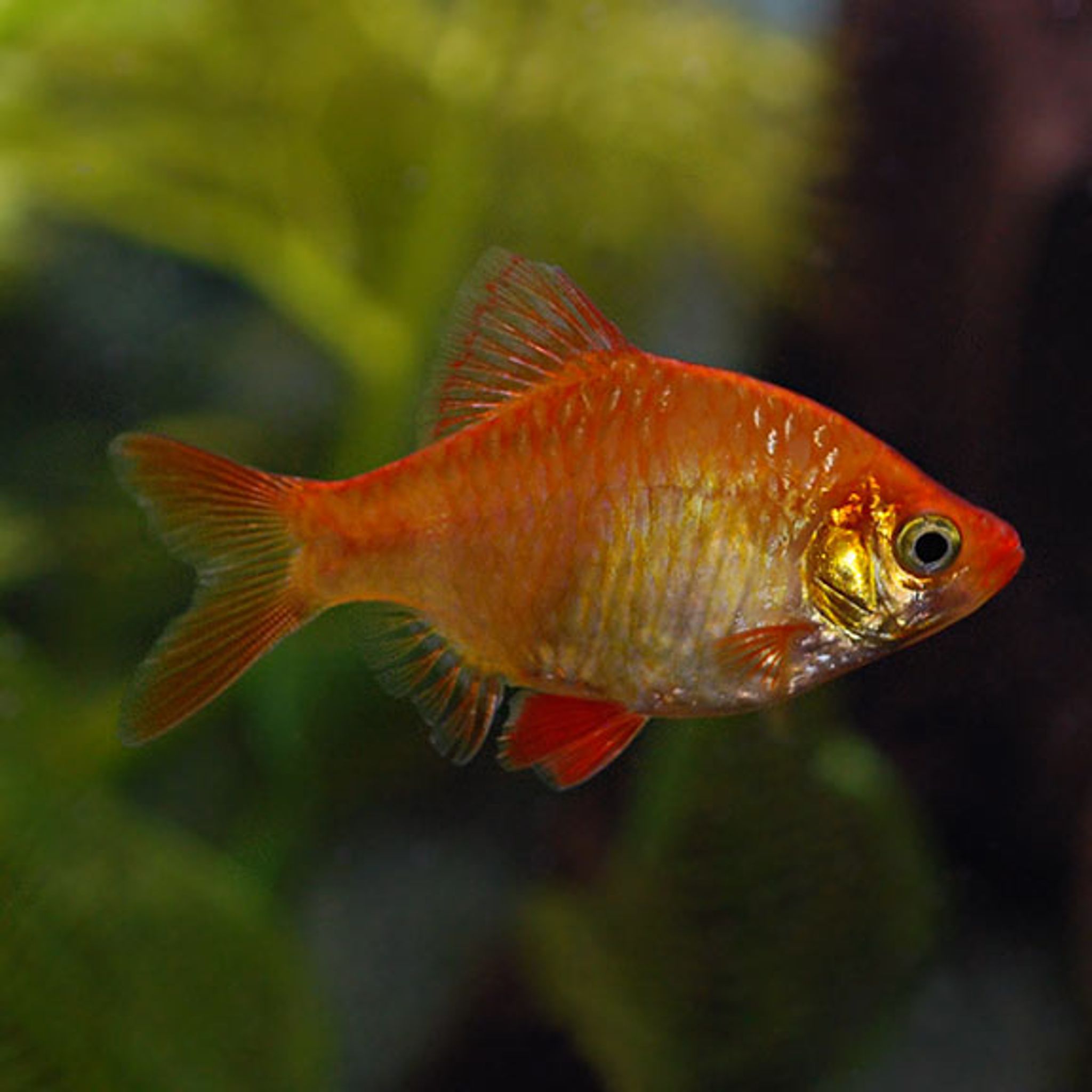
- Color variants: wild-type (orange body with black bars), green tiger barb, and albino/gold tiger barb — all share identical care requirements
Tank Size: Settling the 20-Gallon vs. 30-Gallon Debate
This is where most care sheets leave readers guessing. Here's the reconciliation: 20 gallons (76 L) is an absolute floor, workable only for a small group of 5–6 in a mature, well-filtered tank with light stocking otherwise. 29–30 gallons (110–114 L) is the practical starting point for anyone who wants a full, stable school without needing to upgrade within a year.
The gap between those numbers isn't sources disagreeing on biology — it's the difference between a bare minimum and a comfortable long-term setup. Tiger barbs are active swimmers that need open lanes, and a cramped 20-gallon tank concentrates territorial disputes even when the school size is technically adequate.
Stocking formula: start with 29–30 gallons for a base group of 5–6, then add roughly 3 gallons per additional barb beyond that. A school of 10 barbs, for example, points toward something closer to 40–42 gallons.
Group Size and Sex Ratio
- Minimum: 5–6, never fewer
- Ideal: 8–12 or more
- Sex ratio: aim for more females than males, roughly 2:1 to 3:1
Larger schools redirect nipping energy inward — barbs sparring with barbs — rather than outward at tankmates. A skewed sex ratio matters for the same reason: males chase females and each other for dominance, and spreading that behavior across more females dilutes how much any single fish absorbs. Buying only 2–4 tiger barbs is one of the most common mistakes new keepers make, and it almost guarantees bullying because the group is too small to distribute the pecking order.
Water Parameters Deep-Dive
Tiger barbs are more forgiving than many tropical community fish, but stability matters more than hitting an exact number.
| Parameter | Acceptable Range | Ideal Target |
|---|---|---|
| Temperature | 65–82°F (18–28°C) tolerated | 75–79°F (24–26°C) |
| pH | 6.0–8.0 | 6.0–7.0 |
| General hardness (GH) | 4–20 dGH | Up to ~10 dGH |
| Ammonia | 0 ppm always | 0 ppm |
| Nitrite | 0 ppm always | 0 ppm |
| Nitrate | Under 40 ppm | ~20 ppm or lower |
| Filter turnover | 4–6x tank volume/hour | Moderate-to-strong current |
| Water change | 10–30% weekly | 25–30% weekly |
Why Tiger Barbs Tolerate Cooler Water
Tiger barbs come from hill-stream and subtropical habitats, not true lowland tropics, which is why some sources note tolerance down to 65–70°F. In practice, that means a heater isn't strictly mandatory in a warm room, and a brief unheated cold snap is less dangerous for tiger barbs than it would be for many tropical staples. That said, a heater set to 75–78°F is still the better call for most US homes, because consistent temperature — not just an acceptable range — is what keeps stress and aggression low.
The pH Question
Cited ranges run from 7.0 up to 8.0 on the upper end, and tiger barbs will survive across that whole span. But they display their best color and settle into the calmest behavior in the slightly acidic to neutral 6.0–7.0 zone. Don't chase a specific pH number with additives; a stable 7.2 beats a swinging 6.5.
Diet
Tiger barbs are omnivores with a hearty appetite. Build the diet around:
- A quality flake or micro-pellet as the daily base
- Frozen or live protein 2–3 times a week: brine shrimp, bloodworms, daphnia
- Occasional blanched vegetables: zucchini, spinach, or lettuce
Feed 1–2 times daily, offering only what the school clears in 2–3 minutes. Overfeeding is a common mistake — leftover food fouls water quality and can lead to bloating, both of which increase stress-driven aggression down the line. FishyHub's frozen and freeze-dried food selection under Food & Supplements covers most of these protein options if you want variety beyond flake.
Temperament and Fin-Nipping: Causes and Fixes
Tiger barbs are semi-aggressive, and yes, they nip fins. But that reputation is largely a function of school size and tank size, not innate malice. An undersized group with nowhere to redirect its energy will target the nearest slow, long-finned fish instead.
Common causes of fin-nipping, in order of impact:
- Too few barbs (fewer than 5–6)
- Cramped tank space
- Housing with the wrong tankmates
- Unstable or poor water parameters
- Boredom — lack of plants, current, or feeding variety
The fix order: increase the group size first, then increase tank size if you haven't already, then re-evaluate tankmates. Water instability compounds all of this — sudden temperature or pH swings during water changes do more damage to temperament than a parameter that's slightly off but steady.
Tank Mates to Avoid
- Bettas
- Angelfish
- Fancy guppies
- Other long-finned or very slow-moving fish
Good Tank Mates
- Zebra danios and other fast swimmers
- Other robust barb species (cherry, gold)
- Rainbowfish
- Larger tetras
- Corydoras and other bottom-dwelling loaches
- Plecos
Décor and Enrichment
Dense planting (live or artificial) combined with open swimming lanes gives the school both cover and room to move. Add driftwood or rocks for shelter, and consider dim or tannin-tinted water — it can mute the visual triggers that spark aggression, though this is optional rather than essential. Current from your filter output doubles as enrichment: these are stream fish, and a moderate flow gives them something to work against instead of idling and squabbling.
Introducing Tiger Barbs to an Established Tank
If you're adding tiger barbs to a tank that already has residents, quarantine new arrivals for 2–4 weeks before introduction to catch disease early. Introduce the full school at once rather than trickling fish in over weeks — arriving together prevents an established pecking order from forming against later additions, and it's gentler on existing slow-moving tankmates that haven't had time to build a hierarchy with the barbs.
Signs of a Healthy Tiger Barb (vs. Stress)
| Healthy | Stressed |
|---|---|
| Active schooling behavior | Isolating or hiding |
| Bold, high-contrast stripes | Pale or faded color |
| Steady appetite | Reduced or refused food |
| Upright, unclamped fins | Clamped fins |
| Clear eyes | Gasping at the surface |
Common Tiger Barb Diseases
Stress and unstable water are the root cause behind nearly every tiger barb health issue, which is why stable parameters and adequate group size double as disease prevention.
- Ich (white spot disease): the most common issue. Raise temperature gradually to 82–86°F (28–30°C) alongside medication to speed the parasite's life cycle.
- Fin rot: usually secondary to nipping injuries or poor water quality; treat the water first, medication second.
- Velvet: a fine gold or rust dusting on the skin; responds to similar heat-and-medication protocols as ich.
- Dropsy: a more serious internal infection, often linked to chronic poor water quality or overfeeding.
Catch symptoms early rather than waiting — a mild case treated promptly is far easier to resolve than one that's progressed. FishyHub's medication category under Treatment › Medication covers common ich and fin rot treatments if you need to isolate and treat.
Breeding Tiger Barbs
Tiger barbs are egg-scatterers that form temporary pairs rather than lasting bonds. Sexual maturity is usually cited anywhere from 6–7 weeks to 3–5 months depending on the source — a more reliable indicator than age alone is size and coloration: a plump, well-colored female and a slender, vividly striped male around 1–1.5 inches are ready to spawn regardless of exact week count.
Breeding setup:
- Separate 10–15 gallon breeding tank
- Sponge filter (gentle flow, no fry intake risk)
- Temperature 77–82°F (25–28°C)
- pH 6.0–7.0
- Fine-leaved plants like java moss to catch scattered eggs
Let a conditioned group pair off and spawn, then remove the adults immediately after egg-laying — tiger barbs will eat their own eggs given the chance. Eggs hatch in 24–48 hours, and fry become free-swimming around day 5. Start fry on infusoria or a liquid fry food, then move to baby brine shrimp once they're large enough to take it.
Tiger Barb Size and Growth
Adults reach about 2.5–3 inches (6–8 cm) regardless of color variant, though males tend to stay slightly slimmer and more intensely colored than females, who grow a bit rounder-bodied as they mature and carry eggs. Juveniles purchased at under an inch will reach adult size within several months on a good diet — plan your tank size around the adult footprint of the whole school, not the size they are at the pet store.
Barbs as a Family: Choosing the Right Barb for Your Setup
Tiger barbs aren't the only barb worth considering, and if the nipping reputation gives you pause, there are calmer relatives that share the same easy water parameters:
- Cherry barbs: more peaceful, smaller footprint — a better fit for small or mixed community tanks
- Gold and rosy barbs: peaceful, cooler-tolerant, similar hardiness to tiger barbs without the fin-nipping tendency
- Tinfoil and Denison barbs: much larger-bodied, need significantly bigger tanks — not a small-tank option
- Snakeskin barbs: peaceful temperament, similar size (~3 inches) to tiger barbs, same easy water range, and a solid beginner schooling fish for keepers who want the barb look without the aggression
Types of Barb Fish at a Glance
| Barb | Size | Temperament |
|---|---|---|
| Tiger barb | 2.5–3 in | Semi-aggressive, fin-nipper |
| Cherry barb | ~2 in | Peaceful |
| Gold barb | ~2.5 in | Peaceful, cooler-tolerant |
| Rosy barb | ~3 in | Peaceful, cooler-tolerant |
| Snakeskin barb | ~3 in | Peaceful, schooling |
| Denison barb | 5–6 in | Peaceful but needs a large tank |
| Tinfoil barb | 12+ in | Peaceful but needs a very large tank |
Decision framework: if your existing tank already houses bettas, angelfish, or other slow long-finned fish, skip tiger barbs and choose a peaceful barb instead. If you're building a dedicated fast-water community tank from scratch and can commit to 8+ fish in 30+ gallons, tiger barbs are a strong, colorful choice. Browse FishyHub's full barb selection to compare variants and other species side by side.
Common Mistakes to Avoid
- Buying only 2–4 tiger barbs instead of 8 or more from the start
- Housing them with bettas, guppies, angelfish, or other long-finned, slow fish
- Undersizing the tank even when the school size is correct
- Letting water changes slip and nitrate creep upward
- Causing sudden temperature or pH swings during maintenance
- Overfeeding beyond what's eaten in 2–3 minutes
- Mixing color variants without boosting overall numbers — anecdotally, green and wild-type barbs can sort into sub-groups and pick on each other unless the total school is large enough to absorb it
- Ignoring early ich or fin rot symptoms instead of treating promptly
Frequently Asked Questions
How many tiger barbs should be kept together?
At least 5–6 as an absolute minimum, with 8–12 or more being ideal. Bigger groups redirect nipping energy among the barbs themselves rather than toward other tankmates.
What size tank do tiger barbs need?
Twenty gallons (76 L) is the absolute floor for a small group of 5–6 in a mature, well-filtered setup. Twenty-nine to thirty gallons (110–114 L) is the recommended practical starting size, with roughly 3 additional gallons per barb beyond the base group.
Are tiger barbs aggressive? Will they kill other fish?
They're fin-nippers, not killers. Aggression is manageable through adequate group size, sufficient tank size, and appropriate tankmate choice, and while they rarely cause fatal injury, they can seriously stress slower or long-finned fish.
What is the ideal water temperature for tiger barbs?
75–79°F (24–26°C) is the sweet spot within a broader 65–82°F (18–28°C) tolerance range. Their subtropical, hill-stream origin means they handle cooler unheated setups better than most true tropical community fish.
What do tiger barbs eat?
They're omnivores that do well on a quality flake or micro-pellet base, supplemented with frozen or live protein like brine shrimp and bloodworms plus occasional blanched vegetables. Feed 1–2 times daily, only what's cleared in 2–3 minutes.
Can tiger barbs live with bettas or guppies?
It's not recommended. Long, flowing fins and slow, deliberate movement make bettas and fancy guppies frequent targets for nipping.
How do you breed tiger barbs at home?
Set up a separate 10–15 gallon breeding tank with warm, slightly acidic water and fine-leaved plants, then let a conditioned group pair off to scatter eggs. Remove the adults immediately after spawning to prevent them from eating their own eggs.
What diseases are tiger barbs prone to?
Ich (white spot), fin rot, velvet, and dropsy are the most common issues, and nearly all trace back to stress from unstable water parameters or an undersized school. Stable parameters and adequate group size are the best prevention.
Ready to start your school? Browse live tiger barbs and compatible tankmates in FishyHub's Freshwater Livestock category to plan your full stocking list before you buy.

