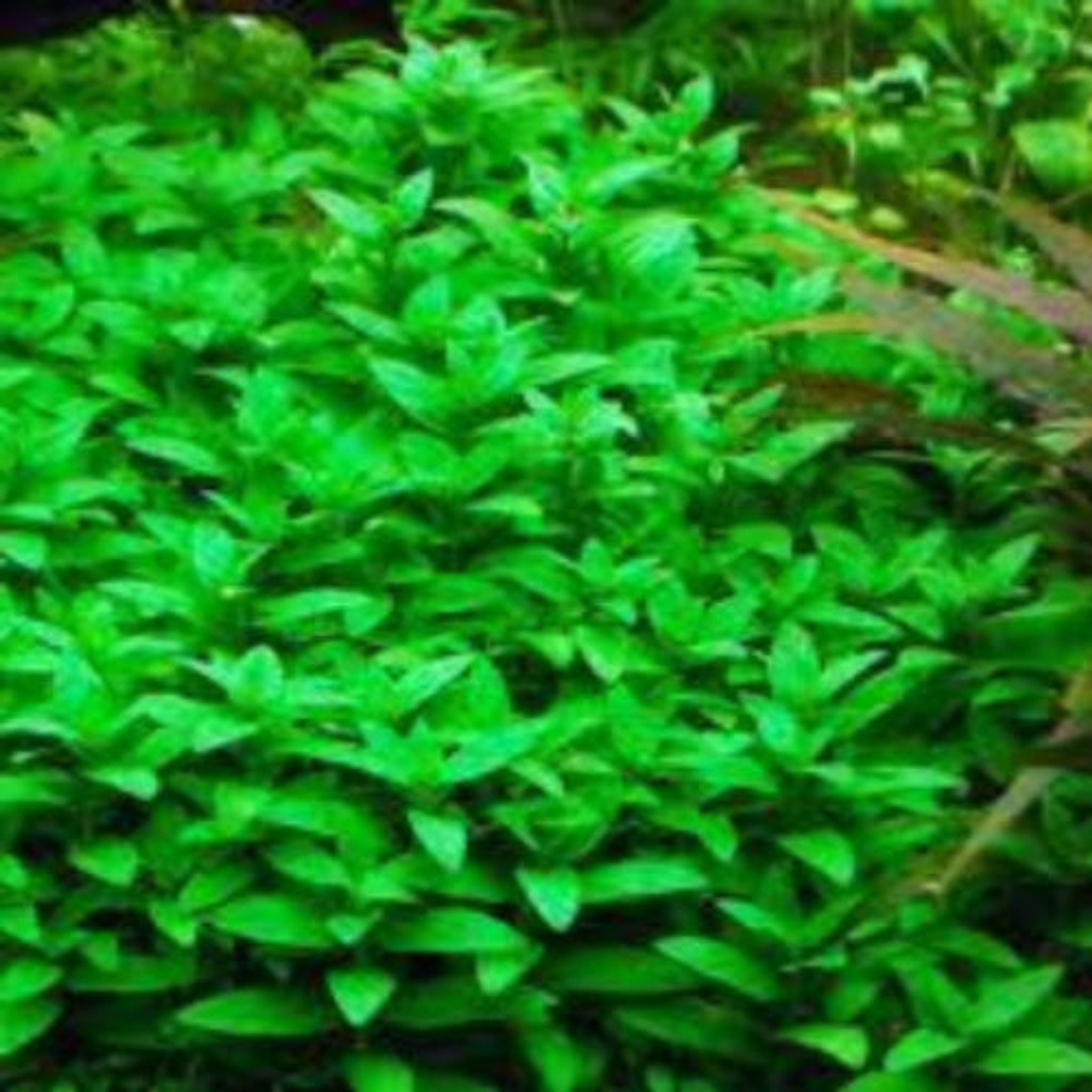
Staurogyne Repens Care Guide: Light, CO2, Substrate and Growth Tips
Staurogyne repens is one of the most forgiving low-growing stem plants available for a planted community tank, tolerating a wide range of light, CO2, and water conditions while still forming a dense foreground carpet or midground clump. This guide covers exactly what it needs — lighting level, CO2 status, substrate choice, planting depth, and trimming technique — so you can get compact growth instead of tall, leggy stems.
What Is Staurogyne Repens?
Staurogyne repens is a compact stem plant native to South America, sold widely as a foreground carpeting option or a low midground filler. Unlike true carpeting mosses or rhizome plants that spread as a mat, it is a rooted stem plant: each shoot grows upright leaves in tight rosettes and sends out side shoots and runners that eventually knit together into a carpet-like layer.
That structural difference matters for care. Because it roots and grows individual stems rather than crawling along a rhizome, it responds well to root-zone nutrition and benefits from a fine substrate that its shallow root system can penetrate easily.
Difficulty level: beginner-to-intermediate. It's one of the more forgiving carpet-style plants because it tolerates a broad parameter range and doesn't strictly require CO2 injection to survive — though it does reward more effort with denser, faster growth.
Lighting Requirements
Staurogyne repens needs medium to fairly high light intensity — roughly 30–50 PAR at the substrate surface for hobbyists using a PAR meter. If you don't have one, aim for a fixture description in the medium-to-high range rather than a low-light "basic" unit.
- Photoperiod: about 8–11 hours per day, with 10 hours as a good target for most tanks.
- Placement: position the plant where light reaches the substrate directly, not shaded under taller plants or hardscape.
- Timer: run your lighting on a timer to keep the photoperiod consistent — long, inconsistent photoperiods invite algae without actually helping the plant.
Insufficient light is the single most common reason this plant fails to carpet. When light is too weak, stems stretch upward and space out their leaves in a leggy, reaching pattern instead of staying low and dense. If you see this, raise the fixture's intensity, lower it closer to the water surface, or move the plant to a brighter zone of the tank.
Lighting for Nano and Small Tanks
Nano tanks need proportionally strong but well-diffused light, since compact fixtures often sit very close to the substrate. A small, adjustable LED fixture with a built-in timer lets you dial in intensity without overpowering a small water volume — overpowering a nano tank accelerates algae far faster than in a larger volume, so start on the lower end of your fixture's range and increase gradually. You can browse compact LED options in FishyHub's LED lighting category when setting up a nano planted tank.
Does Staurogyne Repens Need CO2?
No — Staurogyne repens is genuinely CO2-optional. It adapts well to low-tech, no-CO2 tanks and will still grow and spread, just more slowly. That said, supplemental CO2 (pressurized, liquid carbon, or CO2 tablets) noticeably speeds growth, tightens leaf spacing for a denser carpet, and reduces the appearance of nutrient-deficiency symptoms.
If you do add CO2, pair it with a fertilization routine. Faster growth from added CO2 increases the plant's nutrient demand — CO2 alone without adjusting fertilizer dosing can trigger deficiencies rather than prevent them.
Substrate and Planting Depth
Because Staurogyne repens has a thin, shallow root system, substrate texture matters more than for many other plants. Fine sand or small gravel is important so the roots can anchor and spread without fighting coarse, chunky material.
For the best color and density, a nutrient-rich substrate — either a soil-type planted substrate or an inert substrate with a nutrient layer capped by gravel or sand — gives noticeably better results than plain gravel alone. It's a root feeder, so even in a low-tech, no-CO2 tank, root tabs or an enriched base layer make a real difference in growth rate and leaf color.
Choosing Between Aquasoil and a Capped Nutrient Layer
| Setup goal | Recommended substrate approach | Why it fits |
|---|---|---|
| High-tech tank with CO2, want fastest growth | Nutrient-rich aquasoil as the main substrate | Buffers pH slightly acidic, releases nutrients steadily, ideal with CO2-driven growth demand |
| Low-tech tank, no CO2, want simplicity | Inert gravel or sand + root tabs | No pH swings, easy to maintain, feeds the roots directly where needed |
| Want the look of sand/gravel but better fertility | Thin nutrient base layer capped with 2 inches of gravel or sand | Keeps a clean substrate surface while feeding roots below it |
FishyHub stocks both directions — a soil-type planted substrate under Substrate › Soil and fine gravel or sand options under Substrate › Gravel & Sand — so you can match the substrate to whether you're running low-tech or high-tech.
Planting Depth
Bury stems shallow: about 1/2 to 3/4 inch (1.3–2 cm) into the substrate — just deep enough to anchor the stem, shallow enough that the lower leaves stay above the substrate line. Planting too deep and burying lower leaves is a common mistake that causes stem rot at the base.
Spacing and Density
Start with roughly one stem per 2–3 gallons of tank volume for a natural, gradual fill-in. If you want a faster carpet and don't mind buying more stems, plant tighter at 2–3 inches apart. Overcrowding stems too tightly wastes plants, though — moderate spacing plus patience for side shoots to fill gaps is usually the more cost-effective route.
Water Parameters
Staurogyne repens is broadly tolerant, which is part of why it works across so many tank styles:
| Parameter | Tolerated range | Best-growth target |
|---|---|---|
| Temperature | 68–86°F (20–30°C) | Warmer end grows faster |
| pH | 6.0–8.0 | 6.5–7.0 |
| General hardness | Roughly 1–10 dGH | Mid-range is fine |
On pH, sources vary — some list a broad 6.0–8.0 tolerance, others tighten the ideal to 6.0–7.0. Treat 6.0–8.0 as the range it will survive in, but target 6.5–7.0 if you want the best growth rate and color.
Tank Size
Staurogyne repens works from nano tanks up, but most guidance points to 10 gallons as a comfortable starting point for beginners, since it gives more stable parameters and easier trimming access. It can absolutely be used in smaller nano setups with attentive light and nutrient dosing — just expect less margin for error.
Growth Rate and What to Expect
Growth is slow to moderate. This plant can go weeks without needing a trim, which makes it low-maintenance once established, but it also means patience is required for a full carpet — commonly several weeks to a couple of months depending on your light intensity, CO2 use, and fertilizer routine.
Emersed-to-Submersed Transition ("Melt")
Most Staurogyne repens sold to hobbyists is grown emersed (out of water) at the nursery stage. After you plant it underwater, expect some lower leaves to melt or die back over the first one to two weeks as the plant adjusts. This is normal — don't panic and don't pull the plant. Fresh, more rounded submersed-form leaves typically follow shortly after.
Fertilization
Because it's a substrate feeder, root tabs are a high-value addition even in a low-tech tank. Pair them with a liquid macro/micro fertilizer — especially iron — if you're running higher light or CO2, since faster growth pulls through nutrients faster.
Watch the leaves for feedback:
- Pale, faded, or yellowing leaves — usually a nutrient deficiency; add root tabs or increase liquid dosing.
- Healthy leaves — should stay a rich green with tight leaf spacing along the stem.
Propagation and Trimming
Propagation is straightforward. Once a stem reaches roughly 3–5 inches tall, cut 1–2 inches or more off the top and replant the cutting directly into the substrate. Visible roots aren't required at the time of cutting — as long as leaves remain for photosynthesis, new roots typically form within days. The plant also sends out side shoots and runners on its own over time, which is the main mechanism by which a carpet fills in without replanting.
Trimming Technique for a Denser Carpet
To keep the plant low and full rather than tall and clumpy long-term, top the stems repeatedly rather than letting them grow unchecked. Cutting the growing tip encourages the stem to branch below the cut, producing two or more side shoots where there was one growing point. Repeated light topping over several months is what turns a scattering of individual stems into a genuinely dense carpet.
Common Mistakes and Troubleshooting
- Planting too deep — buries lower leaves and causes stem rot; stick to 1/2–3/4 inch depth.
- Insufficient light causing leggy, upward growth instead of a low mat — raise intensity or lower the fixture.
- Skipping root tabs in a low-tech tank and wondering why growth stalls or leaves look pale — this plant is a heavy root feeder regardless of CO2 status.
- Panicking over initial melt after planting emersed-grown stock — this is a normal transition; new growth follows within a couple of weeks.
- Overcrowding stems at planting — moderate spacing and letting runners fill in naturally is more cost-effective than dense initial planting.
- Poor water flow or clarity — reduced circulation and murky water block light penetration and slow growth even with an adequate fixture.
- Adding CO2 without adjusting fertilizer — faster CO2-driven growth increases nutrient demand, and skipping fertilizer dosing can trigger deficiencies that weren't present before.
Algae on Slow-Growing Leaves
Because Staurogyne repens grows slowly relative to strong lighting, older leaves can accumulate a film of algae before the plant produces enough new growth to replace them. To manage this:
- Improve water flow so nutrients and CO2 (if used) reach the plant evenly and light isn't blocked by suspended particles.
- Balance light intensity with nutrient dosing — strong light without matching fertilization is a common algae trigger.
- Manually wipe or trim older, algae-coated leaves rather than waiting for new growth to outcompete the algae on its own.
Compatibility With Fish, Shrimp, and Snails
Staurogyne repens is a rooted plant, not a floater, and works well in most community setups. It's generally safe with:
- Small community fish and tetras
- Most freshwater shrimp
- Corydoras and other peaceful bottom dwellers
Avoid pairing it with plant-eating or substrate-uprooting species — goldfish, silver dollars, and larger cichlids that dig will damage the roots or eat the foliage outright. Most snails are fine, but predatory or plant-eating species should be avoided. If you're stocking a planted community tank, FishyHub's shrimp category is a good match for a Staurogyne repens carpet, since most community shrimp graze on biofilm without disturbing the plant.
Similar and Companion Plants
Eriocaulon: A Higher-Difficulty Alternative
Eriocaulon species are often suggested as an alternative foreground plant, but they sit at a noticeably higher difficulty tier than Staurogyne repens. Eriocaulon generally needs soft, acidic water, strong light, and consistent CO2 and nutrient dosing to thrive — conditions that make it a poor first carpet plant. If you've struggled with Eriocaulon, Staurogyne repens is the easier plant to fall back on.
Lobelia Cardinalis: A Compatible Midground Companion
Lobelia cardinalis pairs naturally with Staurogyne repens because their care needs overlap closely. It wants moderate-to-high light, treats CO2 as optional-but-recommended for a compact submersed form, and needs a nutrient-rich substrate with 2–3 inches of depth. It grows 4–8 inches tall submersed with a similarly slow-to-moderate growth rate, making it a good taller backdrop behind a Staurogyne repens carpet.
Where It Fits Among Top Midground Plants
When comparing midground and foreground options by height, light demand, and how easy they are to trim and propagate, Staurogyne repens sits near the easy end of the spectrum:
| Plant | Typical height | Light need | Trimming/propagation ease |
|---|---|---|---|
| Staurogyne repens | 2–4 in (low carpet/clump) | Medium-high | Easy — top and replant cuttings |
| Cryptocoryne species | 4–12 in | Low-medium | Easy — mostly hands-off, divides on its own |
| Lobelia cardinalis | 4–8 in | Medium-high | Moderate — needs regular topping to stay compact |
| Dwarf hygrophila | 4–6 in | Medium | Easy — fast grower, frequent trims |
Using Staurogyne Repens in Aquascape Design
Beyond a true low carpet, Staurogyne repens also works as a mid-height accent when allowed to grow a bit taller and clumped rather than trimmed flat — a common technique in nature-style layouts where a soft, mounded texture is wanted between foreground carpet plants and taller background stems. Trimming frequency is what determines which look you get: frequent low topping keeps it as a carpet, while less frequent trimming lets it form a rounded clump.
Setting Up a Planted Tank for Staurogyne Repens
If you're building a new planted tank around this plant, a reliable setup sequence looks like this:
- Lay a thin nutrient-rich base layer, then cap it with about 2 inches of gravel or sand.
- Fill the tank gently — pour over a plate or plastic bag — to avoid disturbing the substrate layers.
- Plant stems at 1/2–3/4 inch depth, spaced per your target density.
- Set lighting to an 8–10 hour photoperiod on a timer.
- If going high-tech, add basic CO2 components: a cylinder, regulator, diffuser, and a drop checker to monitor CO2 levels visually.
- Dose liquid fertilizer weekly, adjusting for whether you're running CO2.
- Start with easier plants alongside it before adding more demanding species — Staurogyne repens is a good "next step up" plant once true beginner species are established.
Frequently Asked Questions
Does Staurogyne repens need CO2?
No. It grows successfully in low-tech tanks without CO2 injection, but adding CO2 speeds up growth and produces a denser, more compact carpet.
What is the ideal substrate for Staurogyne repens?
Fine sand or small gravel over a nutrient-rich base layer works best, or root tabs added to an inert substrate if you don't want to use aquasoil.
How deep should I plant Staurogyne repens stems?
About 1/2 to 3/4 inch into the substrate — enough to anchor the stem without burying the lower leaves.
How long does it take to form a full carpet?
Typically several weeks to a couple of months, depending on your light intensity, CO2 use, and fertilization routine, since it's a slow-to-moderate grower.
Why is my Staurogyne repens growing tall and leggy instead of spreading?
This is almost always insufficient light. Raise the PAR level, lower the fixture closer to the substrate, and trim the stems to encourage lateral branching.
How do I propagate Staurogyne repens?
Cut a few inches off the top of a mature stem and replant the cutting directly into the substrate. New roots typically form within days, even if none are visible at the time of cutting.
Can Staurogyne repens go in a nano tank?
Yes, provided the tank has adequate light for its small footprint and you keep close attention on nutrient dosing, since small water volumes shift quickly.
Is Staurogyne repens compatible with shrimp and snails?
Yes, it's compatible with most community shrimp and non-destructive snail species. Avoid species known to uproot substrate or eat soft plant leaves.
Once your lighting, substrate, and fertilizer routine are dialed in, Staurogyne repens is one of the more forgiving carpet plants to keep looking dense and healthy long-term. Browse FishyHub's substrate options to match a base layer to your setup before planting.

