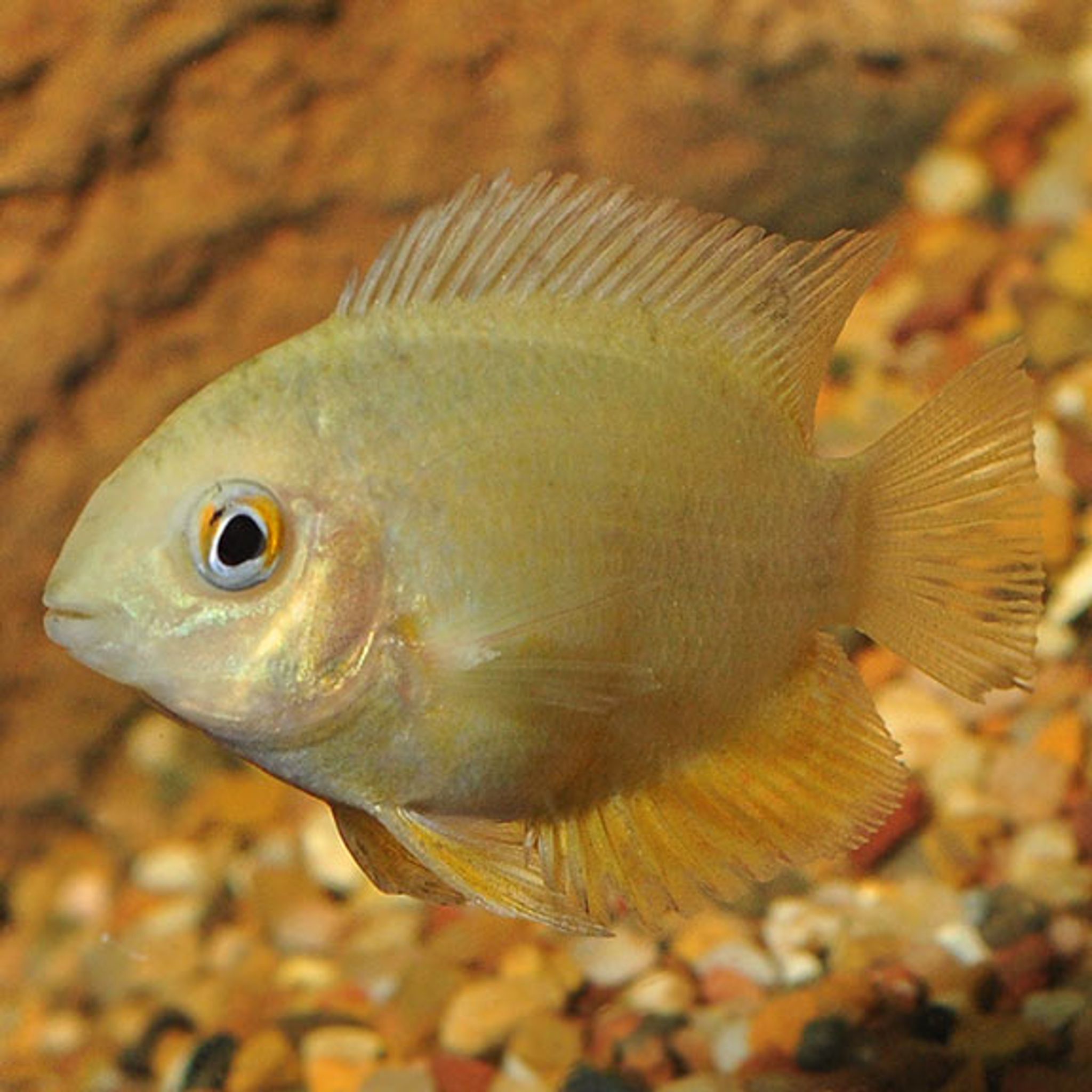
Severum Care Guide: Tank Size, Diet, Water Parameters and Temperament
Severums are large, deep-bodied South American cichlids that outgrow the "juvenile tank" they're usually sold in, so most buying mistakes trace back to underestimating adult size and bioload. This guide gives you the real gallon minimum, the workable temperature and pH range, a feeding routine, and a tankmate framework so you can plan the setup before the fish is in the bag.
Species Snapshot
The Severum belongs to the genus Heros, a group once lumped in with Oscars and other large cichlids because of a similar disc-shaped body plan. It's native to slow-moving rivers and floodplains across the Amazon and Orinoco basins, and decades of captive breeding have produced several distinct color forms.
- Adult size: roughly 7–8 inches, with some wild-caught lines reaching close to 10 inches.
- Body shape: deep-bodied and disc-shaped, similar in outline to a large angelfish but much thicker through the body.
- Lifespan: typically 5–10 years with consistent water quality and diet.
- Common color varieties: Green (the wild-type baseline), Gold, Red Shoulder/Redhead, Rotkeil (a bred hybrid with a bold red throat patch), and Turquoise/Electric Blue strains developed through selective breeding.
A Rainbow Severum isn't a separate species — it's a farm-bred color strain prized for heavier red-orange spotting across the body. Care requirements are identical to a standard Green Severum. Hybrid strains like the Rotkeil can also grow and behave a little differently than wild-type fish, so it's worth asking about a specific fish's lineage if you're comparing options.
Tank Size: How Big Is Big Enough
This is where a lot of guidance online undersells the fish. A Severum sold at 2 inches will not stay a 20-gallon fish, and the deep body plus heavy waste output means volume estimates based on length alone are too optimistic.
| Stocking plan | Recommended tank size | Notes |
|---|---|---|
| Single juvenile (temporary) | 40 gallons (151 L) | Outgrown within a year; not a long-term home |
| Single adult | 55 gallons (208 L) minimum | Realistic long-term baseline |
| Bonded pair | 75 gallons (284 L)+ | More if breeding behavior turns territorial |
| Community with tankmates | 90–125+ gallons (341–473+ L) | Scale up per tankmate species and count |
Sources disagree on the exact floor — some cite 40 gallons as workable, others insist on 55 for even a single fish. The practical answer: 55 gallons is the sensible long-term minimum for one adult, given how deep-bodied these fish get and how much waste they produce. Treat 40 gallons as a stepping-stone size for a juvenile, not an endpoint.
Just as important as raw volume: prioritize footprint over height. Severums are active, horizontal swimmers, so a long, wide tank with a large floor area serves them better than a tall, narrow one holding the same number of gallons.
A Simple Decision Framework
- One Severum: 55 gallons is enough, and a lone specimen is a completely valid, low-conflict stocking choice.
- A pair: budget 75+ gallons so both fish have separate territory to retreat to, especially once they start pairing off.
- A community setup: add capacity per tankmate rather than treating 75–90 gallons as a fixed ceiling — a handful of mid-sized dither fish and a bottom-dweller or two can push the realistic minimum toward 90–125 gallons.
Water Parameters
Severums tolerate a wider range than many care sheets suggest, but stability matters more than chasing an exact number.
- Temperature: 75–84°F (24–29°C), with 78–82°F as the narrower ideal band for everyday keeping.
- pH: 6.0–7.5 overall range. Wild-caught fish do best on the softer, more acidic end (6.0–7.0), but captive-bred Severums — which make up most of what's sold today — adapt well to slightly harder, near-neutral to mildly alkaline water. Aiming for 6.5–7.5 is the easiest target for most home tap water and gives you a stable long-term setup without chasing extreme softness.
- General hardness: roughly 2–15 dGH (soft to moderately hard).
- Ammonia and nitrite: 0 ppm, full stop — Severums are not more forgiving of a poorly cycled tank than any other fish despite sometimes being described as hardy.
- Nitrate: keep under 20–40 ppm through regular water changes.
Severums are messy, heavy eaters that generate significant bioload for their size. Weekly 25–30% water changes are a realistic baseline, not an occasional chore — skipping them is one of the fastest routes to dulled color and unexplained illness in this species.
Substrate, Decor, and Flow
- Substrate: fine sand is strongly preferred. Severums dig and sift through the substrate regularly, and sharp gravel can damage their mouths and fins over time.
- Decor: driftwood, smooth rocks, and caves give them structure and visual breaks. Hardy or floating plants work well, but softer-leaved species may get nibbled or uprooted during digging.
- Lighting: moderate to low is preferred over bright, high-output lighting.
- Flow: gentle to moderate current — these fish come from slow floodplain water, not fast-flowing streams, so avoid strong powerhead-driven turbulence.
Diet and Feeding
Severums are omnivores that lean slightly toward protein and animal matter.
- Staple: a high-quality cichlid pellet or flake formulated for omnivorous cichlids.
- Protein supplements: bloodworms, brine shrimp, mysis shrimp, and earthworms fed a few times a week.
- Plant matter: blanched zucchini, spirulina wafers, and peas round out the diet and support digestion and color.
- Frequency: feed 1–2 times daily, portioned to what the fish clear in 2–3 minutes. Some keepers prefer several smaller feedings instead of two larger ones — both approaches work fine for adults.
The real-world risk here is overfeeding, not underfeeding. A pellet-only diet with no variety, or portions too large for the tank's filtration to handle, leads to bloating, poor color, and nitrate spikes far more often than a fish going slightly hungry.
Temperament and Tankmates
Severums sit in an odd spot in cichlid-aggression discussions — some sources call them nearly peaceful, others lump them in with true aggressive cichlids. The realistic synthesis: mild-to-moderate cichlid aggression, more boisterous and curious than outright hostile, with a lot of variation between individual fish. Aggression tends to rise with breeding activity, crowding, or an undersized tank — not from baseline temperament alone.
Good tankmate candidates:
- Larger, robust dither fish: Congo tetra, silver dollars, larger gouramis, rainbowfish
- Bottom dwellers: plecos, corydoras
- Other moderately sized South American cichlids: keyhole cichlid, geophagus, festivum, angelfish (with some caution given size differences)
- Larger New World cichlids in big enough tanks: Jack Dempsey, Green Terror (large tanks only)
Avoid:
- Very small fish that can be eaten outright
- Slow-moving, long-finned fish that invite fin-nipping
- Highly aggressive New World cichlids that could out-compete a comparatively milder Severum
A Severum can also anchor an advanced, large-scale South American community — a 125-gallon-plus planted setup pairing Severums with Oscars and Discus is a workable combination, provided the tank is large, filtration is strong, and temperature and pH are dialed in for all three species. This is an advanced, large-footprint project, not a typical beginner build. You can browse suitable companions in FishyHub's American Cichlids and Discus selections when planning a mixed setup.
Related and Often-Confused Species
- Festivum cichlid (Mesonauta festivus): frequently discussed alongside Severums and sometimes mistaken for one. It's peaceful, mid-sized (5–6 inches), prefers 72–82°F and pH 6–7.5 in soft, tannic water, and makes a calmer companion or alternative species for a South American community tank.
- Flag, banded, and silver cichlid: these common names mostly refer back to the Festivum/Mesonauta group or closely related Cichlasomatine species, and the naming gets mixed up with Severums often. Their care parameters overlap closely with the Severum/festivum ranges above, so the confusion rarely causes a real husbandry problem.
- Pike cichlid (Crenicichla spp.): a genuinely different, more predatory South American cichlid — not to be confused with a Severum. Pike cichlids are far more aggressive and piscivorous, need a larger tank, and are an unsuitable tankmate for a Severum.
Sexing and Breeding
Sexing juveniles is difficult and largely unreliable. As adults, males typically develop longer, more pointed dorsal and anal fin extensions, sometimes a nuchal hump, and bolder color or gill markings, while females tend to be rounder-finned and slightly smaller.
Severums are monogamous, substrate-spawning pair formers. A bonded pair selects and cleans a flat surface, lays several hundred to a few thousand eggs, and both parents guard the eggs and fry biparentally. A dedicated breeding setup benefits from flat slate or rock, soft and slightly acidic water, and temperatures near 80°F. Fry start on infusoria before graduating to baby brine shrimp or microworms.
Buying Checklist: Don't Forget the Stand
A 55–125+ gallon tank filled with water, substrate, and rockwork can weigh 500 to 1,200+ pounds. Before setup day, confirm your stand is rated for the tank's full filled weight and that it sits on a level, structurally sound floor — this is a five-minute check that prevents a very expensive mistake. Browse tank and stand combinations sized for Severum-appropriate setups in FishyHub's Tanks & Stands category.
Common Mistakes to Avoid
- Keeping a Severum long-term in a 20–30 gallon "juvenile size" tank, which leads to stunted growth and increased aggression.
- Feeding only pellets with no variety, or overfeeding — both cause bloating, dull color, and nitrate spikes.
- Using sharp gravel instead of fine sand, which damages the mouth and fins as the fish digs.
- Mixing Severums with small or slow, long-finned fish that get bullied or eaten.
- Letting nitrate creep up from insufficient filtration or infrequent water changes — a top cause of "unexplained" illness or faded color.
- Mistaking normal digging, rearranging, or territorial flaring for illness or a sign the fish needs to be rehomed.
- Assuming juvenile coloration predicts the adult color variety — many color forms look nearly identical when young.
Frequently Asked Questions
How big of a tank does a Severum actually need?
Plan for 55 gallons minimum for one adult long-term. A pair needs 75+ gallons, and a community setup should scale up further based on the specific tankmates added.
Are Severums aggressive, and can they live with other fish?
They show mild-to-moderate cichlid aggression — more curious and boisterous than outright hostile — and do well with similarly sized, robust tankmates. Avoid tiny fish that can be eaten and highly aggressive cichlids that could out-compete them.
What is the ideal water temperature and pH for Severums?
Aim for 75–84°F (24–29°C) and a pH of 6.0–7.5, with moderate general hardness. Stability over time matters more than hitting one exact number, and captive-bred fish adapt well to a 6.5–7.5 range.
What do Severums eat?
They're omnivores that lean toward protein. Feed a high-quality cichlid pellet or flake as the staple, supplement with bloodworms, brine shrimp, or mysis shrimp, and add occasional vegetable matter like blanched zucchini or peas.
Can you keep just one Severum?
Yes. A lone Severum in a properly sized tank is a completely valid stocking choice, and some individuals are actually calmer without a tankmate. Pairs and groups simply need proportionally more space.
How can you tell males from females?
Adult males usually develop longer, more pointed dorsal and anal fins, sometimes a nuchal hump, and bolder markings. Sexing juveniles reliably is difficult and best left until the fish matures.
Is a Severum the same as a festivum or flag cichlid?
No. The festivum (Mesonauta festivus) is a related but distinct, generally more peaceful species, and "flag" or "banded" cichlid names mostly refer to that group rather than to true Severums. Care requirements overlap closely, but they aren't the same fish.
How long do Severums live and how big do they get?
With consistent care, expect a 5–10 year lifespan and an adult size of roughly 7–8 inches, occasionally larger in some wild-caught lines.
Ready to plan your setup? Explore Severums and compatible South American cichlids in FishyHub's Angelfish, Discus, Rams & Cichlids category.

