Serpae Tetra Care Guide: Tank Size, Diet, Water Parameters and Temperament
Serpae tetras are hardy, bright red schooling fish that do well in a 20-gallon long or larger tank at 72–78°F with a protein-rich diet. The catch is temperament: they are known fin-nippers. Keep them in a large group with fast, short-finned tank mates and they make an excellent, affordable first school.
Serpae Tetra Quick Reference
| Trait | Recommendation |
|---|---|
| Scientific name | Hyphessobrycon eques (older name H. callistus) |
| Other trade names | Red minor, jewel, callistus tetra |
| Adult size | 1.5–2 in (4–5 cm) |
| Lifespan | 5–7 years, sometimes longer |
| Minimum tank | 20 gal (76 L) for 6; 20-gal long or 29 gal (110 L) preferred |
| Group size | 6 minimum, 8–12+ better |
| Temperature | 72–78°F (22–26°C) |
| pH | 6.0–7.5 ideal (tolerates about 5.5–7.8) |
| Hardness | 4–18 dGH (about 70–320 ppm) |
| Ammonia / nitrite / nitrate | 0 / 0 / under 20 ppm |
| Temperament | Active, semi-aggressive, fin-nipper |
| Diet | Omnivore leaning micropredator |
Identifying Serpae Tetras
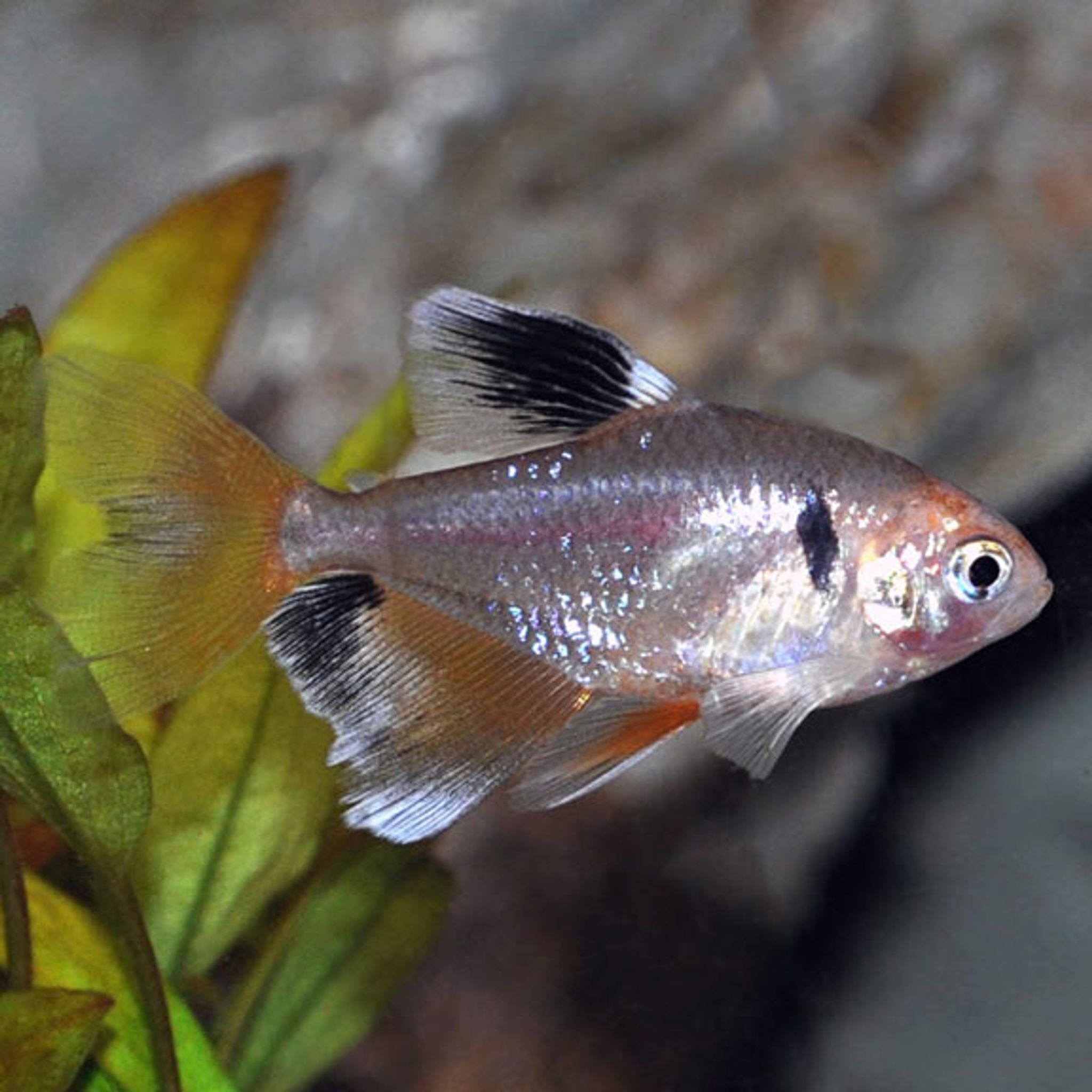
The serpae is a South American characid from the Paraguay, Guaporé and Amazon basins. Its body ranges from blood red to orange-red, with a black comma-shaped spot just behind the gill cover and a black dorsal fin tipped in white. It is one of the most widely sold tetras in the US.
You will also see long-fin and pale "platinum" or "white" varieties. Be careful with long-fins: their own schoolmates often nip those flowing fins, so they do best in a well-planted tank with a large group.
Sexing: males are slimmer, more intensely colored and have a darker dorsal fin. Females are rounder, especially when carrying eggs.
Serpae vs. Red Phantom vs. Colombian Tetra
Stores often mislabel these fish, so check before you buy.
- Red phantom tetra (H. sweglesi): paler and lacks the shoulder spot. It needs softer, cooler, more acidic water (about 4–8 dGH). It also nips but is more timid.
- Colombian tetra (H. columbianus): larger (about 2.5 in / 6 cm), with a blue body and red fins. Its temperament is similar, and it mixes well with serpaes in an active community. It prefers clean, flowing water at pH 6.5–7.5.
- Bloodfin tetras also get confused with serpaes. Across all of these, the shoulder spot and fin markings are the quickest way to tell them apart.
Tank Size and Stocking
Plan for 20 gallons minimum for a group of six. Floor length matters more than height because serpaes are fast, mid-water swimmers, so a 20-gallon long or 29-gallon is the better choice. Add roughly 2–3 gallons (8–11 L) per serpae beyond six.
Sample Stocking Plans
| Tank | Example stocking |
|---|---|
| 20-gal long (76 L) | 6–8 serpaes alone, or 6 serpaes plus a few bottom dwellers such as kuhli loaches |
| 29 gal (110 L) | 8–10 serpaes, 6 Corydoras, 1 bristlenose pleco |
| 40 gal (150 L) | 10–12 serpaes, a school of danios or another robust tetra, 6 Corydoras, 1 bristlenose pleco |
Stock gradually and watch nitrate.
Water Parameters
- Temperature: 72–78°F (22–26°C). Sources quote up to 83°F (28°C), but there is no reason to run a hot tank.
- pH: 6.0–7.5 is ideal.
- Hardness: 4–18 dGH, which is about 70–320 ppm GH on a US test kit.
- Ammonia and nitrite: 0 ppm. Nitrate: under about 20 ppm.
Captive-bred serpaes adapt to most US tap water as long as it is dechlorinated and stable. Stability beats chasing an exact pH number; constant adjustments stress fish more than a steady reading slightly outside the ideal band.
Flow and Temperature: What the Wild Tells Us
In Brazil and neighboring countries, serpaes live in shallow, heavily vegetated margins with tangled roots, often in mixed schools with other characins. Field notes describe cooler water (around 65–70°F / 18–21°C) and sometimes strong current, even though most care sheets recommend calm water. The practical takeaway: provide moderate flow with calm zones, dense planting and moderate temperatures rather than warm, still water.
Tank Setup
- Substrate: dark sand or fine gravel.
- Plants: dense planting around the edges with open swimming room in the middle.
- Decor: driftwood and roots for sight breaks.
- Light: floating plants or dimmer lighting. Tannins from leaves or driftwood are optional but deepen the red.
- Equipment: a filter rated for the tank and a heater with a thermostat.
- Lid: a tight cover, because serpaes can jump.
Tank Setup Checklist
- Tank and stand
- Filter
- Heater and thermometer
- Liquid test kit
- Dechlorinator
- Substrate, plants and decor
Run a fishless cycle for 4–6 weeks until ammonia and nitrite read 0, then stock gradually.
Keeping Serpaes on a Budget
A 20-gallon long kit, hardy plants and inexpensive, widely available fish make serpaes one of the most affordable first schools you can set up.
Maintenance
Change 25–30% of the water weekly, or at minimum 25–50% every other week, and vacuum the gravel during each change. Match the new water's temperature to the tank and always dechlorinate.
Diet and Feeding
Serpaes are omnivores that lean toward micropredator. Sources differ on whether to treat them as general omnivores or mostly carnivores; the balanced answer is a protein-rich prepared food plus frozen foods.
- Base diet: a quality micro-pellet or flake.
- Several times a week: frozen or live brine shrimp, bloodworms, daphnia and mysis.
- Color support: foods with astaxanthin help keep them red.
- Portions: feed small amounts 1–3 times daily, only what they finish in about 2 minutes.
Serpaes are fast and pushy at mealtime. Drop food at two spots at once so slower tank mates get their share. You can browse prepared and frozen-style options in FishyHub's food and supplements.
Temperament: Hardy but Nippy
Opinions range from "peaceful" to "semi-aggressive," and some sources even list bettas as tank mates. Treat serpaes as semi-aggressive and never house them with long-finned fish.
Nipping is worst in small groups and at feeding time. It is opportunistic, not predatory, and far milder than true "problem tetras" like the bucktooth tetra (covered below).
Normal Sparring vs. Real Bullying
Constant chasing and sparring inside the serpae school is normal and actually helps spread aggression around. Real bullying looks different:
- Tank mates with ragged or missing fin edges
- Clamped fins, constant hiding or faded color in other fish
- One fish being chased relentlessly with no break
How to Manage Nipping
- Keep a bigger group. 8–12 serpaes turn their attention on each other instead of your other fish.
- Add everyone at once or add the serpaes last so no one stakes out the whole tank.
- Use sight breaks. Plants, wood and rocks interrupt chases.
- Add dither fish. Fast, active schools like danios diffuse attention.
- Feed well and at two points to reduce mealtime tension.
Tank Mates
Good Choices
Pick fast, short-finned fish of similar or larger size:
- Robust tetras: black skirt, Buenos Aires, Colombian, rummynose
- Danios
- Zebra or kuhli loaches
- Larger rasboras
- Cherry or tiger barbs (in a big enough tank)
- Corydoras and bristlenose plecos
- Bolivian rams
Plenty of these options appear in FishyHub's small community fishes section.
Fish to Avoid
- Bettas and angelfish
- Fancy guppies and other long-fin varieties
- Gouramis with long feeler fins
- Very small or slow nano fish
Shrimp: adult neocaridina shrimp are usually fine in heavy plant cover, but shrimplets get eaten.
The Bucktooth Tetra: A Truly Tough Tetra
The bucktooth tetra (Exodon paradoxus) often gets lumped in with serpaes as a "problem tetra," but it is in another league. It is a scale-eater that reaches 4–5 in (10–13 cm), needs 55 gallons (208 L) or more, and must be kept in a large group of similar-sized fish or a species-only tank. By comparison, serpae nipping is mild and manageable.
Breeding Serpae Tetras
Some keepers call serpaes among the easiest fish to breed, others call them difficult. The truth: spawning is easy, raising the fry takes effort.
- Condition the adults on live or frozen foods.
- Set up a separate tank with soft, acidic water (pH about 6.0–6.5), 78–80°F (26–27°C), dim light, and fine-leaved plants, a spawning mop or mesh.
- Remove the parents after spawning. They are egg-scatterers that do not guard eggs and will eat them.
- A spawn can be a few hundred eggs, which hatch in 1–2 days.
- Feed infusoria first, then baby brine shrimp.
Health and Troubleshooting
Serpaes are hardy, but stress and dirty water trigger ich, fin rot, fungus and flukes or other parasites. Quarantine new fish for 2–4 weeks before adding them.
Why Fish Keep Dying
Repeated losses usually trace back to one of these:
- An uncycled tank, with ammonia or nitrite above 0
- Overfeeding
- Temperature swings
- Overcrowding
- Skipping quarantine
Reading Body Language
Nipped fins, clamped fins, hiding and faded color signal stress. Spinning or swimming in circles is not normal behavior; it points to swim-bladder trouble, toxins, parasites or neurological disease. Test the water first, since that is the most common and fixable cause.
Common Mistakes and Fixes
| Mistake | Result | Fix |
|---|---|---|
| Keeping only 3–4 serpaes | More nipping of tank mates | Add more serpaes |
| Housing with bettas or angelfish | Shredded fins | Rehome one party |
| Bright, bare tank or poor diet | Faded color | Add plants, cover and better food |
| One feeding spot | Timid fish go hungry | Feed at two spots at once |
| Stocking a new tank | Ammonia deaths | Cycle first |
| Ignoring nip wounds | Fin rot or fungus | Clean water; separate victims |
Lessons for New Keepers
Research before you buy, and choose fish for their temperament, not just their looks.
Frequently Asked Questions
Are serpae tetras aggressive?
They are nippy rather than predatory. Most problems come from small groups or poor tank-mate choices, so keep 8 or more and pair them with fast, short-finned fish.
How many serpae tetras can go in a 20-gallon tank?
About 6–8 on their own, ideally in a 20-gallon long. If you add other fish, keep fewer serpaes and stock the rest lightly.
Can serpae tetras live with bettas or shrimp?
Generally not with bettas, since their long fins invite nipping. Adult neocaridina shrimp are usually safe with lots of plant cover, but baby shrimp get eaten.
Why is my serpae tetra losing its red color?
Common causes are stress, poor water quality, a bland diet, age or harsh lighting. Test the water, add plants and cover, and feed frozen foods plus a color-enhancing food with astaxanthin.
Do serpae tetras need a heater?
Usually yes in US homes. Set it to about 75°F (24°C). They tolerate slightly cool rooms better than most tetras, but a thermostat heater prevents temperature swings.
Are serpae tetras good for beginners?
Yes, as long as you accept the temperament caveat. They are hardy and forgiving of water quality mistakes, but you need to plan group size and tank mates around their nipping.
Start Your Serpae School
With a cycled 20-gallon long or larger tank, a big group and the right companions, serpaes are one of the easiest ways to bring bold red color to a community aquarium. Browse tetras on FishyHub to plan your school.

