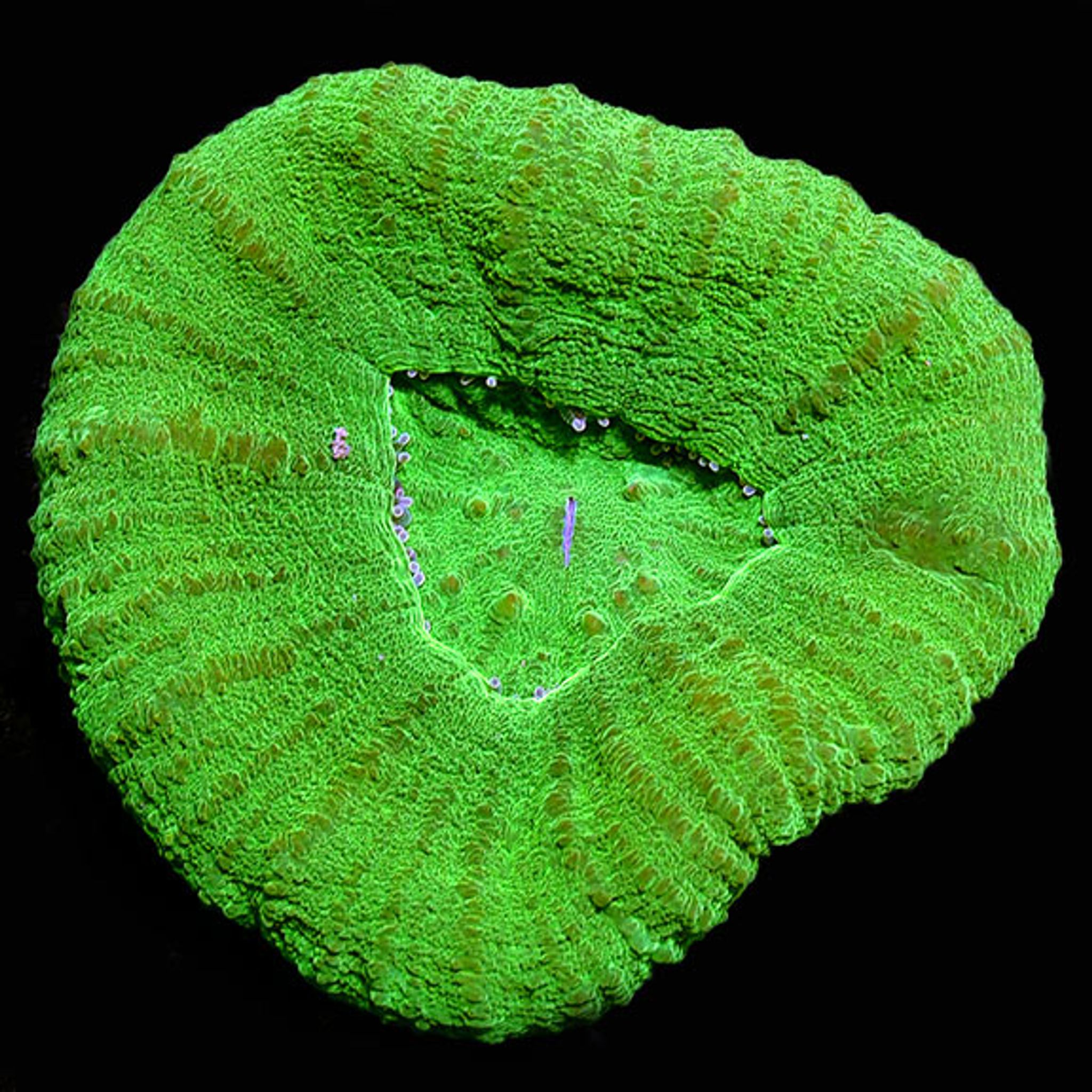
Scolymia Care Guide: Lighting, Flow, Feeding and Placement
A healthy Scolymia should sit low in the tank, stay fully puffed up for most of the day, and take a piece of meaty food within seconds of it landing on the tentacles. Most problems trace back to one of four things: too much light, too much direct flow, feeding at the wrong time, or crowding it against a stinging neighbor. This guide walks through all four, plus how to tell your Scoly apart from the lookalike LPS it's often confused with.
What Exactly Is a Scolymia?
"Scoly" is used loosely at retail to cover several large, solitary, fleshy-mouthed LPS corals, but the taxonomy has shifted. True Scolymia species are Caribbean/Atlantic corals, while most of the large, colorful "Scoly" specimens sold today under names like doughnut coral, disc or disk coral, war paint coral, pinwheel button coral, and bleeding apple coral are actually Homophyllia (especially Homophyllia australis) from Australian and Indo-Pacific waters.
The good news for husbandry: care is nearly identical across genera. Whether the tag says Scolymia or Homophyllia, the same light, flow, feeding, and placement rules apply, so the rest of this guide generalizes safely to either.
Lighting: Keep It Low-to-Moderate
Scolymia and its relatives evolved in shaded, low-light niches — under ledges, in crevices, or on the sandbed — not on exposed reef tops. That makes them one of the more forgiving corals to overlight by accident.
- Target PAR: roughly 50–150 PAR at the polyp. Some references narrow this to 100–150, but a wider window is safer for beginners, since many wild-collected specimens thrive even lower on a shaded sandbed.
- Too much light causes bleaching, browning, and tissue recession over days to weeks.
- Too little light causes poor extension and dull, washed-out color, even if the coral survives.
- Spectrum is flexible. LED, T5, and metal halide all work as long as intensity is controlled. Many keepers favor a broader 14,000–20,000K blend for the best pop of color, but this is aesthetic, not a survival requirement.
Start any new Scolymia low in the tank or shaded under an overhang, use a PAR meter if you have one, and watch tissue color and polyp extension over the first two weeks before considering any adjustment.
Flow: Gentle and Indirect, Not Blasted
This is where the brief's most common mix-up happens. Generic reef-tank advice often cites 20–40x system turnover per hour — but that figure describes total pump output moving water around the whole display, not the current hitting one coral directly.
Flow at the polyp itself should be a different conversation entirely:
| Flow concept | What it means | Target |
|---|---|---|
| System-wide turnover | Total water movement from all pumps/returns, tank-wide | Roughly 20–40x tank volume per hour is a common reef baseline |
| Flow at the Scolymia | Current actually reaching the coral's surface | Low-to-moderate, indirect, turbulent — never aimed straight at it |
Aim pumps so the flow bounces off rockwork and arrives at the coral as gentle, randomized turbulence rather than a direct stream. You want just enough movement to deliver food particles and keep detritus or algae film from settling on the flesh — not so much that the polyp can't fully inflate. A Scolymia that stays shrunken and never puffs up despite good parameters is very often sitting in too much direct current.
Feeding: Meaty Foods, on Its Schedule
Scolymia is carnivorous, with a surprisingly large fleshy mouth for its size. It captures and digests whole pieces of meaty food rather than relying only on light and photosynthesis.
- What to feed: mysis shrimp, chopped table shrimp, silversides, or a prepared LPS-specific pellet or gel food.
- How often: target-feed 2–3 times per week directly onto the mouth with a feeding pipette or turkey baster.
- When: ideally after lights dim or once flow settles for the evening, when tentacles are most extended and receptive.
- Timing rule: wait until the polyp is fully inflated before offering food — a partially closed coral is more likely to reject or fumble the item.
- Cleanup: remove any uneaten food within a few minutes so it doesn't dissolve and foul the water around the coral.
You can browse target-feeding options such as a freeze-dried meaty food sized appropriately for a single large polyp.
Placement: Low, Sheltered, and Clear of Neighbors
Scolymia's natural habitat is sand or rubble in shaded, low-flow pockets — not exposed rock tops. Recreate that by placing it:
- Low in the rockwork or directly on the sandbed, ideally in partial shade from surrounding structure.
- With a halo of several inches on all sides, since the coral can inflate to more than twice its resting diameter and can extend sweeper tentacles at night.
- Where sand or falling detritus won't easily settle on the tissue — if it does, blow it off gently with a turkey baster rather than letting it sit.
Aggression and Tankmate Compatibility
Scolymia is semi-aggressive. Its sweeper tentacles extend mainly after dark and can sting nearby corals, and it can be stung in return by more aggressive species. Keep several inches to a foot of clearance from:
- Hammer, frogspawn, and torch corals
- Galaxea
- Hydnophora
Peaceful options like clams, mushroom corals, and other low-aggression LPS make safer neighbors at a respectful distance. If you're stocking a mixed LPS display, browsing the LPS hard coral selection side by side helps compare aggression levels before placing anything close together.
Water Parameters
Scolymia isn't especially finicky about hitting an exact number, but it does want stability more than perfection. Typical reef targets that work well:
| Parameter | Target range |
|---|---|
| Temperature | 74–82°F (23–28°C), commonly held at 76–80°F (24–27°C) |
| Salinity (SG) | 1.024–1.026 |
| pH | 8.1–8.4 |
| Alkalinity | 8–12 dKH |
| Calcium | 380–450 ppm |
| Magnesium | 1250–1350 ppm |
| Ammonia / Nitrite | 0 |
| Nitrate | Low, single-digit ppm |
Scolymia tolerates slightly more nutrient-rich water than SPS corals, but sudden swings — especially in alkalinity or calcium — can trigger stress, excess mucus production, and a retracted polyp for days.
Fragging: Generally Not Worth the Risk
Unlike branching LPS, Scolymia is a single fleshy polyp sitting on one solid skeleton with no natural branch points. Cutting it risks killing the entire specimen, and recovery from a failed attempt is slow if it happens at all. Rather than fragging an existing coral, it's far more reliable to buy an already-sized frag or colony to begin with.
Acclimation and Quarantine
Because many specimens are wild-collected, arrival stress is common — don't be alarmed if a new Scolymia shows up partially closed or duller than the photos suggested.
- Drip acclimate for salinity and pH before introducing it to the tank.
- Place it in low light and low flow initially, then step conditions up gradually over 1–2 weeks.
- Watch for bleaching or excess mucus as early stress signals and back off light or flow if you see either.
- Wild imports can carry pests such as flatworms or boring sponges, or arrive with tissue necrosis from shipping stress — a dip and quarantine period before adding it to the display tank is worth the extra week.
- Full recovery and re-extension after a rough shipment can realistically take days to a couple of weeks. A closed polyp on day one isn't necessarily a dying coral.
One quirk that surprises new keepers: Scolymia and Homophyllia are typically single-mouthed, but as they mature they can occasionally split into two or more mouths on the same skeleton. That's normal growth, not disease or division into separate colonies.
Solitary LPS Lookalikes: One Care Template, a Few Caveats
Several other large, solitary, fleshy LPS corals get sold alongside Scolymia and share almost the same care profile — low light, gentle flow, sandbed placement, and target feeding — with only size and placement details changing.
Acanthophyllia (Meat/Doughnut Coral)
The most commonly confused lookalike. Acanthophyllia has a much larger, more heavily inflated meat coat than Scolymia and needs to be planted in deep, soft sand so its pointed base can settle in. Give it full inflation clearance of several inches in every direction.
Australophyllia
A genus split out from the old Scolymia/Homophyllia grouping, native to Australian waters and sold under very similar trade names. Husbandry is essentially identical to Scolymia — same light, flow, and feeding targets — so it's frequently mislabeled at retail without any real care difference.
Cynarina (Button Coral)
Cynarina deshayesiana and Cynarina lacrymalis are smaller, thinner-fleshed relatives. They're more sensitive to nutrient swings and physical damage than Scolymia, so they benefit from gentler handling and lighter, more frequent feeding rather than large, infrequent meals.
Plate Corals (Fungia and Relatives)
Not the same genus, but a closely related, free-living fleshy LPS often kept in the same tanks. Plate corals sit loose on the sandbed rather than attaching to rock, and want similar low-to-moderate light and flow plus a comparable feeding regimen — worth keeping in mind if you're stocking a sandbed-focused LPS display.
Common Mistakes and Troubleshooting
| Symptom | Likely cause | Fix |
|---|---|---|
| Bleaching, browning, tissue recession | Placed too high in the light without acclimation | Move lower/shadier; reduce intensity and re-acclimate slowly |
| Polyp won't inflate, tissue looks torn | Direct or excessive flow aimed at the coral | Redirect pumps for indirect, turbulent flow instead |
| Localized tissue damage near one edge | Sweeper tentacle stings from a nearby aggressive coral | Increase spacing; relocate the more aggressive neighbor |
| Polyp shrinks after sand settles on it | Detritus or sand restricting feeding and gas exchange | Gently blow it off with a turkey baster; check flow direction |
| Food spat out, water clouds afterward | Fed before full inflation or offered too large a piece | Wait for full inflation; cut food into appropriately sized pieces |
| Extended mucus, retracted for days | Sudden parameter swing, especially alkalinity or calcium | Test and correct dosing; stabilize before resuming feeding |
| Coral crashes after a frag attempt | Cutting a single-polyp skeleton | Avoid fragging Scolymia-type corals altogether |
Do You Need a Sump or Refugium?
Not mandatory, but a sump adds water volume and buffers parameter swings, which sensitive LPS like Scolymia benefit from. A rough sizing guideline is 20–30% of display volume. Adding a refugium with macroalgae on a reverse light cycle helps export nutrients and stabilize pH overnight, further reducing the stress spikes that can cause a Scolymia to retract or produce excess mucus. Neither is required to keep this coral successfully, but both make parameter stability easier to maintain over the long run.
Frequently Asked Questions
What's the difference between Scolymia and Homophyllia (Australian Scoly)?
They're different genera, but nearly identical in trade appearance and care requirements. Most "Scoly" specimens sold today are actually Homophyllia from Australian and Indo-Pacific waters, while true Scolymia are Atlantic/Caribbean species; the husbandry advice in this guide applies to both.
How much light does a Scolymia need?
Low-to-moderate intensity, roughly 50–150 PAR at the polyp. Start on the low end, ideally on or near the sandbed, and adjust based on how well the coral colors up and extends rather than chasing an exact number.
How often should I feed my Scoly coral?
Target-feed meaty foods like mysis, chopped shrimp, or a prepared LPS food 2–3 times per week. Wait until the polyp is fully inflated before offering food, and feed after lights dim when tentacles are most extended.
Can I frag a Scolymia?
It's not recommended. It's a single fleshy polyp on one skeleton with no natural branch points, so cutting risks killing the entire specimen; buying an already-sized frag or colony is the safer route.
Why is my Scolymia not inflating or staying shriveled?
The most common causes are too much direct flow, too much light, physical irritation from sand or detritus on the tissue, or a stress response to stings from a nearby aggressive coral. Check flow direction and neighbor spacing first.
Where should I place a Scolymia in my tank?
Low in the rockwork or directly on the sandbed, in a shaded spot with gentle, indirect flow. Leave several inches of clearance on all sides since it can inflate to more than twice its resting size.
What livestock is safe near a Scolymia?
Peaceful tankmates such as clams, mushroom corals, and other low-aggression LPS generally coexist well at a respectful distance. Avoid placing it close to Galaxea, hydnophora, or fast-growing hammer/frogspawn/torch corals that can sting it or get stung in return.
Do I need a refugium for LPS corals like Scolymia?
It's not mandatory, but a refugium and sump combination improves nutrient export and parameter stability, which reduces the stress swings that cause mucus production and retraction in sensitive LPS.
If you're ready to add one to your reef, you can browse current specimens and other LPS hard corals on FishyHub to find a Scolymia or a compatible tankmate suited to your setup.

