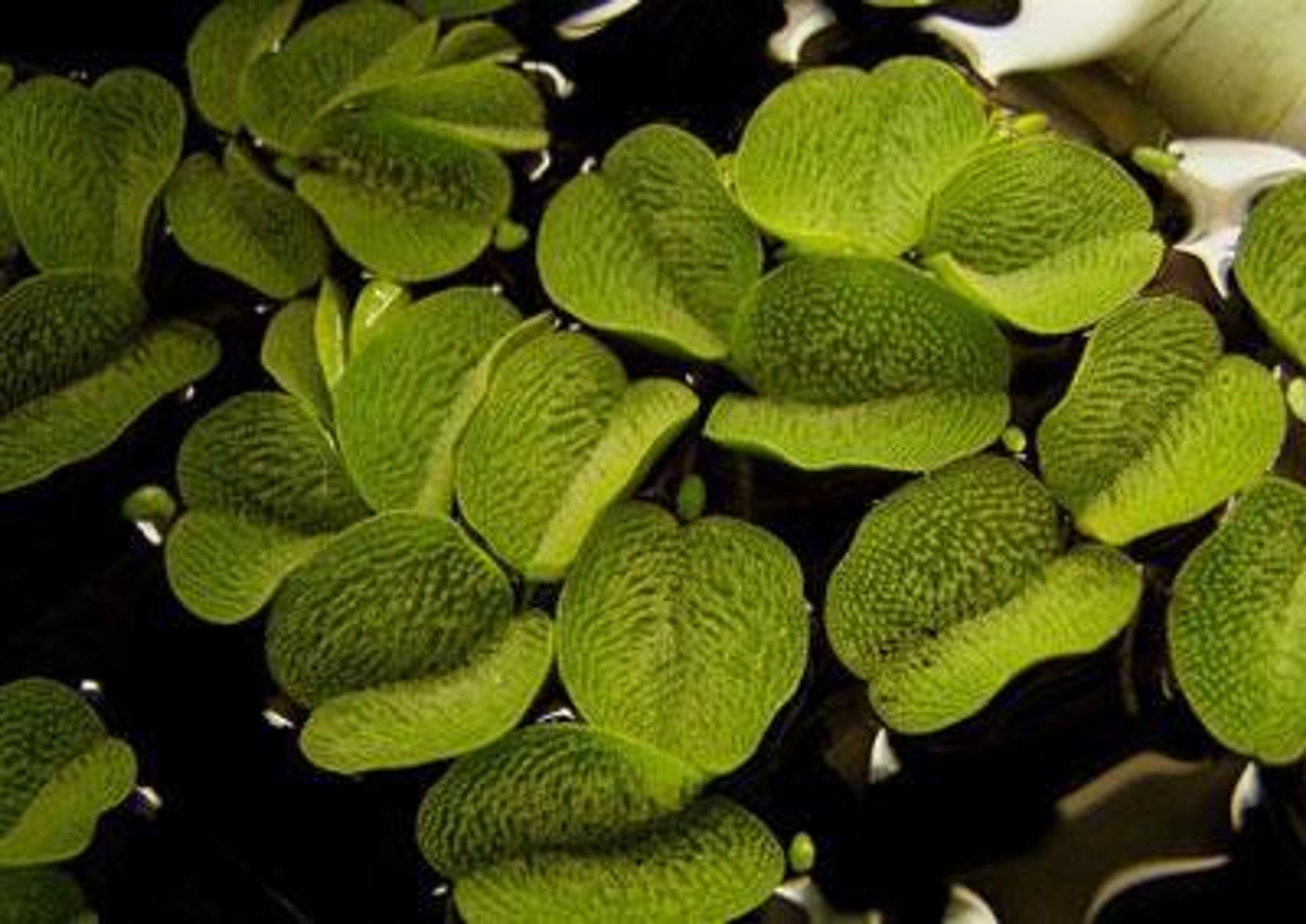
Salvinia Care Guide: Light, CO2, Substrate and Growth Tips
Salvinia is a floating fern that grows fast, needs no substrate, and skips CO2 injection entirely — but it still has real light, water, and maintenance requirements that trip up new keepers. This guide breaks down exactly how much light it needs, why "substrate" is the wrong question to ask, and how to keep a thriving mat from taking over the whole tank.
What Is Salvinia, Exactly?
Salvinia isn't a single plant — it's a genus of floating ferns, and several look-alike species show up in the hobby under the same common name. They're related, not identical, but their care overlaps enough that one guide covers all of them.
| Species | Common name | Leaf notes | Hobby status |
|---|---|---|---|
| Salvinia minima | Water spangles | Small, round, hairy paired leaflets | Most common in the US trade |
| Salvinia auriculata | Giant salvinia (small form) | Slightly larger, folded leaf edges | Common, sometimes sold unlabeled |
| Salvinia natans | Floating fern | Smaller, more delicate fronds | Less common, similar needs |
| Salvinia molesta | Giant salvinia | Large, egg-crate textured leaves | Restricted/banned in parts of the US |
Buying tip: check the leaflet shape before purchase. Salvinia has paired oval leaves covered in fine hairs, with a third leaf modified into root-like structures underwater. That underwater structure isn't a true root — it absorbs nutrients but never anchors into soil, which is the whole reason substrate doesn't matter for this plant. If what you're looking at has flat, single round leaves with a hanging thread-like root, that's duckweed, not salvinia.
A Legal Note on Species
Salvinia molesta is classified as a noxious or invasive aquatic weed in a number of US states and is restricted or outright prohibited from sale and possession in some of them. Before buying, check your state's aquatic invasive species list, and never release any salvinia species into a pond, ditch, or waterway — dispose of excess plant matter in household trash, sealed in a bag, not down a drain or outdoors.
Light Requirements
Salvinia wants moderate-to-high intensity, full-spectrum LED light for about 8–10 hours a day. That's the practical default — adjust up or down slightly based on how the plant responds:
- Too little light: fronds stay small, pale green, and growth slows to a crawl.
- Too much light too close to the surface: fronds can scorch or bleach, especially under high-output reef-style fixtures with no diffusion.
Because salvinia floats right at the surface, it's much closer to the light source than submerged plants are. As a rule of thumb, mount fixtures roughly 6–12 inches (15–30 cm) above the waterline rather than resting them directly on the glass or a low canopy. This buffers heat and light intensity enough to prevent leaf scorch while still delivering enough light to grow well. If you're running a separate refugium or grow-out tank for floaters, an adjustable-intensity full-spectrum LED like those available in FishyHub's LED lighting selection gives you the flexibility to dial things in without swapping fixtures. Running that light on a different schedule than your main display can also help buffer daytime pH swings caused by photosynthesis.
Does Salvinia Need CO2?
No. Salvinia is a floating fern that pulls carbon dioxide directly from the air through its leaves, not from the water column like a submerged plant does. Injected CO2 provides no meaningful growth benefit for salvinia specifically, and it isn't worth setting up a pressurized system just for this plant.
The one caveat: if you already run CO2 injection for other submerged plants in the same tank, salvinia won't be harmed by it, and the extra dissolved nutrients in a well-balanced planted tank can give it a slight edge. It's a bonus in a mixed setup, never a requirement on its own.
Does Salvinia Need Substrate?
No, and this is where a lot of new keepers overthink things. Salvinia has no roots in the traditional sense — the fine, hair-like structures trailing underwater absorb nutrients directly from the water column and never touch or anchor into the substrate. That means:
- Bare-bottom tanks work exactly as well as heavily planted, dirted, or gravel-based setups.
- Root tabs and substrate fertilizers do nothing for salvinia — the "roots" simply aren't in a position to use them.
- Substrate choice matters entirely for whatever other plants share the tank, not for salvinia itself.
If you keep salvinia alongside rooted plants that do care about substrate composition, browse FishyHub's substrate options separately for those species — just don't factor salvinia into that decision.
Water Parameters
Salvinia is forgiving but does have a comfort zone for active growth:
| Parameter | Range |
|---|---|
| Temperature | 72–79°F (22–26°C) |
| pH | 6.0–8.0 |
| GH | ~3–18 dGH (soft to moderately hard) |
| Water flow | Gentle to still surface flow |
Outside the 72–79°F band, salvinia doesn't die immediately, but it stops thriving — growth slows and fronds can yellow. Don't confuse this with the cold tolerance of fairy moss (Azolla), a different floating fern that can survive dormant into the 40s°F; salvinia isn't built for that kind of cold snap.
Flow matters more than most keepers expect. Strong filter outflow or a powerhead aimed at the surface will shred delicate fronds and can physically push the mat into intakes, where it gets sucked up and damaged. Redirect outflow toward the glass or water surface at an angle, or corral floaters with a suction-cup ring or a simple loop of airline tubing so they stay clear of equipment and pool in one attractive area instead of drifting everywhere.
Growth Rate and Fertilizing
Salvinia grows fast — under good light and nutrients, populations can roughly double in about a week, and a modest starter clump can carpet a tank's surface within a couple of weeks.
That speed depends on nutrient availability:
- Use a liquid NPK/micronutrient fertilizer dosed into the water column; root tabs are wasted on this plant.
- Iron and potassium in particular support frond color and healthy root-like development.
- Pale, yellowing fronds despite decent light are the classic sign of a nutrient deficiency, not a lighting problem.
Dose according to the product's label rate for a lightly-to-moderately planted tank, and watch the plant's response over a week or two before adjusting — salvinia will tell you what it needs through leaf color and growth speed faster than any fixed formula can.
Propagation
Salvinia reproduces purely vegetatively — there's no flowering or seed-based propagation to worry about. The plant naturally branches at nodes along its stem, and a healthy mat is constantly producing new fragments on its own. To propagate deliberately, simply separate a piece with a few leaves and its attached root-like structure, then float it in a new tank or container. No cutting technique or rooting hormone needed.
Weekly Maintenance Checklist
Because growth is so fast, salvinia needs active management, not occasional pruning. A simple weekly routine prevents the most common problem: 100% surface coverage that blocks light to plants below and cuts oxygen exchange at the surface.
- Thin the mat with a net, removing enough to keep coverage around 30–50% of the surface.
- Dose liquid fertilizer per label directions.
- Check for pests or hitchhikers — snails, planaria, or algae hiding in the root mass.
- Inspect for leaf rot near the lid, especially under a closed hood where condensation can drip onto fronds; crack the lid slightly for airflow if you see soft, browning spots.
- Check flow and equipment to make sure fronds aren't being pulled into an intake.
Tank Mates
Salvinia pairs well with most community fish and invertebrates:
- Good matches: tetras, rasboras, cherry shrimp, snails, and betta or gourami species that appreciate surface cover (bettas in particular use floating plants as bubble-nest anchors). FishyHub carries both shrimp and bettas that suit a floating-plant setup well.
- Poor matches: goldfish, silver dollars, and larger cichlids will shred, uproot, or eat salvinia daily, undoing any progress from your maintenance routine.
Benefits Beyond Looks
Salvinia does real functional work in a tank:
- Nutrient export: its rapid growth pulls nitrate and ammonia out of the water efficiently, since fast growth equals high nutrient demand.
- Stress reduction: shade and cover from a floating mat lower stress for fish that prefer dim, sheltered water.
- Algae competition: by consuming the same nitrogen and phosphorus algae needs, a healthy salvinia mat can meaningfully suppress algae growth simply by outcompeting it.
- Fry and shrimp shelter: the dangling root-like structures give newborn fish and shrimp somewhere to hide from predators.
Always quarantine new plants before adding them to an established tank — salvinia and other floaters are common carriers of snail eggs, hydra, and other hitchhikers picked up in transit.
Related Floating and Emergent Plants for Nitrate Control
Salvinia is one of several fast-growing plants hobbyists use specifically for nutrient export. Understanding the others helps you build a more complete natural filtration strategy.
Pothos as an Aquarium Filter Plant
Pothos is a common houseplant, not a true aquatic plant, but it's widely grown with its roots trailing in aquarium water — either floating with leaves held above the surface or rooted through a hang-on-back filter. It's extremely effective at pulling nitrate and ammonia out of bioload-heavy tanks, grows quickly, and is inexpensive. Rinse all soil off the roots thoroughly before adding it to avoid clouding the water or introducing contaminants.
Spider Plants as Emergent Aquarium Plants
Spider plants (Chlorophytum) work similarly to pothos: roots submerged, crown and leaves held above the waterline on an open-top tank. They're hardy, low-maintenance, and contribute to nitrate export while adding a decorative, cascading look. Keep the crown out of the water — it isn't a true aquatic plant and will rot if fully submerged.
Houseplants Rooted in Filter Media
A broader version of the same idea: pothos, spider plants, or philodendron placed in a hang-on-back filter's media basket, or grown through holes drilled in a lid, so their roots trail directly into the flow. This adds a layer of biological nutrient uptake and lets keepers repurpose plants they may already own, but it supplements mechanical and biological filter media — it doesn't replace it.
Other Efficient Nitrate Sponges
Salvinia, duckweed, water lettuce, hornwort, and pothos share one trait that makes them effective nitrate control: rapid growth. The faster a plant grows, the more nitrogen it needs to pull from the water to fuel that growth. Combining one or two of these with a regular water-change schedule is a reliable, low-tech way to keep nitrate in check between larger maintenance sessions.
Green Water and Cloudy Water Troubleshooting
Keepers adding salvinia for algae control often run into two different water-clarity issues that get confused with each other:
- Green water is a free-floating algae bloom caused by excess light and nutrients. It's fixed with a UV sterilizer, a multi-day blackout period, or better nutrient control — fast-growing floaters like salvinia help here by competing directly with algae for the same nutrients.
- Cloudy or white water is usually a bacterial bloom (common in newly cycled tanks) or fine substrate dust stirred into suspension. This clears with time, routine water changes, and reduced feeding — not by removing plants, since plants aren't the cause.
Common Mistakes to Avoid
- Letting the mat cover 100% of the surface, cutting oxygen exchange and shading everything below — thin weekly, not "when you remember."
- Pointing filter outflow or a powerhead straight at the floaters, shredding fronds and jamming intakes.
- Buying root fertilizer tabs or nutrient-rich substrate specifically for salvinia — neither does anything; use liquid fertilizer instead.
- Confusing salvinia with duckweed at the store — check for paired, hairy oval leaflets, not single flat round ones.
- Housing it with goldfish or large cichlids and being surprised it's gone within a day.
- Sealing the lid tightly with no airflow gap, so condensation drips onto fronds and causes rot.
- Overdosing liquid CO2 supplements or fertilizers formulated for substrate-rooted plants, which can burn floating fern tissue at concentrations meant for submerged leaves.
Frequently Asked Questions
Does salvinia need CO2?
No. It absorbs carbon dioxide from the air through its leaves rather than from the water column, so injected CO2 isn't necessary for this plant.
Does salvinia need substrate?
No. It floats freely and has no true roots anchored in soil or gravel, so substrate type has no effect on its growth.
How much light does salvinia need?
Moderate-to-high intensity, full-spectrum light for roughly 8–10 hours a day is the practical default, adjusted based on how the plant responds.
Why is my salvinia turning brown or yellow?
Usually a nutrient deficiency that calls for liquid fertilizer, insufficient light, or leaf rot from condensation or standing water sitting on the fronds.
How fast does salvinia grow, and how do I control it?
Very fast — populations can roughly double in about a week. Control it by netting out excess weekly and keeping coverage to around 30–50% of the surface.
Can salvinia live with goldfish or cichlids?
Not well. These fish tend to eat or uproot floating plants; salvinia does much better paired with small community fish and shrimp.
What's the difference between salvinia species like auriculata, minima, and natans?
Mostly minor leaf-size and shape differences. Care requirements are essentially the same across the genus, though S. molesta carries legal restrictions in parts of the US.
Will salvinia stop algae or green water?
It helps by competing with algae for the same nutrients, but a severe bloom may still need a UV sterilizer or a blackout period to fully clear.
Ready to start a floating-plant setup or round it out with tank mates that will leave your salvinia alone? Browse FishyHub's full range of freshwater livestock to find community fish and shrimp suited to a floating-plant tank.

