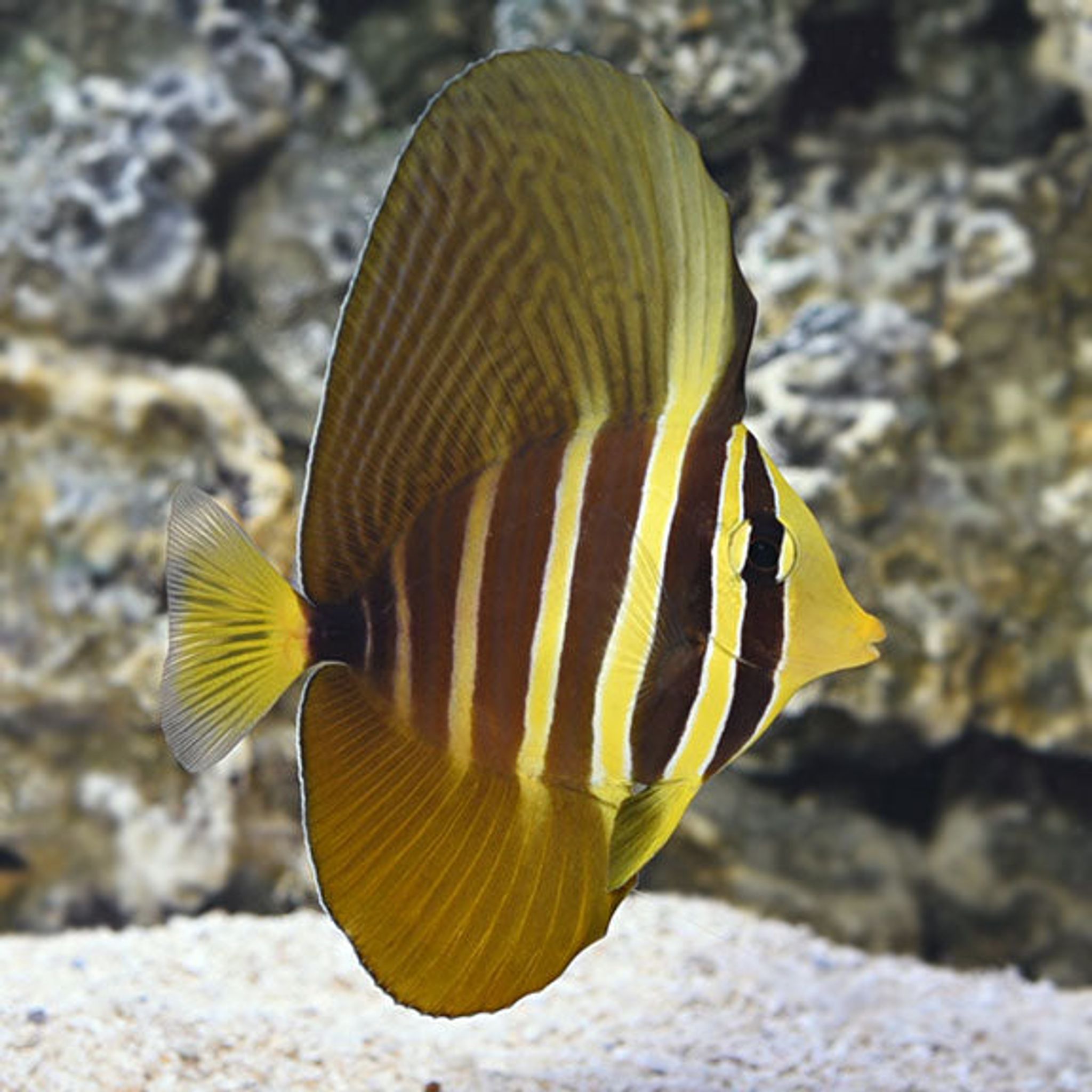
Sailfin Tang Care Guide: Tank Size, Diet, Compatibility and Reef Safety
A sailfin tang is sold as a 2-3 inch juvenile but can reach 15-16 inches in a home aquarium, which is exactly why so many end up crammed into tanks that were never big enough. This guide breaks down the real tank-size requirements by life stage, a practical feeding plan, and a clear verdict on compatibility and reef safety so you can decide whether this fish fits your setup before you buy.
Species Snapshot
The Pacific sailfin tang (Zebrasoma veliferum), also called the Indo-Pacific sailfin tang, is the largest member of the Zebrasoma genus and one of the most commonly available large tangs in the US saltwater trade. It's frequently confused with the Red Sea sailfin tang (Zebrasoma desjardinii), a closely related but distinct species that is often mislabeled or sold under the same common name.
| Trait | Pacific Sailfin Tang (Z. veliferum) | Red Sea Sailfin Tang (Z. desjardinii) |
|---|---|---|
| Native range | Indo-Pacific | Red Sea, western Indian Ocean |
| Adult size | Up to 15-16 in. (38-40 cm) | Similar, up to 15-16 in. |
| Pattern | Bolder vertical striping, more orange spotting on the face | Finer striping, more subtle facial spotting |
| Typical retail price | Generally lower | Generally higher |
| Hardiness | Excellent | Considered by some hobbyists to be slightly hardier |
| Care requirements | Nearly identical | Nearly identical |
Both species belong to the surgeonfish family, Acanthuridae — a group named for the scalpel-like spine on either side of the caudal peduncle that can injure the fish or the handler if it's netted roughly. The family includes several genera worth knowing when comparing options:
- Zebrasoma — sailfin, yellow, and purple tangs; generally smaller-bodied, deep-profile species.
- Naso — unicorn and naso tangs; larger, longer-bodied, strong swimmers.
- Acanthurus — regal (blue) tang, powder brown, and other classic reef surgeonfish.
All of them share the same core needs: near-constant grazing on algae and careful handling around that caudal spine.
Tank Size by Life Stage
This is the single most important decision point, and it's where sailfin tangs are most often mis-housed. Don't plan around the size of the juvenile in the store — plan around the adult it will become.
| Life stage | Minimum tank size | Notes |
|---|---|---|
| Juvenile (2-4 in.) starting point | 100 gallons (379 L) | Workable minimum cited by most sources, but only as a starting tank the fish will outgrow |
| Recommended long-term minimum | 125 gallons (473 L) | Sensible baseline for a single sailfin tang that will be kept for years |
| Full-grown adult | 150-180+ gallons (568-681+ L) | Needed once the fish approaches its 15-16 in. adult length |
Because sailfin tangs are constant open-water swimmers, tank length matters more than raw volume — aim for a minimum of 4-6 feet of tank length rather than a tall, narrow footprint. A 125-gallon tank that's short and deep gives far less usable swimming room than a long 6-foot tank of similar volume.
Don't confuse these numbers with the requirements of bigger relatives:
- Blonde naso tang (Naso sp.) needs 250+ gallons, has a longer body plan than any Zebrasoma, and is generally one of the more peaceful large tangs — a reasonable "go bigger" option if you have the space.
- Dussumieri (yellowtail/eyestripe surgeonfish) also needs 250+ gallons as an adult, is a strong swimmer that demands high flow, and can be territorial with other tangs — best suited to experienced keepers with large systems.
- Black tang (Zebrasoma rostratum) shares a genus with the sailfin but is rare, expensive, and needs 300+ gallons if it's combined with other Zebrasoma species, since intra-genus aggression is severe.
You can browse currently available stock in the Tangs & Surgeons category to compare sizes and species before committing to a tank.
The Tank Must Be Mature, Not Just Cycled
A sailfin tang should only go into a tank that has completed a full nitrogen cycle and had extra time afterward to develop algae film, biofilm, and pod populations on the rock and glass. A standard fishless cycle — dosing an ammonia source and tracking ammonia, nitrite, and nitrate with a test kit — typically takes 4-8 weeks. Adding a tang the moment ammonia and nitrite hit zero is a common mistake; tangs are especially prone to disease in brand-new systems, so give the tank several months of overall maturity before introducing one.
Live rock seeds a new system faster with beneficial bacteria and pod/algae life, which doubles as bonus grazing for herbivorous tangs, but it carries more risk of unwanted hitchhikers and typically costs more. Dry rock is cheaper and pest-free but takes longer to mature biologically. Either path works — the point is not to rush a tang in before the surfaces have had time to grow a natural grazing layer.
Water Parameters
| Parameter | Target range |
|---|---|
| Temperature | 72-78°F (22-26°C) |
| Specific gravity | 1.023-1.025 |
| pH | 8.1-8.4 |
| KH (alkalinity) | 8-12 dKH |
| Ammonia / nitrite | 0 ppm |
| Nitrate | Under 20 ppm (lower for reef tanks) |
Provide strong, varied water flow — these are open-ocean swimmers in the wild, and stagnant flow contributes to stress and poor growth. If you're already running a reef tank, a reef calculator (an online dosing tool for calcium, alkalinity, and magnesium) is worth using alongside routine salt-mix water changes to keep these parameters stable, which benefits fish health as much as coral growth.
Diet and Feeding Schedule
Sailfin tangs are primarily herbivorous grazers that need near-constant access to algae in the wild. Replicating that grazing pattern in captivity is the single biggest factor in preventing disease.
A practical feeding plan:
- Dried seaweed or nori sheets — clip a sheet to the tank wall daily and leave it in place for grazing access throughout the day.
- Herbivore-formulated pellets or flakes with spirulina — offer 1-2 times daily.
- Meaty frozen foods (mysis or brine shrimp) — offer occasionally for variety and to support overall condition, but treat this as a supplement, not the primary diet.
Multiple small feedings or continuous grazing access outperform a single large daily feed. Undernourishment — specifically a lack of vegetable matter — is a leading cause of Hole-in-the-Head disease (HLLE) in tangs, alongside poor water quality and excessive use of activated carbon. If you notice pitting around the head or lateral line, increase nori feeding frequency and variety, review water quality, and reassess carbon use.
Compatibility
Sailfin tangs are generally peaceful toward non-tang tankmates and coexist well with clownfish, gobies, wrasses, and most other reef community fish. Compatibility issues center almost entirely on other tangs and surgeonfish:
- Aggressive toward other Zebrasoma species (yellow tang, purple tang) and similarly shaped or colored surgeonfish, especially in tanks under roughly 200 gallons.
- A useful rule of thumb: avoid combining fish with a similar body shape and color, not just fish in the same genus — this generalizes better than "avoid other tangs" alone, since a sailfin and a differently shaped, differently colored tang may coexist more easily than two similar-looking ones.
- Reduce aggression by adding tangs last to an established community, or introducing multiple tangs simultaneously in a large enough tank so no single fish has already claimed territory.
- Sailfin tangs are not aggressive toward corals or invertebrates, so they mix well with a peaceful reef fish lineup such as clownfish.
Reef Safety
Sailfin tangs are considered reef safe with caution. They will not eat coral or most invertebrates, and they're valued in reef tanks specifically for their algae-control abilities. The caution comes from a minority of reports of occasional nipping at coralline algae, soft coral polyps, or clam mantles — behavior that's far more likely in an underfed fish. Keep a nori clip going and offer consistent grazing access, and a sailfin tang is a genuinely useful, low-risk addition to a reef system stocked with soft corals and similar livestock.
Sailfin tangs are often recommended as a good "first tang" for a reef tank that already meets the size requirement, thanks to their hardiness and algae-eating value — alongside clownfish, gobies, and cardinalfish as beginner-friendly reef fish. The recurring caveat with sailfins is never temperament; it's always tank size and tank maturity.
Health, Disease and Quarantine
Sailfin tangs are highly susceptible to marine ich (Cryptocaryon) and marine velvet, largely due to stress from shipping, acclimation, and undersized tanks. A 4+ week quarantine period before adding any tang to a display tank is strongly recommended, with close observation for early symptoms and prophylactic treatment where appropriate. Treatment (including medications used for hyposalinity or copper-based protocols) is far easier to manage in a separate quarantine tank than in an established reef display.
New sailfin tangs are often shy for days to weeks after introduction before becoming bold — that alone isn't a red flag. Watch instead for signs that distinguish normal acclimation from actual illness:
- Normal: hiding, reduced appetite for the first few days, gradually increasing boldness.
- Warning signs: clamped fins, rapid or labored breathing, visible white spots, scratching against rock or substrate, and persistent darting.
If warning signs appear, move quickly — tang diseases progress fast, and delayed treatment is a common reason outbreaks spread through an entire display.
Common Mistakes to Avoid
- Buying a juvenile for a tank under 75-100 gallons without planning for a 15+ inch adult — the single biggest cause of stunted growth, aggression, and chronic disease in this species.
- Adding a tang to an uncycled or very new tank, the highest-risk period for ich and velvet outbreaks.
- Underfeeding vegetable matter, leading to HLLE and weight loss — fix it by increasing nori frequency and variety.
- Housing multiple similar-shaped or similarly colored tangs in too small a space, causing chasing, stress, and injury.
- Skipping quarantine, given how ich-prone this species is.
- Rough handling or chasing with a net, which risks injury from the caudal spine to both fish and handler — use a container-and-bag method instead.
Before buying any saltwater fish, run through a short checklist: confirm the adult size, confirm the tank is cycled and mature, check compatibility with existing stock, and buy from a source with sound acclimation practices. Avoid impulse-buying a "cute juvenile" without checking whether your tank can support what it becomes — the exact problem that dogs the sailfin tang more than almost any other reef fish.
Frequently Asked Questions
How big of a tank does a sailfin tang really need?
Start with 125 gallons minimum as a long-term baseline, and plan for 150-180+ gallons once the fish reaches full adult size. Prioritize a tank at least 4-6 feet long over one that's simply deep, since sailfins are constant swimmers.
How fast does a sailfin tang grow?
With good food and adequate space, a sailfin tang can add several inches per year. Growth that slows dramatically in a cramped tank is stunting, not a sign of a well-managed fish — it's a warning sign, not a benefit.
Is a sailfin tang reef safe?
Yes, generally. It won't eat coral or most invertebrates and is valued for algae control, but watch for occasional nipping at coralline algae or clam mantles if the fish isn't getting enough algae in its diet.
Can I keep two sailfin tangs together?
Only in very large tanks, roughly 200+ gallons, and ideally by adding them at the same time so neither has established territory first. In smaller tanks, expect chasing and aggression.
What do sailfin tangs eat?
Primarily algae — dried seaweed or nori sheets left in the tank for grazing, plus herbivore pellets or flakes with spirulina once or twice daily. Add occasional meaty frozen food like mysis or brine shrimp for variety, but keep vegetable matter as the core of the diet.
Why does my tang have white spots or keep scratching against rock?
These are classic signs of marine ich or velvet, both common in tangs due to their sensitivity to stress. Treat promptly with an appropriate quarantine and treatment protocol, and review whether the tank is mature enough and stress factors like crowding or poor water quality are contributing.
What's the difference between a sailfin tang and a Red Sea sailfin tang?
They're different species — Zebrasoma veliferum versus Zebrasoma desjardinii — with a very similar look and nearly identical care requirements. The Red Sea variant is typically pricier and some hobbyists consider it slightly hardier, but day-to-day care is essentially the same.
Do sailfin tangs get along with clownfish and other reef fish?
Yes. Sailfin tangs are generally peaceful with clownfish, gobies, wrasses, and most other reef community fish. Aggression is mainly limited to other tangs and surgeonfish with a similar body shape or color.
If you've confirmed your tank meets the size and maturity requirements above, you can browse available sailfin tangs and other Zebrasoma species in FishyHub's Tangs & Surgeons category.

