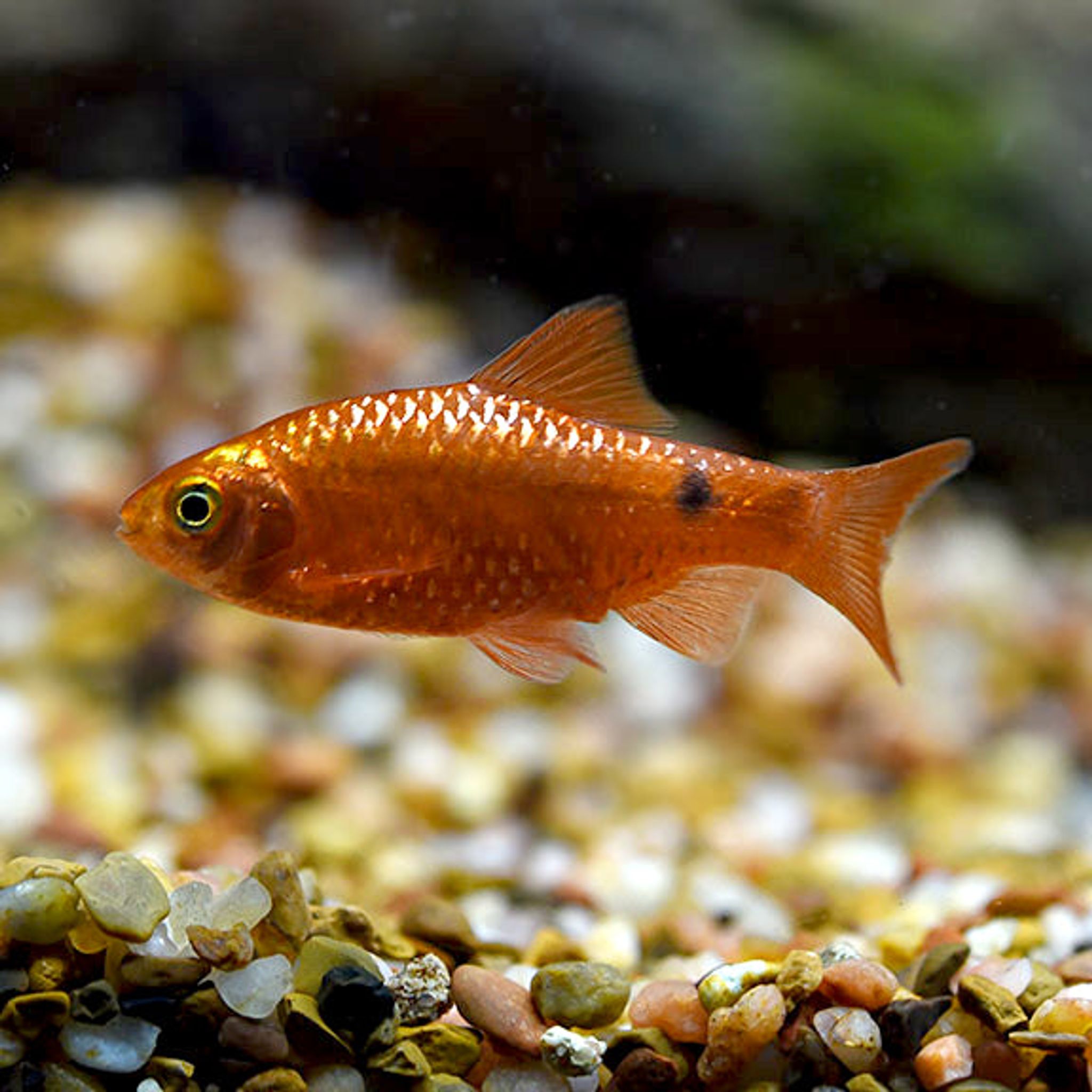

Rosy Barb Care Guide: Tank Size, Diet, Water Parameters and Temperament
Rosy barbs are a hardy, cool-tolerant cyprinid that rewards a proper school size and the right tankmates with vivid color and near-constant activity. This guide gives firm numbers for tank size, water parameters, and diet, explains why rosy barbs get a fin-nipping reputation, and covers breeding, health, and how they compare to their closest barb relatives.
Species Snapshot
The rosy barb (Pethia conchonius, formerly classified as Puntius conchonius or Barbus conchonius) is also sold as the Red Barb. It's native to slow-moving streams and rivers across South Asia, from Afghanistan through Bangladesh and northern India. Decades of captive breeding have made it one of the most beginner-friendly cyprinids in the hobby — tolerant of a wide range of conditions and easy to feed.
- Adult size: roughly 4–6 inches (10–15 cm) for males; females run slightly larger-bodied.
- Captive-bred vs. wild-caught: tank-raised fish commonly top out a bit smaller than wild specimens.
- Lifespan: 4–7 years with good care, averaging around 5 years.
Tank Size and Setup
A single rosy barb rarely causes problems — a group housed too small does. Because these fish are constant, fast swimmers descended from flowing water, footprint matters more than height.
- Absolute minimum: 20 gallons (76 L) long, for a school of 5.
- Recommended starting point: 30 gallons (114 L) — the practical floor most keepers land on once they see how much these fish move.
- Scaling up: add roughly 5–10 gallons (19–38 L) per additional fish beyond the initial school.
- Shape: favor a long, wide tank over a tall one. Swimming length benefits rosy barbs far more than vertical space.
Give them moderate-to-strong water flow — a canister or hang-on-back filter rated for the tank's volume suits their flowing-habitat origins and also helps keep the water well-oxygenated for an active, often larger school.
Water Parameters
Rosy barbs are adaptable, but a few numbers matter more than the rest — especially temperature, where this species stands out from typical tropical community fish.
| Parameter | Range |
|---|---|
| Temperature | 64–75°F (18–24°C) core range; short-term tolerance to 75–79°F (24–26°C) |
| pH | 6.0–8.0 tolerated; 6.5–7.5 ideal |
| General hardness (GH) | 2–19 dGH (wide tolerance) |
| Minimum group size | 5–6 fish |
| Minimum tank size | 20 gallons (76 L), 30 gallons (114 L) recommended |
A Cooler-Leaning Tropical Fish
Most references treat rosy barbs as generic tropical community fish, but their temperature tolerance is genuinely unusual. They're one of the few popular barbs that do fine in an unheated or lightly heated room, garage, or basement setup in mild US climates — not a true coldwater fish, but comfortable running cooler than most tropicals. That makes them a practical option for hobbyists who want a lower-energy-cost tank, or for a sunroom or three-season porch setup where temperatures naturally dip. If you're pairing them with warmer-water community fish, keep the heater set toward the lower end of everyone's shared tolerance rather than pushing rosy barbs into the upper 70s for long stretches.
Diet and Feeding
Rosy barbs are unfussy omnivores. Build the diet around:
- A high-quality flake or small pellet as the daily base.
- Live or frozen bloodworms, brine shrimp, and daphnia a few times a week for protein and enrichment.
- Blanched vegetables — zucchini, spinach, or peas — for fiber and to help maintain red and gold coloration.
Feeding schedule: feed 1–2 times daily, offering only what the school clears in 2–3 minutes per feeding. For a school of six or more, that usually means a small pinch of flake per feeding rather than a heaping one — err on the side of underfeeding and watch how quickly the food disappears before adjusting. Overfeeding a group this size is the fastest way to spike ammonia and nitrate between water changes. A varied diet with regular protein and vegetable matter noticeably intensifies coloration over a few weeks.
Temperament: Are Rosy Barbs Aggressive?
Rosy barbs are classified as semi-aggressive fin-nippers, and that reputation is earned — but it's largely situational rather than an inherent trait.
Nipping is driven by three main factors:
- Under-schooling — fewer than 5–6 fish redirects energy from normal shoaling into harassing tankmates.
- Cramped space — a small tank concentrates fast-swimming fish with nowhere to burn energy.
- Breeding-season territoriality — males can become possessive and chase each other or other fish during spawning behavior.
Distinguish normal playful chasing (brief, no contact, part of natural shoaling and pecking-order behavior) from true aggression: sustained chasing, gill flaring, darkened coloration, and actual fin damage. A properly sized school in a properly sized tank drops nipping incidents sharply — this is the single most repeated fix across the hobby.
Good Tankmates
- Other barbs, danios, and larger tetras
- Corydoras and other armored or robust bottom-dwelling catfish
- Loaches
- Platies and swordtails (short-finned livebearers)
- Rainbowfish
- Larger, peaceful American cichlids
Nerite snails generally coexist fine; shrimp are at risk of being hunted or nipped and are best kept separately.
Fish to Avoid Pairing With
- Bettas
- Fancy long-finned guppies and mollies
- Angelfish
- Any slow-moving, delicate, long-finned fish
You can browse suitable schooling companions like tetras and other small community fish or corydoras directly on FishyHub when stocking a rosy barb tank.
Breeding Rosy Barbs
Rosy barbs are egg-scatterers, not mouthbrooders or livebearers, and adults eat their own eggs on sight — successful breeding requires a dedicated setup.
- Spawning tank: a shallow setup, a few inches of water up to about 10 gallons, with fine-leaved plants or a spawning mop for eggs to fall into.
- Temperature: slightly warmer than the main tank, around 73–80°F (23–27°C).
- Ratio: roughly 1 male to 2 females.
- After spawning: remove the adults immediately — they will eat the eggs otherwise.
- Hatching: roughly 1–4 days depending on temperature (sources cite anywhere from about 24 hours to 4 days).
- Fry care: start with infusoria, then move to baby brine shrimp once fry are large enough.
Sexing Rosy Barbs
Males display more intense red coloration, especially during breeding season. Females are rounder-bodied with more silver, gold, or olive tones and noticeably less red.
Common Health Issues
Standard freshwater disease prevention covers most rosy barb health problems:
- Ich (white spot disease) — the most frequently reported issue, usually triggered by new-fish stress or declining water quality.
- Fin rot and fungal infections — often secondary to nipping injuries or poor water quality.
- Swim bladder issues and bloating — commonly linked to overfeeding.
Quarantine new stock, keep parameters stable, and avoid overfeeding to prevent most of these outright.
Common Mistakes and Troubleshooting
- Keeping too few rosy barbs. Fewer than 5 leads to fin-nipping and stress. Fix: add more fish to reach a proper school.
- Housing with long-finned or slow fish. Expect nipped fins with bettas or fancy guppies. Fix: swap tankmates or house separately.
- Undersized tank for an active schooler. Cramped space raises aggression and limits natural activity. Fix: upsize to 20–30+ gallons.
- Overfeeding. Leads to bloating, swim bladder problems, and water quality crashes. Fix: feed only what's cleared in 2–3 minutes, 1–2 times daily.
- Skipping quarantine. The most commonly cited cause of Ich outbreaks. Fix: quarantine new fish 2–4 weeks before adding them to the main tank.
- Running the tank too warm. Extended time in the upper 70s–80s stresses a species that actually prefers cooler-than-typical tropical conditions. Fix: keep the heater on the lower end of shared tolerance, or choose tankmates that also tolerate cooler water.
- Not removing adults after breeding. Parents eat their own eggs and fry. Fix: separate adults immediately after spawning.
Reading Behavioral Warning Signs
Rosy barb aggression is really one instance of a broader behavioral pattern worth learning to read in any freshwater fish. Watch for:
- Lethargy or hiding
- Gasping at the surface
- Clamped fins
- Faded color
- Erratic swimming
When you see these signs, work through them in order: check temperature and equipment first, test ammonia, nitrite, and nitrate next, then evaluate stocking density and aggression dynamics last. For rosy barbs specifically, sustained chasing paired with gill flaring or darkened color points to social stress or under-schooling rather than illness — while gasping and clamped fins point back to water quality.
Oxygenation for an Active School
A six-plus fish school of fast, continuously swimming barbs has a higher oxygen demand than a similarly stocked tank of slower fish, and warmer water holds less dissolved oxygen to begin with. Keep levels up with:
- An air pump and airstone for extra surface agitation
- Increased filter flow or a powerhead
- Live plants
- Regular partial water changes
This matters more as the tank warms toward the upper end of the rosy barb's tolerance, so aeration and temperature management work together rather than separately.
Acclimating New Rosy Barbs
- Float the sealed bag for 15–20 minutes to match temperature.
- Choose drip acclimation (gradual, over 30–60+ minutes) for tanks with notably different pH, GH, or KH from the store water, or the faster "plop and drop" method — net the fish, discard the bag water, and release directly into the tank — when parameters are close.
- Avoid pouring store water into the display tank in either case, to limit the risk of introducing pathogens.
Comparing Rosy Barbs to Other Popular Barb Species
Cross-shopping barbs is common, since several species look and behave similarly at a glance but differ meaningfully in size and temperament.
| Species | Adult size | Minimum tank | Temperature | Temperament |
|---|---|---|---|---|
| Rosy barb | 4–6 in | 20 gal (30+ recommended) | 64–75°F | Semi-aggressive nipper if under-schooled |
| Clown barb | Up to ~5 in | 30–40+ gal (55 preferred) | Standard tropical range | Bold, active; needs a bigger community |
| Spanner (T-barb) | Larger, sturdy-bodied | 30+ gal | Standard tropical range | Peaceful in schools but too large for small-fish tanks |
| Golden barb | 2–3 in | 20 gal | 68–79°F | Peaceful, less nippy than rosy barb |
| Pool barb | Moderate | 30 gal | 68–79°F (wider warm tolerance) | Hardy, adaptable |
| Gold barb (Chinese barb) | ~3 in | 20 gal | Standard tropical range | Peaceful but nippy; schools of 6+ |
Clown Barb
A larger relative reaching up to about 5 inches, the clown barb needs 30–40+ gallons (55 gallons preferred). Colors intensify over its first two years with a good diet. It comes from acidic swamp and slow-stream habitats and is bold and active — better suited to a larger, more established community than rosy barbs.
Spanner (T-Barb)
A larger, sturdy barb tolerant of pH up to about 7.2 and slightly harder water. Peaceful in schools of 5 or more, but its size makes it a poor fit for small-fish communities. Look for a distinguishing dark vertical eye-band and a tapered body shape.
Golden Barb
A smaller, more peaceful alternative at only 2–3 inches, with a 20-gallon minimum and a 4–6 year lifespan. It thrives at 68–79°F and shows a shimmering gold body with a horizontal black stripe — a good beginner choice for keepers who want the barb look with less nipping risk.
Pool Barb
Hardy and adaptable, needing at least 30 gallons and living 4–6 years. It tolerates 68–79°F, a wider warm range than rosy barbs, and displays a rusty-orange body with black markings that intensify around breeding time.
Gold Barb (Chinese Barb)
Easily confused with the golden barb by name, but a distinct, closely related species. Small at around 3 inches, peaceful but still capable of nipping, and best kept in schools of 6 or more. It does well on a flake-based diet and spawns among fine plants like java moss — like the rosy barb, it will eat its own eggs if adults aren't removed.
Freshwater Care Basics That Still Apply
Rosy barbs are forgiving, but they're not exempt from standard freshwater practices:
- Fully cycle the tank before adding fish.
- Test parameters weekly, especially in a newly established or heavily stocked tank.
- Perform partial water changes, with about 25% weekly as a common baseline.
- Avoid overstocking relative to filtration and tank size.
- Match tankmates for both temperament and swimming speed, not just adult size.
Humane Euthanasia as a Last Resort
Occasionally a fish suffers a terminal illness or injury with no recovery prospect. In that case:
- A clove oil overdose — sedating the fish first, then increasing the dose — is the most commonly recommended at-home method.
- A veterinarian can also perform an anesthetic-overdose euthanasia.
- Never flush a fish, living or dead.
- Dispose of remains in sealed trash or by burial.
This should only be considered after ruling out treatable causes and consulting appropriate care resources.
Frequently Asked Questions
What size tank do rosy barbs need?
A 20-gallon (76 L) long tank is the absolute minimum for a school of 5. Because rosy barbs are fast, active swimmers, 30 gallons (114 L) or more is the more practical starting point, with 5–10 extra gallons per additional fish.
Are rosy barbs aggressive? Do they nip fins?
They're classified as semi-aggressive fin-nippers, but nipping is mostly situational — driven by under-schooling, cramped tanks, or breeding-season territoriality rather than inherent viciousness. Keeping a proper school size and choosing robust, short-finned tankmates manages the behavior effectively.
What is the ideal water temperature for rosy barbs?
64–75°F (18–24°C) is the core comfortable range, with short-term tolerance up to about 79°F. They tolerate cooler conditions notably better than most tropical community fish, though they're not a true coldwater species.
What do rosy barbs eat?
They're unfussy omnivores. Feed a high-quality flake or small pellet as a base, supplement with live or frozen bloodworms and brine shrimp, and add blanched vegetables like zucchini or spinach for fiber and color, offered 1–2 times daily in amounts cleared within 2–3 minutes.
How many rosy barbs should be kept together?
Keep a minimum of 5–6 to encourage natural shoaling behavior and prevent stress-driven nipping. This is the single most important factor in keeping a peaceful rosy barb tank.
What fish make good tankmates for rosy barbs?
Robust, short-finned, similarly fast fish work best: danios, larger tetras, corydoras, loaches, and platies or swordtails. Avoid bettas, angelfish, and other long-finned or slow-moving fish that invite nipping.
How long do rosy barbs live?
Typically 4–7 years with good care, averaging around 5 years.
How do you breed rosy barbs?
Set up a dedicated, shallow spawning tank at 73–80°F with fine-leaved plants or a spawning mop, using roughly 1 male to 2 females. Remove the adults immediately after spawning since they'll eat their own eggs, and expect hatching in roughly 1–4 days depending on temperature.
Ready to start or expand a rosy barb school? Browse available barbs on FishyHub to compare stock and pick out compatible tankmates for your setup.


