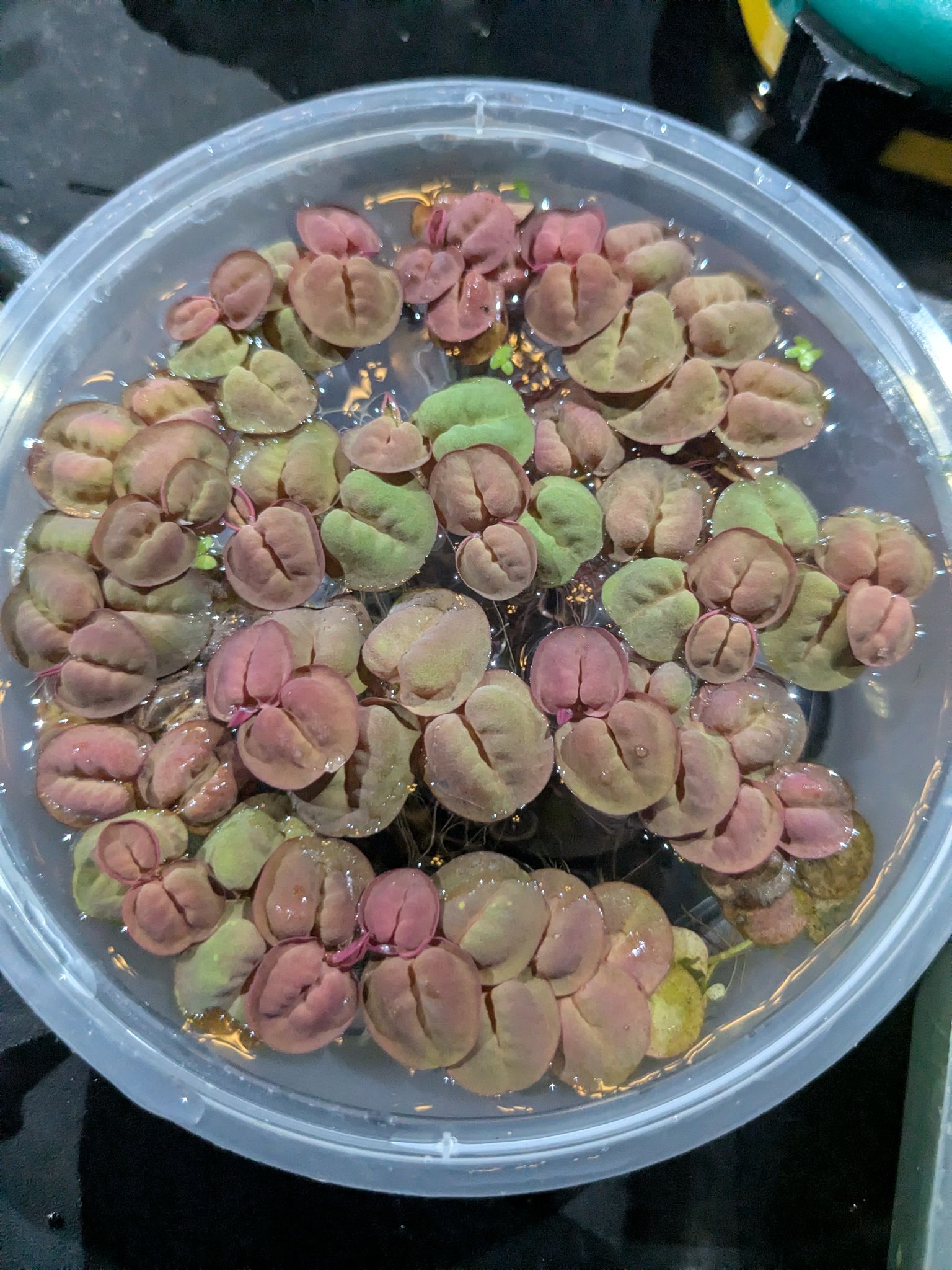
Red Root Floater Care Guide: Light, CO2, Substrate and Growth Tips
Red Root Floater (Phyllanthus fluitans) is a small floating plant prized for its crimson roots and pads, but plenty of tanks end up with a plain green mat instead of the red color the plant is named for. This guide covers the exact light, water, and nutrient conditions that drive coloration, clears up where care advice disagrees, and walks through the most common growing problems and fixes.
What Is Red Root Floater?
Red Root Floater is a true floating plant native to South American waterways, forming small round pads roughly the size of a fingernail with long, bright crimson roots that dangle beneath the surface. Unlike rooted aquarium plants, it has no interest in substrate — everything it needs comes from the water column and the light above it. Its pads shift between green and red depending on tank conditions, which is the plant's defining care challenge and the focus of most of this guide.
It's sometimes confused with other reddish floaters. Mosquito fern (Azolla) has tiny, feathery, overlapping leaves rather than round pads, and red root water hyssop is an entirely different rooted plant. The giveaway for true Red Root Floater is the combination of round, lily-pad-like leaves and unmistakably bright red roots.
Lighting: The Main Driver of Red Color
Light intensity and duration matter more than any other single factor for this plant.
- Intensity: Moderate to high-intensity LED lighting is the standard recommendation for hobbyists who want strong red coloration. LEDs are preferred over older lighting types because they deliver more usable light without adding excess heat to the water surface, where this plant lives.
- Duration: Run the light for 6 to 8+ hours per day on a consistent schedule. Irregular photoperiods slow growth and coloration.
- Low light still works — with a tradeoff: A low-to-medium light tank will keep Red Root Floater alive, but the pads typically stay green or yellow-green rather than turning red. If your goal is simply a floating plant that helps with water quality and cover, low-medium light is an acceptable fallback. If you want the signature red color, moderate-to-high light is the standard to aim for.
- Thin the mat regularly: Because this plant multiplies quickly and floats in a dense layer, the top leaves shade the ones underneath. A thick, unthinned mat often shows red on top and green underneath simply because the lower leaves never see enough light. Regular thinning exposes more of the colony to light and keeps coloration even.
Does Red Root Floater Need CO2?
No. Red Root Floater's leaves sit on top of the water and pull carbon dioxide directly from the air, the same way most floating and emergent plants do. This is fundamentally different from submerged plants like stem plants or carpeting species, which rely on dissolved CO2 in the water column and often benefit noticeably from injected CO2. Adding pressurized or liquid carbon to a tank specifically for Red Root Floater's benefit provides no meaningful growth or color advantage — save the investment for your submerged plants if you keep any.
Substrate: Not Required
Red Root Floater doesn't touch the substrate at all. It's a true floater, absorbing nutrients through its dangling root system directly from the water column rather than drawing on anything buried below. You can run a bare-bottom tank, sand, gravel, or a planted substrate underneath it and the floater won't care either way — its nutrition depends entirely on what's dissolved in the water, which makes fertilization a bigger deal than it would be for a rooted plant.
Fertilizing and Getting the Red Color
Because there's no substrate to feed from, liquid fertilization is the primary way to supply nutrients. Three factors work together to control whether the plant is green or red:
- Light intensity (covered above) — the trigger for pigment production.
- Iron availability — the single most-cited nutrient for red coloration. An iron-rich liquid fertilizer, dosed regularly, is what actually supplies the raw material for red pigment.
- Limited excess nitrogen — high nitrate levels push the plant toward vigorous green growth instead of red pigmentation. Keeping nitrate in a moderate range (rather than very high) gives iron and light the chance to express red color instead of being overridden by lush green growth.
The underlying biology: red pigmentation in floating plants like this one comes from anthocyanin production, which the plant ramps up as a kind of light-stress response. Bright light plus nutrient conditions that aren't overloaded with nitrogen signal the plant to produce more red pigment; low light or nitrogen-heavy water signals it to stay in "grow fast, stay green" mode instead. This is a reversible response, not a permanent trait or a sign of disease — the same plant can shift between green and red as conditions change.
A simple starter dosing routine: Since there's no universal dosing chart for this plant, a practical starting point is a weekly dose of a balanced liquid fertilizer at the label's low-tank recommendation, supplemented by an iron-specific additive two to three times per week. Watch the new growth over two to three weeks — if pads stay green with good light, increase iron frequency slightly before adjusting anything else. Browse liquid fertilizers and water conditioners to build a routine.
If your tank has shrimp or snails, check the label carefully — copper-containing fertilizers are toxic to invertebrates and can cause die-offs even at low doses. Choose an invert-safe, copper-free formula if you're dosing a shrimp or snail tank.
Water Parameters
| Parameter | Recommended range | Notes |
|---|---|---|
| Temperature | 72–80°F (22–27°C) | Tolerates roughly 64–86°F (18–30°C), but growth and color are best in the tighter band |
| pH | 6.5–7.5 | Slightly acidic to neutral is ideal |
| GH (general hardness) | 0–12 dGH | Soft to moderately hard; tolerates up to ~30 dGH but growth and color often suffer in very hard water |
| KH (carbonate hardness) | 0–14 dGH | Wide tolerance |
| Water flow | Still to gentle surface movement | Strong current or turbulence causes melting |
Why Water Flow Matters More Than It Seems
Red Root Floater is fragile at the surface. Strong current, turbulence from a filter outlet, or a powerhead aimed across the top of the tank will physically break up the mat, push plants underwater where they can't get light or air, and lead to melting. Position the plant in a low-flow corner, or use a spray bar, baffle, or floating ring to break up surface agitation before it reaches the colony.
Growth and Propagation
Under good light and steady nutrients, Red Root Floater grows at a moderate-to-high rate. It reproduces vegetatively:
- Side shoots branch off the main stalk.
- As a branch matures and grows its own root cluster, it naturally separates (fragments) from the parent plant and drifts off as an independent plantlet.
- No seeds or manual pollination are involved — propagation for home aquariums is entirely a matter of letting healthy plants multiply and then thinning them out.
New plantlets benefit from the same bright light and iron routine as established plants; give them a few weeks under good conditions and they'll develop their own red coloration rather than staying pale.
Maintenance and Thinning
Because it multiplies quickly, plan on trimming or removing excess floaters regularly. Two reasons this matters:
- Self-shading: an overgrown mat blocks light from reaching its own lower leaves, keeping large portions green even under strong lighting.
- Blocking light below: a solid surface mat cuts off light to any rooted or carpeting plants underneath, and can reduce oxygen exchange and light for fish in the tank.
Skim off excess growth every one to two weeks once the colony is established, keeping coverage to roughly a third to half of the surface for a balanced tank.
Comparing Red Root Floater to Other Floating Plants
Choosing between floaters often comes down to size, light needs, and how aggressively each one covers the surface.
| Floater | Size | Light needs | Root system | Growth speed |
|---|---|---|---|---|
| Red Root Floater | Small (dime-sized pads) | Moderate–high for red color | Long, bright red roots | Moderate–high |
| Dwarf water lettuce | Larger, lettuce-like rosettes | Moderate–bright | Dense, bushy white-green roots | Fast |
| Frogbit | Medium, round pads | Low–moderate | Moderate, feathery roots | Moderate |
| Duckweed | Tiny, single leaves | Low–moderate | Minimal | Very fast, hard to remove |
Dwarf Water Lettuce as a Comparison Point
Dwarf water lettuce shares the same basic care logic as Red Root Floater — no substrate needed, moderate-to-bright light, and a preference for still-to-gentle water movement. The key difference is scale: water lettuce forms much larger rosettes and shades a bigger footprint of the surface per plant. In a small or nano tank, combining aggressive Red Root Floater growth with a fast-spreading water lettuce colony can cover the entire surface faster than expected, cutting off light and gas exchange. If you're running a smaller tank, it's usually better to pick one dominant floater rather than let both compete unchecked.
Building a Self-Sustaining Tank Around Floating Plants
Floating plants like Red Root Floater are a practical building block for a low-maintenance, balanced aquarium. Their dangling roots pull ammonia and nitrate straight out of the water column, competing directly with algae for the same nutrients. A healthy floating mat also cuts down the amount of light reaching the water column below, which helps suppress algae growth, and it gives shrimp and fry a shaded refuge from predation. A tank with a well-managed floater colony, appropriate stocking, and regular water changes needs less intervention over time than a tank with no surface cover at all.
A Note on Nitrate Control
Red Root Floater belongs in the same category as duckweed, frogbit, and water lettuce as a nitrate-removal plant. Its root system draws nutrients directly from the water rather than through a substrate, making it genuinely useful for nutrient export in a lightly to moderately stocked tank — not just decorative. It won't replace water changes in a heavily stocked tank, but it measurably reduces the nutrient load between them.
Green Water and Algae Blooms
Green water (a free-floating algae bloom that clouds the tank) is driven by two things: excess light reaching the water column and excess dissolved nutrients, particularly nitrate and phosphate. Floating plants including Red Root Floater help on both fronts — they shade the water below and compete with algae for the same nitrate and phosphate. As part of a green water response, thin but don't remove your floater colony, combine it with partial water changes, and consider a UV sterilizer for an active bloom; floating plants alone are a preventive measure more than an emergency fix.
Stocking Around a Floater Mat
A floating mat changes the light and cover profile of a tank, which affects stocking choices. Fish that appreciate dimmer light and overhead cover — bettas in particular — tend to do well underneath a Red Root Floater colony, and the plant is a common choice in shrimp tanks for the same reason: shade, security, and nutrient export. If you're stocking a tank around floating plants, check out bettas and shrimp, both of which pair well with floating cover. Keep in mind that a dense mat will reduce light to any carpeting or foreground plants growing below it, so balance coverage if you're also running a planted substrate.
Containing the Mat
If you need a clear patch of surface for feeding, CO2 diffusion (for other plants), or equipment access, a floating ring or a simple plastic frame will corral the colony into one section of the tank instead of letting it drift and spread edge to edge. This is a low-cost way to keep both a floating mat and an open surface in the same aquarium.
Common Mistakes and Troubleshooting
| Symptom | Likely cause | Fix |
|---|---|---|
| Mat melting or falling apart | Excess surface flow/turbulence, or a sudden light change | Reduce flow at the surface; acclimate to new lighting gradually |
| Stays green, never reds up | Insufficient light intensity/duration, or lack of iron | Increase light to moderate-high and add an iron supplement |
| Holes or ragged leaf edges | Potassium deficiency | Add a potassium-rich fertilizer |
| Overgrown mat, plants below dying back | Overgrowth blocking light | Thin the mat regularly; give away or compost excess |
| Shrimp or snails dying after fertilizing | Copper-containing fertilizer | Switch to an invert-safe, copper-free formula |
| Confused with another red floater | Misidentification (Azolla, water hyssop) | Confirm by round pad shape and bright red roots |
Can Red Root Floater Live Outdoors?
Red Root Floater is a tropical plant, so in most of the US it's an indoor tank plant year-round rather than a pond plant. Floating plants in general are popular in outdoor ponds for water clarity and balance, but this species will only tolerate outdoor conditions during warm-season stretches where water stays consistently within its temperature range — it won't survive a cold snap or overwinter outdoors in temperate climates. If you want a floater for a seasonal outdoor setup, treat it as a warm-months addition and bring it back inside, or restock, once temperatures drop.
Frequently Asked Questions
Does Red Root Floater need CO2?
No. Its leaves float on the surface and take carbon dioxide directly from the air, so injected CO2 provides no meaningful benefit, unlike with fully submerged plants.
What light makes Red Root Floater turn red?
Moderate-to-high intensity light, ideally LED, combined with regular iron dosing and moderate (not excessive) nitrogen levels. All three factors work together — strong light alone without iron often isn't enough.
Does it need substrate or root tabs?
No. It's a true floater that feeds through roots suspended in the water column, so root tabs do nothing for it. Use a liquid fertilizer instead, with extra attention to iron.
What temperature and pH does it need?
Roughly 72–80°F (22–27°C) and a pH of 6.5–7.5, in soft to moderately hard water. It tolerates a wider range on both ends, but growth and color are most reliable within that band.
How fast does it multiply, and how do I propagate it?
Growth is moderate to high under good light and nutrients. It propagates through side-shoot branching — new plantlets form their own root cluster, naturally separate from the parent, and drift off on their own; no manual work is required beyond thinning the colony.
Is it safe with shrimp?
Yes, it's a popular choice for shrimp tanks thanks to the cover and nutrient export it provides. The one caution is fertilizer choice — avoid copper-based formulas, which are toxic to shrimp and snails.
Why is my Red Root Floater melting or turning brown and mushy?
The most common causes are excessive surface flow or turbulence, or a sudden change in lighting or water parameters. Reduce agitation at the surface and make any lighting or parameter changes gradually rather than all at once.
Can it live outdoors in a pond?
It's a tropical species, so outdoor use in the US is limited to warm-season ponds where water temperatures stay in its comfort range. In most climates, keep it as an indoor aquarium plant.
Ready to set up your floating plant colony? Browse LED lighting built for planted tanks on FishyHub to get the intensity Red Root Floater needs for strong red color.

