Rabbit Snail Care Guide: Setup, Feeding, Water Parameters and Breeding
Rabbit snails are hardy, alkaline-water grazers from Sulawesi that are easy to keep once their calcium and hardness needs are met. This guide gives you one consolidated set of tank, water, and feeding targets — instead of the scattered numbers you'll find elsewhere — plus how to prevent the shell erosion that causes most losses and what to expect if they breed.
What Is a Rabbit Snail?
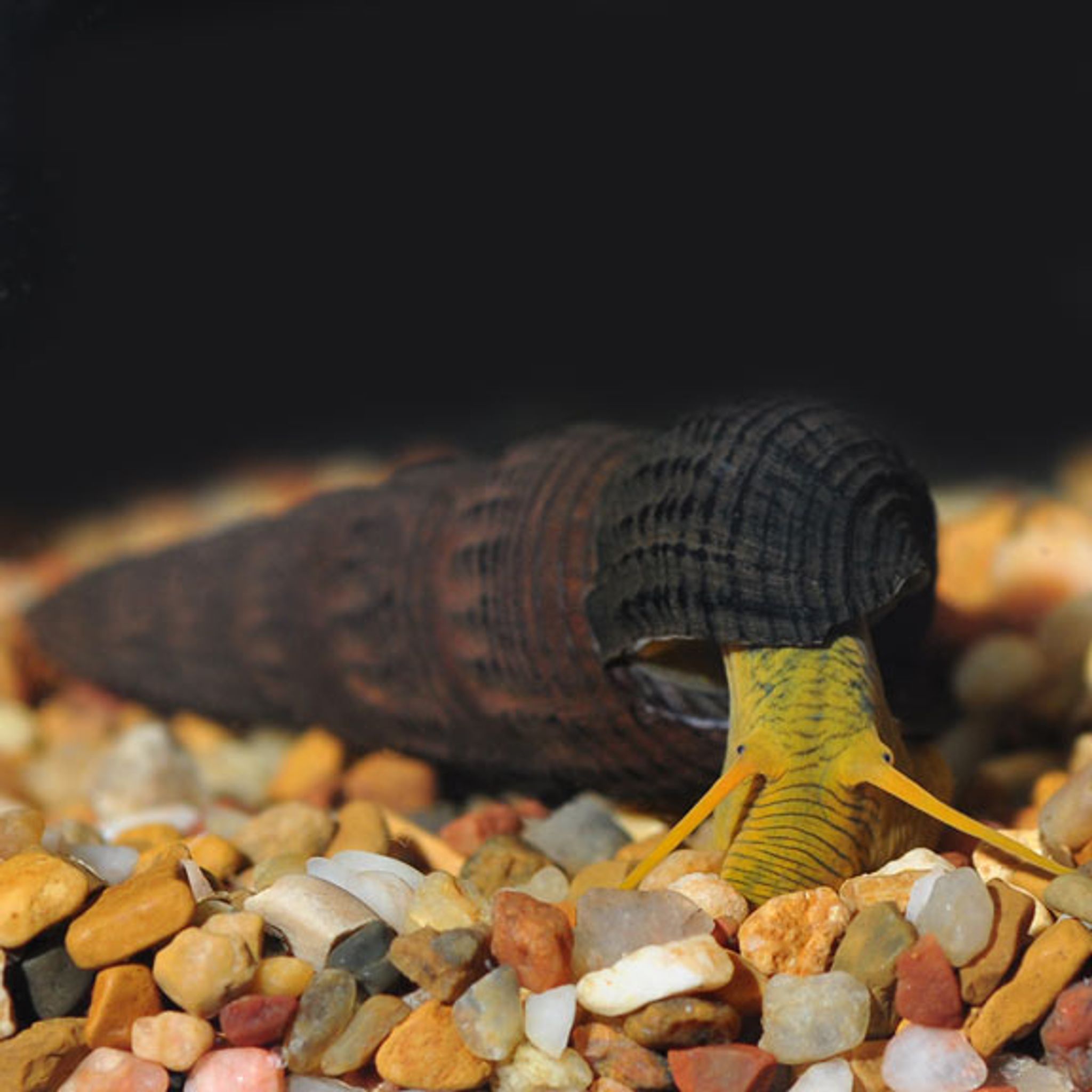
Rabbit snails belong to the genus Tylomelania, native to freshwater lakes and rivers on the island of Sulawesi, Indonesia. Their common name comes from their face: an elongated snout and two drooping antennae that resemble a rabbit's ears. They're peaceful, slow-moving scavengers that spend most of their time plowing through substrate or grazing on surfaces.
The trade sells several species and color forms under the "rabbit snail" umbrella, including:
- Chocolate/brown — the most common, workhorse variety
- Black
- Gold/yellow
- Orange (Sulawesi) — a bright orange-yellow morph from Sulawesi's lakes, reaching up to about 4 in (10 cm)
- Spotted/leopard "Poso" types
- "Elephant snail" varieties, which have a more pronounced trunk-like proboscis
- Hercules snails, a larger giant Tylomelania form marketed under this name, sharing the same genus-wide care but growing noticeably bigger
Labeling in the aquarium trade is inconsistent, and species names frequently get mixed up between sellers. This isn't a major concern for a beginner: care requirements are nearly identical across all Tylomelania colors and species, so buying whichever color catches your eye is a safe choice.
Size and lifespan: Most rabbit snails reach 1.5–3 in (4–7.5 cm), with some Sulawesi and giant types reaching up to 4 in (10 cm). Expect a 1–3 year lifespan in captivity, longer with stable, well-buffered water.
Tank Setup
Tank Size
Sources disagree here — some say 5–10 gallons per snail is enough, others recommend a flat 30-gallon minimum. A practical middle ground: 10 gallons (38 L) is workable for one or two snails, but 20–30 gallons (75–115 L) is the better long-term choice, especially if you're keeping several snails alongside fish or shrimp. A larger volume dilutes waste and buffers the swings in pH and hardness that damage shells.
Substrate
Use fine sand. Rabbit snails burrow and plow through the substrate constantly, and coarse gravel can injure or wear down their foot. Sand also lets them exhibit natural behavior without abrasion.
Lid
A tight-fitting lid is worth adding. Rabbit snails climb glass and decor readily, and an open-top tank is an easy way to find one on the floor.
Filtration
Aim for moderate, steady flow. Rabbit snails aren't strong swimmers and can struggle against a powerful current, but they still need solid biological filtration to keep waste and nitrate under control. A gentle sponge filter or a hang-on-back unit turned down slightly both work well.
Water Parameters
This is the part most guides get vague or contradictory on. Rabbit snails need alkaline, moderately hard water — the opposite of the soft, acidic conditions common in planted, CO2-injected tanks. Use the table below as your reference range.
| Parameter | Target Range | Notes |
|---|---|---|
| Temperature | 74–84°F (23–29°C); best 76–82°F (24–28°C) | Sulawesi-native stock tolerates the warmer end |
| pH | 7.3–8.5; best 7.5–8.0 | Treat 7.3 as a practical floor — below neutral risks slow shell dissolution |
| GH | ~6–12 dGH | General hardness supports shell material |
| KH | ~4–8 dKH | Some sources cite 2–15 dKH; treat the low end as a floor, not a target |
| TDS | ~100–200 ppm | General reference, not a hard rule |
| Nitrate | Under 10–20 ppm | Maintain with 20–30% weekly water changes |
Never keep rabbit snails in soft or acidic water. This is the single biggest driver of shell pitting, cracking, and flaking, and it's a common trap in heavily planted, CO2-injected setups where pH is deliberately pushed down. If your tank runs on driftwood tannins and CO2 to keep plants happy, check your pH and KH before adding rabbit snails — their needs actively conflict with a soft-water planted-tank aesthetic. If your numbers run low, raise GH/KH gradually with a mineral buffer or crushed coral rather than in one large jump.
Understanding KH and Why It Matters Here
KH (carbonate hardness) is the water's buffer against pH swings — it's what keeps pH from crashing after a water change or a spike in organic waste. For general freshwater community tanks, ~4–8 dKH is a reasonable range, and it's directly tied to rabbit snail shell health: low KH means less buffering capacity, more pH instability, and faster shell erosion. You can raise KH with crushed coral or a mineral buffer, or lower it with RO water blended into tap water if your source water runs too hard.
Do Rabbit Snails Need a Heater?
Yes, in most US homes. Rabbit snails need consistently warm water in the mid-70s to low-80s °F range, and most houses run cooler than that, especially overnight or in winter. If your tank isn't reliably staying in that range without help, add a heater.
Feeding
Rabbit snails are omnivorous scavengers and biofilm grazers. In an established, lightly cleaned tank, they'll spend much of their time eating soft algae, biofilm, decaying plant matter, and leftover fish food.
That said, don't assume "they'll eat algae" is enough on its own — it's one of the most common mistakes owners make. Newer or heavily cleaned tanks often don't generate enough biofilm to sustain them, leading to starvation and thinning shells. Supplement their diet every 2–3 days with:
- Algae wafers or sinking pellets
- Spirulina tablets
- Blanched vegetables — zucchini, spinach, broccoli, cucumber, kale, lettuce
- Occasional protein, such as frozen bloodworms
Calcium and Shell Health
Calcium supplementation is essential, not optional. A cuttlebone left in the tank, a dedicated calcium supplement, or mineral-rich foods all help. Combined with alkaline water in the 7.5–8.0 pH range, adequate calcium is what prevents shell pitting and erosion — the most commonly reported health problem with this species. If you're already seeing white pitting or a flaking shell edge, test your GH/KH first, then add a calcium source; the two fixes work together.
Tankmates
Rabbit snails are peaceful and slow, which makes them easy to pair but also puts them at risk around the wrong tankmates.
Safe tankmates:
- Peaceful community fish: tetras, rasboras, guppies, danios, gouramis, otocinclus
- Dwarf shrimp: cherry, amano, and ghost shrimp — rabbit snails don't predate on shrimp
- Other peaceful snail species
Avoid:
- Cichlids, crayfish, goldfish, loaches, and puffers, which may nip at the snail's exposed foot or antennae
- Assassin snails, which actively hunt and eat other snails
- Any large, aggressive, or predatory fish
A rabbit snail can generally live in a betta tank, since bettas are typically peaceful toward slow-moving inverts, but individual temperament varies — watch for fin- or antenna-nipping and be ready to separate if a particular betta turns aggressive. You can browse compatible community fish and dwarf shrimp on FishyHub's Freshwater Livestock and Shrimps categories when stocking a rabbit snail tank.
Behavior: Resting vs. Dead
Rabbit snails are active day and night, despite the sluggish reputation snails have. They're solitary but not aggressive toward each other. A common mistake is assuming a motionless snail has died and discarding it — long stillness is normal resting behavior, not a sign of death.
Before removing a snail you suspect is dead, check for:
- A strong, foul odor coming from the shell
- The body floating, detached, or hanging loose from the shell opening
- No response when gently touched
If none of those signs are present, leave it alone. A resting rabbit snail can stay still for a surprisingly long stretch.
Breeding
Unlike pond, ramshorn, or bladder snails — which lay large clutches and can overrun a tank — rabbit snails reproduce slowly, livebearer-style. Females produce a single translucent, gelatinous egg case containing just 1–3 embryos, roughly every few weeks to a month depending on the individual and conditions. Babies emerge fully formed and are immediately independent, with no larval or free-floating egg stage to manage.
Sexual maturity is reached around 1–1.5 in (2.5–4 cm) of shell length. No separate breeding tank is required — stable, warm water in the upper 70s to low 80s °F combined with good, consistent feeding is what encourages reproduction. Because the reproduction rate is so slow, a population explosion is very unlikely, which is a genuine selling point over other freshwater snails for anyone who wants a clean-up crew without the overpopulation risk.
Related Species Often Confused With Rabbit Snails
Pagoda Snails
Pagoda snails (genus Brotia or Sulcospira) are a related but distinct group, easily told apart by their pointed, layered spiral shell that resembles a pagoda tower. They're frequently mixed up with rabbit snails in the trade. Care overlaps closely: alkaline water and calcium availability matter just as much. Brotia pagodula is a commonly kept pagoda species — it's a freshwater algae and biofilm grazer that prefers harder, alkaline water with some current.
Faunus ater ("Black Faunus")
Faunus ater is another Sulawesi-region livebearing snail sometimes sold alongside rabbit snails, and it's worth distinguishing from true Tylomelania. It shares the same warm, alkaline, calcium-rich water requirements, but it isn't the same genus, so don't assume identical size or appearance expectations.
Algae: What Rabbit Snails Will and Won't Control
Rabbit snails prefer soft biofilm and detritus over tough, established algae, so they're a useful supporting member of a clean-up crew rather than a primary algae-control species. Knowing which algae you're dealing with helps set realistic expectations:
- Green spot algae — small, hard green dots on glass and slow-growing leaves
- Brown algae (diatoms) — dusty brown film, common in new or low-light tanks; usually resolves as the tank matures, and wiping surfaces plus otocinclus or nerite snails speed it along
- Staghorn algae — grey-dark, bushy, branching tufts on leaves and hardscape, caused by nutrient imbalance, poor flow, or excess light hours; treat with manual removal, a blackout period, liquid carbon, better circulation, and a shorter photoperiod
- Hair/string algae — thin green strands, often from excess nutrients and light
- Blue-green algae (cyanobacteria) — a slimy, often smelly film, usually a sign of poor flow or excess organics
Natural Algae Control
Rabbit snails contribute to algae control but shouldn't be your only line of defense. A more complete approach balances:
- Lighting duration (8–10 hours per day)
- Nutrient dosing matched to plant uptake
- Adequate water circulation
- Live plants competing for excess nutrients
- A varied clean-up crew — snails, shrimp, and otocinclus together
Chasing algae with chemical spot-treatments alone rarely fixes the underlying cause. Address water changes, feeding amount, photoperiod, and fertilizer/CO2 balance first, and algae growth typically settles down as the tank matures.
Buying and Acclimating Rabbit Snails
When selecting stock, look for an actively extended foot, a shell free of cracks or heavy pitting, and no strong odor coming from the animal or its bag. Since rabbit snails are usually purchased individually or in small numbers rather than in bulk feeder-stock, it's worth quarantining new arrivals and inspecting any plants added at the same time for hitchhiking pests.
Snails are more sensitive to sudden shifts in temperature and water chemistry than many fish. Drip acclimation over 30–60 minutes — slowly mixing your tank water into the bag or container — is a safer bet than a quick float-and-dump, especially if your source water's pH or hardness differs noticeably from your tank's.
Common Mistakes and Troubleshooting
| Mistake | Consequence | Fix |
|---|---|---|
| Soft/acidic water (common in CO2-injected planted tanks) | Shell pitting, cracking, thin or flaking shell | Test and raise GH/KH; add a calcium source; consider crushed coral or a mineral buffer |
| Assuming stillness means death | Healthy snails discarded | Check for odor and a detached, decomposing body before removing |
| Relying on algae alone to feed them | Starvation, shell thinning | Supplement every 2–3 days, especially in clean or low-algae tanks |
| Housing with fin/antenna-nipping or predatory fish | Injury or predation | Vet tankmates against the avoid list before adding |
| Using copper-based medications | Lethal to snails | Remove snails before treating fish, or use invert-safe medications |
| Open-top tank | Snail escapes via climbing | Use a tight-fitting lid |
| Mixing up species names when buying | Mismatched size/color expectations | Minor issue — care is near-universal across Tylomelania colors |
Frequently Asked Questions
How big do rabbit snails get?
Most rabbit snails reach 1.5–3 in (4–7.5 cm), with some varieties and species, including certain Sulawesi and giant forms, growing to about 4 in (10 cm).
Do rabbit snails multiply out of control like other snails?
No. Unlike pond, ramshorn, or bladder snails, they reproduce slowly, producing a single offspring roughly every few weeks to a month. A population explosion is very unlikely.
What do rabbit snails eat?
They graze on algae, biofilm, and detritus, but should be supplemented every 2–3 days with algae wafers, sinking pellets, blanched vegetables, and a calcium source to prevent shell thinning.
Can rabbit snails live with shrimp?
Yes. They're compatible with cherry, amano, and ghost shrimp and don't predate on them, making them a common addition to shrimp tanks.
Why is my rabbit snail's shell cracking or pitting?
This is usually caused by low pH, GH, or KH, or insufficient calcium in the diet. Test and raise your water hardness, adjust pH into the 7.5–8.0 range, and add a calcium source such as cuttlebone.
Do rabbit snails need a heater?
Yes, in most US homes. They need consistently warm water from the mid-70s to low-80s °F, which is warmer than most unheated rooms run, especially in cooler months.
Are rabbit snails hard to breed?
Not intentionally difficult, but slow. Expect roughly one baby every few weeks under stable, warm, well-fed conditions rather than a sudden population boom.
Can rabbit snails live in a betta tank?
Generally yes, since they're peaceful and slow-moving, but individual betta temperament varies. Monitor for fin- or antenna-nipping and avoid pairing with an unusually aggressive betta.
Ready to add rabbit snails to your setup? Browse compatible stock and calcium-friendly supplies in FishyHub's Freshwater Livestock category.

