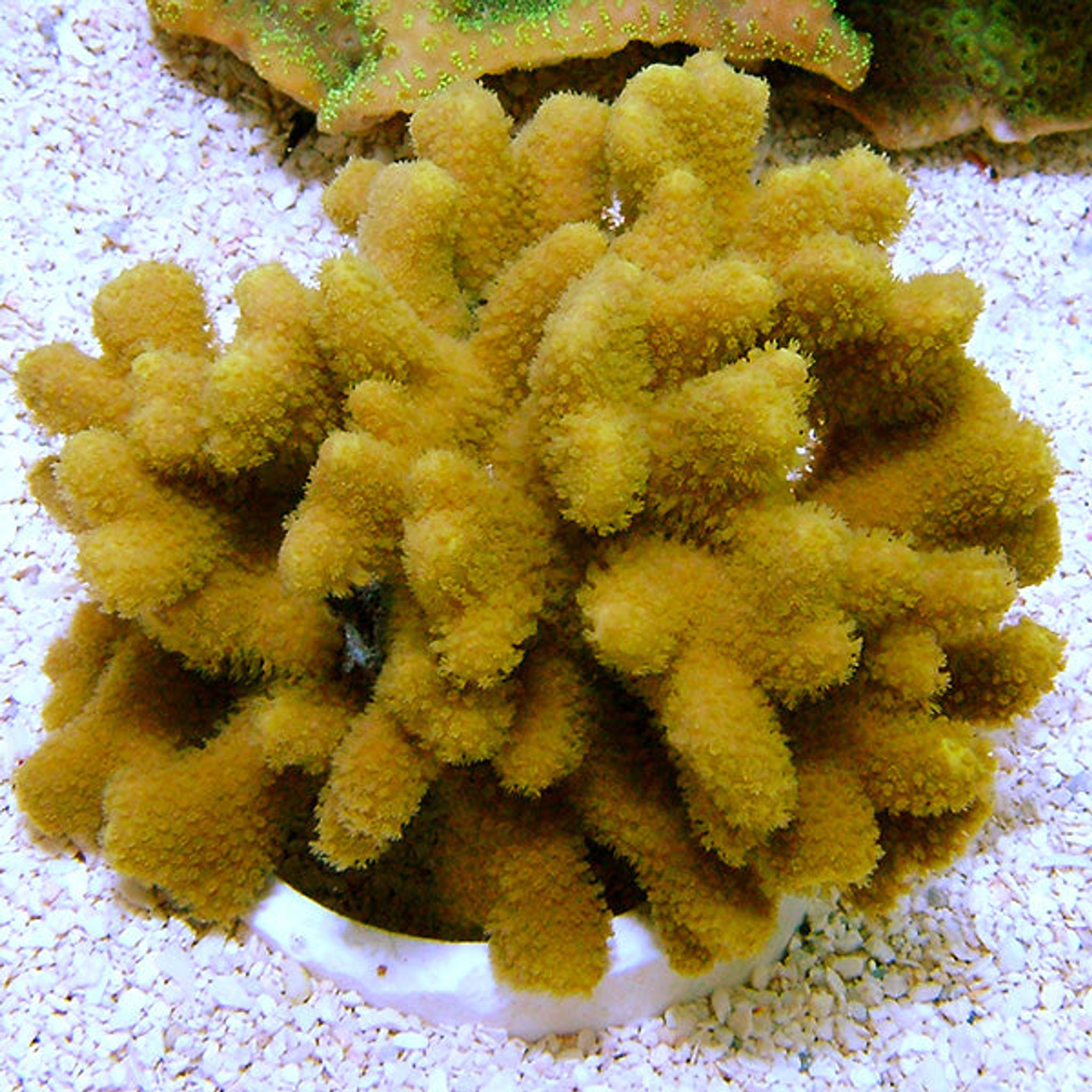

Porites Care Guide: Lighting, Flow, Feeding and Placement
Porites is one of the most under-rated stony corals in the hobby: forgiving of light and flow swings the way a soft coral is, yet still a true reef-building coral that needs real alkalinity and calcium support. This guide covers exactly what lighting, flow, feeding, and placement a Porites colony needs, plus the specific failure mode — tissue recession and mucus loss — that catches new keepers off guard.
What Is Porites, Exactly?
Porites is a large genus in the family Poritidae, easily identified by its very small polyps and tiny skeletal pores, which give the tissue a fuzzy, carpet-like texture rather than the fleshy or bubbly look of larger-polyped LPS. In the trade you'll see three main growth forms:
- Massive/boulder — dense, rounded colonies (often labeled "lutea-type")
- Encrusting — thin sheets that spread across rock
- Branching/digitate — finger-like or "hedgehog" colonies (often labeled "cylindrica-type")
Species-level identification within Porites is genuinely difficult, even for trained taxonomists, because the differences come down to microscopic skeleton structure. Buy based on growth form and coloration rather than trusting a species name on the label — a tag that says "cylindrica" or "lutea" is a reasonable guess, not a guarantee.
Difficulty Level
Porites is generally rated easy to moderate — noticeably more tolerant of light and flow instability than Acropora, and closer to soft-coral resilience in that respect. But it is still a true stony (hard) coral that builds a calcium carbonate skeleton, not a soft coral. That distinction matters: Porites needs the same ongoing alkalinity, calcium, and magnesium diligence as SPS, even though it forgives more drift along the way. Treating it as "set and forget" is one of the most common ways a Porites colony declines over several months.
Lighting
Porites tolerates a wide PAR range, which is exactly why sources disagree about it — some guides lump it with easy LPS at 100–150 PAR, others treat branching cylindrica-type colonies more like SPS at 200+ PAR. The practical approach: start around 100–150 PAR and acclimate upward toward 200+ if you want more intense color or faster growth.
- Placement generally works from lower mid-tank to upper mid-tank.
- Color often washes to a lighter, more pastel tone under very intense light, and turns browner or greener under lower light.
- Porites tolerates blue-heavy reef LED, T5, and legacy metal halide spectrums; color intensifies with more blue light, but tissue does fine under a general-purpose reef spectrum.
- Acclimate slowly — over 1–2 weeks — any time you move a colony to brighter light. Rushing this is the single most common cause of bleaching or tissue recession in an otherwise healthy colony.
You can browse suitable fixtures in FishyHub's LED lighting selection if you're upgrading before adding a Porites colony.
Flow
Porites wants medium to high flow that is turbulent and random rather than laminar. This is another point where sources disagree: some emphasize strong direct flow, while others warn that a single direct powerhead blast can tear or stress the fine tissue on branch tips. The safer recommendation is to run wavemakers on a pulse or random mode rather than aiming one steady jet at the colony.
Random flow matters more for Porites than for many LPS because of its anatomy: the tiny polyps and pores that give Porites its carpet-like texture can't shed settling detritus and film algae as effectively as the larger polyps on a torch or hammer coral. Without enough turbulence, sediment and organic film accumulate on the tissue surface. For branching colonies, make sure flow reaches the interior branches too — dead spots in the middle of a dense branching colony are a common source of localized tissue stress.
Water Parameters
Porites is comparatively tolerant of minor swings, but calcification still depends on stable, adequate alkalinity, calcium, and magnesium — the reef "big three." Use this table as a genus-specific reference rather than a generic LPS or SPS number:
| Parameter | Target Range |
|---|---|
| Temperature | 76–80°F (24–27°C) |
| Salinity | 1.024–1.026 SG |
| pH | 7.8–8.4 |
| Alkalinity | 8–12 dKH |
| Calcium | 380–450 ppm |
| Magnesium | 1250–1350 ppm |
| Nitrate | <10–20 ppm (low, not zero) |
| Phosphate | <0.1–0.2 ppm |
| PAR | ~100–200+ |
| Flow | Medium-high, turbulent/random |
Note that nitrate and phosphate should be low but not scrubbed to zero — ultra-low-nutrient systems can leave Porites pale and effectively starved, which ties directly into the feeding question below.
Feeding
Porites is photosynthetic, hosting zooxanthellae that supply most of its energy needs, so feeding is genuinely optional for a colony in a nutrient-replete tank. That said, the small polyps are also capable of capturing phytoplankton-sized particles and dissolved organics, and sources disagree on how much this matters:
- Some argue Porites rarely needs target feeding because it's almost entirely photosynthetic.
- Others recommend regular fine-particulate feeding for the best growth and color, especially in very clean, low-nutrient systems.
The practical middle ground: feeding is optional insurance in ultra-low-nutrient tanks, and largely unnecessary in systems that already run some background nutrient load. When you do feed, broadcast phytoplankton, fine coral powders, or a gel food-style fine particulate a few times a week. For newly fragged or stressed colonies, target feeding with a turkey baster or pipette during lights-out or a low-flow moment can help speed recovery.
Placement
Place Porites mid to lower-mid tank, on rock, away from aggressive neighbors. Because it's one of the faster-growing stony corals in captivity — especially the branching cylindrica-type — leave several inches of buffer around it so it doesn't overgrow or shade corals placed too close.
- Branching colonies need room to grow outward and upward without shading anything below them.
- Encrusting and massive forms make excellent "base rock" corals lower in the display, near the sandbed or lower rockwork.
- Porites tolerates light sedimentation noticeably better than most SPS, which makes it a genuinely useful option for anchoring sandbed transition zones where a bit of settling sand or detritus is unavoidable.
Growth Rate and Fragging
Porites is one of the faster-growing stony corals in the hobby, and branching cylindrica-type colonies in particular can show visible growth within weeks under good conditions. That growth rate is a double-edged sword: it makes Porites satisfying to watch, but it also means a heavily stocked tank with several fast-growing colonies can draw down alkalinity faster than expected — see the alkalinity section below.
Fragging follows the same basic technique as other stony corals: cut dry with bone cutters or a saw, mount the frag on a plug, and let it heal for 1–2 weeks in low-to-moderate flow and light before moving it into the display. Branching Porites frags heal reliably as long as you avoid strong direct flow during the healing window.
Compatibility and Pests
Porites is peaceful and passive, lacking the strong sweeper tentacles that make some LPS aggressive. It's relatively reef-safe near other corals as long as adequate spacing is maintained — but keep it away from aggressive LPS like torches, hammers, and frogspawn, whose sweeper tentacles can still sting it.
The bigger threat isn't other corals — it's pests. Certain coral-eating nudibranchs and flatworms specifically target Poritidae, along with some predatory snails. Always quarantine and dip new frags before adding them to a display that already houses Porites, since these pests can spread quickly once established.
Why Porites "Fails" Anyway
Given how forgiving it is, most Porites losses trace back to a handful of specific, avoidable mistakes:
| Symptom | Likely Cause | Fix |
|---|---|---|
| Tissue recession/bleaching after a light upgrade | Acclimated too fast to higher intensity | Ramp light gradually over 1–2 weeks; dial back if paling continues |
| Brown jelly-like tissue loss | Physical damage (shipping, fragging, pest bite) plus opportunistic bacteria | Isolate, siphon affected tissue, dip in a coral-safe iodine solution, improve flow |
| Algae or cyanobacteria film on the polyps | Flow or nutrient imbalance | Increase random flow and correct nutrients — don't scrub the coral directly |
| Sudden decline after a water change or new dosing routine | Alkalinity/calcium mismatch between new water and tank | Match new saltwater parameters to the tank; introduce dosing changes slowly |
| Neighboring corals getting shaded or overgrown | Porites is a fast, ambitious grower | Prune or reposition proactively once it approaches nearby corals |
If you're shopping for a first Porites colony or a compatible tankmate, FishyHub's LPS hard corals and broader coral selection are good places to compare growth forms side by side.
Alkalinity Deep-Dive
Alkalinity (dKH) measures the water's buffering capacity — specifically, the carbonate and bicarbonate available for coral skeleton building. For Porites, stability matters more than hitting an exact number within the 8–12 dKH range. Swings larger than about 1–1.5 dKH per day are what stress stony corals, not small deviations from a target.
In a coral-heavy tank, test alkalinity two to three times a week. Common dosing methods include two-part liquid solutions, kalkwasser, and calcium reactors — the right choice depends on how much stony coral biomass you're supporting and how much manual dosing you're willing to do.
When a Calcium Reactor Makes Sense
A calcium reactor dissolves calcium carbonate media using CO2-acidified water, releasing calcium, alkalinity, and magnesium back into the tank. It's best suited to larger or heavily stocked SPS-dominant systems where dosing pumps would need constant refilling, and it requires a pH controller or careful drip-rate tuning to avoid over- or under-dosing.
This connects directly back to Porites: because branching colonies grow quickly, a tank with several established Porites colonies (or a mix of Porites and other fast SPS) can draw down alkalinity meaningfully faster than a soft-coral-dominated tank. If you find yourself dosing daily and still chasing alkalinity swings, that's the point at which a reactor becomes worth considering over manual two-part dosing.
Related Stony Corals Worth Knowing
Two other unusual stony corals sometimes come up in the same conversation as Porites, mostly by contrast:
- Blue coral has a solid blue aragonite skeleton and is rarely kept outside specialist or educational collections.
- Pipe organ coral, despite its stony appearance, is actually a soft coral relative with a red tubular skeleton — another collector curiosity rather than a mainstream reef tank staple.
Both highlight how accessible Porites is by comparison — a genuine reef-building stony coral that behaves, in practice, more like a beginner-friendly soft coral.
Psammocora contigua is a closer cousin worth a look if you enjoy Porites: another small-polyped stony coral with a similar fine, textured surface and moderate care requirements. It's a natural "if you liked this coral" cross-shop for anyone building out a small-polyped stony coral collection.
Did You Know: Wild Porites Spawning
In the wild, Porites lutea populations — documented in locations including Hawaii — undergo mass, sometimes daytime, spawning events. Most captive Porites colonies won't spawn in a home aquarium, but understanding synchronized spawning explains why wild colonies maintain such high genetic diversity, and why some boulder-form colonies in the wild are estimated to be centuries old.
Frequently Asked Questions
Is Porites coral hard to keep?
No — it's one of the more forgiving stony corals for reef beginners once basic alkalinity and calcium dosing is in place. It still needs stable reef parameters, unlike a true soft coral, but it tolerates more drift than Acropora.
How fast does Porites grow?
It's among the faster-growing stony corals kept in captivity, especially branching cylindrica-type colonies, which can show visible growth within weeks under good lighting, flow, and stable parameters.
What lighting does Porites need?
Moderate to moderately high PAR, roughly 100–200 or more, acclimated gradually over 1–2 weeks. It tolerates a range of LED, T5, and metal halide spectrums, with color intensifying under more blue-heavy light.
Does Porites need to be fed?
Not strictly — it gets most of its energy from photosynthesis. Occasional fine-particulate feeding is optional insurance that can help growth and color in very clean, low-nutrient tanks.
Why is my Porites losing color or turning pale?
Usually too much light introduced too quickly, or nutrients running too low. Paling can also be an early sign of heat or light stress bleaching, so check both your lighting ramp and your nitrate/phosphate levels.
Can Porites sting other corals?
It has minimal sweeper-tentacle aggression compared to LPS like torches or hammers, so it's relatively reef-safe. Still give it growing room, since its main threat to neighbors is physically overgrowing them, not stinging.
What pests attack Porites?
Certain coral-eating nudibranchs and flatworms specifically target Poritidae, along with some predatory snails. Quarantine and dip every new frag before it goes into a display that already holds Porites.
If you're ready to add one to your system, browse FishyHub's current coral livestock to compare branching, encrusting, and massive Porites growth forms alongside other LPS and SPS options.


