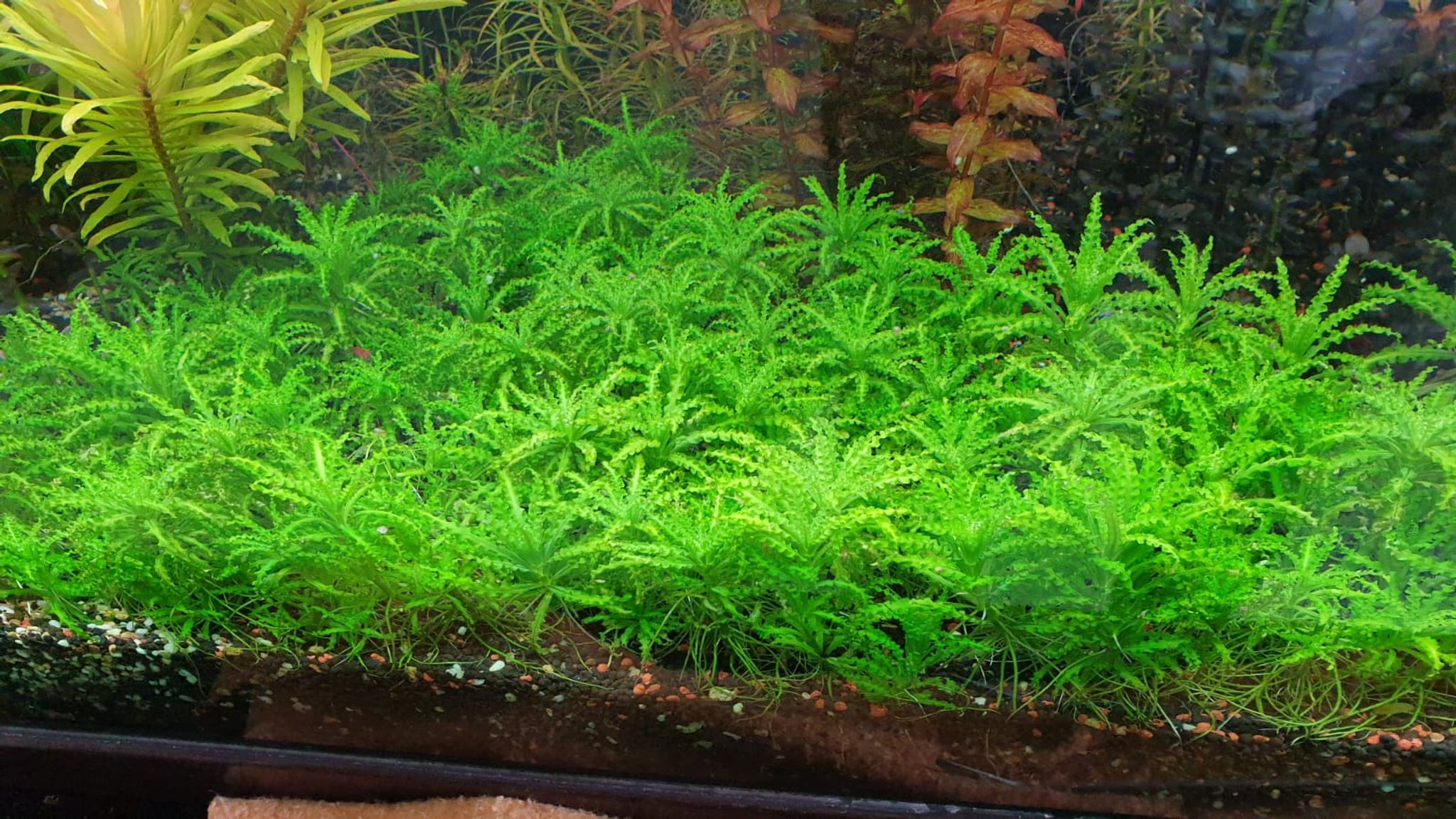
Pogostemon Helferi Care Guide: Light, CO2, Substrate and Growth Tips
Pogostemon helferi, commonly called Downoi, is a wavy-leaved foreground rosette plant that looks compact and full in photos but often stretches, thins out, or melts in a home tank. This guide breaks down the light, CO2, and substrate combination that actually produces the tight "starburst" look, plus a troubleshooting section for the stretching, browning, and melting problems most buyers run into first.
What Downoi Is and Why It's Tricky
Downoi is native to shaded streams in Thailand and grows as a low, bushy rosette of ruffled, bright-green leaves, typically 2-4 inches (5-10 cm) tall. It spreads sideways via runners, gradually filling in as a textured, clumping mat rather than a flat lawn.
It has a reputation as a beginner plant because it's widely sold and photographed in stunning aquascapes, but it's really a moderate-demand plant. It survives a wide range of conditions, but the compact, dense look people buy it for only shows up when light, CO2, and substrate are all reasonably dialed in together — miss on more than one, and you'll get a leggier, sparser version of the plant.
Light Requirements
Downoi needs medium-to-high light to hold its tight rosette shape. The consensus target is roughly 30-50+ PAR at the substrate, run for an 8-10 hour photoperiod.
- Too little light: the plant doesn't die, but it stretches vertically, loses its compact rosette form, and the leaves thin out and pale.
- Enough light with CO2/nutrients matched to it: short, dense, wavy leaves that hug the substrate.
- Too much light without matching CO2 and fertilizer: invites algae on the leaves before it improves plant density.
Choosing a Light for a Downoi Carpet
Match the fixture to the plant's demand tier instead of shopping by wattage or lumens, which don't tell you what reaches the substrate. A few practical rules:
- Start the photoperiod and intensity on the low side and ramp up gradually over a few weeks — this avoids kicking off an algae bloom before your plants and CO2 are established.
- PAR at your tank's depth matters far more than the marketing numbers on the box; a shallow nano tank needs much less raw output than a tall aquascape to hit the same PAR at the substrate.
- If a fixture is running hotter than the plant needs, you can raise it higher above the water or shorten the photoperiod instead of buying a dimmer light.
- Many current LED fixtures offer app or Bluetooth control for sunrise/sunset ramping and saved intensity presets — a convenience for dialing in Downoi's range precisely, not a requirement. You can browse full-spectrum LED lighting options sized to different tank depths.
Aquarium light in general drives both photosynthesis and leaf coloration: too little produces leggy, pale growth across most plants, too much invites algae, and a timer that holds a consistent photoperiod matters more for long-term stability than most people expect.
Does Downoi Need CO2?
This is where sources genuinely disagree. One camp treats CO2 as optional — the plant "gets by" without it, just leggier. Another treats it as effectively mandatory for the classic compact look and to avoid melt. The practical middle ground: CO2 or at minimum liquid carbon dosing is strongly recommended if you want the tight carpet look. Without it, the plant will still live — just set your expectations toward a taller, looser, slower-growing plant rather than treating any level of CO2 as a hard requirement.
Three Tracks for a Planted Tank (and Where Downoi Fits)
| Track | Setup | Downoi outcome |
|---|---|---|
| Low-tech, no CO2 | Low-to-medium light, easy plants, minimal dosing | Survives; taller, sparser, slower growth; lowest maintenance |
| Liquid carbon (middle path) | Medium-to-high light, liquid carbon supplement, root tabs/liquid fert | Noticeably more compact and denser than low-tech, without pressurized gear |
| Pressurized CO2 injection | High light, injected CO2, full fertilizer dosing | Best shot at the tight, full carpet shown in photos; more equipment and monitoring |
Pick the track that matches your equipment budget and tolerance for maintenance, then set your light and fertilizing to match — chasing a single "ideal" light or CO2 number without picking a track first is a common source of frustration.
Substrate
Downoi's roots are fine and delicate, so avoid sharp, coarse gravel that can shred them as they spread. A nutrient-rich planted substrate (aqua soil type), roughly 2-3 inches (5-7.5 cm) deep, is the preferred choice and gives the fullest, fastest growth.
It will also tolerate inert sand or gravel if you supplement with root tabs and liquid fertilizer — growth will be slower and less full, but it's a workable budget path. You can compare substrate soil and gravel and sand options when deciding which route fits your tank and budget.
Planting Technique
- Separate the plant into small clumps of 3-5 stems, spaced about 1 inch apart.
- Press each clump shallowly into the substrate so the roots are just covered and the crown sits at or above the surface — burying the crown causes rot.
- Give it an open, unshaded spot in the foreground; taller neighboring plants that shade a Downoi patch will stunt it.
Water Parameters
| Parameter | Target range | Notes |
|---|---|---|
| Temperature | 72-82°F (22-28°C) | Stable is more important than exact number |
| pH | 6.0-7.5 | Some tolerance down to ~5.5 and up to ~8.0 if stable |
| GH | Moderate, roughly 2-15 dGH | Soft to moderately hard water both work |
Quoted ranges for pH and GH vary widely across sources — treat 6.0-7.5 and moderate hardness as your safe target, with tolerance outside that band only if parameters stay stable. Sudden swings during water changes are more damaging than being slightly outside the ideal range, and are a common trigger for melt.
Growth Rate and the Emersed-to-Submerged Transition
Downoi's growth rate is genuinely condition-dependent, which is why you'll see it described as both fast and slow. Submerged, it's slow to moderate; grown emersed (above the waterline, as in a nursery pot or paludarium setup), it grows noticeably faster.
This matters at purchase time: most retail Downoi is grown emersed. When you plant it underwater, it's normal for some of the emersed leaves to melt back or drop as the plant converts to submerged growth. This isn't a sign of a dying plant — trim the dying leaves, keep water parameters stable, and new, submerged-form growth should appear within a few weeks.
Propagation and Trimming
Downoi propagates primarily through lateral runners (side shoots) that root on their own along the substrate. Snip a rooted runner free with scissors and replant it to fill a bare patch or start a new clump. Small plantlets can form the same way. Flowering and seed propagation only occur when the plant is grown emersed and isn't practical for most home aquarists.
For long-term maintenance of a dense patch rather than a one-time planting:
- Periodically trim back shoots that grow tall or leggy — this encourages denser, lower regrowth instead of a plant that keeps reaching upward.
- Replant the healthy cut side-shoots into thin or bare spots in the same patch.
- Thin overcrowded sections every few months so light reaches the base of the rosettes.
Fertilization
In a CO2-injected, higher-light tank, Downoi's nutrient demand goes up accordingly. It benefits from:
- Root tabs pushed near the root zone, especially in substrate-grown setups.
- Liquid macro and micro fertilizer covering nitrogen, potassium, and iron.
Pale or yellowing new growth is the main visible sign of a deficiency — it's worth increasing dosing before assuming a light or CO2 problem.
Tank Size and Placement
Downoi works in tanks from nano (5 gallons / 19 L and up) to large aquascapes — just scale the number of starter clumps to the foreground area you're trying to fill. It's a true foreground plant: it needs open space and unshaded light rather than being tucked under or behind taller stem plants.
Common Mistakes and Troubleshooting
| Problem | Likely cause | Fix |
|---|---|---|
| Rot at the base | Planted too deep, crown buried | Replant shallowly with the crown at the substrate surface |
| Melt right after planting | Normal emersed-to-submerged transition | Trim dead leaves, hold parameters stable, wait a few weeks |
| Stretching, pale, thin stems | Low light combined with no CO2 | Raise light and add CO2/liquid carbon, or accept a taller, looser habit |
| Stunted, small patch | Shaded by taller neighboring plants | Relocate to open foreground space |
| Yellow or pale new leaves | Nutrient deficiency | Dose root tabs and liquid macro/micro fertilizer |
| Shredded or ragged leaves | Grazing by snails or fish | Check tankmates; leaves are soft and palatable to some grazers |
| Melt after a water change | Sudden parameter swing | Acclimate gradually; keep changes smaller and more frequent |
If you keep grazing snails, shrimp, or algae-eating fish, watch new Downoi growth closely for the first few weeks — soft, tender leaves are an easy target compared to tougher-leaved plants. Species kept from the shrimp category are generally low-impact grazers, but heavier grazing fish can shred a young patch faster than it can regrow.
Related Plants Worth Comparing
If you like the genus but want a different growth form or an easier substitute, two plants are commonly grouped with Downoi in plant orders:
- Pogostemon stellatus (including the 'Octopus' cultivar): a background/midground stem plant, not a carpeting rosette. It tolerates medium light with CO2 optional, grows fast, and propagates easily by cutting and replanting stems.
- Lobelia cardinalis, especially the 'Mini' cultivar: a foreground-to-midground plant often bought alongside Downoi. The mini form stays compact and works as a substitute or companion carpet/midground plant — like Downoi, it prefers moderate-to-high light, benefits from CO2, and propagates via cuttings and runners.
Frequently Asked Questions
Does Pogostemon helferi need CO2?
Not strictly required to survive, but pressurized CO2 or liquid carbon is the main lever for getting the tight, compact carpet look. Without it, expect looser, taller growth rather than the dense rosette shown in photos.
Why is my Downoi turning brown or melting?
Usually one of three causes: transition stress from emersed-to-submerged growth, unstable water parameters, or too little light. Trim the affected leaves and stabilize conditions — new growth should follow within a few weeks.
Can Downoi grow without special substrate?
Yes, it can grow in inert sand or gravel with root tabs and liquid fertilizer, though it grows fuller and faster in nutrient-rich aqua soil.
How much light does Downoi need?
Medium-to-high light, roughly 30-50+ PAR, for 8-10 hours a day. Too little light causes stretching; too much light without matching CO2 and nutrients can invite algae on the leaves.
How do I propagate Downoi?
Let it send out lateral runners or side shoots, which root on their own along the substrate. Snip a rooted runner free and replant it to fill gaps or start a new patch.
Is Downoi a true carpet plant?
It grows as a bushy, spreading rosette rather than a flat lawn like dwarf hairgrass or Monte Carlo. Expect a textured, clumping carpet rather than a perfectly flat one.
What tank size works for Downoi?
Any size from nano tanks (5 gallons / 19 L and up) works — just scale the number of starter clumps to the foreground area you want covered.
Why does my Downoi look different from photos — taller and sparser?
Photo-tank specimens are usually grown under high light with CO2 injection and rich substrate. A lower-tech setup will still grow the plant, just in a looser, less compact form.
Ready to start a Downoi patch or fill in an existing one? Browse planted-tank substrate options on FishyHub to find the right base for the growth level you're aiming for.

