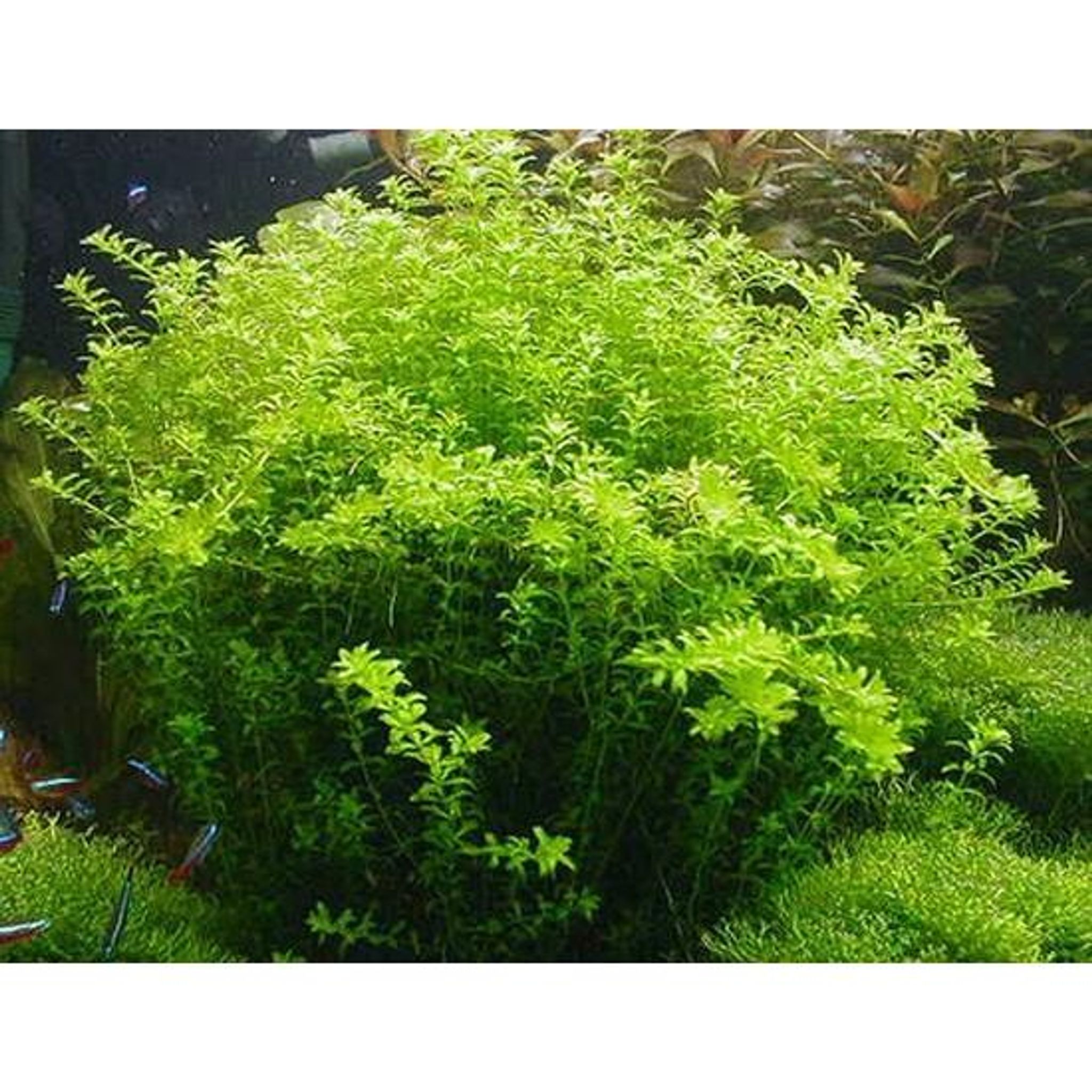
Pearl Weed Care Guide: Light, CO2, Substrate and Growth Tips
Pearl weed is one of the easiest small-leaved carpeting plants for a freshwater tank, but the name gets applied loosely to several look-alike species, which causes a lot of buyer confusion. This guide sorts out what you actually bought, then covers the light, CO2, substrate, and trimming specifics that decide whether it forms a dense carpet or just grows tall.
What Plant Did You Actually Buy?
"Pearl weed" or "pearlweed" almost always refers to Micranthemum micranthemoides, formerly classified as Hemianthus micranthemoides. An older synonym, Micranthemum glomeratus, is sometimes used for the same plant, and the common name "pearl grass" is used interchangeably with it too.
The confusion comes from two other plants sold nearby in the same section:
- Micranthemum tweediei "Monte Carlo" — rounder, slightly larger leaves, marketed as a pearl weed substitute.
- Micranthemum umbrosum — a bigger-leaved, faster-growing background plant in the same genus.
If your tag just says "pearlweed" with no species name, check leaf size: true pearl weed has tiny, tightly spaced oval leaves on thin stems. If the leaves look noticeably larger and rounder, you likely have Monte Carlo instead — still easy, but with a different growth habit (more on that below).
Light Requirements: Background Growth vs. a Tight Carpet
Light needs depend entirely on what you want the plant to do:
- General growth (background/midground stem plant): medium light is sufficient. The plant survives and spreads under a standard community-tank fixture.
- Low, dense carpet: you need medium-to-high light, roughly 30–50+ PAR at the substrate, which corresponds loosely to 2–4+ watts per gallon under older T5/T8 benchmarks.
Run the photoperiod at 8–10 hours a day. Under low light, pearl weed doesn't die — it just stretches. Leaves space out along the stem and growth goes vertical instead of filling in horizontally, which is the single most common mismatch between what people plant it for and what they set up.
Lighting matters beyond the plant, too: intensity and duration affect fish coloration and day-night rhythm, and — contrary to the instinct to blame the bulb — most algae outbreaks come from too much light relative to available nutrients and CO2, not from the light itself being "too strong." Dial in your photoperiod before assuming you need a dimmer fixture. You can browse LED aquarium lighting sized for planted tanks if you're upgrading from a stock hood light.
Does Pearl Weed Need CO2?
No — it survives fine without it, growing as an ordinary stem or background plant. But CO2 is strongly recommended if your goal is carpeting:
- It speeds up growth and thickens the mat.
- It's the main trigger for pearling — visible strings of oxygen bubbles forming on the leaves under strong light and good CO2, a sign the plant is photosynthesizing at full tilt.
Treat CO2 as optional-but-helpful rather than mandatory. A low-tech tank with medium light and no CO2 will still grow pearl weed; it just won't carpet as tightly or as fast.
Substrate: Not Picky, But a Boost Is Available
Pearl weed has a thin, weak root system and feeds mainly through its leaves from the water column, so substrate choice doesn't make or break survival. Sand, gravel, or a plain substrate all work.
Where sources disagree is whether substrate matters at all. The honest middle ground: a nutrient-rich planted substrate visibly speeds up and thickens growth compared to inert gravel, but it's an upgrade, not a requirement. If you already have a community tank with standard gravel, don't feel you need to tear it down — dose the water column instead. If you're setting up new, a mineral-rich planted substrate paired with a basic gravel and sand substrate cap can give you both the aesthetic and the nutrient benefit.
Water Parameters at a Glance
| Parameter | Range |
|---|---|
| Temperature | 66–82°F (19–28°C) |
| pH | 6.0–7.5 |
| General hardness (GH) | ~1–20 dGH |
| Carbonate hardness (KH) | ~1–15 dKH |
| Minimum tank size | ~5 gallons |
These ranges overlap with most community tank setups, so pearl weed rarely requires you to adjust water chemistry specifically for it.
Fertilization
Because the roots are weak feeders, liquid or water-column fertilizer matters more than root tabs. Keep nitrates and phosphates at adequate levels to prevent yellowing or melting, and don't skip dosing just because "any substrate works" — that's a common mistake that stalls growth even in a nutrient-rich setup. Iron and other micronutrients help maintain leaf color. Root tabs aren't wasted, but they're a secondary boost, not the primary feeding method.
Growth Rate and Habit
Pearl weed is slow to establish: expect 1–3 weeks of minimal visible progress right after planting while roots take hold. After that, growth accelerates, and under good light plus CO2 it can carpet a small or nano tank in roughly 2–3 months.
Growth habit depends on management:
- Strong light + regular trimming → low, creeping carpet.
- Lower light or no trimming → upright, bushy stem growth.
Planting and Anchoring
Separate tissue-culture cups or bunches into small clusters of 2–3 stems, then press them gently into the substrate a few millimeters apart using tweezers. Plant shallow — burying the crown too deep slows spread, and planting too sparsely leaves gaps that take longer to fill.
Stems are light and float easily right after planting, especially from tissue culture. A few practical fixes:
- Weigh clusters down with a small smooth stone or a fine plastic mesh sheet pinned at the edges.
- Tie loose portions to hardscape (driftwood or rock) with thread until roots anchor.
- Leave anchors in place for roughly 1–2 weeks, or until you see new white root growth holding the stems in the substrate, then remove them.
Pearl weed can also be left floating or tied to hardscape as a permanent look rather than planted.
Trimming and Propagation
Once established, trim runners and stems every 1–2 weeks — more frequently in high-light, high-CO2 tanks. Regular trimming keeps the mat low and dense and prevents lower leaves from being shaded out and dying off, which shows up as yellow or brown patches at the base of an overgrown patch.
Use fine or curved scissors for carpet maintenance to avoid uprooting neighboring stems. Cut portions aren't waste: replant trimmed stems directly into bare patches or a second tank. A single tissue-culture cup can multiply into a full carpet over a few rounds of trimming and replanting without buying additional stock.
Compatibility
Pearl weed is safe with community fish, dwarf shrimp, and most snails, making it a solid choice alongside a freshwater shrimp colony or a nano community tank. Avoid pairing it with fish or invertebrates that dig or graze heavily on soft plants — goldfish, large cichlids, and crayfish are the main offenders that will uproot or eat a young carpet before it establishes.
Troubleshooting: Symptom to Fix
| Symptom | Likely Cause | Fix |
|---|---|---|
| Leggy, widely spaced leaves growing upward | Light too low for a carpet goal | Raise PAR to 30–50+ or accept stem-plant growth |
| Stems floating loose | Not anchored, roots not established yet | Weigh down with a stone/mesh or tie to hardscape for 1–2 weeks |
| Leaves melting or dropping shortly after planting | Normal transition melt from emersed to submersed form | Keep parameters stable, wait 1–3 weeks before judging |
| Yellowing despite "easy" substrate | Water-column nutrients too low | Add liquid fertilizer; don't rely on substrate alone |
| Yellow/brown patches at the base of a thick patch | Overgrowth shading lower leaves | Trim every 1–2 weeks to open up the canopy |
| Algae on slow new plantings | Light/nutrient/CO2 imbalance, not a plant problem | Trim photoperiod slightly and match CO2/fertilizer to light level |
Similar Carpeting Plants Worth Comparing
Hydrocotyle tripartita ("Mini Pennywort")
Standard tripartita has larger, more deeply lobed leaves and grows more upright, making it less of a true carpet plant. The "mini" cultivar stays smaller and denser and is a closer substitute for a low mat. A variegated mini form also exists — it looks striking but grows slightly slower and needs medium-high light to hold its color, since variegated leaves carry less chlorophyll than solid green ones.
Micranthemum "Mint Green"
A related Micranthemum cultivar with bright green color and slightly larger, rounder leaves than pearl weed. It shares a nearly identical care profile — medium light, easy difficulty, benefits from CO2 — and works well as an alternative foreground or midground filler if you want the same general look with a bolder leaf.
The Micranthemum Family, Compared
Pearl weed, Monte Carlo, Dwarf Baby Tears (Hemianthus callitrichoides, "HC"), and Mint Green are often shopped as a group:
- Dwarf Baby Tears is the most demanding: it needs high light and pressurized CO2 to carpet reliably, or it grows tall and thin instead.
- Monte Carlo is the easiest of the group and can carpet even under moderate light without CO2.
- Pearl weed and Mint Green sit close to Monte Carlo in ease, tolerating lower light but rewarding more light and CO2 with a tighter mat.
All four benefit from consistent water-column nutrients and regular trimming regardless of species.
Whorled Pennywort (Hydrocotyle verticillata)
A useful contrast rather than a substitute: whorled pennywort is a taller, hardier background or floating-capable plant with round, lily-pad-like leaves. It's very undemanding, does fine in a low-tech tank with no CO2, and grows upright rather than carpeting — a good pick if you want greenery without the light and trimming commitment a carpet requires.
General Live Plant Care Basics
A few habits apply across nearly any live aquarium plant, pearl weed included:
- Match your light intensity and photoperiod to the specific plant's needs rather than a one-size-fits-all setting.
- Dose fertilizer — liquid, substrate tabs, or both — based on how the species actually feeds.
- Consider CO2 for anything carpeting or otherwise light-demanding.
- Quarantine or rinse new plants before adding them to an established tank to avoid introducing snails or algae spores.
- Trim off dead or decaying leaves promptly; decomposing plant matter degrades water quality.
Frequently Asked Questions
Does pearl weed need CO2?
No. It survives and grows as a normal stem or background plant without CO2. CO2 is optional but strongly recommended if you want dense carpeting, faster growth, or visible pearling.
Is pearl weed a carpet plant or a background plant?
Both, depending on light and trimming. High light plus frequent trimming keeps it low and carpet-like; low light with no trimming lets it grow upward as a bushy stem plant.
What is pearl weed's ideal temperature and pH?
Roughly 66–82°F (19–28°C) and pH 6.0–7.5, which overlaps with most community tank setups, so you rarely need to adjust water chemistry specifically for it.
Why is my pearl weed melting or turning yellow after planting?
This is usually normal transition melt as the plant shifts from emersed (grown above water) to submersed form, especially with tissue culture. Keep conditions stable and give it 1–3 weeks before concluding it's failing.
Can pearl weed grow without substrate fertilizer or root tabs?
Yes. It feeds mainly through its leaves, so liquid or water-column fertilizer matters more for its health than substrate nutrients or root tabs do.
How is pearl weed different from Monte Carlo or Dwarf Baby Tears?
All three are compact Micranthemum-family plants, but pearl weed is the easiest and least light/CO2-demanding of the group. Dwarf Baby Tears is the most demanding, needing high light and pressurized CO2 to carpet. Monte Carlo sits in between and is a common substitute for either.
How often should I trim pearl weed?
About every 1–2 weeks once it's established, and more often in high-light, high-CO2 tanks. Regular trimming keeps the mat dense and prevents lower leaves from dying off from shade.
What tank size and tankmates work with pearl weed?
A minimum of around 5 gallons works. It's safe with community fish, dwarf shrimp, and most snails, but avoid goldfish, large cichlids, and crayfish, which tend to uproot or eat it.
Ready to set up a carpet or background patch of pearl weed? Browse substrate options on FishyHub to find a base that fits your tank's look and nutrient needs.

