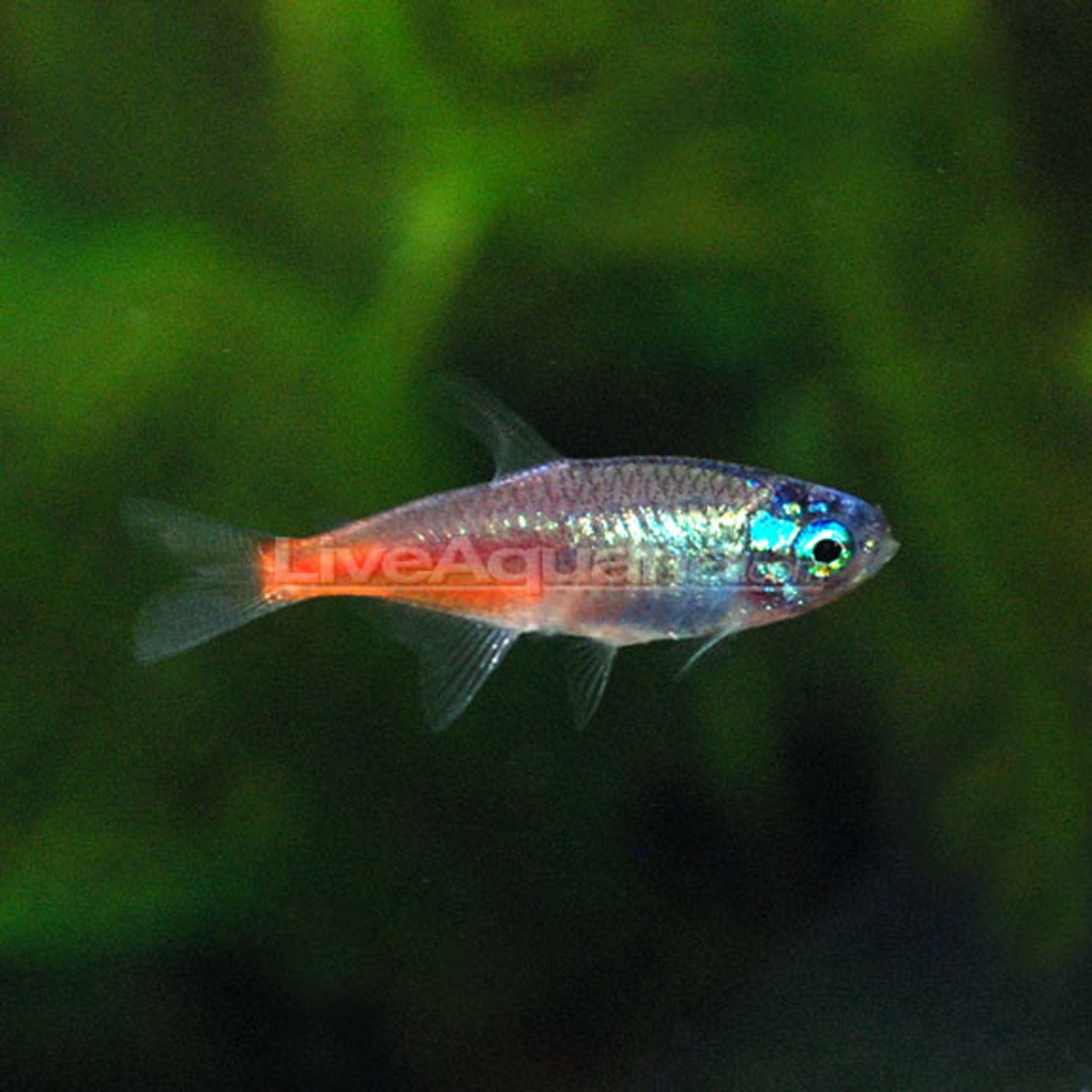
Neon Tetra Care Guide: Tank Size, Diet, Water Parameters and Temperament
Neon tetras do best in a school of at least 6 (ideally 10–15) in a fully cycled, planted tank of 20 gallons (76 L), kept at 72–78°F (22–26°C) with a pH of about 6.0–7.0 and stable, clean water. They are peaceful, small-mouthed omnivores that eat micro-pellets, crushed flakes and small frozen foods. They are hardy once settled but not bulletproof, and the first few weeks after purchase decide whether they thrive.
Neon Tetra Quick Stats
| Trait | Recommendation |
|---|---|
| Scientific name | Paracheirodon innesi (family Characidae) |
| Adult size | 1–1.5 in (2.5–4 cm) |
| Lifespan | About 5 years typical; 8–10 possible but uncommon |
| Minimum tank | 10 gal (38 L) for a small group; 20 gal (76 L), ideally a 20 long, recommended |
| School size | 6 minimum, 10–15+ preferred |
| Temperature | 72–78°F (22–26°C); reported range 68–82°F (20–28°C) |
| pH | 6.0–7.0 preferred; captive-bred fish tolerate up to about 7.5 if stable |
| Hardness | GH about 2–10 dGH; KH low to moderate |
| Ammonia / nitrite | 0 ppm |
| Nitrate | Under 20 ppm ideal; 40 ppm hard ceiling |
| Temperament | Peaceful, shy, midwater schooler |
| Diet | Omnivore with a meaty lean |
Meet the Neon Tetra
The neon tetra comes from the soft, tea-colored blackwater streams of the upper Amazon in Peru, Colombia and Brazil. That origin explains most of its preferences: shade, soft water, leaf litter and gentle current.
You can recognize a neon by the iridescent blue line running from the eye to the adipose fin, with a red band on the rear lower half of the body only. If the red runs the full length of the body, you are looking at a cardinal tetra instead.
Sexing Neons
- Females are rounder in the belly, which makes the blue line look slightly bent.
- Males are slimmer, with a straighter blue line.
Color Varieties
Long-fin, gold/albino, black diamond and diamond-head neons are all the same species. They school together happily, and their care is identical to the standard form.
Where US Neons Come From
Neons are cheap and sold in nearly every US chain and local fish store. Most are farm-bred in Asia and imported, so they arrive after a long trip. When choosing fish:
- Pick active, brightly colored fish that school normally.
- Skip any tank with dead fish in it.
- Ask how long the fish have been in the store; fish that have settled for a week or more have already survived the hardest stretch.
Tank Size and Setup
A 10-gallon (38 L) tank is the floor for a small school, and it works best for keepers who stay on top of maintenance. A 20-gallon (76 L) tank, preferably a 20 long, is the better target for a school of 10 or more. Sources cite 10, 15 or 20 gallons as a minimum; more water means more stability, which is what neons need most.
- Footprint beats height. Neons swim horizontally, so a long tank gives them more usable room than a tall one of the same volume.
- Use a lid. Neons can jump, especially when startled.
- Filtration should be gentle. A sponge filter works well, or add a pre-filter sponge to the intake of a hang-on or canister filter so small fish are not pulled in.
Aquascape for Color and Confidence
- Dense planting, live or silk, around the sides and back.
- Driftwood, plus leaf litter or catappa leaves to release tannins.
- Dark substrate, which makes their colors stand out.
- Subdued lighting, or floating plants that shade the surface.
- Open mid-level swimming space in front where the school can move together.
A bright, bare tank leaves neons looking washed out and nervous. Cover and dimmer light fix this quickly.
Water Parameters
Temperature
Aim for 72–78°F (22–26°C). Published ranges stretch from 68°F to 82°F (20–28°C), but the middle band is the safest. Warmer water speeds up metabolism and tends to shorten life; cooler water slows them down. Keeping neons toward the cooler end of the sweet spot, around 72–75°F (22–24°C), is a reasonable way to favor longevity without stressing them.
Use an aquarium heater and avoid swings. A neon can technically live without one only in a room that stays steadily above 72°F, which most US homes do not manage year-round.
pH and Hardness
Neons prefer pH 6.0–7.0 and soft to moderately soft water (about 2–10 dGH). Some keepers insist on staying below 7; others accept 6.5–7.5. Captive-bred neons adapt well, so stability matters more than hitting a number.
Many US cities supply hard tap water with a pH of 7.5–8. Neons usually adapt to it if it stays consistent. Do not chase a lower pH with pH-down chemicals, which cause swings that do more harm than moderately hard water. Blending in RO water is only really needed if you plan to breed them.
Water Quality and Maintenance
- Ammonia and nitrite: 0 ppm.
- Nitrate: under 20 ppm ideally, never above 40 ppm.
- Water changes: 20–25% weekly. Match the new water's temperature, use a dechlorinator, and avoid large sudden changes.
Tank Maturity
Add neons only to a fully cycled, stable tank, ideally one that has been running for 4–6 weeks or more. Neons handle new-tank swings badly, and adding them too early is the most common cause of mass die-offs.
Diet and Feeding
Neons are omnivores with a meaty lean, and their mouths are tiny.
- Staple: a quality micro-pellet or crushed flakes.
- Protein 2–3 times per week: frozen or live brine shrimp, daphnia, bloodworms or mosquito larvae.
- Plant matter weekly: a vegetable-based flake or similar food.
Feed small pinches once or twice a day, only as much as the school eats in about 2 minutes. Crush large flakes and chop bloodworms so they fit. Remove leftovers, because overfeeding leads to ammonia spikes and bloated fish.
Temperament and Tank Mates
Neons are peaceful, shy midwater fish. Their schooling tells you how they feel: a tight, bunched school usually signals stress, while a loose, spread-out group means they are comfortable. Groups of 3 or fewer stay stressed and hide, which is why 6 is the floor and 10 or more is the goal.
Good Companions
- Rasboras and other small, peaceful tetras
- Corydoras (pygmy species suit small tanks well) and otocinclus
- Small peaceful gouramis and pencilfish
- Guppies and endlers
- Small plecos
- Snails and Amano shrimp
Adult cherry shrimp usually coexist with neons in planted tanks, but neons will eat shrimplets, so expect fewer babies.
Fish to Avoid
- Anything with a mouth big enough to swallow a neon, including angelfish (cute as juveniles, predators as adults), large cichlids and big barbs.
- Fin-nippers and bullies.
Bettas are a split decision. Some bettas ignore neons; others chase them. It depends on the individual, and it is risky in small tanks. If you try it, use at least 10 gallons (38 L) with plenty of cover and watch closely.
A 20-Gallon Starter Plan
For a 20-gallon long (76 L):
- 12 neon tetras in the midwater
- 6 pygmy corydoras on the bottom
- 1 nerite snail for algae
Add the neons after the tank has been cycled for several weeks, plant it heavily, and keep the light moderate. That stocking leaves room for good water quality and a school large enough to act naturally.
Bringing New Neons Home
Acclimation
Acclimate slowly over 30–60 minutes, either with a drip line or by floating the bag and adding small amounts of tank water at intervals. Keep the lights off for the first day so the fish can settle.
Quarantine
Hold new neons in a separate quarantine tank for 2–4 weeks before adding them to an established community. Because nearly all US neons are shipped long distances, this is the single best way to protect the fish you already have.
Health and Disease
Neon Tetra Disease vs. False NTD
Neon Tetra Disease (NTD) is caused by a microsporidian parasite. Signs include:
- Color fading that does not return
- Lumps or cysts under the skin
- A curved spine
- Erratic swimming
There is no cure. Remove affected fish promptly to protect the rest of the school.
False NTD looks similar but is bacterial, and it is sometimes treatable with appropriate medication. Because the two are hard to tell apart by eye, isolate any suspect fish first, then decide on treatment.
Other Common Problems
- Ich: white spots. Some keepers use aquarium salt, but tetras are salt-sensitive. A gradual temperature increase combined with a half-dose of ich medication is the gentler route.
- Fin rot and columnaris: usually linked to poor water quality or stress.
- Dropsy: swelling and raised scales, often a sign of advanced internal illness.
Normal Color Fading
Neons fade at night and when stressed, which is a normal rest-mode response. Color should return once the lights come on. Persistent fading in a single fish, especially with lumps or a bent spine, is the warning sign.
Common Mistakes and Troubleshooting
- Adding neons to a brand-new tank. This causes more die-offs than anything else. Cycle first.
- Buying 3 or fewer. They stay stressed and hide.
- A bright, bare tank. Add plants, driftwood and shade.
- Deaths in the first week. Usually shipping stress or a parameter mismatch. Test ammonia, nitrite, nitrate and pH, then review how you acclimated.
- Overfeeding. Leads to ammonia spikes and bloating.
- Keeping them with angelfish that eventually grow large enough to eat them.
- Big swings from oversized water changes or chemical pH adjusters.
Breeding Neon Tetras (Brief Overview)
Neons are challenging but possible to breed at home:
- Use a separate, dimly lit tank with very soft water (under 4 dGH), pH 5.0–6.5 and about 75°F (24°C).
- Neons are egg scatterers, laying roughly 60–130 eggs.
- Remove the adults after spawning, since they eat eggs.
- Eggs hatch in about 24 hours. Keep the tank dark, since eggs and fry are light-sensitive.
- Feed fry infusoria first, then baby brine shrimp as they grow.
Neon vs. Cardinal vs. Green Neon
| Feature | Neon tetra | Cardinal tetra | Green neon tetra |
|---|---|---|---|
| Scientific name | P. innesi | P. axelrodi | P. simulans |
| Adult size | 1–1.5 in (2.5–4 cm) | About 1.75 in (4.5 cm) | About 0.8 in (2 cm) |
| Red coloring | Rear lower half only | Full body length | Little to none; blue-green stripe |
| Temperature | 72–78°F (22–26°C) | 78–82°F (26–28°C) | Warm, soft, acidic water |
| Source | Mostly farm-bred | Often wild-caught | Varies |
| Beginner-friendly | Yes | Moderate | No |
For beginners, the neon is the better pick: it is cheaper, hardier and tolerates cooler water. Cardinals want warmer, softer water and usually cost more.
Other Tetras to Consider
Most tetras are small South American (plus some African) characins that share roughly 72–80°F (22–27°C) and pH 6–7.5. The practical way to group them is by size and nip risk.
Good Neon Companions or Alternatives
- Glowlight: orange-red stripe, about 1.5 in (4 cm), easy and peaceful.
- Lemon: yellow with black-edged fins, about 2 in (5 cm), peaceful.
- Pristella (golden x-ray): very hardy, tolerates harder water, peaceful.
- Flame: small, red-orange, easy.
- Kitty (H. heliacus): yellow-orange; keep in schools of 6 or more.
- Raccoon: silver with a dark eye mask.
- Blueberry (H. wadai): males turn blue with yellow fins; needs soft water.
- Coffee bean (H. takasei): two dark flank spots; needs soft, acidic water.
- Candy cane (HY511): tank-bred, pink-maroon with white-tipped fins; plan on 20 gallons (76 L).
Larger or Nippier Choices
- Bleeding heart, diamond and emperor: 2–2.5 in (5–6.5 cm), better in 20–30+ gallons (76–114 L). Bleeding heart males spar.
- Penguin: black diagonal line, active and mildly nippy.
- Bloodfin and green fire (Aphyocharax): hardy, fast and fine in cooler water, but can be nippy.
- Buenos Aires: up to 3 in (7.5 cm), eats plants and can nip. Not an ideal neon mate.
You can compare many of these species in FishyHub's tetra collection, and bottom-dwelling partners such as corydoras round out a neon community nicely.
Frequently Asked Questions
How many neon tetras can go in a 10-gallon tank?
About 6–8 neons if they are the only fish. If you add other species, reduce the neon count to keep the bioload manageable. A 20-gallon (76 L) tank gives you far more flexibility.
Why are my neon tetras dying?
The usual causes are a tank that was not fully cycled, shipping stress, ammonia or nitrite in the water, or disease. Test your water first, then isolate any fish showing lumps, persistent fading or a bent spine. Quarantining new arrivals prevents many of these losses.
Do neon tetras need a heater?
In most US homes, yes. Neons need a steady 72–78°F (22–26°C), and they can go without a heater only in a room that stays reliably above 72°F. A heater also prevents the temperature swings that stress them.
Can neon tetras live with a betta?
Sometimes. It depends on the betta's personality, and it works best in 10 gallons (38 L) or more with dense plants for cover. Watch closely for chasing or fin damage and be ready to separate them.
Do neon tetras need live plants?
No, silk plants can provide cover too. That said, live plants, leaf litter and shade noticeably improve their color and make them calmer and more willing to school in the open.
Why do neon tetras lose color at night, and how long do they live?
Fading at night is a normal rest-mode response, and color should return when the lights come on. With good care, neons typically live about 5 years, and occasionally longer.
Build Your Neon Tetra School
Neons reward a patient setup: a cycled tank, a school of 10 or more, soft stable water and plenty of cover. When your tank is ready, browse FishyHub's small community fishes to find neons and peaceful companions for your aquarium.

