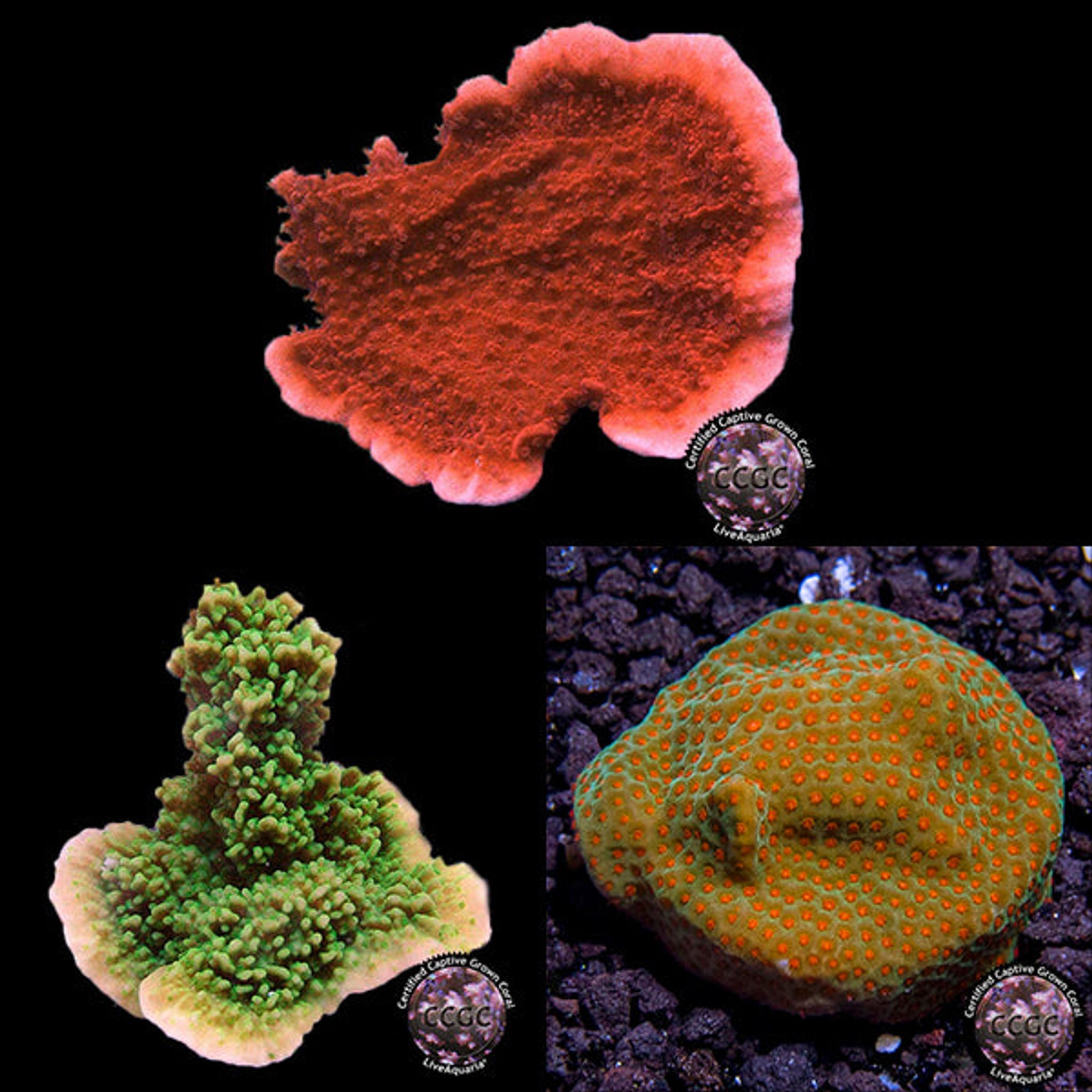
Montipora Care Guide: Lighting, Flow, Feeding and Placement
Montipora is one of the most approachable small polyp stony (SPS) corals for a reefer moving up from softies and LPS, but success depends on getting light, flow, and stability right rather than chasing a single "ideal" number. This guide breaks down real PAR ranges, flow patterns, feeding routines, and placement strategy so you can avoid the bleaching and stinging problems that trip up most first-time SPS keepers.
What Montipora Is and Why It's a Good First SPS
Montipora is an SPS genus that grows in several distinct forms, and the form matters as much as the species when you're planning placement:
- Encrusting/plating types (often sold as "cap" or "rainbow" monti) spread flat across rock and can dome upward into plates.
- Branching/digitate types (digitata-type growth) form upright fingers or twiggy colonies.
- Mounding/nodular types (such as setosa or capricornis forms) build denser, bumpy colonies.
Compared to Acropora, Montipora tolerates a wider swing in parameters, grows faster, and frags more easily — which is why it's consistently recommended as a "gateway SPS." It's more forgiving of minor nutrient and flow mistakes, though it still needs a genuinely stable reef system, not just a fish-only tank with a bright light bolted on.
SPS by Experience Level
Not all SPS corals demand the same precision. A rough beginner-to-advanced ranking helps set expectations before you buy:
| Experience level | Example genera | Why |
|---|---|---|
| Beginner | Montipora, Pocillopora | Wide parameter tolerance, fast growth, forgiving of minor swings |
| Beginner-intermediate | Stylophora, Seriatopora | Hardy but thinner-tissued, want more stable flow |
| Intermediate-advanced | Acropora (easier species like A. yongei) | Needs tighter nutrient and alkalinity control |
| Advanced | Acropora (color-intensive/SPS-dominant species) | Narrow tolerance for swings, sensitive to shipping stress |
Common Starter SPS Corals
If you're building a first SPS section, Montipora pairs well with a few other approachable genera:
- Montipora — fastest to encrust, most color variety, very frag-friendly.
- Pocillopora (bird's nest) — bushy growth, tolerant of a range of flow.
- Stylophora/Seriatopora — colorful, moderately hardy once acclimated.
- Easier Acropora (like A. yongei) — a reasonable next step once Montipora is thriving.
You can browse live specimens across growth forms in FishyHub's SPS coral selection when you're ready to stock a frag or colony.
Lighting: Moderate-to-High, Introduced Gradually
Montipora needs strong light, but "strong" is more moderate than many beginners assume, and it varies by growth form:
- Encrusting/plating forms: roughly 100–200 PAR.
- Branching/digitate forms and intensely pigmented morphs: often 150–250 PAR, sometimes more once fully acclimated.
Under a typical LED reef fixture, a moderate-to-high intensity setting (roughly 40–70% on many popular fixtures) at 10–14 inches (25–36 cm) of depth is a reasonable starting point. Older references citing very high light (equivalent to 4–6 watts per gallon of metal halide) for certain intensely colored morphs reflect an earlier lighting era; modern LED-era guidance for typical plating Montipora is more moderate. Treat 100–200 PAR as the safe default and let specific morphs earn more light over time rather than starting high.
Photoperiod: run a broader 10–12 hour lighting cycle with 8–10 hours of "peak" intensity in the middle, ramping up and down at the edges rather than switching abruptly.
Light Acclimation Protocol
Sudden light changes are the single biggest reported cause of Montipora failure — new frags bleach or brown out within days when dropped straight under an established tank's full-intensity light. A gradual ramp avoids this:
- Weeks 1–2: place the frag in a shaded or lower-light spot (bottom of the tank, under a rock ledge, or with fixture intensity reduced) at well below your target PAR.
- Weeks 2–3: move it up a level, or increase fixture intensity by roughly 10–15%, and watch polyp extension and color.
- Weeks 3–4: continue stepping up toward the target 100–200+ PAR range, only advancing if the coral shows full polyp extension and stable or improving color.
If a coral pales or the tissue looks stressed at any step, hold or back off before increasing further. A dependable LED fixture with adjustable intensity makes this ramp far easier to control than an all-or-nothing light.
Water Flow: Turbulent, Not Blasting
Montipora wants moderate to high flow that's turbulent and randomized rather than one direct, laminar jet. Randomized flow:
- Keeps detritus and film algae from settling on plating surfaces.
- Encourages full polyp extension across the colony.
- Benefits from occasional stronger surges, which help self-clean plating forms the way wave action would on a reef.
Too little flow leads to algae and film buildup, dulled color, and eventually tissue recession. Too much direct flow — a single powerhead aimed straight at a frag — can keep polyps retracted and, on thin-tissued color morphs, shred tissue over time. Rather than chasing a specific gph number, adjust based on what you observe: full polyp extension and no detritus accumulation is the target, and a wavemaker or repositioned powerheads usually gets you there faster than a single fixed-flow pump.
Water Parameters at a Glance
Stability matters more than hitting an exact number — a steady value slightly outside the "ideal" range causes far less damage than a swing within it. Use this table as your target range and dose/test consistently rather than chasing perfection:
| Parameter | Target range |
|---|---|
| Temperature | 75–80°F (24–27°C) |
| Salinity | 1.024–1.026 SG (~35 ppt) |
| pH | 8.1–8.4 |
| Alkalinity | 8–10 dKH (~3–3.6 meq/L) |
| Calcium | 380–450 ppm |
| Magnesium | 1250–1350 ppm |
| Nitrate | 2–10 ppm (up to ~15 ppm tolerable) |
| Phosphate | 0.03–0.1 ppm |
Nutrients: More Forgiving Than Acropora
Some coverage treats all SPS as needing near-zero nitrate and phosphate, the way Acropora often does. Montipora is more nutrient-tolerant, and chasing "zero" can backfire: in an ultra-low-nutrient system, Montipora tends to look pale or washed out and grows slower, because it doesn't have enough available nutrition to support both zooxanthellae and pigment production. Too much nutrient swings it the other way — browning and nuisance algae. The practical target is "low but not zero," using the ranges above rather than driving nitrate and phosphate to undetectable.
Why Magnesium Matters
Magnesium doesn't get discussed as often as calcium and alkalinity, but it's the parameter that keeps them in solution. When magnesium runs low (below the 1250–1350 ppm target), calcium and alkalinity can precipitate out even when you're dosing correctly — a common hidden cause of "why won't my numbers hold" frustration. Check magnesium first if calcium or alkalinity keeps drifting despite consistent dosing.
Feeding Montipora
Montipora gets most of its energy from photosynthesis through its zooxanthellae, so feeding isn't strictly required — but supplemental feeding measurably improves growth rate and coloration, especially in a low-nutrient system. Good options include:
- Fine phytoplankton
- Coral-specific pellet or powder foods sized for small polyps
- Amino acid or coral-food blends
Feed a few times a week, either target-fed with a syringe close to the colony or broadcast with flow paused briefly so the fine particles have time to settle onto the polyps before flow resumes.
Coloration: Light, Nutrients, and Genetics Together
Color intensity comes from the interplay of light spectrum/intensity and nutrient level, not from either alone:
- Blue-shifted spectrum + low-to-moderate nutrients generally produces the richest, most saturated color.
- Too little light or too much nutrient pushes the coral toward brown or green, because the zooxanthellae population increases and masks the coral's own pigments.
Sunset and Rainbow Color Morphs
Named color morphs — sunset, rainbow, forest fire, and similar multicolor patterns — use the exact same care routine as standard Montipora. They're simply more sensitive to light and nutrient swings, so their vivid, multicolored patterning is best thought of as a reward for consistent husbandry rather than a coral that needs a different regimen.
Placement: Give It Room to Grow
Montipora, especially fast-growing plating types, will grow into and sting slower-growing neighbors — including other SPS — if placed too close. Because a healthy colony can double in size within months and potentially triple over a year or more, plan placement around its future footprint, not its current frag size:
- Leave several inches of clearance on all sides when mounting.
- Re-check spacing every few months as colonies expand, and relocate or trim before contact happens.
- Middle-to-upper tank placement suits most color morphs once light-acclimated; some deeper-water or heavily pigmented morphs do better slightly lower in the tank, where light is more moderate.
Comparing Tank Mates: Merulina, Psammocora, and Stylocoeniella
- Merulina is an LPS-adjacent coral with a folded, wavy growth form and generally lower light and flow needs than Montipora — useful as a shadier, calmer neighbor rather than a direct tank mate at the same flow/light zone. You can compare options in LPS hard corals.
- Psammocora and Stylocoeniella are less common encrusting corals sometimes grouped with beginner SPS. Both want similar moderate light and flow to Montipora, but grow noticeably slower — good as a low-drama contrast piece rather than a fast-spreading centerpiece.
Signs of a Healthy Montipora
Check new additions and established colonies against this list:
- Full polyp extension across the colony, not just the center.
- Vivid, consistent coloration edge-to-edge, with no pale halo.
- Visible new growth — an encrusting edge or branch tip that's clearly extending.
- No receding tissue or exposed bare skeleton patches.
- No excess slime or mucus production.
Growth Rate and Fragging
Montipora is one of the fastest-growing SPS genera in a stable reef tank; plating forms in particular can double in size within a few months given good light, flow, and stable parameters. That fast growth also makes it one of the most frag-friendly corals available:
- Clean tools and wear gloves.
- Cut plating pieces with bone cutters or shears; snap or cut branching pieces to size.
- Dip the frag in an iodine or coral-safe dip.
- Mount it to a frag plug or rock with cyanoacrylate coral glue gel or epoxy putty.
- Place the fresh frag in low-to-moderate flow and light to heal for 1–2 weeks before moving it to its permanent, normal-intensity spot.
Montipora heals and re-attaches faster than most SPS, which is exactly why it's a favorite for frag swaps and frag racks. Plating pieces are generally ready to frag once there's enough encrusted area to cut a viable piece — often within several months of healthy growth.
Frag Tanks for Growing Your Own
A frag tank is a dedicated, low-maintenance system — typically bare-bottom, with high flow and strong lighting plus frequent dosing — used to grow out cuttings on plugs or racks before they move to a display tank or get traded. If you find yourself fragging Montipora regularly, a small dedicated frag system keeps healing frags separate from your display and simplifies flow/light tuning for that early recovery period.
Scaling Up: Stability and Automation
As you move from a single frag to a colony (or several), the consensus across advanced and commercial SPS keeping is the same: a stable, well-dosed system is what makes SPS reliable long-term, not a single perfect parameter reading. That means:
- Automated dosing or a calcium reactor to smooth out calcium/alkalinity demand.
- Consistent, randomized flow across the tank, not just at one coral.
- Redundant equipment so a single pump or heater failure doesn't cause a parameter crash.
- A controller that monitors pH, temperature, and sometimes ORP or alkalinity, catching drift before it becomes a swing.
A monitoring controller isn't required for a first Montipora frag, but it's a worthwhile upgrade once you're running several SPS colonies and want to catch instability before it shows up as bleaching or recession.
Common Mistakes and How to Fix Them
| Mistake | Result | Fix |
|---|---|---|
| Placing a new frag straight under full-intensity light | Bleaching/paling within days | Shade or place low for 1–2 weeks, raise gradually |
| Placing plating Montipora too close to neighbors | Stinging and tissue damage on both corals | Leave generous clearance, recheck spacing regularly |
| Chasing zero nitrate/phosphate | Pale color, slowed growth | Keep nutrients low but measurable |
| Inconsistent alkalinity/calcium dosing | Tissue recession, slowed growth | Test regularly, dose consistently, change gradually |
| Low or stagnant flow | Algae film, dulled color, stressed tissue | Add a wavemaker or reposition powerheads |
| Skipping supplemental feeding | Slower growth, washed-out color | Feed fine particulate coral food a few times weekly |
Frequently Asked Questions
Is Montipora a good coral for beginners?
Yes. It's among the most forgiving and fastest-growing SPS corals and is commonly recommended as a first SPS purchase, provided your basic reef parameters (alkalinity, calcium, temperature) are already stable.
How much light does Montipora need?
Most encrusting/plating forms do well around 100–200 PAR, introduced gradually over 2–4 weeks. Some intensely pigmented morphs can handle or need more light once fully acclimated.
Does Montipora need to be fed?
Not strictly — it gets most of its energy from zooxanthellae — but supplemental feeding of fine particulate foods a few times a week improves growth rate and coloration, especially in lower-nutrient systems.
Why is my Montipora turning brown?
This usually points to too little light and/or excess nutrients, which lets zooxanthellae proliferate and mask the coral's own pigment. Check your PAR reading and nitrate/phosphate levels.
Why is my Montipora losing color or bleaching?
This is typically caused by too much light introduced too quickly, or a parameter swing in alkalinity or calcium. Dial back light intensity, acclimate more gradually, and check that your dosing has been consistent.
What flow rate does Montipora need?
Moderate, turbulent, randomized flow works better than one strong direct jet. Adjust based on polyp extension and detritus buildup rather than targeting a specific gph figure.
Can Montipora sting other corals?
Yes. As it spreads, it can out-compete and sting slower-growing or more sedentary neighbors, so spacing and planning for future growth matter from the day you place it.
Ready to add Montipora to your reef? Browse live frags and colonies across growth forms and color morphs in FishyHub's coral selection.

