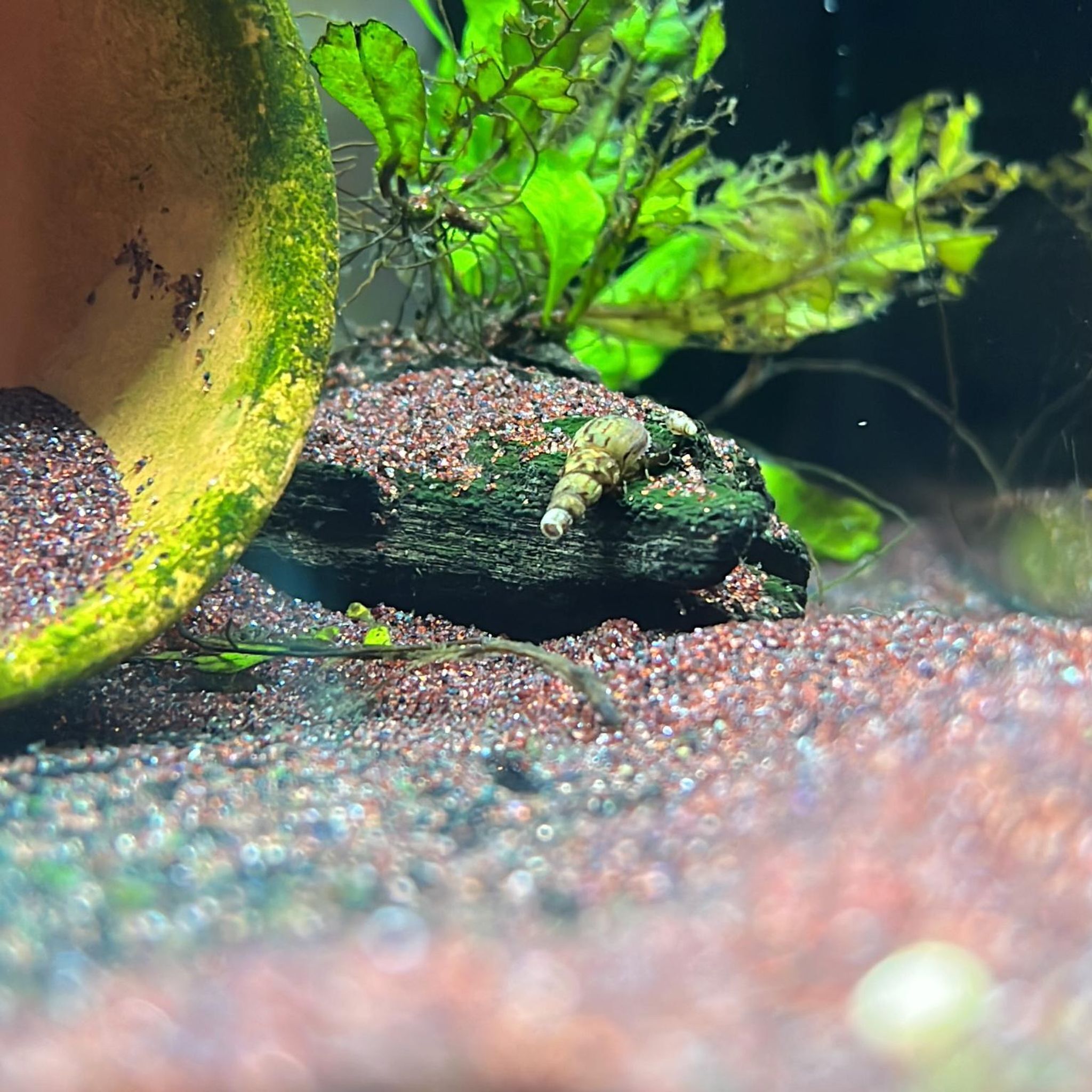
Malaysian Trumpet Snail Care Guide: Setup, Feeding, Water Parameters and Breeding
Malaysian trumpet snails (Melanoides tuberculata) are a small, cone-shelled scavenger that most hobbyists meet by accident, hitchhiking in on a plant, before deciding whether to keep or eliminate them. This guide covers ideal setup, feeding, and water parameters, plus the breeding biology and practical control tactics needed to keep a colony useful instead of overwhelming.
What Is a Malaysian Trumpet Snail?
Melanoides tuberculata is a live-bearing freshwater snail with a narrow, turret- or cone-shaped shell reaching about 1 inch (2.5 cm) at full size. It's nocturnal and spends daylight hours burrowed in the substrate, emerging after dark to forage. That daytime disappearing act is normal behavior, not illness.
How MTS Compares to Other Common Aquarium Snails
Shoppers often confuse MTS with other snails sold for cleanup duty. Here's where it fits:
| Snail type | Typical size | Main role | Breeding speed |
|---|---|---|---|
| Malaysian trumpet snail | Up to 1 in (2.5 cm) | Substrate burrower, biofilm/detritus cleanup | Very fast (live-bearing) |
| Mystery/apple snail | 2-3 in (5-7.5 cm) | Algae grazing, larger bioload | Moderate (egg clutches above water) |
| Nerite snail | 0.5-1 in (1.3-2.5 cm) | Algae control, won't breed in freshwater | Slow (needs brackish water to hatch) |
| Ramshorn snail | 0.5-1 in (1.3-2.5 cm) | Surface/glass algae, plant grazing | Fast (egg-layer) |
| Pond snail | 0.5-1 in (1.3-2.5 cm) | Opportunistic scavenger, common hitchhiker | Fast (egg-layer) |
MTS is the smallest of this group and the only one that actively tills the substrate, which makes it uniquely useful for aeration but also the reason it's so easy to overlook until numbers climb.
Look-Alikes and Naming Confusion
A few related species are sold or confused under the same common name:
- Black devil (spike trumpet) snail: A related, larger turret snail with a dark or near-black shell. Care is nearly identical to MTS, but it grows bigger, tends to cost more, and reproduces less prolifically.
- Malaysian fire snail: A turret-shelled color variant marketed under this name, typically showing reddish-orange banding on the shell. Care requirements match standard MTS.
- Chopstick snail: A nickname sometimes applied to true MTS and sometimes to a separate long, narrow-shelled species (Stenomelania or Faunus types). If precise identification matters for your setup, ask the seller which species is actually in the tank before buying.
Tank Setup and Substrate
There's no strict minimum tank size for MTS — a handful can live comfortably in a 5-gallon (19 L) tank. As a general population guideline, aim for roughly 1-2 snails per gallon of water to keep numbers balanced with available food and burrowing space.
Substrate is the single most important setup decision. MTS burrow daily, so:
- Use fine sand or fine gravel — coarse, sharp gravel can injure them or block burrowing.
- Avoid substrate that's excessively deep or heavily compacted; snails can get trapped, die, and trigger localized ammonia spikes from decomposition.
- A properly maintained fine-substrate bed lets snails till it continuously, which prevents anaerobic pockets and the buildup of trapped gases underneath.
They don't require a heater or specialized filter beyond what a normal, cycled freshwater community tank already has — a heater is only necessary if room temperature regularly falls outside their tolerance range.
Water Parameters
MTS are unusually tolerant, and exact numbers vary somewhat between sources. The practical takeaway: stability matters more than hitting one precise figure, but staying inside these ranges keeps shells healthy and snails active.
| Parameter | Tolerable range | Best range |
|---|---|---|
| Temperature | 65-86°F (18-30°C) | 70-79°F (21-26°C) |
| pH | 6.5-8.5 | 7.0-8.0 |
| General Hardness (GH) | — | 6-15 dGH |
| Carbonate Hardness (KH) | — | 3-12 dKH |
Why Shell Erosion Happens
Shell erosion isn't random — it's chemistry. A snail's shell is largely calcium carbonate, and in soft, acidic, low-carbonate-hardness water, that calcium carbonate slowly dissolves faster than the snail can rebuild it. The result is pitted, thin, flaking, or cracked shells over weeks to months. If you notice this, the fix is to raise GH/KH rather than treat it as a disease:
- Add crushed coral or a mineral supplement to the filter or substrate.
- Offer occasional calcium supplementation (cuttlebone, crushed coral, or a calcium-supplement product) if shells already look thin or etched.
- Use a small, measured dose of baking soda (sodium bicarbonate) to raise KH and buffer pH upward in soft tap-water setups — dose gradually and retest rather than guessing at quantities.
Feeding
MTS are omnivorous scavengers that eat algae, biofilm, leftover fish food, decaying plant matter, and even dead animals. In an established, algae-present tank, they're largely self-sufficient and need no dedicated feeding.
Supplement only when needed:
- Algae wafers or a gel food if the tank is unusually clean and food is scarce.
- Blanched vegetables (zucchini, spinach) as an occasional treat.
- Calcium sources (cuttlebone, crushed coral) specifically if shells show pitting or thinning, not as a routine addition.
They will not significantly damage healthy live plants — their diet targets algae, biofilm, and decaying tissue, not living plant matter, so they're considered plant-safe in a planted tank.
Behavior: Burrowing, Nighttime Activity, and the "Canary" Effect
Seeing a mass of trumpet snails emerge onto the glass or substrate surface right after lights-out is completely normal foraging behavior, not an infestation on its own. Judge population size by trends over several weeks, not a single nighttime glance.
However, MTS also work as a rough water-quality indicator. If snails are surfacing and roaming heavily during the day rather than staying buried, it usually signals poor water quality or low dissolved oxygen. Treat unusual daytime surfacing as a cue to test your water and increase surface agitation or water changes.
Breeding and Population Control
MTS reproduce through parthenogenesis, meaning a single snail can start an entire colony without a mate, in addition to normal sexual reproduction. They are ovoviviparous live-bearers: a female carries young in a brood pouch and releases them fully formed rather than laying external eggs.
- Maturity: roughly 3-5 months old, at about 0.3-0.4 inches of shell length.
- Output: brood-size claims vary widely by source, but a single female can reliably produce well over 100 offspring across her reproductive lifespan.
- Lifespan: roughly 1-2 years per individual.
Because of parthenogenesis, even one accidental hitchhiker on a new plant can seed a full population within months.
A Weekly Checklist to Keep Numbers in Balance
Population size is controlled by one combined lever — feeding, substrate care, and water changes — not any single fix:
- Portion control: feed fish only what's eaten in 2-3 minutes; leftover food is the main driver of population booms.
- Substrate check: confirm no compacted or oxygen-starved zones have formed.
- Water change: 10-25% weekly (or 20-30% biweekly) with dechlorinated, temperature-matched water.
- Vacuum lightly: clean substrate around plant roots without aggressively disturbing burrowing snails everywhere.
- Visual population count: scan glass and substrate surface at night once a week to track the trend, not a single count.
DIY Trap Method
If numbers need thinning:
- Place a piece of blanched vegetable (zucchini or a lettuce leaf) in a small jar, cup, or fine-mesh trap overnight.
- Snails cluster onto the bait by morning.
- Lift the trap out and discard the snails (in the trash, never into a local waterway — see below).
- Repeat every few nights until numbers drop to a manageable level.
Hand-picking alone is inefficient long-term. Combine trapping with reduced feeding, and if full eradication (not just control) is the goal, a natural predator such as an assassin snail or a snail-eating loach species will do the rest. Avoid keeping MTS with those same predators, or with puffers, if you actually want the colony to persist.
An Environmental Note
Malaysian trumpet snails are considered invasive or non-native in many U.S. waterways. Never release excess snails, or any aquarium livestock, into local ponds, lakes, rivers, or storm drains. Dispose of unwanted snails in the trash or find another hobbyist willing to take them.
Compatibility
MTS are generally safe with:
- Cherry, amano, and ghost shrimp
- Other peaceful snail species
- Community fish
Avoid keeping them long-term with assassin snails, loaches, puffers, and other snail-crushing or snail-eating fish, unless population reduction is specifically what you want.
MTS in a Shrimp Tank
MTS are considered one of the better tankmates for a shrimp tank. They occupy the same fine-substrate, scavenger niche as shrimp without competing aggressively for food, and their burrowing helps control the detritus and biofilm buildup that can otherwise foul shrimp water. The only real risk is the same one that applies everywhere: overfeeding a shrimp tank can trigger an MTS population boom right alongside it.
Acclimating MTS to Brackish Water
In the wild, Melanoides tuberculata naturally occurs in brackish estuaries and tolerates low-level salinity. If you're moving snails between a freshwater and a brackish setup, drip-acclimate slowly over 30-60+ minutes rather than dropping them straight into a different salinity. A sudden jump can cause osmotic shock even in a normally tolerant species.
Common Mistakes and Troubleshooting
- Soft, acidic water without minerals: leads to pitted or dissolving shells. Fix by raising GH/KH gradually (crushed coral, measured baking soda, or a mineral supplement) rather than assuming disease.
- Overfeeding fish: the actual cause of most population explosions — the snails aren't the problem, the extra food is.
- Panicking at a nighttime glass "invasion": normal behavior, not proof of an infestation; track counts over weeks.
- Overly deep, compacted, or coarse substrate: traps or injures burrowing snails, which can decompose and spike ammonia.
- Hand-picking as the only control method: too slow on its own; pair it with reduced feeding, trapping, and/or a predator species.
- Skipping quarantine on new plants and decor: the number-one way MTS (and other pest snails) enter a tank unintentionally. A brief quarantine dip on new additions catches hitchhikers before they reach your main tank.
Related Freshwater Problem-Solving
A few symptoms often get blamed on snails but usually trace back to maintenance basics:
- Rotten-egg or musty odors: typically anaerobic pockets in substrate, overfeeding, or a dirty filter. Deep-clean substrate (which a healthy MTS population helps prevent by burrowing continuously), improve water flow, and do a partial water change.
- Rising ammonia: do an immediate 25-50% water change, pause feeding temporarily, add a beneficial-bacteria or ammonia-detoxifying conditioner, and check for overstocking or a decomposing animal. Confirm your filter is fully cycled and not overloaded.
- Cloudy water, stressed fish, or algae blooms: usually stem from overfeeding, an immature nitrogen cycle, or infrequent water changes. Routine testing and a consistent maintenance schedule resolve most of these, and a healthy scavenger population — snails included — reduces the underlying detritus load that feeds these problems in the first place.
Low-Effort Cleanup Habits Worth Adopting
MTS work best as one layer in a broader "set and forget" cleanup approach:
- A turkey baster for spot-cleaning visible debris in corners.
- A gravel vacuum during routine water changes.
- A scavenger clean-up crew (snails, shrimp) handling the ongoing biofilm and detritus load between manual cleanings.
If you're building out a cleanup crew or need shrimp tankmates to pair with your snails, you can browse shrimp available on FishyHub or check current stock in freshwater livestock for compatible community fish. For substrate suited to burrowing snails, FishyHub's gravel and sand selection is worth reviewing before setup.
Frequently Asked Questions
Are Malaysian trumpet snails good or bad for my tank?
They're beneficial in normal numbers, aerating substrate and cleaning up detritus and biofilm. They only become a nuisance when the population explodes, and that's almost always caused by overfeeding rather than the snails themselves.
How do I get rid of Malaysian trumpet snails?
Reduce feeding first, since less leftover food directly limits population growth. Combine that with overnight bait-and-trap removal (a blanched vegetable in a jar or net) and, if full eradication is the goal, a natural predator like an assassin snail or a snail-eating loach.
Will Malaysian trumpet snails eat my live plants?
No. They're not significant plant-eaters — their diet targets algae, biofilm, leftover food, and decaying matter, not healthy plant tissue, which makes them safe for planted tanks.
Do Malaysian trumpet snails need a filter or heater?
They tolerate a wide temperature range and thrive in a normally cycled, filtered freshwater tank without special equipment. A heater is only needed if your room temperature regularly falls below their comfortable range.
Can Malaysian trumpet snails live with shrimp?
Yes. They're one of the most commonly recommended tankmates for shrimp tanks, sharing the same fine-substrate scavenger niche without competing aggressively for food.
How fast do Malaysian trumpet snails reproduce?
Very fast. A single snail can start a colony alone through parthenogenesis, without needing a mate, and typically reaches sexual maturity around 3-5 months of age.
Why are all my snails coming out during the day?
Daytime surfacing usually signals poor water quality or low dissolved oxygen, unlike normal nighttime foraging. Test your water parameters and increase surface agitation or water change frequency in response.
Can Malaysian trumpet snails survive in brackish water?
Yes, to a degree — they occur naturally in brackish estuaries in the wild. Any move between freshwater and brackish conditions should be done gradually through drip acclimation rather than a sudden salinity change.

