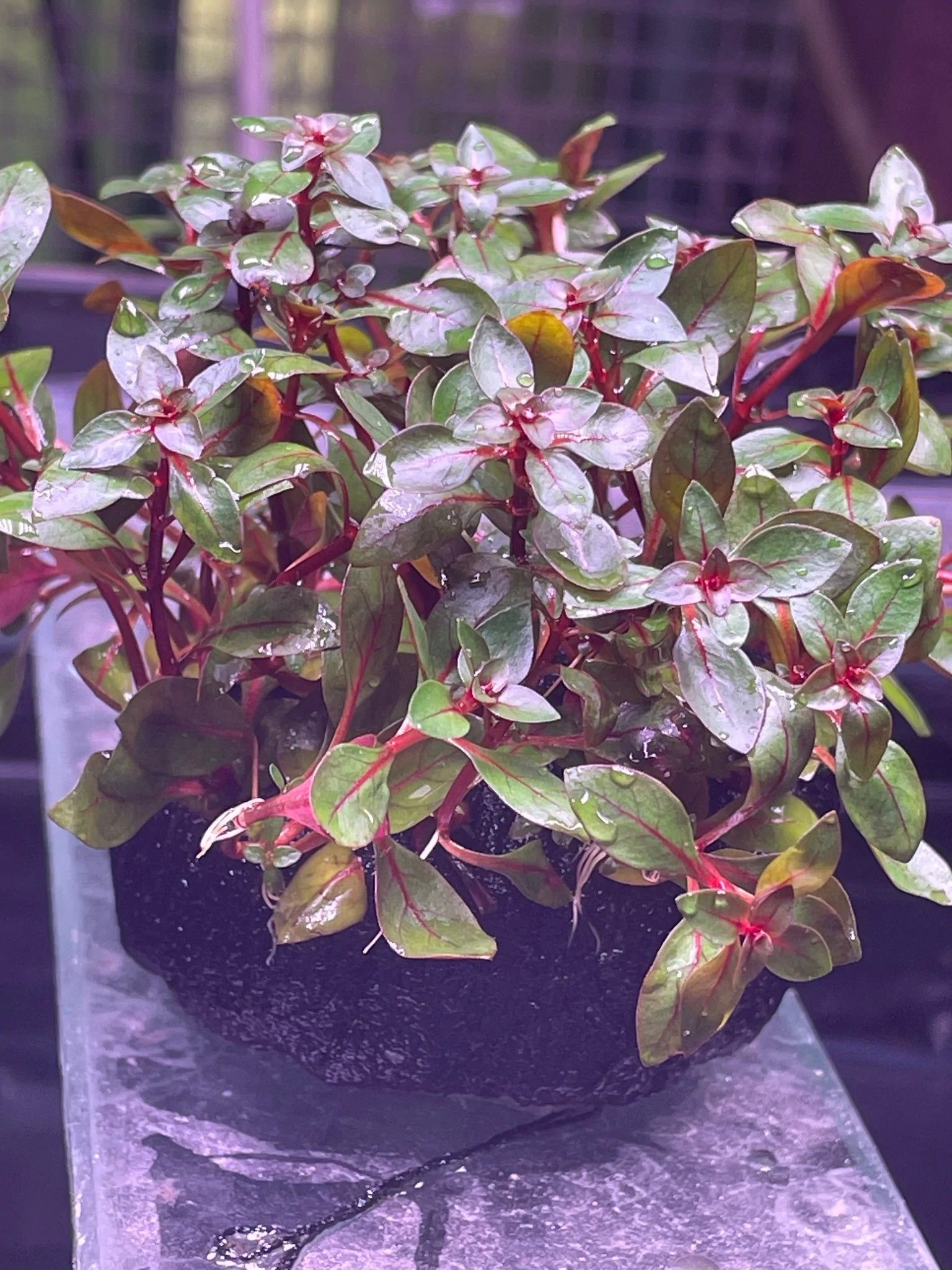
Ludwigia Super Red Care Guide: Light, CO2, Substrate and Growth Tips
Ludwigia Super Red is a forgiving stem plant to keep alive but a demanding one to color up properly. This guide breaks down exactly which light, CO2, substrate, and fertilizer conditions push it from dull green toward its signature deep red, and how to troubleshoot the most common problems along the way.
What Is Ludwigia Super Red?
"Ludwigia Super Red" is a trade name applied to red-leaning cultivars from the Ludwigia palustris/repens group, sometimes labeled with mixed lineage rather than a single clean species. It is frequently confused with true Ludwigia natans, and different suppliers sell visually similar plants under slightly different names.
For care purposes this labeling inconsistency matters less than it sounds: nearly all of these red-leaning Ludwigia cultivars respond to the same core drivers — light intensity, iron availability, and stable water chemistry — so the guidance below applies broadly even if the tag on your plant reads slightly differently.
Difficulty: easy-to-moderate. The plant tolerates a wide range of water chemistry and will survive in modest setups, but achieving strong, even red coloration is the harder, more advanced part of keeping it.
Water Parameters
Ludwigia Super Red is adaptable, which is part of why it survives in so many different tank setups.
| Parameter | Range |
|---|---|
| Temperature | 68–82°F (20–28°C) |
| pH | 6.0–7.5 (6.5–7.0 is the sweet spot) |
| General Hardness (GH) | 3–8 |
| Carbonate Hardness (KH) | Low to moderate |
| Water type | Soft to moderately hard |
Consistency matters more than hitting an exact number. Sudden pH, temperature, or hardness swings are more likely to trigger leaf drop or melt than being slightly outside the ideal range on any single parameter.
The Anthocyanin Mechanism: Why Light Drives Red Color
Red coloration in Ludwigia comes from anthocyanin, a pigment the plant produces partly as a protective response to strong light exposure. Under low light, the plant has no reason to produce it and stays green or olive, using chlorophyll as its primary light-capturing pigment. Under medium-to-high light, the plant produces anthocyanin as a kind of internal sunscreen, and that pigment is what you see as red, pink, or orange coloration in the leaves and stems.
This is why light intensity — not any single fertilizer — is the primary trigger for red color. Iron and manganese availability then determine how vivid that red becomes once the light-triggered pigment production is underway. A plant with plenty of light but no iron will often color weakly or unevenly; a plant with iron but insufficient light will stay mostly green regardless of dosing.
Lighting Requirements
PAR, Kelvin, and Lumens Explained
These three terms get used interchangeably but measure different things:
- PAR (Photosynthetically Active Radiation) measures the actual light energy usable by plants at a given point in the tank — the number that matters most for growth and coloration.
- Kelvin describes the color temperature of the light (warm vs. cool white appearance), not its intensity.
- Lumens measure brightness as perceived by the human eye, which does not correlate reliably with how much usable light plants receive.
A fixture's wattage or lumen rating alone tells you very little about whether it will color up a red stem plant — two fixtures with identical wattage can deliver very different PAR at the substrate depending on their LEDs, lenses, and distance from the water surface.
Target Light Level
Ludwigia Super Red needs medium to high intensity to develop good red color. As a working target, aim for roughly 40–80 PAR at substrate level where the plant is rooted, with an 8–10 hour photoperiod. Under low light, expect the plant to stay green or olive, stretch toward the light source (legginess), and drop lower leaves over time.
Old Fluorescent Setups vs. Modern LEDs
Older T5HO and metal halide setups can produce adequate PAR, but many older fluorescent tubes are weighted toward green wavelengths that contribute little to plant pigmentation or photosynthesis. Modern full-spectrum LED fixtures marketed for planted tanks, typically in the 6500–8000K range with red/blue emphasis, tend to deliver better Photosynthetically Usable Radiation (PUR) — the portion of the spectrum plants actually use — rather than just looking bright to the eye.
When choosing a fixture, prioritize one with adjustable spectrum and intensity over one chosen by wattage alone. Being able to dial in more red/blue emphasis and raise or lower intensity as the tank matures gives far more control over coloration than a fixed-output tube. You can browse a range of planted-tank-ready LED lighting options to compare intensity and spectrum controls.
Photoperiod and Algae Risk
Run the light on a timer for a consistent 8–10 hours daily. More light is not automatically better: extending the photoperiod past 12 hours does not meaningfully improve coloration and instead tends to encourage algae growth, especially if CO2 and fertilizer dosing haven't been scaled up to match the extra light. Consistency in duration matters as much as the intensity itself.
CO2: Optional, But the Biggest Lever for Color and Growth
Ludwigia Super Red does not strictly require CO2 injection to survive — it will grow in a non-CO2 setup. However, pressurized CO2, targeted around 20–30 ppm, is the single biggest lever for improving both growth rate and red intensity. With CO2, expect thicker stems, faster growth, and noticeably deeper color; without it, growth will be slower and the red tone tends to stay more muted or greenish.
Treat CO2 as recommended for best results, not mandatory — a good non-CO2 setup with strong light and iron dosing can still produce a reasonably colored plant, just not as vivid or as fast-growing as a CO2-injected one.
Substrate
A nutrient-rich, fine-to-medium grain planted substrate (aquasoil-type) is strongly preferred over plain inert gravel or sand. Ludwigia is a root-feeding stem plant in addition to absorbing nutrients through its leaves, so a substrate that actively supplies nitrogen, potassium, and trace elements at the root zone gives it a real advantage.
Inert gravel or sand can still work, but only if you supplement with root tabs on a regular basis — otherwise the plant is limited to whatever it can pull from the water column. If you're setting up a new planted section of the tank, a nutrient-rich aqua soil substrate removes much of the guesswork around root feeding.
Fertilization: Iron Is the Key Driver of Red
Full fertilization, not deprivation, is what produces the best red color. Some hobbyists assume that starving a plant of nitrogen intensifies red as a stress response — and nutrient-starved plants can redden somewhat, but the result is typically a weak, dull red paired with stunted growth, not the vivid, healthy color that comes from proper feeding.
The better approach:
- Liquid macronutrients (nitrogen, phosphorus, potassium) to support overall growth and stem thickness.
- Root tabs in the substrate for sustained macro and micro feeding at the roots.
- Chelated iron and micronutrients, dosed a few times weekly in CO2-injected tanks (less frequently in non-CO2 tanks), specifically to intensify pigmentation.
Iron and manganese are repeatedly identified as the key drivers of red pigment vividness once light intensity has triggered anthocyanin production in the first place. In short: high light + adequate iron-rich fertilization, not nutrient starvation, is the formula for strong color.
A Starter Recipe
For a coherent starting point rather than scattered individual settings:
- Light: 40–80 PAR at the plant, 8–10 hour photoperiod on a timer
- CO2: 20–30 ppm if injecting
- Substrate: aquasoil, or inert substrate plus root tabs every 2–3 months
- Liquid fertilizer: macro blend a few times weekly, iron/micro blend 2–4 times weekly in CO2 tanks
Adjust dosing frequency downward in low-tech (non-CO2) tanks, since slower growth means lower nutrient uptake.
Placement, Growth Rate, and Trimming
Ludwigia Super Red works as a mid-ground to background stem plant. Plant it in groups of 8–12 or more stems, spaced roughly 1 inch apart, for a fuller, bushier look rather than as isolated single stems. Left unpruned, it can reach 16–20+ inches in height.
Growth rate is fast under good conditions — high-tech (CO2-injected, high-light) tanks may need trimming every 1–2 weeks, while low-tech setups might only need topping every 3–4 weeks.
Trimming and Propagation
- Top-cut healthy stems just above a leaf node; the parent stem will branch into a bushier shape from the cut point.
- Remove the lower leaves from the cutting, then replant it directly into the substrate.
- Cuttings typically root within a few days to about a week under stable conditions.
Handling Note
Stems are relatively delicate and brittle. Handle them gently during planting and trimming — use tweezers to grip the very base of the stem rather than forcing it through dense substrate, since snapped or bruised stems are more prone to melting.
Acclimation: Why New Plants Often Melt
Plants sold in stores are frequently grown emersed (above water, in humid nursery conditions) before being shipped as submerged stems. After planting, it's common for the older emersed-grown leaves to melt away over the following one to three weeks while new, submerged-adapted growth takes over. This is a normal transition, not disease — keep water parameters stable, trim off melted tissue as it appears, and wait for fresh growth rather than assuming the plant is failing.
Common Mistakes and Troubleshooting
| Symptom | Likely Cause | Fix |
|---|---|---|
| Plant stays green/olive | Insufficient light intensity or duration | Increase PAR/photoperiod, or move plant higher toward the light |
| Leggy growth, big gaps between leaves | Low light causing stretching | Raise light intensity |
| Melting or leaf drop after purchase | Normal emersed-to-submerged transition | Keep parameters stable, trim melted leaves, wait 1–3 weeks |
| Pale or yellow new growth | Iron/micronutrient deficiency | Dose chelated iron and micro fertilizer |
| Weak, thin stems that flop over | Insufficient light and/or CO2/nutrients | Increase light, add root/liquid fertilizer, consider planting deeper |
| Algae on leaves | Light duration too high relative to CO2/fertilizer dosing | Rebalance the light-CO2-nutrient triangle; reduce photoperiod |
| Snapped stems while planting | Rough handling or dense substrate | Plant gently with tweezers at the base |
Related Red Stem Plants
If you're deciding between red stems for an aquascape, a few comparisons are worth knowing:
- Ammannia gracilis/senegalensis — a similarly popular red stem, but generally more CO2-demanding and finicky than Ludwigia Super Red, making it a step up in difficulty rather than a direct substitute.
- Ludwigia Pantanal — a related cultivar with a similar care profile and slightly different leaf shape/coloring.
- Rotala species (such as Rotala rotundifolia) — comparable light and CO2 requirements, often grown alongside Ludwigia for color contrast.
Red Aquarium Plants Roundup
Among popular red aquarium plants — Ludwigia Super Red, Rotala rotundifolia, Alternanthera reineckii, and Ammannia species — Ludwigia Super Red is generally considered one of the easier entry points into red-plant aquascaping, thanks to its tolerance for a range of water chemistry even though top color still requires strong light and iron dosing.
Tankmates
Ludwigia Super Red is well suited to peaceful community tanks and shrimp setups, including a range of freshwater shrimp. Avoid pairing it with large or herbivorous fish that tend to shred or eat soft-leaved plants, including larger silver dollars, some cichlids, and goldfish.
Frequently Asked Questions
Does Ludwigia Super Red need CO2?
No. It will grow without CO2 injection, but adding pressurized CO2 (around 20–30 ppm) meaningfully improves growth rate and red intensity. Without it, expect slower growth and a more muted, greenish-red color rather than vivid red.
Why is my Ludwigia turning green instead of red?
The most common causes are insufficient light intensity or photoperiod, or low iron availability. Increase PAR toward the 40–80 range at the plant, keep an 8+ hour photoperiod, and dose an iron-rich fertilizer regularly.
What substrate is best?
A nutrient-rich planted (aqua) soil substrate is best, since Ludwigia feeds through its roots as well as its leaves. Inert gravel or sand can work, but only with regular root tab dosing to make up for the lack of built-in nutrients.
How much light does it need?
Medium to high intensity light, roughly 40–80 PAR at the plant, run on an 8–10 hour photoperiod. Low light will keep the plant alive but prevents it from developing strong red coloration.
How do I propagate it?
Cut a healthy stem section below a leaf node, strip the lower leaves from the cutting, and replant it directly into the substrate. The parent stem will branch out from the cut point, and the new cutting typically roots within a few days to a week.
Is Ludwigia Super Red easy for beginners?
Yes, in terms of basic survival — it tolerates a wide range of water chemistry and is not fussy about exact parameters. Getting vivid, even red coloration throughout the plant is the more advanced part and requires attention to light, CO2, and iron dosing.
Why did my new plant melt after I put it in my tank?
This is a normal adjustment from the store's emersed (above-water) growing conditions to fully submerged growth. Older leaves die back while new submerged leaves develop over roughly one to three weeks — keep parameters stable and trim off melted tissue rather than assuming disease.
What fish or tankmates should I avoid with it?
Avoid large, herbivorous, or plant-nibbling fish such as goldfish, larger silver dollars, and some cichlids, which may shred or eat the soft leaves. It pairs well with shrimp, tetras, and other peaceful community fish.
Ready to build out your planted setup? Browse substrate options on FishyHub to find the right base for strong root growth and vivid color.

