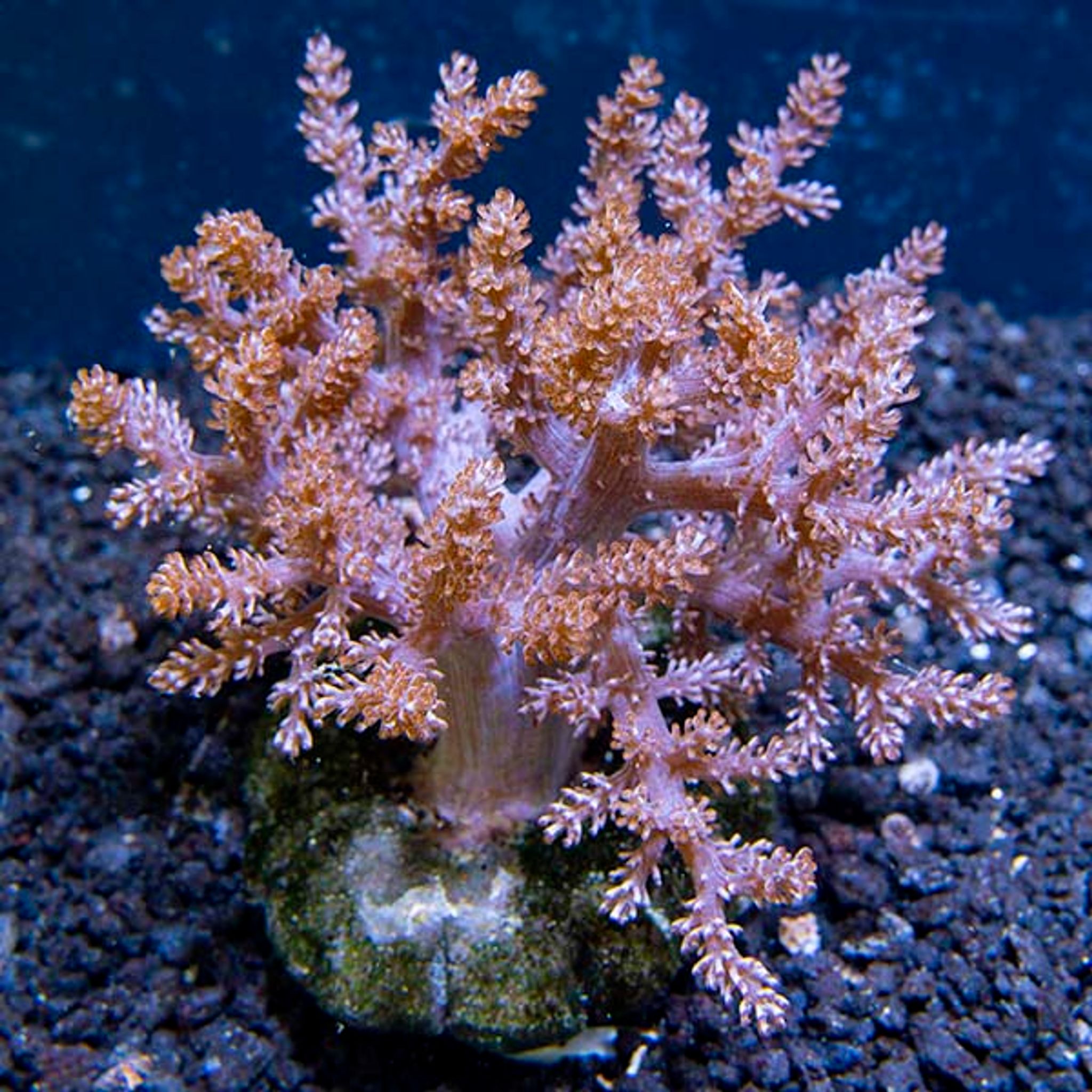
Kenya Tree Coral Care Guide: Lighting, Flow, Feeding and Placement
Kenya tree coral (Capnella sp.) is one of the toughest, fastest-growing soft corals in the hobby, which makes it a favorite first coral for new reefers. This guide walks through the lighting, flow, feeding, and placement it actually needs, plus the population-control habits that keep an easy coral from becoming an unwanted one.
What Is Kenya Tree Coral?
Kenya tree coral belongs to the genus Capnella in the family Nephtheidae, and is also sold as "tree coral" or "cauliflower coral." It's a soft octocoral with a fleshy body and little to no internal skeleton, so its branches sway and flex in the current rather than holding a rigid shape. Colonies are usually tan, cream, or brown, though a pink color morph is popular and widely traded.
It's considered one of the hardiest corals available, tolerating a wider swing in conditions than most SPS or LPS species. Somewhat counterintuitively, it does poorly in ultra-sterile, "nutrient-zero" reef systems — it actually prefers a system that isn't stripped bare of nutrients.
Lighting
Kenya tree coral wants moderate light, roughly 75–100 PAR, delivered for 8 or more hours a day. A full-spectrum LED fixture or T5 tubes with actinic supplementation both work well.
- Too much light (for example, a metal halide fixture mounted close overhead) can cause polyp retraction and bleaching.
- Too little light leads to poor polyp extension and a duller, washed-out appearance.
- Coloration actually shifts with intensity: brighter light tends to lighten and fade the branches, while lower light deepens the color. If a colony looks pale, that's often a lighting cue rather than a health problem.
Track actual output at the coral's placement depth with a PAR meter if you have access to one, since the number on the fixture's box rarely matches what reaches the rock. A basic reef-capable LED fixture from the Lighting category is more than enough for this species.
Flow
Aim for moderate to high, turbulent flow rather than a single direct jet. Branches should sway continuously — that motion clears shed waste and mucus off the tissue and helps the coral capture particles from the water column.
| Flow condition | What you'll see | Fix |
|---|---|---|
| Too strong (direct jet) | Polyp retraction, branches tearing, colony sagging or detaching | Redirect powerhead, add a wavemaker for randomized flow |
| Too weak | Algae film on branches, poor extension, sluggish growth | Add a small powerhead or reposition closer to circulation |
| Just right | Constant gentle swaying, full polyp extension most of the day | Maintain, recheck after any rockwork changes |
A single laser-focused powerhead pointed directly at the colony is the single most common flow mistake — it looks like "more flow," but it stresses the coral instead of helping it.
Feeding
Kenya tree coral gets most of its energy from photosynthesis through the zooxanthellae living in its tissue, so feeding isn't mandatory for survival. That said, supplemental feeding supports faster growth and better color.
- Baseline: broadcast-feed a phytoplankton product roughly weekly.
- Optional boost: add small zooplankton or a commercial coral food ("reef roids"-style product) once or twice a week for faster growth or richer color.
- Targeted feeding is optional, not required — the branches passively capture drifting particles from broadcast feeding, so a pipette or turkey baster isn't necessary unless you want to concentrate food on a specific colony.
- Deliberate underfeeding is a legitimate strategy some hobbyists use specifically to slow this coral's aggressive growth rate.
Don't assume zero feeding is automatically fine just because the coral is photosynthetic — a chronically starved colony will shrink, brown out, or develop drooping, wilted-looking branches over time.
Water Parameters
Kenya tree coral is forgiving, but it still needs stable reef-standard water. It tolerates a somewhat higher-nutrient system better than SPS-dominant tanks, but "tolerates dirtier water" doesn't mean high nitrate or phosphate is desirable — it means it doesn't need the near-zero nutrient levels an SPS tank is tuned for.
| Parameter | Target range |
|---|---|
| Temperature | 72–82°F (22–28°C) |
| Salinity (SG) | 1.023–1.025 |
| pH | 8.0–8.4 |
| Alkalinity | 8–12 dKH |
| Calcium | 350–450 ppm |
| Magnesium | 1200–1350 ppm |
| Nitrate | ~2–10 ppm |
| Phosphate | Near-zero, but not absolute zero |
| Ammonia / Nitrite | 0 |
If you run heavy skimming or frequent large water changes to keep an SPS-focused system ultra-clean, that same setup can leave a Kenya tree coral running low on the modest nutrient availability it wants. A little more nutrient headroom than a strict SPS tank is normal here, not a sign something's wrong.
Placement
The middle of the tank on rockwork is the classic default placement, though this coral adapts reasonably well to lower or higher positions as long as light and flow stay in the moderate range described above. Use polyp extension and color as your feedback loop — if it isn't opening fully after a few days of acclimation, adjust height rather than assuming a bigger problem.
Give it real, open space:
- Minimum tank size: around 10 gallons (38 L) for a single frag.
- Mixed-reef displays: 30 gallons (114 L) or more gives it room to spread without immediately crowding tankmates.
- Spacing from neighbors: several inches minimum, more in larger tanks, since this coral spreads laterally and will eventually reach whatever is nearby.
Growth, Spreading, and Fragging
Kenya tree coral is an extremely fast grower. It spreads two ways: by dropping or breaking off branch tips that float, settle elsewhere in the tank, and root, and through ordinary lateral creeping growth across the rock.
That same trait makes it easy to propagate on purpose:
- Cut a healthy branch cleanly with a sharp blade or scissors.
- Let the cut surface callus (heal over) for a short time before handling it further.
- Attach the frag to a plug or rock using a rubber band, coral-safe glue, or by wedging it firmly into rockwork.
- Wait days to weeks for it to fully attach before moving it again.
Aggression and Compatibility
Kenya tree coral doesn't have long sweeper tentacles, so it isn't a stinger at a distance. It's chemically aggressive instead — it releases terpenoid compounds through allelopathy that can inhibit or damage more sensitive neighbors, particularly LPS and SPS corals, on contact or through the water itself.
- It's reef-safe with typical community reef fish and invertebrates.
- Avoid large angelfish, butterflyfish, and other known polyp-nippers.
- In mixed-softie or mixed-species tanks, running activated carbon helps pull allelopathic compounds out of the water column.
Population Control
Because this coral grows so fast, population control needs to start on day one rather than after it's already a problem.
- Prune regularly — treat trimming as routine maintenance, not a last resort.
- Remove drifting fragments promptly, before they settle and root somewhere you didn't choose.
- Scrape off unwanted tissue from rock, then dab superglue gel over the bare spot to discourage regrowth there.
- Reduce feeding or light slightly to slow growth if needed — but treat this as a secondary lever, not a substitute for physical removal.
Removing an Established Colony
If a colony has already rooted deeply into rock, expect to physically chip or cut it away along with a thin layer of the rock surface it's fused to, rather than just peeling tissue off. Cure and quarantine any removed frags in a separate container before adding them to another tank or offering them to someone else, since fragments can carry hitchhiking pests.
First-Day Checklist for New Frags
New Kenya tree frags deserve the same care as any other coral import:
- Drip acclimate the bag slowly over 30–60 minutes to match temperature and salinity before release.
- Consider a coral dip to knock off hitchhikers like aiptasia or flatworms before it touches display rock.
- Quarantine the frag for a couple of weeks in a separate system when possible, rather than adding it straight to your main display.
- Add a light cleanup crew from the Marine Invertebrates category to help manage detritus and shed skin in the flow zone around the colony.
Common Mistakes
- Placing it too close to other corals without accounting for how fast it spreads, leading to allelopathic damage to neighbors.
- Letting broken frags drift unnoticed until they've rooted and multiplied across the tank.
- Blasting it with a direct powerhead on the theory that more flow is always better.
- Assuming zero feeding is fine because it's photosynthetic, then wondering why the colony is shrinking or browning out.
- Mistaking a normal periodic "skin" shed — the coral looks shiny or filmy for a day or two — for disease. Real decline looks like browning, tissue loss, holes or bruising, or non-extension that drags on for many days.
- Keeping it in an ultra-low-nutrient, SPS-tuned system and being surprised it struggles.
- Skipping proactive pruning and ending up with a deeply rooted colony that's hard to remove months later.
Related Soft Corals
Nephthea Corals
Nephthea is a close relative often confused with Kenya tree at the shop level. It's also a soft octocoral under moderate light, but it actually darkens under very bright light due to dense zooxanthellae. It prefers gentle, laminar or tidal-style flow rather than turbulent chop, does best placed flat on a rock slab instead of a vertical wall, and isn't a strong zooplankton feeder — occasional phytoplankton is enough. It's fairly forgiving of water quality once acclimated.
Caribbean Gorgonians (Sea Fans)
Gorgonians use a flexible, proteinaceous ("horny") skeleton instead of a rigid or fleshy body. Coming from shallow, current-swept, sunlit Caribbean reef zones, they want strong current and bright light, and should be mechanically anchored to rock or rubble with epoxy or reef glue rather than simply wedged in place. They're generally disease-resistant but can suffer bacterial band diseases, and many species — despite being photosynthetic — still need supplemental zooplankton-type feeding to thrive.
This comparison is a useful reminder that "soft coral" covers a wide range of flow and feeding needs — what works for Kenya tree won't automatically suit every relative in the group.
Frequently Asked Questions
Is Kenya tree coral good for beginners?
Yes. It's very hardy, tolerant of parameter swings, has minimal feeding demands, and is widely considered an ideal first soft coral for a new reef tank.
Why is my Kenya tree coral not opening or extending?
Usually the cause is flow or light that's too strong or too weak, a recent natural shedding cycle, or a water-quality or acclimation adjustment period. Give it a few days before assuming there's a real problem.
How do I stop Kenya tree coral from taking over my tank?
Prune it regularly, remove floating fragments before they attach anywhere, glue over cut sites to discourage regrowth, and give the colony isolated real estate well away from prized corals from the start.
What does Kenya tree coral eat?
Mostly light, captured through its zooxanthellae, supplemented with phytoplankton and small zooplankton or coral foods. Feeding isn't mandatory, but it helps growth rate and coloration.
Can Kenya tree coral sting other corals?
It doesn't have long sweeper tentacles, but it is chemically aggressive through allelopathy and can harm sensitive neighbors on contact or through compounds released into the water — keep real distance between it and prized LPS or SPS pieces.
What's the ideal tank size for Kenya tree coral?
A single frag can go in a tank as small as about 10 gallons (38 L), but a mixed-reef display benefits from 30 gallons (114 L) or more so it has room to spread without immediately crowding tankmates.
How do you frag or propagate Kenya tree coral?
Cut a healthy branch with a clean blade, let the cut surface callus briefly, then secure the fragment to a plug or rock with a rubber band or coral-safe glue until it attaches on its own, typically within days to weeks.
Is Kenya tree coral the same as Nephthea?
No. They're related soft corals often sold under similar-looking labels, but they're different genera with somewhat different flow and placement preferences — Nephthea prefers gentler, laminar flow and flat placement, while Kenya tree tolerates more turbulence and a wider range of heights.
Ready to add one to your system? Browse available frags and colonies in FishyHub's Soft Corals category and pick a piece that fits the space you've planned for it.

