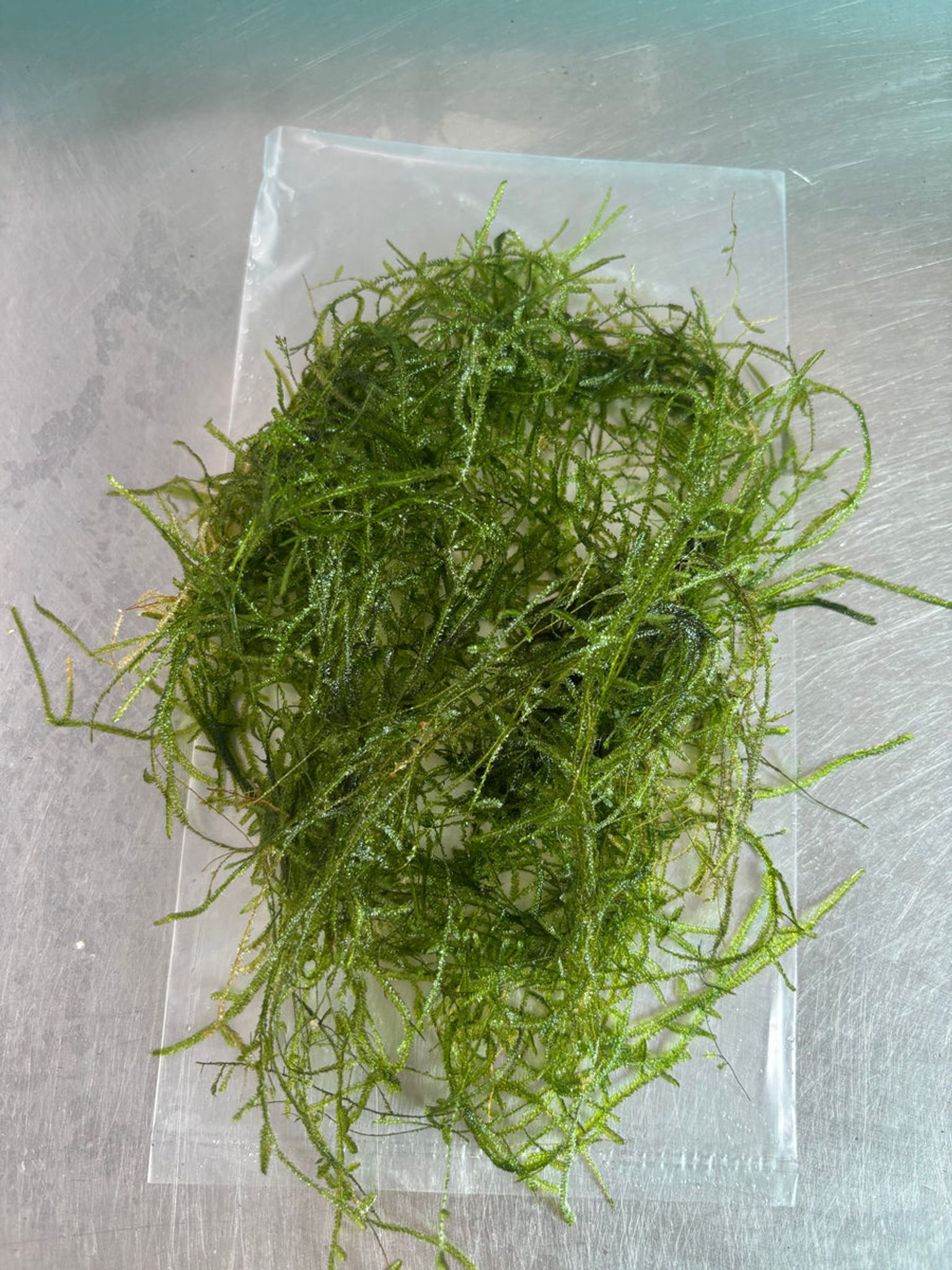
Java Moss Care Guide: Light, CO2, Substrate and Growth Tips
Java moss is one of the most forgiving plants in the hobby, but "easy" doesn't mean "no rules" — a few wrong habits can still turn a healthy mat into a brown, rotting clump. This guide gives concrete light, CO2, substrate, and water-parameter targets in US units, plus a step-by-step path to a denser, faster-growing moss wall or carpet.
What Java Moss Actually Is
Java moss (Taxiphyllum barbieri) is a stem-less, rootless bryophyte native to Southeast Asia. It has no true roots — instead it clings to surfaces using thread-like structures called rhizoids. This single fact explains almost everything about how to keep it: it doesn't plant into substrate, it attaches to hardscape, and it spreads by lateral growth rather than sending up new shoots from soil.
Aquarium Mosses as a Category
Before getting into Java moss specifics, it helps to know that most aquarium mosses share the same core requirements:
- No substrate needed — they attach to hardscape instead of rooting
- Tolerant of a wide range of water parameters
- Best growth under low-to-moderate light
- A go-to choice for shrimp and fry tanks, since dense mats shelter small livestock and host grazable biofilm
Java moss is simply the most widely available and most forgiving member of this group, which is why it anchors most beginner plant lists.
Light Requirements
Java moss survives across a huge light range — from near-darkness to well over 200 PAR in dedicated aquascaping setups. That range causes a lot of conflicting advice online, but the practical takeaway is simple:
- Low-to-moderate light (roughly 10–40 PAR) is the sweet spot for most home tanks — it produces a compact, algae-resistant mat without extra equipment.
- Higher light (up to 200+ PAR) speeds growth and thickens the mat, but only pays off if nutrients and CO2 are dosed to match. Without that balance, excess light just feeds algae.
- Keep the photoperiod to 8–10 hours a day. Longer photoperiods on their own don't grow more moss — they mostly invite algae and encourage the mat to overgrow itself.
A basic LED fixture from FishyHub's lighting selection is more than enough for a low-tech Java moss setup.
Does Java Moss Need CO2?
No. Java moss grows fine without supplemental CO2 and is a completely viable no-CO2 plant. CO2 is best framed as an optional accelerant, not a requirement:
- Without CO2, growth is moderate but reliable, and the moss still spreads to fill gaps over weeks to a couple of months.
- With supplemental CO2 (generally kept under roughly 30 ppm for livestock safety), growth becomes noticeably denser and faster — useful for aquascapers building a moss wall or carpet on a deadline.
- Adding CO2 without also increasing light and nutrients accomplishes little; the three need to move together.
Substrate: Not Required, But Not Irrelevant
Java moss doesn't root, so it has no substrate requirement at all. Sand, gravel, bare-bottom, or planted substrate all work equally well as tank decor — the choice is purely aesthetic or for other plants/fish in the tank.
The one mistake to avoid: don't bury Java moss in substrate expecting it to root. It has no roots to establish, so buried moss simply rots, fouling the substrate and wasting the portion you buried. Always tie it to hardscape instead.
How to Attach Java Moss
- Divide the moss into small, thin portions — thick clumps take longer to anchor and are more prone to rotting in the center.
- Lay each portion against driftwood, rock, or a plastic/stainless mesh frame.
- Secure it with cotton thread, fine fishing line, or a plant-safe superglue gel. Thread and line eventually dissolve or can be trimmed away; glue holds instantly but isn't reusable.
- Leave the ties in place and don't disturb the moss while it establishes.
What to Expect, Week by Week
| Timeframe | What's happening |
|---|---|
| Week 1 | Some initial shedding or minor melt is normal as damaged fronds die back; new rhizoids begin forming |
| Weeks 2–3 | Rhizoids grip the hardscape surface; the moss resists gentle tugging |
| Weeks 3–4 | Attachment is generally secure enough to remove thread or line |
| Weeks 4–8+ | Visible new growth — bright lime-green tips against the older, darker-green base — fills in gaps and thickens the mat |
Patience matters here: pulling at the moss to "check" progress in week one just delays attachment.
Water Parameters
Java moss tolerates an unusually wide range of conditions, which is why it works in everything from heated community tanks to unheated bowls.
| Parameter | Tolerated range | Ideal range |
|---|---|---|
| Temperature | 59–86°F (15–30°C) | 68–77°F (20–25°C) |
| pH | 5.0–8.0 | 6.0–7.5 |
| Hardness | 2–15 dGH | Soft to moderately hard |
| Light | 10–200+ PAR | 10–40 PAR |
| Flow | Very still to moderate | Gentle to moderate |
Above roughly 80°F, growth tends to slow and algae pressure rises, so keep warmer tanks well-lit and well-maintained if you're also running Java moss.
Water Flow
Java moss prefers gentle-to-moderate circulation — enough to prevent detritus from settling into the mat and to deliver dissolved nutrients, but not so strong it shreds fronds or tears loose fragments free. This matters even more for delicate cousins like Fissidens (see below), where strong direct flow can prevent attachment altogether. During the first few weeks after tying moss down, it's worth pointing filter output away from the newly attached patch.
Nutrients and Fertilizer
Fertilizer isn't required, but a liquid all-in-one fertilizer dosed per label directions noticeably improves color and density, especially in low-tech tanks without CO2. Like most aquatic plants, Java moss also takes up ammonia, nitrite, and nitrate as nutrients, which modestly helps offset nitrogen-cycle load — though it's a supplement to water changes and filtration, never a replacement for them.
Growth Rate, Trimming, and Maintenance
Under typical low-tech conditions, Java moss is a moderate grower that can look deceptively fast because it spreads laterally to cover open space rather than growing tall. Push light, nutrients, and CO2 together and growth genuinely accelerates — this is the source of "it took over my tank" warnings.
Mature strands run about 2–4 inches long. Left untrimmed, the outer layer shades the inner mat, which goes dark, dies back, and starts fouling the water.
Maintenance routine:
- Trim every 2–4 weeks, or sooner if the mat looks shaggy or detritus is visibly trapped inside it. Trimming keeps light reaching the interior and stops loose fragments from clogging filter intakes.
- Rinse or agitate the mat monthly — swish it in tank water, use a turkey baster, or give it a gentle blast from a powerhead to shake out trapped mulm and fish waste.
- Use a pre-filter sponge on intakes if loose fragments are a recurring problem.
Propagation
Propagation could not be simpler: cut or tear off any portion of the mat and re-tie it elsewhere. Every fragment, no matter how small, can grow into a new colony — making Java moss one of the cheapest plants to expand across multiple tanks or aquascape features.
Common Mistakes to Avoid
- Burying it in substrate — it rots instead of rooting; always tie to hardscape.
- High light with no nutrients or CO2 — invites hair algae and green dust; fix by lowering intensity or photoperiod, improving flow, and adding manual removal or algae-grazing shrimp/otocinclus from FishyHub's algae eater selection.
- Never trimming — the inner mat goes dark and dies from light starvation and detritus buildup.
- Ignoring detritus — the fine structure of the moss traps mulm and waste; skip the monthly rinse and water quality suffers.
- Strong flow during attachment — especially damaging to delicate mosses like Fissidens; redirect flow until established.
- Expecting instant results — attachment takes several weeks; pulling at ties early undoes progress.
- Loose fragments in filter intakes — trim before pieces break free, and use a pre-filter sponge.
- Assuming online "Java moss" is always genuine — mislabeled Taxiphyllum species or "weeping moss" are common; appearance can vary from the photo you ordered from.
Uses in the Aquarium
- Moss walls, trees, and carpets — tie moss over a wire or mesh frame to create an aquatic "bonsai" effect, or let it spread across the substrate for a carpet look.
- Spawning mops — loose moss gives egg-scattering fish a place to deposit eggs.
- Shrimp and fry-rearing tanks — dense structure shelters shrimplets and fry while hosting biofilm and infusoria as a grazing food source. Pair it with FishyHub's shrimp selection for a low-maintenance breeding setup.
Related Mosses (and Moss Look-Alikes) Worth Knowing
Java moss anchors a whole category of similar plants, some genuinely related and some only moss-like in appearance.
True Mosses
- Christmas moss — nearly identical care to Java moss, but grows in a distinctive fir-tree branching pattern, making it popular for detailed aquascaping.
- Cameroon moss — a West African moss valued for notably fast growth and low maintenance; same attach-and-trim routine as Java moss but fills in faster.
- Willow moss (Fontinalis antipyretica) — a naturally cold/temperate-stream species with feathery, flowing fronds; prefers cooler water and low-to-moderate light, making it a strong coldwater-tank alternative to Java moss.
- Fissidens fontanus (Phoenix moss) — delicate and slow-growing, with a strong dislike of strong current; needs clean, stable, low-moderate flow. A good "next step up" moss for hobbyists who like the Java moss look but want a finer texture and don't mind the extra care.
Moss Look-Alikes (Not True Mosses)
- Plagiomnium sp. "Butterfly" moss — actually a liverwort, not a true moss, identifiable by rounded, overlapping "butterfly-wing" leaflets. Easy-care and tolerant like true mosses despite the different classification.
- Red moss (Caloglossa) — actually a red algae, not a moss at all. It's hardy and adaptable, but can become aggressive and difficult to eradicate once established — worth a caution before adding it deliberately.
Knowing which category a "moss" actually belongs to explains a lot of behavioral differences — true mosses (Bryophyta) behave predictably like Java moss, while liverworts and algae can grow or spread differently even though they look similar on a shelf.
Choosing the Right Moss for Your Tank
| Tank type | Best pick | Why |
|---|---|---|
| Nano or shrimp tank | Java moss, Subwassertang | Small footprint, minimal light, dense shelter |
| Coldwater or unheated tank | Willow moss | Naturally adapted to cooler water |
| High-flow tank | Java moss or Cameroon moss | More flow-tolerant than delicate species |
| Detailed aquascape wall/carpet | Christmas moss, Cameroon moss | Defined growth pattern, fast fill-in |
| Spawning mop | Java moss | Loose, easy to propagate and replace |
| Low-flow, patient hobbyist | Fissidens fontanus | Finer texture, needs stable low-flow conditions |
Java Moss for Nano Tanks and Beginners
Java moss consistently tops "easiest aquarium plants" lists alongside dwarf Anubias and Java fern — all three share no-CO2, no-substrate, low-light, epiphytic (attach-don't-plant) care. For nano tanks specifically, Java moss pairs well with dwarf Anubias, Subwassertang, and small ferns, all of which have a minimal footprint and low light needs.
Java Moss for Breeding and Fry Tanks
Dense moss (Java, Christmas, or Subwassertang) is a top pick for breeder and fry-rearing tanks because the tangled structure creates hiding spots for fry and shrimplets while hosting biofilm they can graze on. Other solid breeding-tank plants include hornwort, whose bushy stems offer similar cover, along with other bare-root or floating plants that need no substrate — a practical fit since breeder tanks are often run bare-bottom for easy cleaning. A basic gravel or sand layer from FishyHub's substrate range can still be added purely for aesthetics without affecting how the moss attaches or grows.
Buying and Quarantining New Moss
New moss can carry hitchhikers — snails, hydra, or pest algae — so it's worth rinsing thoroughly under running water and inspecting closely before adding it to an established tank. A short quarantine or dip is cheap insurance compared to dealing with a snail or hydra outbreak later. It's also worth knowing that "Java moss" purchased online isn't always genuine; other Taxiphyllum species or weeping moss are sometimes mislabeled, so appearance can vary somewhat from the listing photo.
Frequently Asked Questions
Does Java moss need CO2?
No. It grows fine without supplemental CO2 — CO2 only speeds up and thickens growth for keepers chasing a denser moss wall or carpet, and remains entirely optional.
Does Java moss need substrate?
No. It attaches to hardscape rather than rooting in substrate, so substrate is purely optional decor in a Java moss tank.
How do I attach Java moss to driftwood or rock?
Tie small, thin portions onto the surface with cotton thread, fine fishing line, or a plant-safe glue gel. Rhizoids typically anchor the moss within 2–4 weeks, after which any thread or line can be removed.
Why is my Java moss turning brown or dying?
The usual causes are insufficient light reaching the whole clump, poor water flow or quality, or an untrimmed mat shading its own interior. Trim the mat back and improve flow and light to recover it.
How often should I trim or clean Java moss?
Roughly every 2–4 weeks, or whenever the mat looks shaggy or detritus is visible inside it. Regular trims and rinses keep the plant healthy and prevent loose fragments from clogging filters.
Can Java moss live in a bowl or unheated tank without a filter or heater?
Yes. Its wide temperature and water-quality tolerance make it suitable for cold, unfiltered, or low-tech setups, though regular water changes are still necessary regardless of equipment.
Will Java moss take over my tank?
It can spread aggressively under strong light, nutrients, and CO2. Keeping light and nutrient levels moderate and trimming on a regular schedule keeps growth in check.
What's the difference between Java moss and other aquarium mosses?
Care is nearly identical across the group, but growth pattern differs: Java moss branches irregularly, Christmas moss grows in a fir-tree pattern, Cameroon moss fills in faster than either, and Fissidens grows more slowly and is more sensitive to current. Pick based on the look and flow tolerance your tank needs.
Ready to start a moss wall, carpet, or fry-tank setup? Browse FishyHub's freshwater livestock selection to find tankmates that pair well with a dense Java moss layout.

