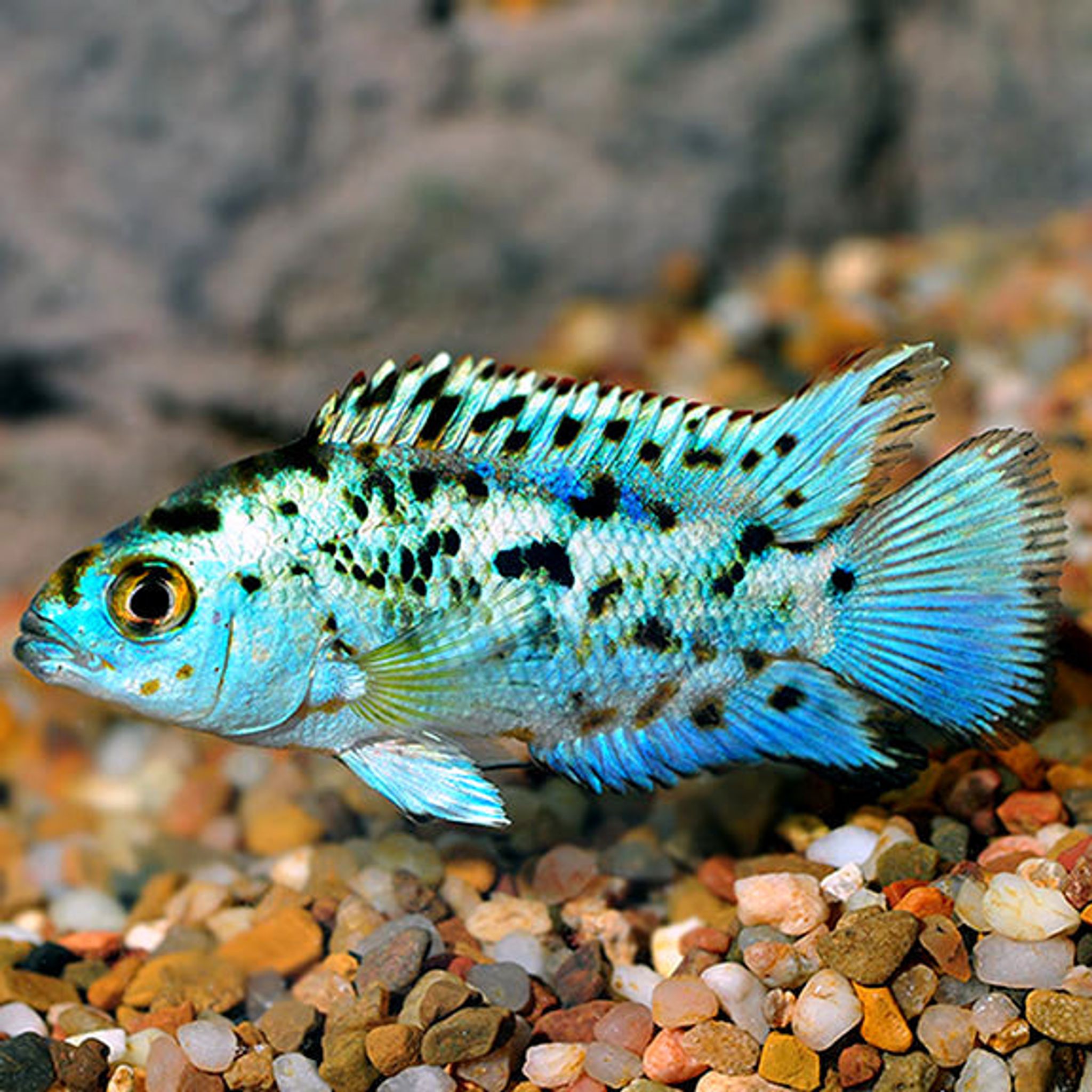
Jack Dempsey Care Guide: Tank Size, Diet, Water Parameters and Temperament
A Jack Dempsey bought as a 2-inch juvenile at a chain store can grow into an 8-to-10-inch, strongly territorial cichlid within a year, which is where most care problems start. This guide covers the tank size, water parameters, diet and temperament you need to plan for before you buy one, plus how to tell a Jack Dempsey apart from similar-looking Central American cichlids.
Species Snapshot
The Jack Dempsey (Rocio octofasciata, formerly classified as Cichlasoma octofasciatum) is a Central American cichlid native to slow-moving, warm, often murky waters along the Atlantic slope of southern Mexico, Belize, Guatemala and Honduras. The nickname comes from the 1920s heavyweight boxer, a nod to the fish's set jaw and combative attitude.
- Adult size: males typically reach 8-10 inches (20-25 cm) in home aquaria; females run smaller, around 6-8 inches (15-20 cm). Wild fish can exceed aquarium sizes.
- Sexing: males grow larger with more pointed, extended dorsal and anal fins and brighter iridescent flecking; females are more compact and often show a dark spot on the lower gill cover (opercle).
- Lifespan: commonly 8-10 years, with well-maintained fish reaching 12-15 years.
- Growth timeline: most of that adult size is packed on in the first 6-12 months, which is exactly when undersized "starter" tanks get outgrown.
Tank Size: Plan for the Adult, Not the Juvenile
Care sources disagree on the exact minimum, with figures ranging from 50 to 80 gallons for a single fish. A practical rule: 55 gallons (208 L) is the floor for one adult, and a 75-gallon (284 L), 4-foot-long tank is the better long-term choice. Length and floor space matter more than height, since Jack Dempseys are ground-oriented, territorial fish.
| Setup | Recommended tank size |
|---|---|
| Juvenile (temporary) | 30 gal (114 L) — expect to upgrade within 6-12 months |
| Single adult | 55 gal minimum, 75 gal ideal |
| Bonded pair | 75-90+ gal |
| Community of large cichlids | 125 gal (473 L) or larger |
| Electric blue morph, single | 55 gal+ (avoid relying on a 40-gal breeder) |
Rather than following a rigid "X gallons per fish" formula — advice here ranges wildly from 10 to 55 gallons per additional fish — plan around footprint and defensible territories. Each fish needs its own cave or rock structure with broken sightlines to the next one; the tank needs to be big enough that no fish is ever cornered.
Budgeting for a 75-Gallon Setup
A tank this size is a real investment: the tank and stand, a canister filter rated well above the tank volume, a secure lid, sand or gravel substrate, rockwork and driftwood, a reliable heater, and ongoing food and water-conditioner costs. Factoring this in before buying the juvenile avoids the most common mistake in this hobby — see the mistakes section below.
Water Parameters
Jack Dempseys are hardy and adapt to a range of conditions, but stability matters more than chasing an exact number.
| Parameter | Tolerated range | Recommended target |
|---|---|---|
| Temperature | 72-86°F (22-30°C) | 76-80°F (24-27°C) |
| pH | 6.0-8.0 | 6.5-7.8 |
| General hardness | up to ~20 dGH | 8-12 dGH (roughly 140-215 ppm) |
| Ammonia / Nitrite | — | 0 ppm |
| Nitrate | — | under 20-40 ppm |
Sources disagree on the fine points. Some recommend a slightly acidic 6.0-7.0 pH and warn that higher temperatures increase aggression; others cite the moderately hard, neutral-to-slightly-alkaline water of the species' native habitat and a broader 72-86°F range. In practice, 76-80°F with a pH of 6.5-7.8 suits most setups; reserve 84-86°F for short-term ich treatment or as a breeding trigger, since sustained high heat raises metabolism and, with it, aggression. Ordinary dechlorinated US tap water is fine — this species does not need soft, acidic water to thrive.
Filtration and Maintenance
Jack Dempseys produce a heavy bioload for their size. Filter at 2x or more of total tank volume per hour using a canister filter, a large hang-on-back unit, or a sump. Keep ammonia and nitrite at zero and nitrate under roughly 20-40 ppm — persistent high nitrate is a leading cause of hole-in-the-head disease in this species.
A realistic weekly routine:
- 25-30% water change weekly to every other week, more often in smaller tanks.
- Vacuum the sand during water changes; Jack Dempseys dig constantly and stir up debris.
- Rinse or replace mechanical filter media as needed to keep flow up.
Décor and Aquascaping
- Substrate: sand, about 2 inches (5 cm) deep — Jack Dempseys rearrange it constantly.
- Hardscape: caves, rockwork and driftwood to break sightlines and create separate territories. Rest rocks directly on the tank bottom, not stacked on sand, so digging can't collapse them.
- Plants: rooted stem plants get uprooted almost immediately. Tough epiphytes like anubias or java fern tied to wood, or hardy floating plants, hold up better.
- Lighting: subdued lighting suits their natural murky-water habitat and reduces stress-related color loss.
- Lid: a tight, heavy-fitting lid is essential — these are strong, sometimes surprisingly jumpy fish.
Diet
Jack Dempseys are best described as predatory omnivores leaning carnivore — sources split between calling them strict carnivores and general omnivores, but the practical answer is to feed mostly protein with some plant matter mixed in.
- Staple: a sinking cichlid pellet sized appropriately for the fish's mouth.
- Protein additions: frozen bloodworms, mysis shrimp, brine shrimp, krill, and chopped earthworms.
- Occasional plant matter: blanched vegetables or a spirulina-based food.
- Feeding frequency: adults 1-2 times daily, juveniles 2-3 times daily, offering only what's eaten within about 2 minutes.
- Avoid: feeder goldfish or rosy reds (disease and parasite risk, plus a thiaminase enzyme that interferes with vitamin absorption) and any mammal meat, which is too fatty for a fish's digestive system.
Overfeeding to "grow them fast" is a common mistake that leads to obesity, bloat, nitrate spikes, and hole-in-the-head disease — better to feed a measured amount and let growth happen at a normal pace.
Temperament
Jack Dempseys are territorial and rated anywhere from semi-aggressive to highly aggressive, depending on the source. The realistic summary: they're moderately aggressive as juveniles and escalate with age, with aggression rising further in undersized tanks and around spawning. Individual temperament varies a lot — plan for the more aggressive end of that range rather than hoping for a mellow individual.
Tankmates
Suitable tankmates are similar-sized, robust fish, ideally added at the same time or with the Jack Dempsey introduced last into a freshly rearranged tank:
- Other mid-to-large Central or South American cichlids: convicts, firemouths (with adequate space), blue acaras, or green terrors and oscars in sufficiently large tanks.
- Large plecos and bigger catfish.
- Clown loaches.
- Fast dither fish such as silver dollars or giant danios.
Avoid anything bite-sized, slow-moving long-finned fish, shrimp, and snails. Sources disagree on whether to keep Jack Dempseys singly or in groups to "diffuse" aggression — for most home tanks, a single fish or a bonded pair is the safer choice; two males housed together usually end up fighting.
For anyone building out a large-cichlid community, FishyHub's American Cichlids selection and Monster Fishes category are good places to browse compatible large tankmates.
Managing Aggression in a Cichlid Tank
Jack Dempseys sit mid-pack on the aggression scale compared to other popular large cichlids — milder than oscars, Midas cichlids, peacock bass, pike cichlids, and bucktooth tetras, but still capable of serious damage to the wrong tankmate. Useful tactics regardless of species:
- Oversize the tank relative to the fish's adult size, not its current size.
- Break sightlines densely with rock and wood so subordinate fish can escape view.
- Rearrange decor whenever adding a new fish, which resets territorial claims for everyone.
- Spread food across multiple points in the tank so one fish can't guard the entire feeding area.
- Keep a spare tank or breeder box on hand as a time-out space for an injured or bullied fish.
Look-Alikes and Related Species
Jack Dempseys are frequently confused with other Central American cichlids at the store. Knowing the differences helps buyers pick the right fish for their tank.
Texas Cichlid
The Texas cichlid shares a similar pearl-spangled pattern but grows larger and meaner — around 10-12 inches — and needs a 75-gallon tank for one, 110-125 gallons for a pair. It tolerates 71-80°F and pH 6.5-8, a slightly cooler and more alkaline-tolerant range than a Jack Dempsey.
Jaguar Cichlid (Parachromis managuensis)
Sometimes suggested as an "upgrade" from a Jack Dempsey, the jaguar cichlid is a much larger predator, reaching 14-16 inches in tanks and requiring 125 gallons or more. It is significantly more aggressive and is not a suitable next step for anyone without a genuinely oversized tank. The name refers to its spotted pattern, and related Parachromis species such as P. motaguensis are similarly large, similarly aggressive predators. They are prolific spawners with fierce brood-guarding behavior, similar in spirit to Jack Dempseys but on a bigger scale.
Pike Cichlid (Crenicichla)
An elongated South American ambush predator needing 90 gallons or more, the pike cichlid will eat any tankmate small enough to fit in its mouth. It's a poor Jack Dempsey tankmate unless the tank is very large.
Electric Blue Jack Dempsey
The electric blue is a recessive color morph of the same species — smaller, generally gentler, and more sensitive to water quality than the standard form, with a somewhat shorter typical lifespan (up to around 10 years). Because of its sensitivity, use a 55-gallon tank or larger rather than relying on a 40-gallon breeder, and pair it with calmer tankmates. Breeding blue-to-blue produces frail fry; crossing a blue with a non-blue "carrier" fish tends to produce healthier offspring. Blue fry are paler and more translucent and should be separated early from stronger, standard-colored siblings.
Other Central American Cichlids (Vieja Group)
Fish like the redhead cichlid, pantano cichlid, Mexican gold cichlid, chameleon cichlid, and harlequin cichlid are often sold nearby and belong to the related Vieja/Paratheraps group. Many grow larger than a Jack Dempsey, lean more herbivorous in diet, and need correspondingly bigger tanks — worth considering as alternatives or as large-tank companions once you understand their size and dietary differences.
Breeding
Jack Dempseys are monogamous substrate spawners that mature around 4-5 inches, roughly one year of age. The usual approach is to raise a group of juveniles and let a pair form naturally, or introduce two fish gradually with a tank divider.
- Pairs clean a flat rock or cave before spawning.
- A single spawn can produce 500-800 eggs.
- Eggs hatch in about 3 days at roughly 80°F (27°C).
- Fry become free-swimming in 7-10 days and can be fed baby brine shrimp.
- Parents guard the brood fiercely — remove any other tankmates during this period.
Health
Jack Dempseys are generally hardy fish, but watch for:
- Ich — white-spot parasite, often triggered by temperature swings or stress.
- Hole-in-the-head / lateral line erosion — linked to poor water quality, elevated nitrate, and nutritional gaps.
- Bloat and obesity — usually from overfeeding.
- Fin damage — from territorial fights, especially in undersized tanks or mismatched pairs.
A Note on Release
Jack Dempseys are not native to the United States, and established wild populations already exist in warm US waterways, including parts of Florida and other Sun Belt states. Never release an unwanted Jack Dempsey into local waters — it can harm native ecosystems and may violate state wildlife regulations. If you can no longer keep one, look into rehoming through a local aquarium club or a store that accepts livestock.
Common Mistakes
- Buying a 2-inch juvenile "for now" in a 20-30 gallon tank and never upgrading before it outgrows it.
- Housing a Jack Dempsey with community fish or shrimp, resulting in nipped fins or missing tankmates.
- Overfeeding to speed up growth, leading to obesity, bloat, nitrate spikes, and hole-in-the-head disease.
- Feeding feeder goldfish, which can introduce disease and parasites.
- Running an undersized filter, leading to chronically cloudy water after digging sessions.
- Adding a new fish directly into an established Jack Dempsey's territory without rearranging decor first, or without adding the Jack Dempsey last.
- Ignoring early signs of pair aggression — one fish hiding with torn fins calls for a divider, more caves, or separation.
- Assuming sudden dark coloring and hiding is just "personality" rather than testing the water first.
- Overlooking pits forming on the head or face, which warrant a check of nitrate levels, activated carbon use, and diet variety.
Frequently Asked Questions
How big do Jack Dempseys get, and how fast?
Males typically reach 8-10 inches and females 6-8 inches in home aquaria. Most of that growth happens in the first year, which is why a "temporary" small tank rarely stays adequate for long.
Can a Jack Dempsey live in a 55-gallon tank?
Yes, 55 gallons is a workable minimum for a single adult, though a 75-gallon tank gives more room for territory and is the better long-term choice.
Can I keep two Jack Dempseys together?
Only as a bonded pair or in a genuinely large tank with plenty of broken sightlines. Two males housed together will typically fight.
Are electric blue Jack Dempseys as aggressive as the standard form?
Generally no — electric blues tend to be milder-tempered but also more delicate and more sensitive to water quality swings than standard Jack Dempseys.
Can Jack Dempseys live with an oscar, convict, or angelfish?
An oscar or convict cichlid can work in a sufficiently large tank with careful introduction, but angelfish are not a good match — they're too slow and too easily bullied or injured.
Why is my Jack Dempsey turning dark?
Darkening usually signals stress, aggression from a tankmate, or breeding coloration. Check water parameters first, then look at tankmate behavior and recent changes to the tank.
Are Jack Dempseys good beginner fish?
They're hardy and forgiving of common water-quality mistakes, which makes them appealing, but they're better suited to keepers who are ready for a large tank and the aggression that comes with an adult cichlid, rather than a true first fish.
Browse FishyHub's American Cichlids category to see available Jack Dempseys and compatible large cichlid tankmates for your setup.

