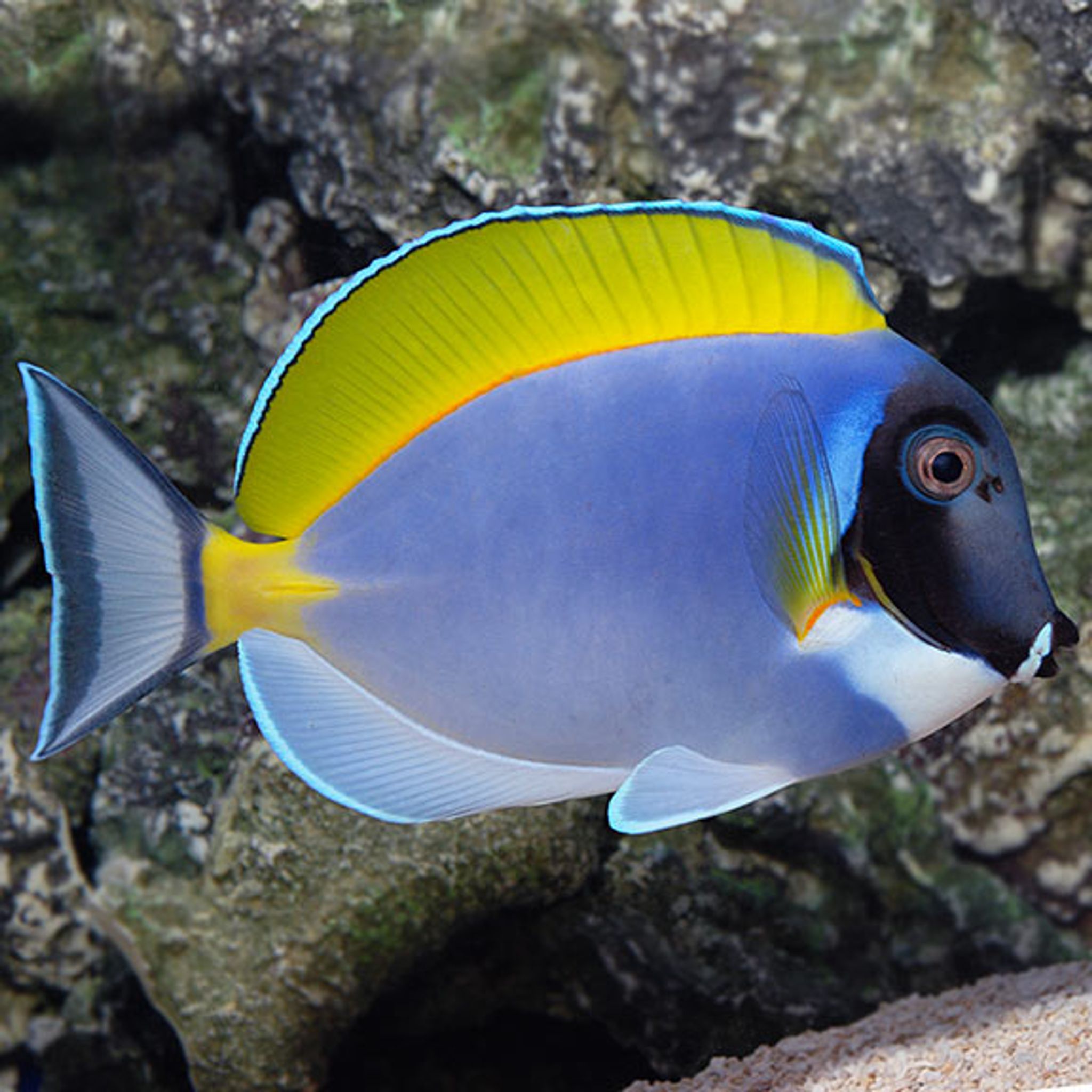
Is Powder Blue Tang Reef Safe? Coral and Invertebrate Compatibility Explained
Yes, the Powder Blue Tang (Acanthurus leucosternon) is reef safe: it's a dedicated algae grazer that has no interest in eating coral polyps or invertebrate tissue. The real caveats aren't about diet at all — they're about occasional curious nipping at clams, and a disease susceptibility that makes this one of the riskier tangs to bring into an established reef.
Meet the Powder Blue Tang
The Powder Blue Tang, also called the Powder Blue Surgeonfish, is an Indo-Pacific surgeonfish instantly recognizable by its powder-blue body, bright white belly, black "mask" across the eyes, and a narrow yellow band along the dorsal fin. It's a popular reef fish for its color, but it's also an active, fast-growing swimmer that reaches roughly 9 inches as an adult.
Like all Acanthurus tangs, it's built to graze constantly. In the wild it spends most daylight hours picking algae and diatom film off rock and reef structure — behavior that shapes everything else about how it fits into a reef tank.
Is a Powder Blue Tang Reef Safe? The Short Answer
Yes, with minor exceptions. The Powder Blue Tang is herbivorous and does not prey on stony coral (LPS or SPS) tissue, soft coral, or most sessile invertebrates. That's the basis for its "reef safe" classification, and it holds up well in practice.
The exception: some keepers report occasional nipping at large-polyp coral flesh or clam mantles. This isn't predation — it's almost always curiosity or boredom nipping from a fish that isn't getting enough grazing material, not a fish hunting coral as food. It's worth separating two different questions reef keepers often blur together:
| Question | Answer for Powder Blue Tang |
|---|---|
| Will it eat coral or inverts as food? | No — diet is herbivorous, not predatory |
| Could it physically damage something out of curiosity or stress? | Occasionally, mainly clam mantles and rarely LPS flesh |
| Will it harass tankmates (temperament)? | Can be aggressive toward other tangs/surgeonfish, generally peaceful otherwise |
Treating "reef safe" and "won't bother any tankmate" as the same question is where most confusion comes from — they're separate compatibility questions with separate answers.
Coral Compatibility, Coral by Coral
For essentially all coral types, a well-fed Powder Blue Tang is a non-issue:
- SPS corals (Acropora, Montipora, etc.): safe. Tissue isn't a food source.
- LPS corals (hammer, torch, frogspawn, favia): safe in almost all cases; rare reports of curious nipping at fleshy polyps when grazing food is inconsistent.
- Soft corals (zoanthids, mushrooms, leathers): safe.
- Clams (Tridacna): the one genuinely mixed case. Many reef keepers run Powder Blue Tangs alongside clams with zero problems; others report occasional mantle nipping. Monitor a newly added tang closely around clams for the first several weeks, and keep grazing food consistent to reduce the odds of it happening.
You can browse a wide range of reef-safe stony and soft options in FishyHub's coral selection when planning what to pair with a Powder Blue Tang.
Invertebrate Compatibility
Ornamental shrimp, snails, hermit crabs, starfish, and feather dusters are all generally safe with this species. A large, established Powder Blue Tang could occasionally harass a very small or slow-moving invertebrate, but this is uncommon and not typical behavior for the species.
Risk tiers, in plain terms:
- Essentially zero risk: snails, hermit crabs, feather dusters, starfish
- Low risk: ornamental shrimp (occasional interest in a fresh molt, not the shrimp itself)
- Low-to-moderate risk: clam mantles, especially in an underfed or newly stocked tank
Why This Tang Is Considered "Hard to Keep" — It's Not the Diet
If you've seen the Powder Blue Tang described as difficult, that reputation has nothing to do with coral compatibility. Two factors drive it:
Extreme disease susceptibility
This species is widely regarded as one of the most disease-prone tangs in the hobby, particularly for marine ich (Cryptocaryon irritans) and marine velvet (Amyloodinium). Shipping stress and undersized housing are common triggers for outbreaks. Some sources treat its ich risk as comparable to other tangs; most specialist reef keepers single it out as a worse-than-average offender. Either way, the safe approach is the same: treat this species as high-risk and quarantine strictly, regardless of which camp a given source falls into.
Territorial aggression
Powder Blue Tangs are territorial toward other tangs and surgeonfish, especially ones with a similar shape or color. They're best added last to a reef tank, or introduced as a single specimen — a mated or established group only works in very large systems. They can also turn on new tankmates added after they're already settled in as residents.
Tank Size and Setup Requirements
| Requirement | Recommendation |
|---|---|
| Minimum tank size | 125–180+ gallons (450–680+ L); 180 gallons is the safer target |
| Tank shape | Long/wide footprint (4–6+ feet), not just tall — active swimmers need lateral space |
| Temperature | 72–78°F (22–26°C) |
| pH | 8.1–8.4 |
| Salinity | 1.023–1.025 SG |
| dKH | 8–12 |
| Ammonia/nitrite | Near zero |
| Nitrate | Low |
| Flow/oxygenation | Strong, well-oxygenated water; avoid stagnant systems |
You'll see tank size guidance ranging from 100 gallons in older, more lenient guides up to 180+ gallons in stricter modern ones. The stricter number is the sensible one: a larger volume dilutes pathogen load, gives this fast, active swimmer room to move, and reduces the chronic stress that triggers ich and velvet outbreaks in the first place. Stable parameters matter more than hitting an exact number on any single reading.
If you keep two Powder Blue Tangs, it only works reliably in systems of 200+ gallons, with both individuals introduced simultaneously as juveniles — adding a second tang later, or into a smaller tank, usually triggers fighting.
Feeding to Prevent Nipping
Because nipping behavior traces back to insufficient grazing material, feeding schedule is a real prevention tool, not generic advice:
- Clip dried seaweed or nori to the tank daily — this species should have something to graze on essentially all day, not just at a single feeding.
- Supplement with marine algae, spirulina-based pellets, or herbivore flake to round out nutrition.
- Keep grazing material available consistently; gaps in feeding are when curiosity-driven nipping at coral polyps, coralline algae, or clam mantles is most likely to happen.
Introducing a Powder Blue Tang Into an Established Reef
A few practical notes that often get skipped:
- Add the tang before delicate new coral or clam additions when possible, or at minimum, watch new additions closely for the first 2–3 weeks after the tang is already resident — this is the window where curiosity nipping is most likely to surface.
- If the tang is being added to a tank that already has clams, monitor daily for the first few weeks specifically for mantle retraction or nipping marks.
- Add the tang last among tankmates when stocking a mixed reef, particularly if any other tangs, surgeonfish, or similarly-shaped fish are planned.
Compatible Tankmates
Beyond corals and inverts, the Powder Blue Tang is generally peaceful toward non-surgeonfish tankmates. Good pairings include:
- Clownfish, gobies, blennies, and wrasses
- Angelfish, with some care taken on individual temperament
- Other herbivorous grazers, provided the tank is large enough to support them
Avoid other Acanthurus or tang species in tanks under roughly 180–200 gallons — this is where most aggression problems originate. FishyHub's tangs and surgeonfish category is worth reviewing if you're considering a second grazer, so you can compare body shape and coloration before adding one.
Quarantine: Not Optional for This Species
Given its disease track record, skipping quarantine is the single most common — and most costly — mistake keepers make with this species. A dedicated QT setup should include:
- A 10–20 gallon bare-bottom tank — no substrate or rock, so parasites and symptoms are easy to spot and medication dosing stays accurate
- A sponge filter or seeded filter media to maintain biological filtration without hiding places for parasites
- A heater to hold stable temperature
- A PVC pipe hide for security without complicating observation
Quarantine timeline and method
- Minimum 4 weeks, extended to 6–8 weeks if any symptoms appear during the observation period — this window matches the life cycle of Cryptocaryon and Amyloodinium, which need time to complete a full reproductive cycle before you can call a fish clear.
- Use a copper-based treatment or the tank-transfer method for ich/velvet prevention — tangs are high-risk enough to warrant proactive treatment, not just watch-and-wait.
- Hyposalinity is a viable alternative for particularly sensitive individuals.
- Observe daily for flukes, ich (white spots/dust), and velvet (rapid breathing, flashing, a fine dusting on the skin).
- Acclimate gradually both into QT and again into the display tank once quarantine is complete.
Reef-safe medications and treatment supplies for a dedicated QT setup are available in FishyHub's treatment and medication category.
Common Mistakes to Avoid
- Skipping quarantine because "it's just a herbivore" — this is precisely the species you can't skip it for.
- Undersized housing (under 100–125 gallons), leading to stress, stunted growth, and recurring disease flare-ups.
- Adding a second tang too soon, or one with a similar shape/color, triggering territorial fighting.
- Inconsistent grazing food, leading to bored or hungry nipping at coral polyps, coralline algae, or clam mantles.
- Underestimating flow and oxygenation needs, which can cause gasping or lethargy in this active species.
- Mistaking early ich/velvet symptoms — flashing, rapid breathing, white spots — for normal behavior and delaying treatment until it's advanced.
- Buying a stressed specimen: pale coloration, clamped fins, or rapid breathing at the point of purchase are red flags for imminent illness.
Frequently Asked Questions
Is Powder Blue Tang reef safe with corals?
Yes, for essentially all coral types, since it's an algae grazer rather than a coral predator. The only caveat is occasional curious nipping at fleshy LPS polyps, which is uncommon and usually linked to inconsistent grazing food.
Will it eat my clam?
Rare but possible mantle nipping has been reported by some keepers. Monitor a newly introduced tang closely around clams for the first few weeks and keep it well-fed on algae to reduce the risk.
What's the minimum tank size?
180 gallons is the safe recommendation, favoring a long, wide footprint over a tall one. Older guides sometimes cite 100 gallons, but given this species' disease sensitivity and active swimming, more volume and length reduce stress substantially.
Can I keep two Powder Blue Tangs together?
Only in very large systems of 200+ gallons, introduced simultaneously as juveniles. Adding a second tang later, or into a smaller tank, typically results in aggression.
Why is this tang considered hard to keep?
Not because of diet or coral compatibility — it's because of high susceptibility to ich and velvet, plus the need for a large, stable, well-oxygenated system. Diet and coral safety are actually the easy parts of keeping this species.
Do I really need to quarantine it?
Yes. Quarantine is arguably more important for this species than almost any other common reef fish, given its documented track record with ich and velvet outbreaks.
What should I feed it?
Daily nori or dried seaweed, marine algae, and herbivore-formulated pellets or flakes, offered consistently enough that it's grazing throughout the day rather than going hungry between feedings.
Is it aggressive toward other reef fish?
Generally peaceful toward non-surgeonfish tankmates like clownfish, gobies, blennies, and wrasses. Its aggression is mainly directed at other tangs or similarly shaped/colored fish.
Ready to plan your stocking list? Explore FishyHub's marine livestock and invertebrates to find reef-safe additions that pair well with an active grazer like the Powder Blue Tang.

