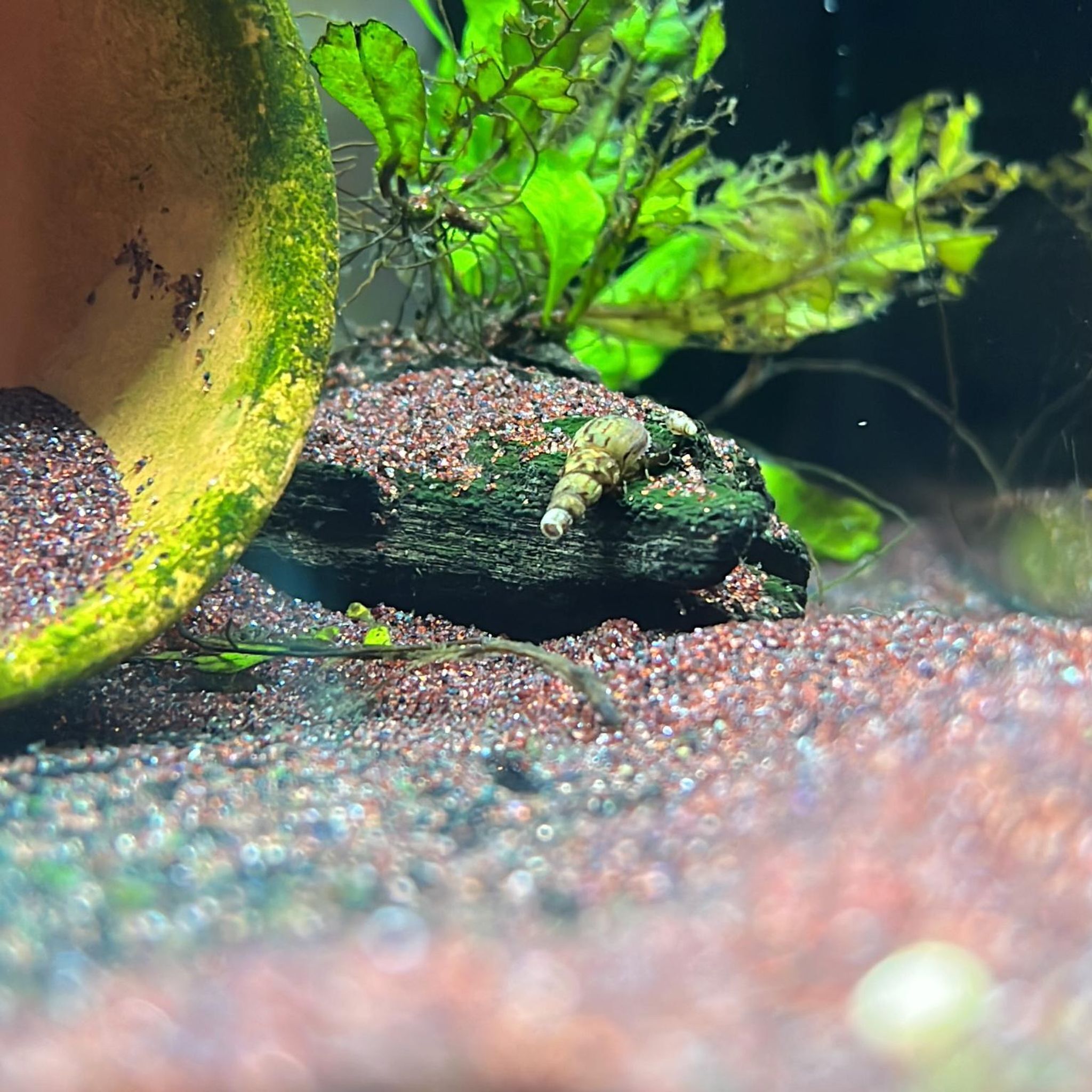
How to Set Up the Ideal Tank for Malaysian Trumpet Snail
Malaysian trumpet snails (MTS) need almost nothing beyond a normal, cycled freshwater tank with the right substrate — they are not a fussy species with special equipment demands. This guide covers the one setup detail that actually matters (substrate), the standard water and filtration basics, and the honest truth most guides skip: your real challenge won't be keeping them alive, it will be keeping their numbers in check.
Do You Want MTS on Purpose, or Did They Arrive Uninvited?
Before setting anything up, figure out which situation applies to you, since it changes what you actually need to do:
- You're adding them deliberately as a substrate cleanup crew. Follow the setup steps below and introduce a small starting group.
- They showed up as hitchhikers on new plants or hardscape and you're deciding whether to keep or remove them. Good news: they're harmless to fish, shrimp, and healthy plants, so many hobbyists just let them stay and manage the population instead of removing them outright.
- You want to prevent them entirely going forward. Quarantine and rinse or dip new plants before adding them to your display tank — this is by far the most common way MTS enter a tank uninvited, since their eggs and tiny juveniles are easy to miss.
Tank Size
There's no strict minimum tank size for Malaysian trumpet snails. They can live in anything from a 5-gallon (19 L) nano tank to a large community setup. A 10-gallon (38 L) tank is a comfortable practical starting point if you're adding a small colony on purpose, since it gives enough substrate surface area for burrowing without the population outpacing the space too quickly.
Substrate: The One Setup Detail That Actually Matters
MTS are burrowing snails — they spend the day buried in the substrate and emerge mostly at night or when the substrate is disturbed. This burrowing behavior is the entire reason people keep them, so substrate choice is the single most important decision in the setup.
What works:
- Fine sand or fine gravel
- At least 2–3 inches (5–7.5 cm) deep
What to avoid:
- Large, sharp, or very coarse gravel — snails struggle to burrow through it and can injure themselves on sharp edges
- Substrate that's too shallow to burrow into at all, which defeats the purpose of keeping them
Sources disagree on the exact minimum: some say 1 inch is enough for a snail to simply survive, while others insist on 2–3+ inches for the burrowing benefit to actually happen. A sensible middle ground is to treat 2 inches as a practical minimum — deeper is better for substrate aeration, but not strictly required for the snails themselves to live.
That aeration matters because a burrowing colony continuously turns over the top layers of substrate, which prevents compaction and stops anaerobic pockets (and the hydrogen sulfide gas that comes with them) from building up under the surface. You can browse fine-grained options in FishyHub's substrate and sand and gravel selection when choosing a burrowable material.
Water Parameters
MTS are more forgiving than most fish and tolerate a fairly wide range, but they still have preferences — particularly around hardness, since their shells are made of calcium carbonate.
| Parameter | Ideal Range | Why It Matters |
|---|---|---|
| Temperature | 70–79°F (21–26°C) | Standard tropical community range |
| pH | 7.0–8.0 | Slightly alkaline water supports shell growth |
| GH (hardness) | Moderate to hard | Soft/acidic water gradually erodes shells |
| KH | Stable | Prevents pH swings that stress shells and other livestock |
| Ammonia/Nitrite | 0 ppm | Same nitrogen-cycle rules as any fish tank |
| Nitrate | Kept reasonably low | High nitrate stresses the whole tank, not just snails |
One flag worth calling out clearly: MTS, like all snails and invertebrates, are highly sensitive to copper. Avoid copper-based medications, and check that any fertilizers or tap water conditioners you use aren't copper-based, both before and after introducing snails. A dose that's harmless to fish can be lethal to your entire snail (and shrimp) population.
Filtration and Flow
Any standard filter works fine for a tank housing MTS — hang-on-back, sponge, or canister filters are all suitable. Snails don't need extra flow, but their tiny juveniles can get pulled into intakes, so a sponge filter or a pre-filter sponge over an intake is a smart, inexpensive safeguard rather than a strict requirement.
As a general filtration guideline (not species-specific to snails), aim for filter turnover of roughly 4–8 times your tank volume per hour for a standard freshwater community tank, adjusting up or down based on bioload and whether the tank is heavily planted. FishyHub's filter selection covers hang-on, canister, sponge, and internal options if you need to size one up.
Lighting
MTS have no special lighting requirement. Since they're nocturnal burrowers that hide from light during the day, standard lighting for your plants or fish is all you need — the snails simply won't be visible much until the lights go out or the substrate gets disturbed.
Diet and Calcium
MTS are scavengers and detritivores. Their natural diet is:
- Leftover fish food
- Decaying plant matter
- Algae film and biofilm on surfaces
In most established, moderately stocked tanks, they need no additional feeding at all — they live off what's already there. If the population is large or food is genuinely scarce, you can supplement with algae wafers or blanched vegetables like zucchini or spinach.
Calcium supplementation (cuttlebone, crushed coral, or calcium-rich foods) helps maintain shell strength, especially in soft or acidic water. In harder water with a stable pH, it's less necessary since the water itself supplies enough calcium.
Breeding and Why Populations Explode
MTS are livebearers (ovoviviparous), and in many populations they're also parthenogenic — meaning a single snail can reproduce without a mate and start an entire colony on its own. Combined with a scavenging diet, this is why a tank can go from "a few snails" to "hundreds" within weeks.
The single biggest driver of population booms is overfeeding fish. Excess food that sinks to the substrate is exactly what fuels rapid MTS reproduction — feed less, and growth slows dramatically. There's no universal numeric formula, but a reliable practical cue is: if you're seeing daily uneaten food reach the substrate, you're feeding too much for your snail population's comfort level, and numbers will keep climbing until that's corrected.
Population Control
If numbers get ahead of you, address the cause before the symptom:
- Reduce feeding first. This is the root fix for most "snail explosion" complaints — cutting back food intake slows reproduction at the source.
- Manual removal of visible snails reduces numbers short-term but won't stick if overfeeding continues.
- Assassin snails are an effective, deliberate biological control — they actively hunt and eat MTS.
- Baited overnight traps let you pull out large numbers in one pass; bait with a piece of blanched vegetable or fish food and remove it (with the snails inside) each morning.
Avoid the common mistake of panic-removing every snail by hand while ignoring the cause — the population rebounds quickly unless feeding and waste levels are actually corrected.
Compatibility
MTS are peaceful and compatible with nearly all community fish and shrimp. Many shrimp keepers deliberately add them as substrate cleaners in shrimp tanks, since they pose no threat to shrimp of any size. You can browse compatible freshwater shrimp if you're building a planted shrimp tank around them.
Some fish will eat MTS and can be used intentionally for population control, including:
- Certain loaches (clown loach among them)
- Some puffers
- Certain cichlids
Do They Solve Algae Problems? Setting Expectations
This is where a lot of guidance overstates what MTS actually do. They graze on soft biofilm and diatom film, mostly on the substrate surface — but they are not a meaningful solution for hair algae, film algae on glass, or algae on hardscape. Position them correctly:
- Primary role: substrate and detritus management
- Secondary, incidental benefit: grazing soft biofilm
- Not their job: treating an existing algae outbreak on glass or decor
If you have an algae problem, pair proper light and nutrient control with dedicated algae-eaters such as shrimp, otocinclus, or nerite snails rather than relying on MTS to fix it.
Do They Damage Live Plants?
No — MTS target decaying organic matter and biofilm, not healthy plant tissue. They leave live leaves alone. The one caveat: at very high densities in soft substrates, some root disturbance has been reported as the colony burrows through root zones, though this is not typical at normal population levels.
Aquarium Cleaning Around a Burrowing Colony
A snail colony changes how you approach routine maintenance slightly:
- Gravel vacuuming: use a lighter touch and stir the top layer rather than deep-cleaning the substrate — the snails themselves do much of the "stirring" work for you, and aggressive deep-vacuuming can pull them into the siphon and defeats their aeration role.
- Cleaning sand specifically: use a fine-tipped vacuum or gently disturb just the top layer during water changes. Avoid routinely disturbing sand too deep, since that undoes the benefit of having burrowers in the first place.
- Glass and hardscape: an algae scraper or pad works normally; MTS mostly stay in the substrate during the day so this rarely disturbs them.
General Maintenance Schedule
MTS don't change your baseline maintenance routine — they just make it slightly gentler in the substrate zone. A reasonable schedule:
| Task | Frequency |
|---|---|
| Partial water change (10–25%) | Weekly |
| Larger water change (25–50%) | Biweekly, if preferred over weekly small changes |
| Filter media rinse (in removed tank water, not tap) | Monthly |
| Water parameter testing | Weekly, more often during setup or after changes |
| Equipment check (heater, filter flow, seals) | Periodic, at every water change |
Smaller, more frequent water changes are gentler on the whole tank and reduce parameter swings compared to large, infrequent ones. Rinse filter media in removed tank water rather than tap water to avoid killing off the beneficial bacteria that chlorine or chloramine would harm.
Acclimation
Introduce MTS the same way you would any new livestock — drip acclimation or a float-and-mix method to match temperature and chemistry gradually. As noted above, make sure no copper-based products have been used in the tank recently, since copper is toxic to snails even at doses safe for fish.
Common Mistakes and Troubleshooting
- Overfeeding fish — the number one cause of unwanted MTS population booms.
- Copper exposure — copper-based medications, some fertilizers, and certain tap water treatments can kill snails outright.
- Substrate too coarse or too shallow — defeats the entire purpose of keeping a burrowing species.
- Panic-removing snails by hand without fixing feeding or waste levels — the population rebounds.
- Misreading nighttime emergence as a problem — it's normal behavior, not a health issue.
- Missing real warning signs — mass daytime surfacing or snails climbing out of the water across the whole colony can signal low oxygen or an ammonia spike and warrants a water test, unlike the occasional individual snail moving around during the day.
- Expecting them to fix algae — they manage detritus and biofilm, not glass or hardscape algae.
Proactive Fishkeeping Habits
A few habits reduce most of the problems above before they start:
- Test water parameters regularly, especially in a newly set up tank.
- Quarantine new plants and fish — this is exactly how MTS most often arrive uninvited.
- Keep a simple maintenance log so you notice trends (rising nitrate, more frequent surfacing) rather than reacting to a single data point.
- Learn what normal snail behavior looks like for your tank so you can tell the difference between routine nighttime activity and a genuine water quality warning sign.
A Few Related Setup Notes
Activated carbon is optional chemical filtration media — it removes odors, discoloration, and some medication residues or toxins from the water. It's not required for a snail-only or general community setup, but it's useful after a medication treatment or for tannin and odor control. It stops adsorbing after a few weeks and needs periodic replacement rather than being a permanent media.
A leaky tank isn't snail-specific, but it's worth knowing: reseal with aquarium-safe silicone, inspect corner seams closely, and never reuse a tank with a failed seal without resealing it first.
Basic supplies checklist for any freshwater setup, MTS included: tank, filter, heater (if your room temperature won't hold 70–79°F/21–26°C on its own), substrate, a water conditioner, a liquid test kit, a net, a bucket or siphon, a thermometer, and a lid. For conditioners and other water treatment basics, see FishyHub's water conditioning and additives category.
Malaysian trumpet snails are about as close to zero-maintenance as aquarium livestock gets — the entire setup comes down to a properly cycled tank with the right substrate depth, and the entire ongoing job is feeding discipline rather than exotic care. Get those two things right and the rest takes care of itself.
If you're ready to start or expand a colony, browse FishyHub's full range of tanks, substrate, and filtration in the freshwater livestock category to find everything a burrowing cleanup crew needs.
Frequently Asked Questions
Do Malaysian trumpet snails need a filter?
Yes. They're not a filter-free "starter" pet — standard nitrogen cycling and filtration rules apply exactly as they would for any fish tank.
What size tank do I need?
There's no strict minimum. A 5–10 gallon (19–38 L) tank works fine for a small colony, and MTS adapt equally well to larger community tanks.
Will they overrun my tank?
Their population can grow quickly if fish are overfed and numbers go unmanaged. Feeding discipline, manual removal, or predator snails and fish keep it in check.
Do they eat plants?
No. They target decaying matter and biofilm rather than healthy plant tissue, and are generally considered plant-safe.
Can they live with shrimp?
Yes. They're widely considered shrimp-safe and are often added deliberately to shrimp tanks as substrate cleaners.
What eats Malaysian trumpet snails?
Assassin snails are the most common deliberate predator. Certain loaches (clown loach among them), some puffers, and certain cichlids will also eat them.
Do they need calcium supplements?
It helps in soft or acidic water to keep shells strong. In harder water with a stable pH, additional calcium is less necessary since the water already supplies enough.
Why are my snails all coming out during the day?
A few individuals moving during the day is usually just a response to substrate disturbance and is normal. Persistent daytime surfacing across the whole colony, though, can signal low oxygen or poor water quality and is worth checking with a water test.

