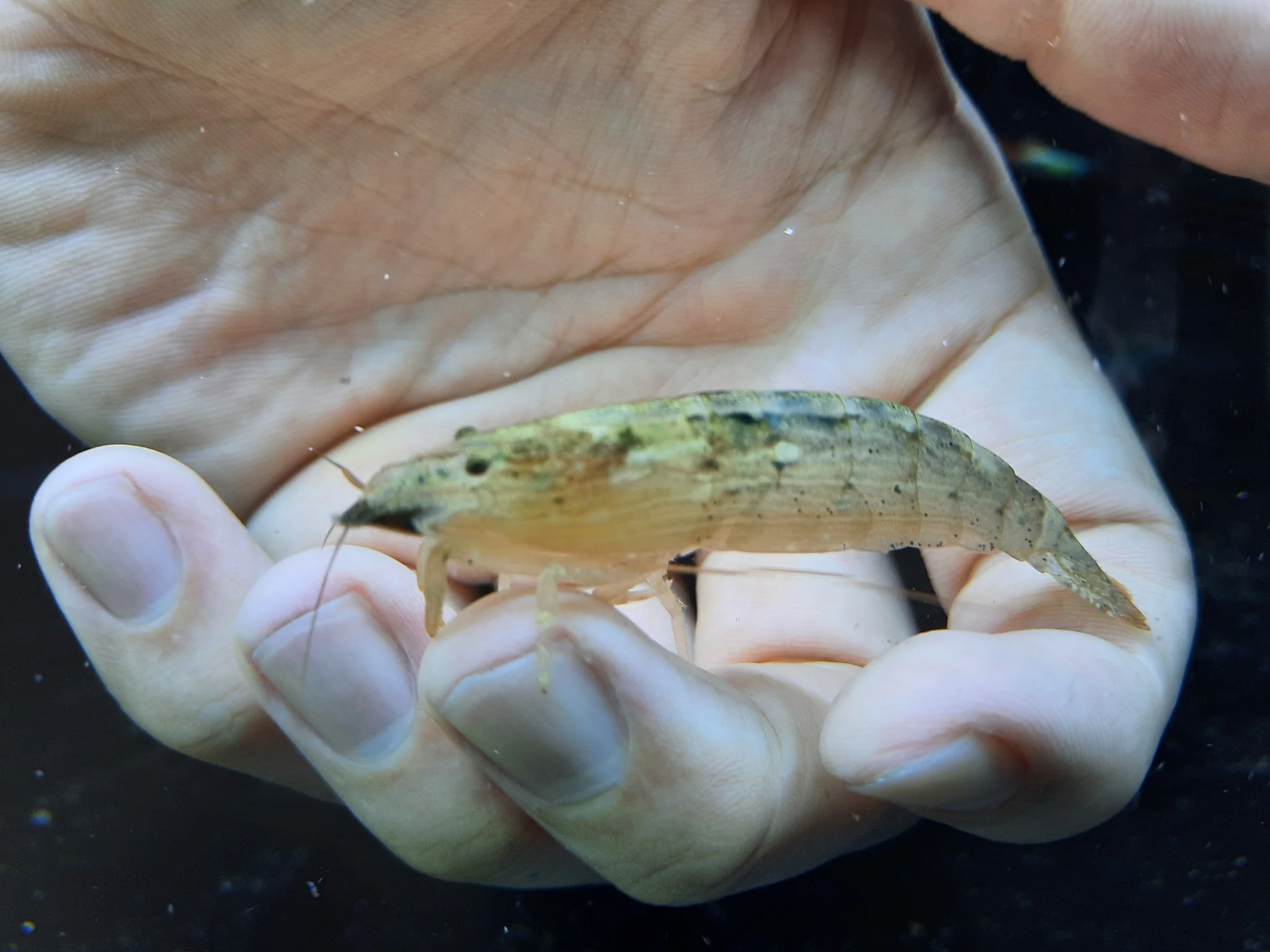
How to Set Up the Ideal Tank for Bamboo Shrimp
Bamboo shrimp are unlike almost any other shrimp sold for freshwater tanks: they don't graze algae, they filter it out of the water column. That single fact should drive every decision you make about tank size, filter choice, and decor. This guide walks through a bamboo shrimp tank setup built around current and feeding, not just general shrimp-keeping advice.
Species Snapshot
Bamboo shrimp (Atyopsis moluccensis) are also sold as wood shrimp, Singapore shrimp, flower shrimp, or fan shrimp — all the same animal. A few things set them apart from dwarf shrimp like cherry or Amano shrimp:
- Size: they reach 2-3 inches (5-8 cm), noticeably larger than most freshwater dwarf shrimp.
- Feeding style: they are true filter feeders, using fan-shaped appendages to strain particulate matter out of moving water — they cannot eat algae or biofilm off surfaces.
- Temperament: generally peaceful and somewhat territorial over a good feeding perch rather than aggressive toward tankmates.
Because of that feeding style, a tank that looks "clean" with no visible current or floating particulate can slowly starve a bamboo shrimp even if the water parameters are perfect.
Choosing the Right Tank Size and Shape
Recommendations vary across the hobby. Some sources say a single bamboo shrimp can get by in a 10-gallon tank in a calm community setup, but the safer consensus is 20 gallons as a baseline for one shrimp, and bigger is better here for a specific reason: a larger volume of water supports a stronger, more stable current without swinging temperature or oxygen levels around.
Shape matters as much as volume. Favor a long, wide footprint over a tall one:
- More surface area means more room for current to travel and more places to position a perch.
- A tall, narrow tank concentrates flow near the filter outlet and leaves the rest of the water column nearly still.
Standard rectangular glass tanks are the default choice and work fine; a "long" style (extra length at standard height) beats a bowfront or tall-format tank for this species specifically because length maximizes the current's travel path relative to total volume. You can browse long-format setups under Tanks & Stands when shopping for a footprint that fits your space.
Water Parameters and Cycling
Bamboo shrimp are sensitive invertebrates, so get the water chemistry stable before adding one:
| Parameter | Target range |
|---|---|
| Temperature | 70-78°F (21-26°C) |
| pH | 6.5-8.0, ideally near 7.0 |
| General/carbonate hardness | roughly 3-10 dKH |
| Ammonia | 0 ppm |
| Nitrite | 0 ppm |
| Nitrate | Low |
Fully cycle the tank before adding shrimp. Ammonia and nitrite spikes are lethal to shrimp faster than to most fish, and skipping the cycling process is one of the most common ways new shrimp die within the first week. Also confirm the tank and any used equipment have never been dosed with copper-based medication — copper is toxic to bamboo shrimp and all other invertebrates, and it can leach out of substrate or decor for a long time after treatment.
Building the Current: The Core of a Bamboo Shrimp Setup
Current is the single defining requirement for this species. A bamboo shrimp needs a steady, moderate-to-strong flow that keeps fine particulates suspended and moving past its feeding fans. Weak or still water is the number one cause of starvation and stress in this species — not poor water quality.
A useful rule of thumb that most general shrimp guides skip: aim for filter or pump output around 5-10 times the tank volume per hour when the tank is being built around a filter feeder, noticeably higher turnover than the 3-5x range often quoted for a general community tank.
Reading the Shrimp as a Flow Indicator
A bamboo shrimp's posture is a live diagnostic tool. If it's perched with its fans fully extended into the current and visibly catching debris, flow and food are adequate. If it stays curled up, hidden, or tucked low for long stretches, that's usually a sign of insufficient current, not necessarily illness.
Filter Type Trade-Offs
There's no single "correct" filter — it's a spectrum:
- Sponge or air-driven filters: gentle and safe for shrimp legs and juveniles, and the simplest choice for a beginner. The risk is running one too weak to generate real current — if flow disappears, so does the food supply.
- Power (HOB) or canister filters: produce stronger, more reliable flow, but standard intakes can strip fine food particles out of the water and can injure shrimp or pull in juveniles. Fit any HOB or canister intake with a pre-filter sponge or intake guard — this protects the shrimp while preserving flow.
Browse both intake-friendly and standard options under Filters, including Hang On Filters and External Filters.
Do You Need an Air Pump Too?
Not always. HOB and canister filters already agitate the surface and oxygenate the water, so a separate air pump isn't required for every setup. Air pumps and airstones become more important when:
- You're running a sponge filter as the primary or only filtration.
- The tank is densely stocked.
- Water is on the warmer end of the range, since warmer water holds less dissolved oxygen.
- You want backup oxygenation for power outages.
For a bamboo shrimp tank specifically, an airstone-driven bubble column can double as part of the flow system — position it so the rising bubbles push water toward a perch, supplementing a filter's output without over-relying on one device.
Running One Air Pump for Multiple Tanks
If you keep more than one tank, a single air pump can supply several via a gang valve or manifold, with a check valve on every line. Check valves are non-negotiable — without one, water can siphon backward through the airline if the pump loses pressure or is turned off, potentially draining a tank onto the floor. Size the pump's rated gallon capacity to the combined volume of every tank it feeds, not just one.
Feeding a Filter Feeder
Since bamboo shrimp can't graze algae, their diet has to come to them as suspended particulate matter:
- Infusoria
- Powdered fry food
- Crushed flake
- Baby brine shrimp
- Blended frozen foods
Introduce food into the current so it drifts naturally past the shrimp's fans rather than dropping straight to the substrate. Whether you need to feed manually depends on the tank:
- A mature, well-planted, established tank can partially self-feed the shrimp through biofilm and detritus generated by plants and decor.
- A very clean or low-bioload tank needs manual supplementation, roughly 2-3 times per week.
The best gauge is the shrimp itself: if it's stretched out and actively catching debris, minimal supplementation is fine. If it looks curled up, listless, or visibly thin, start manual feeding. You'll find suitable fine and freeze-dried foods under Food & Supplements, including options in Freeze Dried Food.
Decor: Perches Matter More Than Substrate
Substrate choice isn't critical for this species — bamboo shrimp don't burrow or graze the substrate, so standard gravel or sand both work fine. Put your decor budget toward current and perching instead.
Perches are essential: driftwood, tall rock stacks, or tall plant stems positioned directly in the current give the shrimp somewhere to climb and hold a stable feeding position. Without an elevated perch in the flow path, a bamboo shrimp struggles to reach food-rich water even if the current elsewhere in the tank is adequate.
If you're keeping more than one bamboo shrimp, provide multiple perch spots — they can be territorial over a favored feeding position, and a single good perch in a tank with two or three shrimp invites conflict.
Avoiding Trapped or Injured Shrimp
New decor layouts should be checked for narrow gaps a shrimp could wedge into, especially after a molt or a startle response. A few habits reduce risk:
- Leave clearance behind and around large decor pieces and filter housings.
- Mount background decorations rather than leaning or floating them, so they can't shift and create a new pinch point.
- Re-check the layout any time you rearrange, not just on initial setup.
Plants: Pros and Cons for a Shrimp Tank
Moderate live planting is a net positive for a bamboo shrimp tank specifically, because plants generate biofilm and detritus that function as a passive, secondary food source. Additional benefits include extra hiding and perching spots and some buffering of water quality.
The downsides are worth planning around:
- Overgrown plants can clog the current's path, defeating the purpose of your flow setup.
- Fast-growing species can outcompete slower plants for light.
- Decaying plant matter that isn't cleaned up can spike ammonia.
Position plants so they add biomass without blocking the flow route between your filter or pump and the shrimp's perch.
A Secure Lid Is Not Optional
Bamboo shrimp are competent climbers and will attempt to leave the tank, especially during acclimation or if water quality drops. A well-fitted, secure lid with no gaps at the corners or around cord cutouts is one of the cheapest and most effective things you can add to the setup.
Molting and Handling the Vulnerable Period
Like all shrimp, bamboo shrimp molt periodically as they grow, shedding their exoskeleton. This is normal — don't panic if you find what looks like a dead shrimp that's actually just a shed shell. During and immediately after a molt, the shrimp is soft-bodied and vulnerable, so having hiding spots available (in addition to perches) gives it somewhere to retreat until the new shell hardens.
Tankmates and Acclimation
Bamboo shrimp do well in a peaceful community setup. Good tankmates include:
- Cherry shrimp and other peaceful dwarf shrimp
- Nerite or mystery snails
- Tetras
- Corydoras
- Otocinclus
- Gouramis
Avoid predatory or nippy fish, larger cichlids, and anything else that hunts invertebrates. Also avoid copper-based medications in any tank housing shrimp, since copper is toxic to them even at doses fish tolerate.
Bamboo shrimp are more sensitive to sudden parameter swings than most community fish, so drip acclimate new arrivals slowly rather than doing a quick float-and-dump. If you're adding a shrimp to an established display tank, it's also worth quarantining it briefly first, particularly if any of your equipment was previously used in a tank treated with copper-based medication — residue can linger longer than expected.
Filter Maintenance for a Bamboo Shrimp Tank
Routine filter care needs a slight adjustment for this species, since over-cleaning removes the fine particulate food the shrimp depends on.
- Cleaning schedule: rinse mechanical and biological media in removed tank water, never tap water, to protect the nitrifying bacteria colony. Clean monthly, or whenever flow visibly drops.
- Mechanical media (floss/pads): replace every 2-4 weeks as it compacts and loses effectiveness.
- Chemical media (carbon, etc.): spent within 3-4 weeks; replace or remove rather than leaving it in indefinitely.
- Biological media (sponges, bio-rings): rinse only — rarely, if ever, fully replace it.
- Use a fine-mesh media bag for loose carbon or similar chemical media so it doesn't cloud the water or get ingested.
When choosing a filter's rated output, look for something sized to 1.5-2x your actual tank volume in gallons per hour as a baseline, then confirm visible current actually reaches the shrimp's perch once it's running — a spec sheet number doesn't guarantee usable flow at the far end of a long tank.
Preparing for a Power Outage
Because this whole setup depends on current, a power outage is a bigger risk to a bamboo shrimp tank than to a typical community tank. Priorities in order:
- Battery-powered air pump — oxygen matters more than filtration in the short term.
- Insulate the tank with blankets or towels to slow heat loss.
- Avoid opening the lid unnecessarily, which speeds heat and gas exchange loss.
- Manual agitation — gently stirring or pouring water back into the tank can substitute briefly if no battery backup is available.
Most fish and shrimp, bamboo shrimp included, tolerate several hours without power as long as they stay oxygenated and temperature stays reasonably stable.
Other Household Factors That Affect the Tank
A few things outside the tank itself can undermine an otherwise well-set-up bamboo shrimp aquarium:
- Airborne aerosols: cleaning sprays, air fresheners, and candle smoke can settle into an open-top tank and affect water quality.
- Fumes: paint or pesticide fumes nearby can also dissolve into the water.
- Placement: unstable furniture and direct sunlight both contribute to temperature swings and algae blooms.
- Tap water changes: municipal water treatment can shift periodically, so it's worth rechecking your water conditioner routine occasionally rather than assuming it never changes.
Common Mistakes to Avoid
- Buying a bamboo shrimp expecting it to clean algae off glass or decor — it physically can't, and will starve without suspended food.
- Setting up all filtration to be gentle and diffused for delicate fish, leaving no real current anywhere in the tank.
- Running an unguarded power filter or canister intake, which can injure shrimp legs or pull in juveniles.
- Skipping the nitrogen cycle before adding shrimp.
- Using copper-based medication, or reusing equipment previously exposed to it.
- Using a loose-fitting lid, which invites an escape during a stress event.
- Over-cleaning the tank or filter to the point of stripping out the fine particulates the shrimp needs to eat.
Frequently Asked Questions
Do bamboo shrimp eat algae?
No. They're filter feeders that catch suspended particles with fan-like appendages, and they don't graze algae or biofilm off surfaces the way dwarf shrimp or algae-eating snails do.
What size tank does a bamboo shrimp need?
20 gallons in a long shape is the safe baseline for one adult. Bigger and longer tanks support a stronger, more stable current, which matters more for this species than for most shrimp.
Do bamboo shrimp need a strong filter?
They need strong, steady current more than raw filtration power. Sponge filters, airstones, or a guarded power filter can all work as long as visible flow reaches the shrimp's perch.
Can bamboo shrimp live with fish?
Yes, with peaceful community species like tetras, corydoras, otocinclus, and gouramis. Avoid predatory or nippy fish and never use copper-based medications in a shared tank.
How do you feed a bamboo shrimp if there's no algae?
Feed powdered or fine foods — crushed flake, powdered fry food, baby brine shrimp, or blended frozen food — into the current 2-3 times a week if the tank isn't naturally rich in particulate matter.
Why is my bamboo shrimp not moving or hiding?
Usually it's insufficient current or food, a recent molt (which is temporary), poor water parameters, or stress from tankmates. Check its feeding posture first — a curled-up shrimp is often a flow problem, not an illness.
Can bamboo shrimp live in a planted tank?
Yes. Plants add biofilm and detritus as a bonus food source along with extra hiding spots, just make sure dense growth doesn't block the current path to the shrimp's perch.
What happens to my bamboo shrimp during a power outage?
Prioritize oxygen with a battery-powered air pump and insulate the tank against temperature swings. Most invertebrates tolerate several hours without filtration as long as they stay aerated and the temperature stays stable.
Once your flow, filtration, and perches are dialed in, you can browse live Shrimps on FishyHub to find a bamboo shrimp ready for a properly prepared tank.

