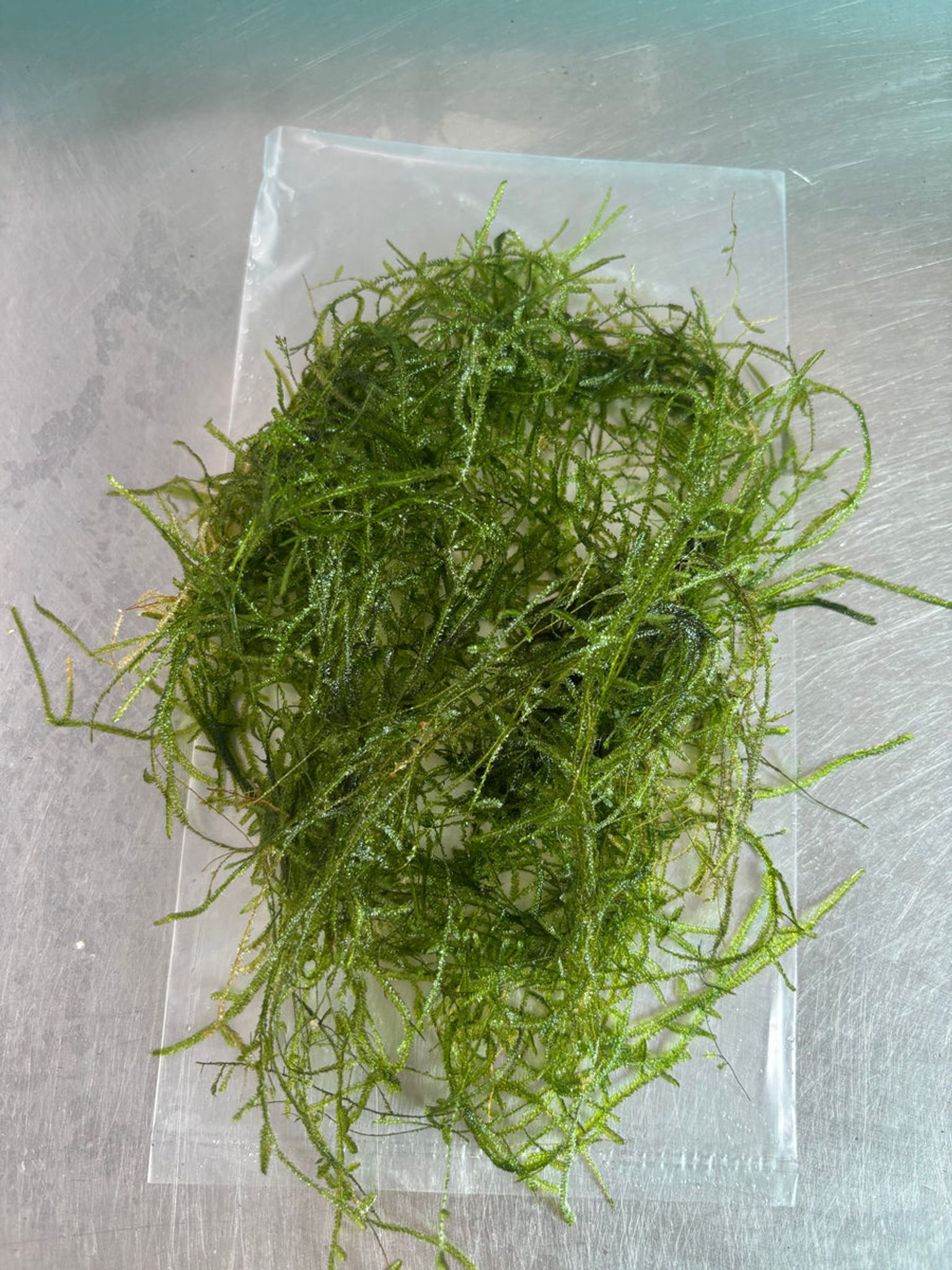
How to Plant and Propagate Java Moss in a Freshwater Aquarium
Java moss is the most forgiving carpet and hardscape moss in the hobby, but it doesn't "plant" the way a rooted stem or sword does. This guide covers how to attach it, the water conditions it actually needs, how it multiplies, and how to stop it from turning into a detritus trap.
What Java Moss Is
Java moss is the common name for Taxiphyllum barbieri (sold historically as Vesicularia dubyana), a moss native to Southeast Asia. It grows as an irregular, feathery mat of tiny bright-green leaves branching off thin creeping stems. Unlike a true rooted plant, it has no root system — it anchors itself with thread-like rhizoids that grip onto rough surfaces rather than pulling nutrients from substrate.
That single fact drives almost everything else in this guide: how you plant it, how you propagate it, and why burying it in gravel is a common mistake.
Water Parameters Java Moss Tolerates
Java moss is prized as a beginner plant because it shrugs off a wide range of conditions:
| Parameter | Tolerable range | Best for full, green growth |
|---|---|---|
| Temperature | 59–86°F (15–30°C) | 68–82°F (20–28°C), ideally low-to-mid 70s°F |
| pH | 5.0–8.0 | 6.0–7.5 |
| Water hardness | Soft to moderately hard (~2–15 dGH) | Mid-range of that band |
| Lighting | Low to moderate (~10–30 PAR) | 8–12 hours/day on a timer |
The temperature range is often cited inconsistently across sources — some say 68–82°F, others stretch it to 59–86°F. Both are correct in context: java moss can survive the wider range, including unheated tanks, but it looks its fullest and greenest in the low-to-mid 70s°F. Treat the extremes as survival limits, not growth targets.
CO2 injection and liquid fertilizer are optional accelerants, not requirements. Since java moss isn't substrate-rooted, it draws most of its nutrients from the water column rather than root uptake. Adding CO2 and ferts will noticeably speed up growth and density, but skipping them just means slower, sparser growth — not failure. One caution: cranking up light intensity without adding more nutrients or CO2 to match tends to invite algae growth on the moss itself, since the moss can't use the extra light energy fast enough to out-compete algae for it.
How to Plant (Attach) Java Moss
Because java moss clings rather than roots, "planting" really means securing a division to something it can grip.
Materials
- Cotton thread or fine fishing line (cheap, fully reversible)
- Plastic-safe mesh, for carpets or background walls
- Aquarium-safe cyanoacrylate ("super") glue gel
Sources split on which attachment method is best. Thread and fishing line are the safer default for beginners — they're inexpensive, and if you tie it wrong, you just cut and retry. Glue gel is a legitimate faster option once you're comfortable using an aquarium-safe product correctly; it cures underwater in seconds and skips the trimming-off-thread step later.
Method
- Divide a small portion from your moss mat or cup culture.
- Spread it thin across the rock, driftwood, or mesh. This is the step most beginners skip — a thick clump looks fuller on day one, but the center rots from lack of water flow and light penetration within a few weeks.
- Secure it by wrapping thread in a loose crisscross pattern, or by dabbing small amounts of glue gel and pressing the moss on before it fully sets.
- Wait. Rhizoids typically take 2–4 weeks to grip the surface firmly enough that thread or line can be trimmed away or simply left to dissolve/rot out on its own.
Java moss doesn't have to be tied down at all. It can be left loose or floating, weighted onto mesh to form a removable carpet, or laid directly on substrate for a moss "lawn" — though a loose lawn needs occasional re-anchoring since it isn't truly rooted and will drift with flow or curious fish.
Bonsai Driftwood Trees
One of the most popular uses for java moss is building a "bonsai tree" look: moss tied or glued onto the upper branches of manzanita or spiderwood driftwood to mimic a tree canopy. Christmas moss is often used alongside it for the same effect. Start with thin layers on the branch tips, then trim the mass into a rounded canopy shape as it fills in over several months — treat it like topiary, shaping gradually rather than all at once.
Propagating Java Moss
Java moss propagates exclusively by fragmentation — there are no flowers or seeds involved. Any healthy pinch of new growth, even a small clump, can start a new colony:
- Snip or gently pull apart a section of established, actively growing moss.
- Attach the cutting to new hardscape using the same thread/glue method above.
- Keep parameters stable while it establishes new rhizoids.
In practice, this means routine trimming produces free plants. Save trimmings for a second tank, a wabi-kusa ball, or trading with other hobbyists rather than tossing them.
A Realistic Growth Timeline
| Week | What to expect |
|---|---|
| 0 | Moss attached, thread/glue visible, moss looks loose |
| 1–2 | Slight color brightening if healthy; some initial melt is normal |
| 2–4 | Rhizoids grip the surface; thread can usually be removed |
| 4–8 | Visible new growth fills gaps; first light trim needed |
| 8+ | Established mat; regular trimming every 2–4 weeks maintains shape |
Growth rate is another point where sources disagree — some call java moss "fast growing," others describe it as slow unless boosted. A fair read: it's among the quicker aquatic mosses relative to other mosses, but far slower than a stem plant. Expect roughly 0.4–1 inch (1–2.5 cm) of growth per month under decent conditions, faster with CO2, more light, and liquid fertilizer.
Java Moss Varieties and Growth Habit
All of the common aquarium mosses attach the same way — thread, line, or glue to hardscape or mesh — but their growth habit changes the finished look:
- Java moss — irregular, feathery growth in all directions; the most flexible for filling gaps.
- Christmas moss — more structured, triangular fronds; favored for detailed bonsai "canopy" work.
- Weeping moss — creeps downward, ideal for a cascading effect off ledges or branches.
- Flame (Taiwan) moss — grows upward in a spiky pattern, useful as a vertical accent.
If you're ranking these by speed, java moss, Christmas moss, and Taiwan moss are generally considered among the quicker growers, while weeping moss tends to fill in more slowly — worth knowing if you're choosing based on how fast you want a finished look.
Trimming and Shaping
Use scissors — dedicated aquascaping shears make this easier than kitchen scissors, which are too bulky for tight spaces — and trim every 2–4 weeks or whenever the mat starts looking shaggy or uneven. Remove any browning, dying, or decaying sections as soon as you spot them; dead moss traps detritus and can quietly foul water quality in smaller tanks.
Cleaning Java Moss and Detritus Control
Java moss's dense structure is exactly what makes it good at catching fish waste, uneaten food, and general mulm — which also means it needs regular cleaning or it becomes a nitrate/ammonia problem hiding in plain sight, especially in smaller tanks where trapped waste has an outsized effect on the nitrogen cycle.
A simple maintenance routine:
- Agitate the moss gently with a turkey baster or soft brush to lift trapped debris into the water column, then siphon it out during a water change.
- For heavily soiled mats, remove the moss entirely and rinse it under dechlorinated water or spare tank water outside the aquarium.
- Stock algae-eating shrimp (cherry or amano) and nerite snails to graze the moss continuously between manual cleanings — shrimp are especially effective at working through dense moss mats.
Uses in the Tank
Beyond aesthetics, java moss is functional:
- Carpeting the foreground on mesh or loose on substrate
- Covering driftwood or rocks for an aged, "found in the wild" look
- Background walls attached to mesh panels
- Breeding and fry cover — shrimp and betta fry hide in the mat, and it's a common spawning-mop substitute for egg-scattering fish
The Dry Start Method (DSM) with Moss
Growing java moss emersed — out of water, on damp hardscape inside a sealed or misted container — lets it root and thicken using atmospheric CO2, which is far more available in air than dissolved in water. This produces a denser mat before you ever flood the tank. Expect some melt or dieback as the moss converts from emersed to submersed growth once flooded; that's a normal adjustment, not a failure, and new growth typically resumes within a couple of weeks. Overall, DSM can save several weeks compared to starting fully submersed.
Wabi-Kusa with Moss
A wabi-kusa is a Japanese-style emersed plant ball — often a moss or sphagnum core wrapped around stem plants, anubias, or bucephalandra — displayed above water in a shallow bowl or on a tray. It's a fun side project that uses the same moss-handling and propagation skills covered above, without needing a full aquarium setup, and makes a good use for leftover trimmings.
Equipment for a Low-Tech Moss Tank
Java moss doesn't demand a high-tech setup. Minimum gear for a low-tech tank built around moss:
- A basic LED aquarium light on a timer
- A filter — sponge, hang-on-back, or canister all work
- A heater, if keeping tropical fish that need it (skip it for coldwater or unheated setups)
- Optional root tabs or liquid fertilizer for faster growth
CO2 injection and pressurized systems are upgrades that speed things up — they are not requirements for java moss specifically.
Live Plants vs. Algae
Live plants, including fast-growing mosses, compete with algae for the same light and nutrients. A tank that's well-planted and appropriately lit — not overlit — tends to run cleaner with less nuisance algae than a bare or overlit tank, because the plants are consuming the same resources algae would otherwise use unchecked. That said, a thin film of algae exists in essentially every tank; the realistic goal is balance, not total elimination.
General Plant Maintenance Tips
A few habits that apply beyond just moss:
- Keep a consistent lighting schedule, roughly 10–12 hours per day
- In higher-tech setups, test and dose iron and micronutrients as needed
- Keep pH and KH stable rather than letting them swing
- Remove dead or dying leaves promptly
- Use dedicated aquascaping scissors and tweezers instead of kitchen tools, which are too imprecise for tight plantings
Live plants generally shelter fish and fry and absorb waste compounds that would otherwise feed algae or spike nitrate. Different species need different pH, hardness, and light levels — java moss's flexibility on all three is exactly what makes it a safe first plant for a new planted tank.
Common Mistakes and Troubleshooting
- Planting too thick a clump at once — the center rots from poor flow and light penetration. Spread thin instead.
- Burying moss in substrate like a rooted plant — it isn't rooted, and will float free or die back. Always attach it to a surface or lay it loose on top.
- Skipping maintenance — moss becomes a detritus trap, leading to cloudy water, odor, or algae outbreaks. Agitation and siphoning are not optional in a busy tank.
- Browning or melting after purchase or after a dry-start flood — usually transplant shock or the emersed-to-submersed transition. Trim dead parts, keep water quality stable, and expect new growth within a couple of weeks.
- Turning brown, black, or stringy over time — often old growth dying at the base under low flow or light, or hair algae taking hold from excess light without enough nutrient uptake to match. A hard trim, improved flow, and a look at your light duration/intensity usually solves it.
- Skipping quarantine on new moss — dense moss mats are one of the most common vectors for pest snails, planaria, and hydra. A brief bleach or alum dip, or at minimum a close visual check, before adding new moss to an established tank is worth the extra step.
If your moss arrived dried out or shipped bare-damp, don't panic — moss tolerates being kept moist-but-not-submerged surprisingly well. Rinse it gently, trim any clearly dead sections, and give it a few weeks submersed under stable conditions before judging whether it's recovering.
Frequently Asked Questions
Does java moss need to be planted in substrate?
No. Java moss attaches to hardscape via rhizoids or can simply float or lie loose in the tank. Substrate isn't required for it to grow.
How long does it take java moss to attach itself?
Roughly 2–4 weeks for the rhizoids to grip a surface firmly enough that you can remove the thread or fishing line used to hold it in place.
Can java moss grow without CO2 or special lighting?
Yes. It's one of the few aquarium plants that thrives in a basic low-tech setup with no CO2 injection or fertilizer dosing, though both will speed up growth if you choose to add them.
Why is my java moss turning brown or black?
This is usually old or dead sections, poor flow trapping debris in the mat, or transplant/dry-start shock. Trim the affected areas and improve water flow and quality; new growth typically follows.
How do I get rid of algae growing on my java moss?
Reduce your light's duration or intensity, improve water flow, add algae-eating shrimp, snails, or otocinclus, and manually trim the worst-affected patches rather than waiting for the algae crew alone to catch up.
Can java moss survive in cold water or unheated tanks?
Yes. Its wide temperature tolerance, down to around 59°F (15°C), makes it a common choice for unheated tanks, coldwater setups, and outdoor tubs.
Is java moss good for fish breeding?
Yes. It's widely used as a spawning mop substitute for egg-scattering fish and as cover for shrimp and betta fry.
How is java moss different from Christmas moss or weeping moss?
The growth pattern and leaf shape differ — irregular for java moss, triangular fronds for Christmas moss, and downward-creeping for weeping moss — but water parameter needs and attachment methods are essentially the same across all of them.
Once you've got a mat established and know how you'll attach it, browse aquarium substrate options on FishyHub to round out the hardscape you'll be tying or gluing your java moss onto.

