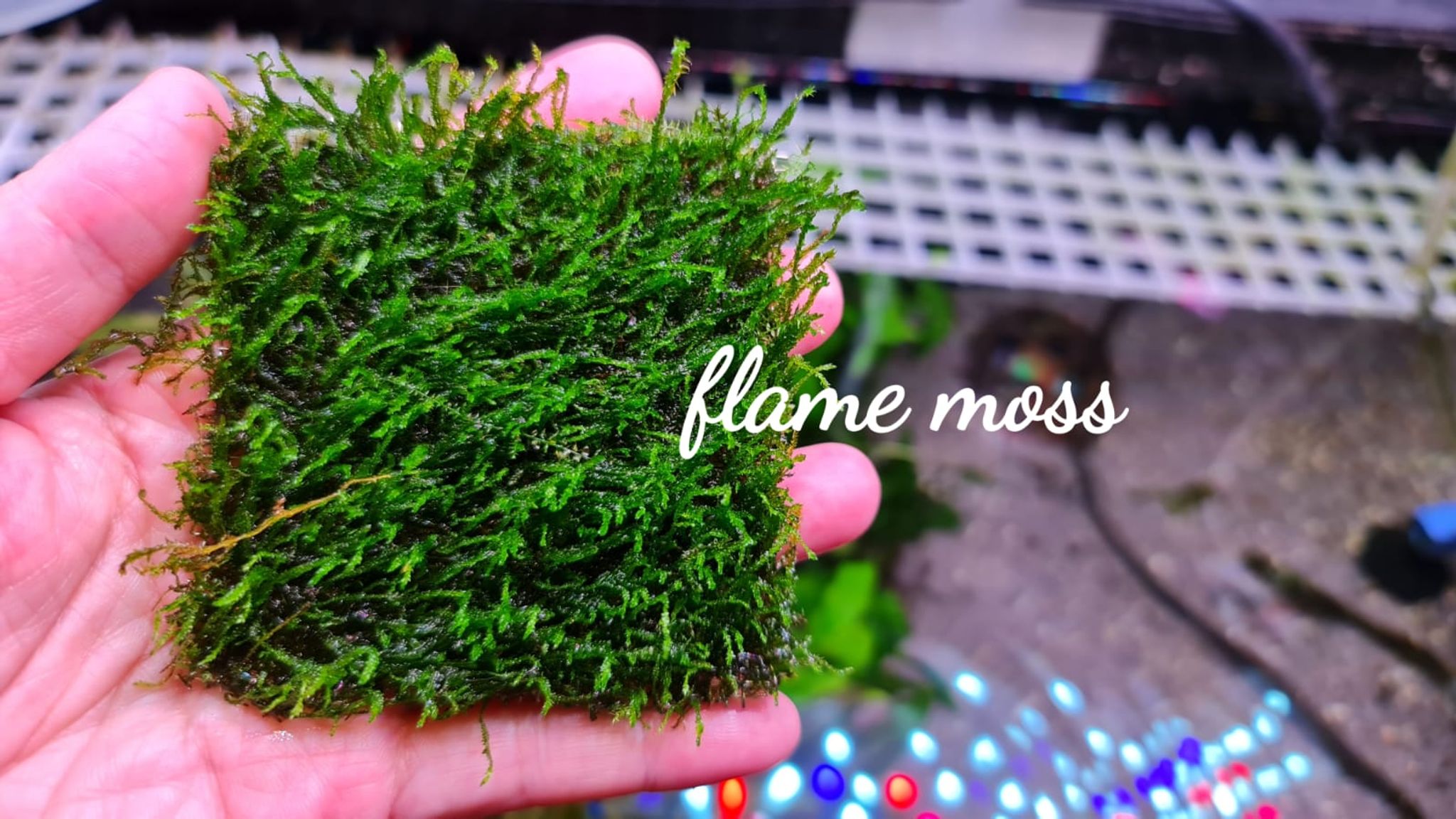
How to Plant and Propagate Flame Moss in a Freshwater Aquarium
Flame moss rewards patience: it isn't planted in substrate like a stem plant, and it grows far slower than the java moss most beginners try first. This guide covers exactly how to attach it to hardscape, keep it healthy while it establishes, and cut it into new portions once it fills in.
What Makes Flame Moss Different
Flame moss (Taxiphyllum sp. "Flame Moss") is a true aquatic moss, but its growth habit sets it apart from the flatter, sprawling mats of java moss. Instead of spreading sideways across a surface, flame moss fronds grow vertically and with a slight spiral twist, giving each clump a flickering, flame-like silhouette when it fills out.
Two things follow from that habit:
- It's slower. Flame moss is generally slower-growing than java moss, though it's still faster than something like Christmas moss under comparable low-light, low-tech conditions. Under true low-tech, no-CO2 setups, expect genuinely slow progress rather than a quick carpet.
- It stays more compact. Shoots typically reach 2–4 inches (5–10 cm), occasionally stretching to 6 inches (15 cm) if left untrimmed, which makes it well suited to accent clumps on driftwood rather than sprawling backgrounds.
Water Parameters for Flame Moss
Flame moss tolerates a wide range of conditions, but stability matters more than hitting an exact number.
| Parameter | Tolerated Range | Ideal / Notes |
|---|---|---|
| Temperature | 68–83°F (20–28°C) | Mid-range is safest for mixed community tanks |
| pH | 5.5–8.0 | 6.5–7.5 for best growth and color |
| General hardness | Soft to moderately hard | Consistency matters more than the exact figure |
| Lighting | Low to medium, 6–8 hrs/day | Roughly 20–40 µmol PAR |
| CO2 | Not required | Optional; speeds growth and deepens color |
Sources vary on the pH ceiling — some cite 6–8, others 5–8 or 5.5–8. The wider 5.5–8.0 window reflects how tolerant the moss actually is, but if you're aiming for the densest, deepest-colored growth, keep it closer to 6.5–7.5.
On lighting, too much of it without matching CO2 or nutrients is a common trap: bright light pushes algae growth faster than it pushes moss growth, so fronds end up coated in diatoms or hair algae before the moss itself catches up.
How to Attach (Plant) Flame Moss
Flame moss is an epiphyte — it lives on hardscape, not in the substrate. Planting it like a rooted stem plant is one of the most common mistakes beginners make, and it causes the moss to rot rather than establish.
Step 1: Divide the Portion
Separate your moss into thin, manageable clumps. Thinner layers attach faster and more evenly than thick clumps, which tend to smother themselves in the middle.
Step 2: Choose an Attachment Method
- Cotton thread or fine fishing line — the default choice for beginners. It's gentle on the fronds, works well on curved driftwood, and lets water circulate through the moss while it roots.
- Plant-safe cyanoacrylate glue gel — faster, and useful for small spot-fixes on flat rock, but easy to overuse. A thick bead of glue smothers the rhizoids and fronds underneath, blocking both attachment and photosynthesis, so apply it sparingly.
For larger portions, thread or line is the better default; save glue for small, precise touch-ups.
Step 3: Tie or Glue It Down
Wrap thread around the moss and the hardscape several times, tying it off snugly but not so tight that it crushes the fronds. If using glue, dot small amounts directly against the surface and press the moss into it briefly.
Step 4: Place It in Low-to-Moderate Flow
Strong current tears delicate fronds and can rip loose fragments free before they've had a chance to anchor. Position moss-covered hardscape somewhere with gentle circulation rather than directly in a filter outflow.
Step 5: Wait for Rhizoids to Grip
Rhizoids — the root-like threads flame moss uses to anchor itself — typically take 2–4 weeks to grip the surface. After that, thread can be removed if it bothers you, or simply left in place; it decays and gets hidden by new growth over time.
Expect Some Melt at First
Some browning or minor fragment loss right after planting is normal transplant shock, especially following shipping. The biggest mistake here is overcorrecting: large water changes or sudden parameter swings — even when done "to be extra careful" — tend to worsen melt rather than fix it. Stable, unchanged conditions and a few weeks of patience resolve most cases.
Troubleshooting: Symptom-to-Cause Table
| Symptom | Likely Cause | Fix |
|---|---|---|
| Browning tips shortly after planting | Transplant shock/melt | Keep parameters stable; wait it out |
| Black, mushy patches | Rot from being buried or over-glued | Trim away, re-expose to light/flow |
| Slimy coating on fronds | Poor flow or nutrient buildup | Improve circulation, spot-clean gently |
| Thinning at the base | Shading from untrimmed top growth | Trim to let light reach lower portions |
| Green/brown dust on fronds | Diatoms or algae from excess light with low CO2/nutrients | Reduce photoperiod or add CO2/fertilization |
| Fragments rooting on filter intake or glass | Loose clippings left in the tank after trimming | Siphon out clippings immediately after cutting |
How to Propagate Flame Moss
Flame moss is one of the easiest aquarium plants to multiply — nearly any healthy fragment can grow into a new plant.
- Shield the filter intake or turn it off temporarily before trimming, so loose clippings aren't pulled in.
- Cut healthy portions into smaller clumps using sharp scissors.
- Siphon out floating fragments right away — left in the tank, they'll root wherever they land, including inside equipment or on plants you didn't intend to cover.
- Tie or glue each new clump onto fresh hardscape using the same method described above.
Routine Trimming
Beyond propagation, periodic haircuts are part of normal maintenance. Trimming every few weeks to a couple of months (depending on growth rate) keeps the moss dense and prevents lower, shaded portions from dying off and fouling the water with detritus.
The Mesh (Moss Wall) Method
For a denser, more uniform look, sandwich a thin layer of moss between two pieces of plastic or stainless steel mesh, then tie the mesh down over a flat surface. This "moss wall" technique is a popular way to build a carpet-like backdrop or cover a piece of flat rock evenly, since the mesh holds fragments in place across the whole surface rather than just at tie points.
Where Flame Moss Fits in the Tank
- Shrimp and betta tanks: the dense frond structure grows biofilm and infusoria that shrimp and fry graze on, plus it offers cover and a spawning surface.
- Breeding setups: flame moss doubles as a low-cost alternative to a dedicated spawning mop for egg-scattering fish, and it gives fry somewhere to hide from adults.
- Aquascaping accents: its upright, twisting growth adds vertical texture on driftwood that flatter mosses can't match.
If you're stocking a moss-friendly tank, flame moss pairs naturally with shrimp or a betta, both of which use the moss for grazing and cover without disturbing it.
Live Moss vs. Fake Plants: A Quick Decision Guide
| Live plants (e.g., flame moss) | Fake (silk/plastic) plants | |
|---|---|---|
| Water quality | Absorb ammonia/nitrite, add oxygen | No water-quality benefit |
| Appearance | Grows and fills in over time, natural movement | Static; never melts |
| Maintenance | Needs light, occasional trimming/fertilization | Zero maintenance |
| Fish safety | Soft, generally fin-safe | Rigid plastic can fray long fins |
| Downsides | Can melt, algae, requires patience | Collects algae/debris with no biological benefit |
Choose live moss or similar low-tech plants when you want water-quality benefits and can provide modest light. Choose fake plants for zero-maintenance décor or a very low-light room where even shade-tolerant plants would struggle.
Beyond the Water Line: Flame Moss in a Paludarium
Flame moss isn't limited to fully submerged setups — it tolerates high humidity well and can be grown emersed. This makes it a natural fit for a paludarium, a setup that combines a reduced water level with an elevated "land" shelf, often built from an egg-crate or light-diffuser panel, positioned at the waterline.
A few build notes if you're considering one:
- Background material like cork bark gives emersed and epiphytic plants somewhere to mount.
- Water movement typically relies on powerheads plus dense planting, since standard canister or hang-on-back filter intakes don't work well at partial fill.
- Flame moss can be tied onto the humid rockwork or land shelf just as it would be tied to submerged driftwood, adding texture above the waterline instead of below it.
Choosing Lighting for Moss and Other Low-Light Plants
Judge a fixture by its PAR or lux output, not the older watts-per-gallon rule of thumb, which doesn't account for modern LED efficiency. LED fixtures are the standard modern choice for planted tanks because of their efficiency and lifespan.
Match intensity to what you're growing:
- 20–40 µmol PAR — low-light plants like flame moss and anubias
- 40–90 µmol PAR — moderate-demand plants
- 90–150+ µmol PAR — high-light, red stem plants
A color temperature around 6500–8000K gives a natural, plant-friendly appearance across most of these ranges. You can measure actual output with a PAR meter, or judge more casually with lux if that's what your fixture reports.
General Planted Tank Parameters Worth Knowing
Beyond moss-specific numbers, a few core parameters matter for any mixed planted community tank:
- pH: commonly kept around 6.5–7.5 for a general community planted tank.
- General hardness (GH): roughly 70–140 ppm (about 4–8 dGH) suits most community setups.
- Dechlorinator: always treat tap water before adding it, since chlorine/chloramine harms both plants and livestock.
- Livestock needs can be narrower than plant needs — shrimp in particular often require tighter, more stable parameters than the moss or other plants sharing the tank, so stock to the most sensitive animal, not the most tolerant plant.
Common Mistakes to Avoid
- Planting moss into substrate instead of tying/gluing it to hardscape or mesh.
- Over-gluing, which smothers rhizoids and fronds before they can attach.
- Leaving trimmed clippings floating instead of siphoning them out.
- Placing moss directly in strong flow, which tears fronds and dislodges unanchored fragments.
- Running high light with no CO2 or nutrients, inviting algae to outcompete the slow-growing moss.
- Overreacting to melt with large water changes, which usually makes browning worse.
- Giving up too early, expecting java-moss speed from a genuinely slower plant.
- Skipping trims, which shades and kills lower portions and builds up detritus.
Frequently Asked Questions
How long does it take flame moss to attach to driftwood or rock?
Roughly 2–4 weeks for rhizoids to grip the surface. Once attached, any thread or line used to hold it in place can be trimmed away or simply left to decay and disappear under new growth.
Does flame moss need CO2 to grow?
No. CO2 is optional — it speeds growth and deepens color and density, but flame moss survives and grows without it under low-tech conditions, just more slowly.
Can flame moss be kept without substrate?
Yes. It's an epiphyte tied or glued to hardscape or mesh, and it draws nutrients mostly from the water column rather than roots in substrate.
Why is my flame moss turning brown or falling apart after planting?
This is usually transplant shock or melt from the move or shipping stress, or from unstable water parameters. Keep conditions steady and give it a few weeks; most cases resolve without intervention.
Can I glue flame moss instead of tying it?
Yes, a small dab of aquarium-safe cyanoacrylate gel works well for spot attachment on flat rock. For larger clumps or curved driftwood, thread or fishing line is gentler and lets water circulate better.
How do I turn one portion of flame moss into more plants?
Cut it into smaller clumps with sharp scissors, then tie or glue each piece onto a new spot of hardscape. Nearly any healthy fragment can regrow into a full new plant.
Will flame moss grow in a betta or shrimp tank?
Yes, it's a common and practical choice for both. It provides grazing surface, cover, and tolerates the moderate, stable parameters those setups typically require.
If you're ready to start a moss-covered hardscape piece, you can browse driftwood, mesh, and other planted-tank supplies alongside livestock like freshwater livestock on FishyHub to plan out a tank built around it.

