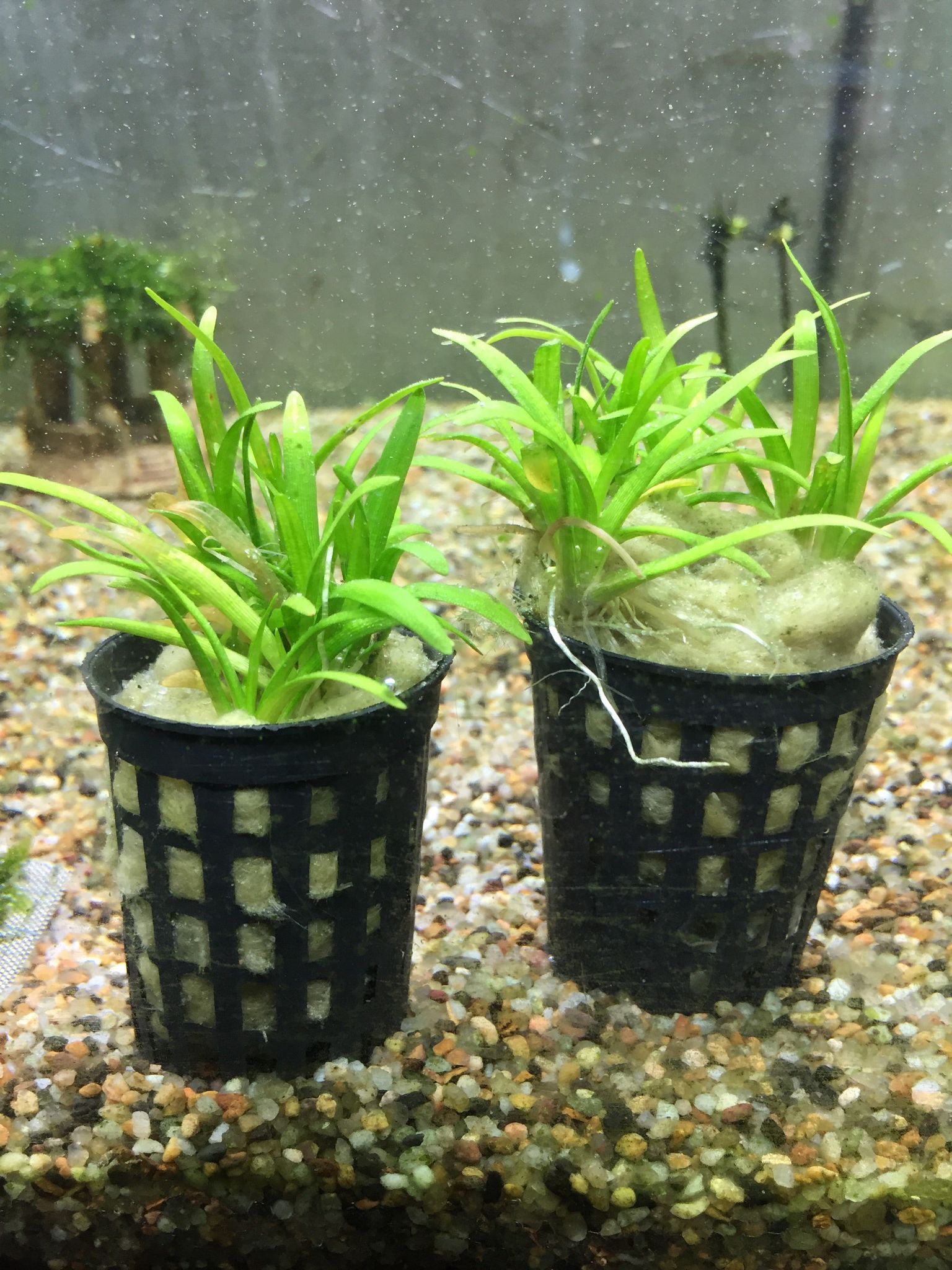
How to Plant and Propagate Dwarf Sagittaria in a Freshwater Aquarium
Dwarf sagittaria is one of the easiest true carpeting plants to grow, but most failures come down to one planting mistake and one moment of misplaced panic. This guide walks through correct planting depth, the substrate and light setup that lets it thrive, and exactly how to multiply it from runners so it fills a tank on its own.
What Is Dwarf Sagittaria?
Dwarf sagittaria (Sagittaria subulata) is also sold as dwarf arrowhead or narrowleaf sagittaria. It's a grass-like, amphibious plant native to marshes and slow rivers in eastern North America, meaning it grows equally well emersed (out of water) at a nursery or submersed in an aquarium. In the tank it looks like a shorter, denser cousin of Vallisneria, with narrow, strap-like blades that fan out from a central crown.
Because it tolerates such a wide range of conditions, it works in more roles than most carpeting plants:
- Foreground carpet under higher light, where it stays low and dense.
- Midground "lawn" filling gaps between taller stem plants.
- Background filler under lower light, where it grows tall and grassy instead of carpeting.
Ideal Water Parameters
| Parameter | Range | Notes |
|---|---|---|
| Temperature | 60–84°F (15.5–29°C) | Best growth around 70–82°F (21–28°C) |
| pH | 6.0–8.0 | Most comfortable at 6.5–7.5; handles hard, alkaline tap water well |
| General hardness (GH) | 2–15 GH | Very adaptable, soft to hard water |
| Lighting | Moderate to high | Roughly 60–150+ PAR; low light plants survive but stretch |
| CO2 | Optional | Not required, but noticeably improves density |
| Growth rate | Moderate to fast | Can colonize a tank footprint in roughly a year |
| Height | 4–12 in (10–30 cm) | Shorter and denser under strong light, taller under weak light |
This species is unusually forgiving of the hard, alkaline tap water common in many US municipal systems, which makes it a low-risk choice if you haven't tested your water chemistry in detail.
Lighting and CO2: What the Numbers Actually Mean
Older plant guides quote lighting in watts-per-gallon (WPG), suggesting 2–3+ WPG for dwarf sagittaria. That metric was built around fluorescent tubes and doesn't translate cleanly to modern LED fixtures, where efficiency varies enormously between products. A more reliable target is PAR (photosynthetically active radiation) at the substrate: aim for roughly 60–150+ µmol/m²/s if you want a compact carpet. Treat the WPG figure as a rough legacy reference only, not a real design target for an LED-lit tank.
Under low light, dwarf sagittaria still grows — it just won't carpet. Expect leggier, taller growth, though exactly how tall depends heavily on your specific fixture and tank depth, so don't fixate on a single number from any one source.
On CO2, there's a real split in how it gets described. Some sources call it "not required," which is true — dwarf sagittaria is one of the few genuine carpeting plants that can fill in without injected CO2. Others treat CO2 as the single biggest growth booster, which is also basically true. The practical takeaway: CO2 is optional for survival and general growth, but if your goal is a dense, fast-filling, low-profile carpet rather than a scattered patch of grass, injected CO2 (dosed up to roughly 30 ppm, running a couple of hours before lights-on through lights-off) is the difference-maker.
Substrate Choices for Dwarf Sagittaria
Dwarf sagittaria is a root feeder, so what's under it matters more than what's dissolved in the water column. You have two workable paths:
- Nutrient-rich substrates — aqua soils and clay-based substrates (Fluorite-type products) give the best root access and built-in nutrient exchange through their cation exchange capacity. This is the lower-maintenance option long-term.
- Inert gravel or sand plus root tabs — cheaper and more flexible for aquascaping, but the plant needs supplemental feeding. Push a root tab near the base every 2–4 months.
Either way, aim for a minimum substrate depth of about 2 inches (5 cm) so roots have room to anchor and spread. You can browse substrate options including gravel and sand and nutrient-rich aquarium soil to match whichever approach fits your setup.
General Substrate Prep Notes
If you're setting up a new planted tank around this plant:
- A layered approach — a thin nutrient-rich base cap under an inert gravel or sand top layer — works well and is often cheaper than filling the whole tank with aqua soil.
- Rinse gravel or sand thoroughly before adding it, even bagged "aquarium-safe" products, to cut down on initial cloudiness.
- Avoid calcium-carbonate substrates like crushed coral if you want a soft-water look, since they slowly raise pH and hardness — not ideal if you're chasing the lower end of dwarf sagittaria's comfortable range.
Mulm: Friend and Occasional Nuisance
Mulm — the decomposing organic debris that settles into substrate over time — is actually a benefit for a root feeder like dwarf sagittaria, releasing nutrients slowly as a tank matures. The catch is that once a carpet gets dense, mulm can get trapped between the leaves and form small anaerobic pockets, leading to brown algae or a faint odor near the substrate surface. The fix isn't to avoid mulm altogether; it's to lightly vacuum around (not into) the carpet during routine water changes so debris doesn't accumulate unchecked.
Fertilizing: Watch for Iron
Dwarf sagittaria responds well to root tabs and/or liquid fertilizer, but iron is usually the first nutrient it runs short on. If new leaves come in pale or yellow while older leaves stay green, that's the classic sign — dose a chelated iron supplement or switch to root tabs formulated with iron.
How to Plant Dwarf Sagittaria: Step by Step
This is the part that determines whether a plant thrives or rots, so it's worth doing carefully.
- Separate individual plantlets from the pot or bunch you're starting with, keeping roots intact.
- Space them roughly 2–3 inches (5–7.5 cm) apart — close enough to fill in as a carpet, not so close that new runners have nowhere to go.
- Push each plantlet straight down into the substrate rather than laying the roots sideways. A pair of aquascaping tweezers makes this much easier in a planted tank.
- Bury only the roots and the very base of the plant. The crown — the point where the leaves emerge — must stay at or above the substrate line.
- Never bury the crown. This is the single most common mistake with this species, and it causes basal rot and plant death within days, not weeks.
Expect Melt After Planting — It's Normal
Nursery-grown dwarf sagittaria is usually raised emersed, out of water. When it's submerged in your tank, it commonly melts back or turns pale as it converts to its aquatic growth form. This is a normal transition, not a sign of bad water or missing fertilizer. Trim off the dead leaves, keep your water parameters stable, and give it time — new growth and root/runner spread can take a few weeks to resume.
How Dwarf Sagittaria Spreads
Once established (usually a few weeks in, once the plant is around 2–3 inches tall and actively growing), dwarf sagittaria sends out horizontal runners (stolons) in multiple directions, much like a strawberry plant or Vallisneria. Small plantlets form along each runner and root into the substrate on their own as they go. Given good light and nutrients, a single plant can spread across an entire tank footprint within roughly a year.
How to Propagate Dwarf Sagittaria
Propagating dwarf sagittaria is mostly a matter of patience rather than technique.
- Let the mother plant establish for several weeks until it's healthy and actively growing before expecting runners.
- Watch for runners extending out along or just under the substrate, with small plantlets forming at intervals.
- Check for roots before separating. A plantlet is ready to be separated once it has developed its own visible roots and a few true leaves. One still without roots is too young — separating it early sets it back or kills it outright.
- Snip or pinch the runner connecting the daughter plant to the mother once roots are visible, then gently lift the daughter, keeping its roots intact.
- Replant the daughter exactly like an adult plant — base and roots buried, crown exposed, spaced a couple of inches from its neighbors.
- Or skip harvesting entirely. Leaving daughter plants attached fills in a carpet faster and denser with zero extra effort — only separate plantlets if you want to fill a second tank or share/sell them.
- If moving plantlets to a new tank or sharing them, rinse the roots gently and keep them moist in transit, treating them like any bare-root aquatic plant.
Quarantining New Stock
Before adding any newly acquired dwarf sagittaria to an established tank, give it a quick rinse and visual inspection — and ideally a short quarantine or dip — to check for hitchhiking snails or pest eggs on the leaves and roots. This is an easy step to skip but a cheap insurance policy against an unwanted snail population later.
Trimming Without Killing the Leaf
Don't cut dwarf sagittaria leaves mid-blade to tidy up a carpet. A damaged leaf tip melts and dies back to the base anyway, so cutting mid-blade just wastes the leaf and invites decay. Instead:
- Pluck or pinch individual unwanted leaves off at the base, right where they emerge from the crown.
- To control spread, pinch off runners before daughter plants root, or cut the connecting runner to redirect or remove a daughter plant you don't want.
Common Mistakes and Troubleshooting
| Problem | Likely Cause | Fix |
|---|---|---|
| Plant rots and dies within days | Crown buried under substrate | Replant with crown exposed above the surface |
| Pale or melting leaves right after planting | Normal emersed-to-submersed transition | Remove dead tissue, keep parameters stable, wait a few weeks |
| Whole leaf dies after trimming | Cut mid-blade instead of at the base | Pluck individual leaves at the crown instead |
| New leaves yellow or pale | Iron deficiency | Dose chelated iron or iron-enriched root tabs |
| Tall, sparse growth that won't carpet | Insufficient light (often also low nutrients/CO2) | Increase PAR and/or lighting duration before assuming a bad plant |
| Debris and algae collecting at the carpet base | Trapped mulm and detritus | Lightly vacuum around, not into, the carpet during water changes |
| Runners spreading into neighboring plants or open substrate | Left uncontrolled | Pinch off unwanted runners early |
Tankmate Compatibility
Dwarf sagittaria's thin leaves aren't built to survive constant grazing or digging. Avoid pairing it with crayfish, large cichlids, or goldfish, which will happily shred or uproot a young carpet. It coexists well with most small community fish, shrimp, and snails, making it a solid match for a peaceful planted community tank — you can browse compatible options among small community fishes if you're stocking a new planted setup.
A Natural Fit for Low-Tech and Dirted Tanks
Because it's a root-feeding, highly tolerant species, dwarf sagittaria suits low-tech "dirted" or Walstad-style tanks especially well. It draws nutrients from a rich substrate layer with minimal need for dosing or CO2 injection, which lines up neatly with the low-maintenance philosophy behind that style of setup — worth considering if you want a carpet without a heavy equipment list.
A Surprising Detail: Flowering
Given enough light and shallow water, dwarf sagittaria can send up a thin emergent flower stalk that breaks the surface and opens small white flowers above the waterline. It's uncommon in a fully submersed, deep tank, but it's a fun detail to watch for in shallower setups or paludariums.
Dwarf Sagittaria vs. Dwarf Hairgrass vs. Vallisneria
These three often get lumped together because they're all grass-like, but they're distinct plants:
- Dwarf hairgrass is finer-bladed and shorter, and generally needs more light to form a true dense lawn than dwarf sagittaria does.
- Vallisneria is a taller, similarly shaped relative, usually grown in the background rather than as a carpet.
- Dwarf sagittaria sits in between — coarser than hairgrass but shorter and denser than Vallisneria, and one of the few species in this group that carpets reliably without CO2.
Frequently Asked Questions
Does dwarf sagittaria need CO2?
No. It's one of the few true carpeting plants that grows and spreads without injected CO2. That said, adding CO2 speeds growth noticeably and produces a thicker, denser carpet than you'll typically get without it.
Why is my new dwarf sagittaria melting after planting?
This is almost always normal transition shock, since nursery stock is usually grown emersed and needs to convert to its submersed form in your tank. Trim off dead leaves, keep water parameters stable, and new growth should appear within a few weeks.
How deep should I plant dwarf sagittaria?
Bury only the base and roots — never the crown, where the leaves emerge. A substrate depth of about 2 inches (5 cm) is enough for the roots to anchor and access nutrients.
How fast does dwarf sagittaria spread and carpet a tank?
Growth is moderate to fast. With good light and nutrients, a healthy plant can spread via runners to fill a tank's footprint within several months to about a year.
Can dwarf sagittaria grow in low light or plain substrate without special products?
Yes, but expect taller, leggier growth rather than a dense low carpet under weak light. If you're using inert gravel or sand instead of a nutrient-rich substrate, add root tabs periodically to keep it fed.
How do I propagate dwarf sagittaria?
Wait for a runner-borne plantlet to grow its own visible roots and a few true leaves, then pinch or snip the runner connecting it to the mother plant and replant the daughter the same way you'd plant an adult — crown exposed, roots buried.
Why are my dwarf sagittaria leaves turning yellow?
This is almost always iron deficiency, the nutrient this species tends to run short on first. Dosing a chelated iron or micronutrient fertilizer, or switching to iron-enriched root tabs, usually clears it up within a couple of weeks.
Is dwarf sagittaria the same as dwarf hairgrass or Vallisneria?
No — it's its own species, Sagittaria subulata. Dwarf hairgrass is finer and lower but needs more light for a true lawn, while Vallisneria is a taller relative typically used as a background plant.
Ready to start a carpet of your own? Browse substrate options on FishyHub to find the right base for your setup, whether you're going with a nutrient-rich soil or inert gravel and root tabs.

