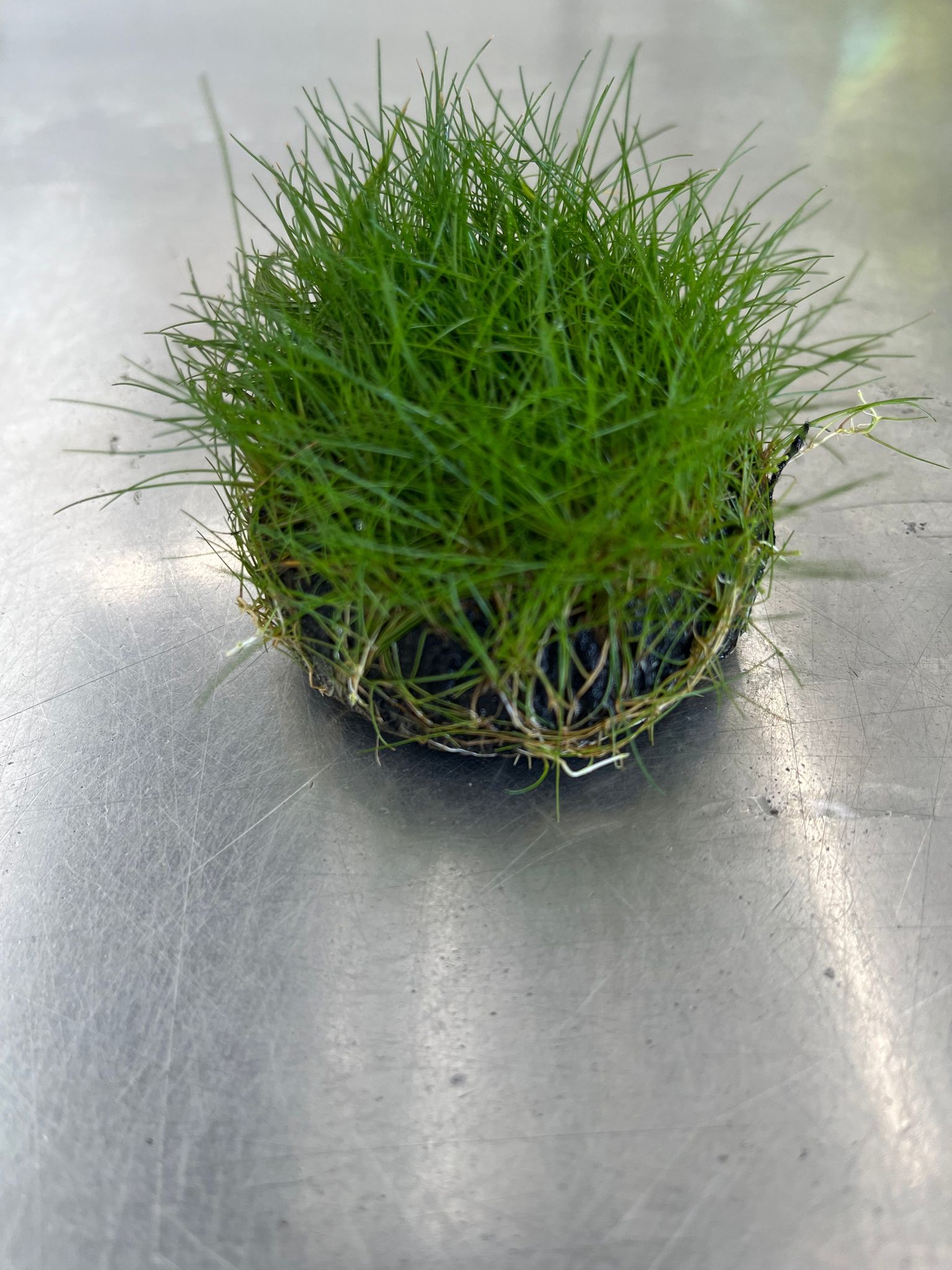
How to Plant and Propagate Dwarf Hairgrass in a Freshwater Aquarium
Dwarf hairgrass is one of the most popular carpeting plants for freshwater tanks, but a surprising number of new plantings end up patchy, tall, or floating loose within a week. Getting a dense, low green lawn comes down to three things: the right substrate, enough light and nutrients, and planting it correctly in the first place. This guide walks through substrate selection, step-by-step planting, and how to propagate an existing patch into a full carpet.
What Is Dwarf Hairgrass?
"Dwarf hairgrass" is a trade name applied to several Eleocharis species, and labeling at the point of sale is inconsistent enough that many buyers can't tell which one they actually purchased. Knowing the differences helps set realistic expectations for height and difficulty.
| Variety | Typical height | Difficulty | Notes |
|---|---|---|---|
| Eleocharis parvula (true dwarf) | 1–2 in (2.5–5 cm) | Moderate to hard | Shortest form, slowest grower, most demanding of light/CO2 |
| Eleocharis sp. "mini" | 2–4 in (5–10 cm) | Easy to moderate | Most common form sold in the trade |
| Eleocharis belem | 3–5 in (7–12 cm) | Easy | Most forgiving, tolerates lower light better than the others |
All three are easy to keep alive in general community-tank conditions; the challenge is coaxing them into a dense, low carpet rather than a scattered stand of taller blades.
Choosing a Substrate
Substrate is the single biggest point of confusion for people planting a carpet, and it deserves more thought than "whatever looks nice."
Substrate Types Overview
- Inert gravel: No nutrient content, widely available, doesn't affect water chemistry. Needs root tabs and liquid fertilizer to support a carpet plant.
- Inert sand: Similar to gravel — no nutrients, but finer grain size that fine-rooted plants can anchor into more easily.
- Nutrient-rich aquasoil (active substrate): Contains nutrients for root uptake and often softens water and lowers pH slightly. Generally considered the best single choice for a dense hairgrass carpet.
- "Dirt" method: A thin layer of nutrient-rich topsoil capped with 1–2 in (2.5–5 cm) of sand or gravel. Effective and inexpensive, but messier to set up and prone to clouding water if disturbed.
Sources disagree on how strictly necessary aquasoil is. Some hobbyists successfully grow hairgrass in plain sand or gravel with consistent root tabs, liquid fertilizer, and CO2. Others treat aquasoil as close to mandatory for a true, dense mat. The practical middle ground: aquasoil gives the fastest, thickest results with the least fuss, while sand or gravel plus a supplement routine is a workable budget alternative that will simply be slower and somewhat less dense.
Grain Size and Color
Fine-to-medium grain, roughly 1–3 mm, is the sweet spot — small enough for thin hairgrass roots to grip, coarse enough to allow some water flow through the substrate bed. Large, sharp gravel is a poor match because clumps can't anchor and tend to work loose. Darker substrate colors are generally preferred for carpeting plants for aesthetic reasons: green blades show up in sharper contrast against a dark background than a light one, which also tends to visually calm the overall aquascape.
Growing in Sand Specifically
Plain fine sand can support dwarf hairgrass, but it has no inherent nutrients and can compact over time, which restricts root penetration and can create anaerobic (oxygen-starved) pockets deeper in the bed — especially in tanks with a heavier bioload feeding waste into the substrate. If using sand, keep the depth reasonable, stir the surface occasionally during maintenance, and add root tabs beneath planting areas or a thin nutrient layer underneath as a dirt-style setup.
Substrate Depth and How Much to Buy
Most root-feeding carpet plants do best with 1.5–3 in (4–8 cm) of substrate depth. Thinner beds under about 1 in don't give roots enough room and tend to dry out or shift; deeper "dirt method" setups with a nutrient layer plus a 1–2 in cap can run toward the higher end of that range. Keep depth consistent across the whole footprint where a carpet is planned, rather than only sloping thicker toward the back — an even bed helps the carpet fill in uniformly instead of leaving thin spots up front.
As a rough rule of thumb, budget 1 to 1.5 lb of substrate per gallon of tank volume to reach a 2–3 in depth. For a more precise estimate, use the footprint formula:
Tank length × width × desired depth = volume needed, then convert to weight or bag count based on the product's coverage rating.
| Tank size | Approx. footprint | Substrate for ~2–3 in depth |
|---|---|---|
| 10 gal (38 L) | 20 × 10 in | 10–15 lb |
| 20 gal long (76 L) | 30 × 12 in | 20–30 lb |
| 40 gal breeder (151 L) | 36 × 18 in | 40–60 lb |
Bag coverage varies by product, so treat this as a starting estimate and round up slightly — it's easier to have leftover substrate than to run short mid-fill. Fine-grain aquasoil and gravel/sand blends suited to carpet plants can be browsed in the substrate category, including options sorted specifically as gravel and sand.
Water Parameters
Dwarf hairgrass is adaptable to standard community-tank conditions:
- Temperature: 68–82°F (20–28°C)
- pH: 6.5–7.5
- Hardness: Soft to moderately hard
Planting Dwarf Hairgrass Step by Step
- Separate the plant into small clumps. Break the potted portion apart with your fingers or aquascaping tweezers into groups of just 2–5 blades each. Small clumps root faster and fill in more evenly than a few large tufts.
- Trim the roots. Cutting roots back to roughly 0.5 in encourages the plant to send out lateral runners rather than growing one long taproot — this speeds up horizontal spreading.
- Plant in a grid pattern. Space clumps about 0.5–1 in (1–2 cm) apart across the substrate. Tighter, more numerous plantings close the carpet gaps faster than a few widely spaced clumps.
- Bury only the base. Push just the root and rhizome portion into the substrate, leaving the green blades above the surface. Aquascaping tweezers make it much easier to insert clumps into soft substrate without disturbing neighboring plantings.
- Weigh down floaters. New clumps often pop loose before roots take hold. A thin mesh laid over the area, a few small smooth stones, or dedicated plant weights can hold everything in place for the first week or two.
- Keep flow gentle at first. Moderate circulation across the carpet area helps prevent debris settling on the blades and discourages algae, but strong flow right after planting can uproot clumps before they anchor. Ease flow up once plants have settled in.
Light and CO2 Requirements
A low, dense carpet needs meaningfully more light than a background plant does. Aim for medium-to-high light, roughly in the 30–50+ PAR range at the substrate on a standard planted-tank LED fixture, run for a 6–8 hour photoperiod. Under low light, dwarf hairgrass tends to grow tall and leggy as it stretches toward the surface instead of spreading sideways.
CO2 is not strictly required, but it makes a substantial difference in how dense and low the resulting carpet is:
- No supplemental CO2: Possible, but growth is typically slower, patchier, and taller.
- Liquid carbon supplement: A moderate, lower-cost improvement over no CO2 at all.
- Pressurized CO2: Produces the fastest, densest, lowest-growing carpets — the standard choice for hobbyists specifically chasing a full lawn.
Suitable LED fixtures for planted setups are available in the lighting category.
Fertilization
Carpeting plants are heavier feeders than most people expect, since a dense mat of tiny plants is drawing nutrients from a relatively small root zone. A two-part approach works well:
- Root tabs pushed into the substrate near the root zone for steady root-level feeding.
- Liquid macro and micro fertilizer (nitrogen, phosphorus, potassium, and iron) dosed on a regular schedule to support the higher light and CO2 environment a carpet needs.
Skipping fertilization is one of the most common reasons a carpet stalls even with good light and CO2 — light and carbon alone can't compensate for a nutrient shortfall.
Propagation: Turning One Patch Into a Full Carpet
Dwarf hairgrass spreads on its own once established, sending out runners (rhizomes) just under the substrate surface that pop up as new shoots some distance from the parent clump. Under favorable conditions — decent light, CO2 or liquid carbon, and consistent fertilization — a planted area typically fills into a connected mat over 4–8 weeks, though it can take several months under lower light or without CO2.
You can accelerate and direct that spread:
- Divide and replant. Once a section of carpet is established, a small patch can be lifted, split into smaller clumps, and replanted elsewhere to seed new growth areas rather than waiting for runners to reach them naturally.
- Reuse trimmings. Clippings from routine trimming are viable propagation material, not waste — replant them into thin or bare patches instead of discarding them, effectively getting free plants from maintenance.
Trimming and Maintenance
Once the carpet fills in, regular trimming with scissors or a curved hairgrass trimmer keeps growth low and dense and reinforces horizontal spreading over vertical growth. Left untrimmed, a carpet gradually thickens upward and can shade its own lower blades.
The Acclimation Period: Melt Is Normal
Newly planted dwarf hairgrass very often browns, yellows, or appears to "melt" for the first 1–3 weeks after planting. This is a normal transplant response, not a sign of failure, and pulling struggling clumps too early is one of the most common beginner mistakes. Keep water parameters stable, maintain the lighting and fertilizing routine, and give it time — new growth typically pushes through well before any visible spreading begins.
Transitioning an Existing Tank to Support Hairgrass
A full substrate teardown isn't always necessary if you already have gravel or sand down and simply want to add a carpet area. Root tabs placed directly under the planting zone can supply nutrients without disturbing the rest of the tank, or you can spot-add a small amount of nutrient-rich substrate underneath just the section being planted, capped with your existing gravel or sand on top. This targeted approach lets a carpet establish in an established tank without rescaping the whole aquarium.
Common Mistakes and Troubleshooting
| Problem | Likely cause | Fix |
|---|---|---|
| Patchy, slow-filling carpet | Too few blades per clump, clumps spaced too far apart | Plant smaller clumps closer together |
| Clumps floating loose | Not weighed down before roots establish | Use mesh, small stones, or plant weights |
| Tall, thin growth | Insufficient light | Check PAR/wattage and photoperiod (6–8 hrs/day) |
| Stalled growth despite good light/CO2 | Skipped fertilization | Add root tabs plus a liquid macro/micro routine |
| Algae on blades | Light and nutrients outpacing CO2/plant uptake | Rebalance the light–CO2–nutrient triangle |
| Clumps uprooting and drifting | Substrate too coarse or too shallow | Use finer substrate (1–3 mm) at 1.5–3 in depth |
| Root damage in sand substrate | Anaerobic pockets from overfeeding/heavy bioload | Reduce feeding, stir sand surface, add root tabs |
Frequently Asked Questions
Do I need CO2 to grow dwarf hairgrass?
No, but it's much easier to get a full, low carpet with CO2 or at least a liquid carbon supplement. Without any added carbon, expect slower, patchier, and noticeably taller growth.
What is the best substrate for dwarf hairgrass?
Nutrient-rich aquasoil is generally the best choice for a dense, fast-filling carpet. Sand or gravel can work too, but they need consistent root tabs and liquid fertilizer, and growth will be slower and sparser than with aquasoil.
How long does it take dwarf hairgrass to carpet?
Typically 4–8 weeks under good light, CO2, and fertilizer. Under lower light or without CO2, it can take several months to fully connect into a mat.
Why is my dwarf hairgrass turning brown or melting after planting?
This is normal transplant shock, usually lasting the first 1–3 weeks after planting. Keep parameters stable and continue your regular routine — new growth generally appears before any visible spreading starts, so avoid pulling plants too early.
How do I keep dwarf hairgrass short and carpet-like instead of tall?
Provide medium-to-high light and trim regularly. Adequate light plus routine trimming trains the plant to spread horizontally along the substrate rather than growing upward.
Can dwarf hairgrass grow in low light?
It will survive in low light but will typically grow taller and sparser rather than forming a true low carpet, which generally requires medium-to-high light.
Can I propagate dwarf hairgrass by dividing or cutting an existing carpet?
Yes. Established mats can be lifted, divided into smaller clumps, and replanted elsewhere, and the plant also spreads on its own via runners. Trimmed clippings are viable planting material too, so they can be used to fill in bare patches rather than thrown away.
Getting dwarf hairgrass to carpet well is mostly a substrate and consistency problem rather than a difficult-plant problem — pick a fine, nutrient-capable substrate, plant small clumps close together, and stay patient through the melt phase. Browse aquasoil, gravel, and sand options built for planted setups in FishyHub's substrate category to get started.

