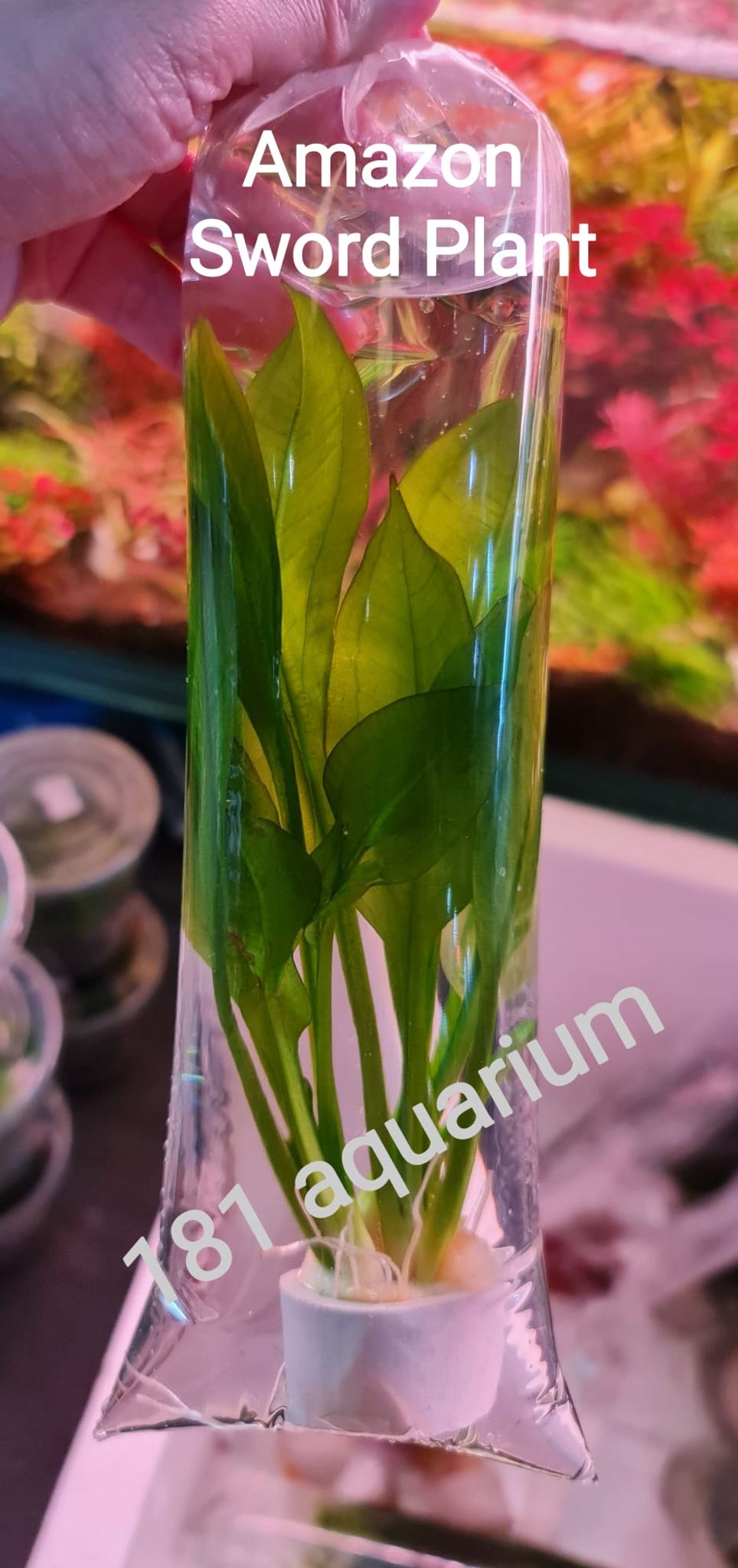
How to Plant and Propagate Amazon Sword in a Freshwater Aquarium
The Amazon sword is one of the easiest large plants for a freshwater tank, but also one of the easiest to plant wrong. This guide covers correct planting depth, substrate choices, and ongoing care, then shows how to turn one healthy sword into several new plants using its runners.
Know What You're Planting First
"Amazon sword" is a common name applied loosely to several Echinodorus species, most often the bleheri, amazonicus, and grisebachii group. Because the name is used interchangeably, individual plants can vary somewhat in leaf shape, growth rate, and final size.
The one trait nearly all share is that they get big. A healthy, well-fed specimen commonly reaches 12–20 inches across and tall, with broad rosette leaves radiating from a central crown. Check that your tank can accommodate that footprint before buying — a 5- or 10-gallon tank will be overwhelmed within months. A 20-gallon long (76 L) tank or larger is the realistic minimum for one full-size specimen without shading the rest of the layout.
Preparing the Plant Before Planting
Most Amazon swords arrive potted in rockwool or foam, sometimes with a fertilizer tablet in the base. Skipping prep is a common mistake, since leftover packing material and fertilizer can cloud the water or spike ammonia once submerged. Before planting:
- Remove the pot and gently squeeze the rockwool or foam plug free from the root ball, working it loose in sections rather than yanking.
- Rinse the roots under dechlorinated water to clear remaining debris.
- Trim damaged roots — snip off any tips that are mushy, yellow, or rotting; healthy roots are pale and firm.
- Check for a hidden fertilizer tab in the root mass and discard it; add your own root tabs later, on your own schedule.
Choosing and Preparing Substrate
Amazon swords are heavy root feeders, drawing most of their nutrition through the root system rather than the water column. Substrate choice affects how quickly the plant establishes and how much supplemental feeding it needs.
Soil, Sand, or Gravel?
Sources differ on how important substrate type really is. Some treat nutrient-rich aquasoil as clearly superior for a root feeder; others say plain gravel or sand does just as well with consistent root tabs. In practice, both are legitimate paths:
- Aquasoil gives an easier head start, richer leaf color, and generally faster runner production with less dosing.
- Gravel or sand plus regular root tabs is a fully viable, often cheaper route for a beginner community tank.
| Substrate type | Nutrient content | Grain size | Ease of planting | Root tabs needed | Best for Amazon sword |
|---|---|---|---|---|---|
| Nutrient-rich soil | High (built-in) | Fine, soft | Easy — roots grip fast | Optional, less frequent | Best head start, richest growth |
| Sand | Low (inert) | Very fine | Moderate — can compact | Yes, regularly | Workable, watch for anaerobic pockets |
| Fine-to-medium gravel | Low (inert) | ~2–5 mm | Easiest to anchor roots | Yes, regularly | Great practical default |
| Large/river-rock gravel | Low (inert) | Large, uneven | Hard — poor root grip | Yes, regularly | Not recommended |
Pick aquasoil for the lowest-maintenance path to strong growth if the higher cost is fine; pick gravel or sand plus root tabs if you're budget-conscious or already have a gravel tank. Compare a dedicated soil substrate and gravel and sand blends to see what fits.
Gravel Depth and Grain Size
Regardless of substrate type, depth matters more than most beginners expect. Aim for 2.5–3 inches (about 6–7.5 cm) for adequate root development. Medium grain gravel (roughly 2–5 mm) strikes the best balance — fine enough to hold roots, coarse enough for normal water and gas exchange.
Avoid very large, river-rock-style gravel: the gaps are too big for fine roots to grip, and newly planted swords work loose repeatedly. Very fine sand has the opposite problem — if roots haven't established, it can compact and go anaerobic underneath. Medium-fine gravel avoids both failure modes.
How to Plant an Amazon Sword
Planting technique for a rosette plant like the Amazon sword differs from stem plants (pushed in small bunches) or rhizome plants like Anubias and java fern (never buried). For a sword, bury the roots while keeping the crown — where the leaves emerge — right at, or just above, the substrate surface.
- Dig a hole with your fingers or tweezers, wide and deep enough to fan the roots out rather than bunching them into a ball.
- Spread the roots across the bottom so they radiate outward, not folded upward or crammed to one side.
- Bury the root mass 2–3 inches deep, covering it completely with substrate.
- Leave the crown exposed at or just above the substrate line. This is the single most important detail — burying the crown traps the growth point in an oxygen-poor pocket and causes rot and melt.
- Firm the substrate gently around the base without compacting it too hard.
Spacing
Because a mature sword can spread 12–20 inches, plant with at least 12 inches of clearance from neighboring plants, decorations, and the glass. Planting too close is a common mistake — it looks fine for the first few weeks, then one plant shades and chokes its neighbors as both mature.
Anchoring a Newly Planted Sword
Freshly planted swords haven't gripped the substrate yet, so they're prone to floating loose or getting uprooted — especially by digging fish, crayfish, or a strong filter outflow — during the first week or two. A few practical options:
- Weight the base lightly with a small, plant-safe rock or ceramic weight pressed into the substrate near (not on top of) the crown.
- Use a rubber band and rock temporarily around the root ball, removing it after a week or two once new roots take hold.
- Use a decorative planter or pot insert if your tank has persistent diggers, keeping the root ball contained while still letting it read as planted.
Once new white roots visibly grip the substrate — usually within one to two weeks — the plant no longer needs help staying put.
Light, Water Parameters, and Feeding
Amazon swords are forgiving on lighting and water chemistry, which is part of why they're a community-tank staple.
| Parameter | Range |
|---|---|
| Temperature | 72–82°F (22–28°C) |
| pH | 6.5–7.5 |
| Water hardness | Soft to moderately hard |
| Lighting | Medium (low tolerated, high accelerates growth) |
| CO2 | Not required |
Lighting: Medium light is enough to keep an Amazon sword alive and growing steadily. More intense lighting plus CO2 and root tabs speeds growth and produces larger leaves, but none of that is required — it grows fine without CO2 or high light, just more slowly with fewer runners.
Feeding: Root tabs are the single highest-impact input for growth and runner production, since swords feed mainly through their roots. Push a tab into the substrate near the root zone (not directly against it) every 1–3 months — check your product's recommended interval. A liquid fertilizer with iron and micronutrients helps leaf color but doesn't substitute for root feeding. Skipping root tabs in inert substrate is a common cause of stunted growth, pale leaves, and no runners.
Ongoing Maintenance
- Remove old leaves at the base as they yellow, rather than leaving them to decay.
- Vacuum only the surface near the plant — deep vacuuming around the roots strips out the nutrient-rich mulm layer a root feeder relies on in a gravel-only setup.
- Expect some transplant melt. A burst of yellowing leaves in the first couple of weeks is normal stress, not failure. If the crown and roots are healthy, growth typically resumes within 2–4 weeks — resist pulling the plant.
Propagating Amazon Sword via Runners
Once a sword is mature, well-rooted, and fed consistently, it typically sends out a runner (or stolon) — a horizontal stem extending from the base that produces baby plantlets along its length, each with its own small root system.
Conditions That Trigger Runners
Runner production isn't guaranteed just because a plant is old. The plants most likely to runner are mature and well-established with a strong root system, fed consistently with root tabs, and growing under at least medium light. Plants stuck in poor, inert substrate with no supplemental feeding, or kept in unstable water conditions, rarely produce runners even if they're otherwise surviving.
Step-by-Step: From Runner to New Plant
- Let the runner develop. Leave it attached while plantlets form along its length — this typically takes a few weeks per plantlet.
- Wait for roots and leaves. A plantlet is ready to become independent once it has several leaves of its own and visible roots.
- Option A — plant while still attached. Gently press a developed plantlet's roots into nearby substrate while it's still connected to the runner, letting it draw support from the parent until self-sufficient.
- Option B — cut and separate. Once the plantlet has its own leaves and roots and looks fully independent, cut the runner close to both the parent and the plantlet, then plant the baby separately.
- Repeat for chains of plantlets. A single runner often produces several plantlets in a row at different stages. Separate each one only when it individually is ready — don't cut the whole runner just because the first plantlet is mature, since later ones may still need more time.
The most common propagation mistake is impatience: cutting and separating a plantlet before it has independent roots. Without its own root system, it often stalls or dies rather than establishing. When in doubt, leave it attached longer.
Secondary Method: Dividing the Crown
Runners are the primary and easiest method, but an older plant with multiple growth points on its rhizome/crown can also be divided. If you spot more than one distinct crown at the base, separate the root mass so each growth point keeps its own roots, then replant the sections individually. This is less common and more disruptive than waiting for runners, so treat it as a secondary option once a plant has clearly outgrown its space.
Frequently Asked Questions
How deep should I plant an Amazon sword?
Bury the root mass about 2–3 inches into the substrate, but leave the crown exposed right at the surface. Burying the crown itself causes rot and leaf melt.
Do Amazon swords need special substrate?
Not strictly. Nutrient-rich aquasoil gives an easier start and richer growth, but plain gravel or sand works fine with root tabs every 1–3 months.
Why are my Amazon sword's leaves melting after planting?
This is usually normal transplant stress, not a sign the plant is dying. Keep water parameters stable; new growth typically resumes within 2–4 weeks if the crown and roots stayed healthy through planting.
How do I propagate an Amazon sword?
Wait for a mature, well-fed plant to send out a runner that produces plantlets with their own leaves and roots. Plant a plantlet while still attached, or cut the runner near both plants once it's self-sufficient.
How often should I fertilize with root tabs?
Roughly every 1–3 months, inserted near — not directly against — the root mass; check your product's recommended interval. A liquid micronutrient fertilizer helps leaf color in addition.
How big does an Amazon sword get, and how much space does it need?
Most reach 12–20 inches across and tall at maturity. Plan for at least a 20-gallon long tank and 12 or more inches of clearance from neighbors and the glass.
Can an Amazon sword grow without CO2 or high light?
Yes. It tolerates medium-to-low light and no CO2, just with slower growth and fewer runners than under stronger light and root feeding.
Why isn't my Amazon sword producing runners?
Usually insufficient root feeding, poor substrate without supplemental tabs, or a plant that's still too young. Keep up consistent root tabs and give a healthy plant more time to mature.
Once your sword is settled in and growing, browse substrate options on FishyHub to round out the setup, or check sizing against the full range of tanks and stands before your collection outgrows its current home.

