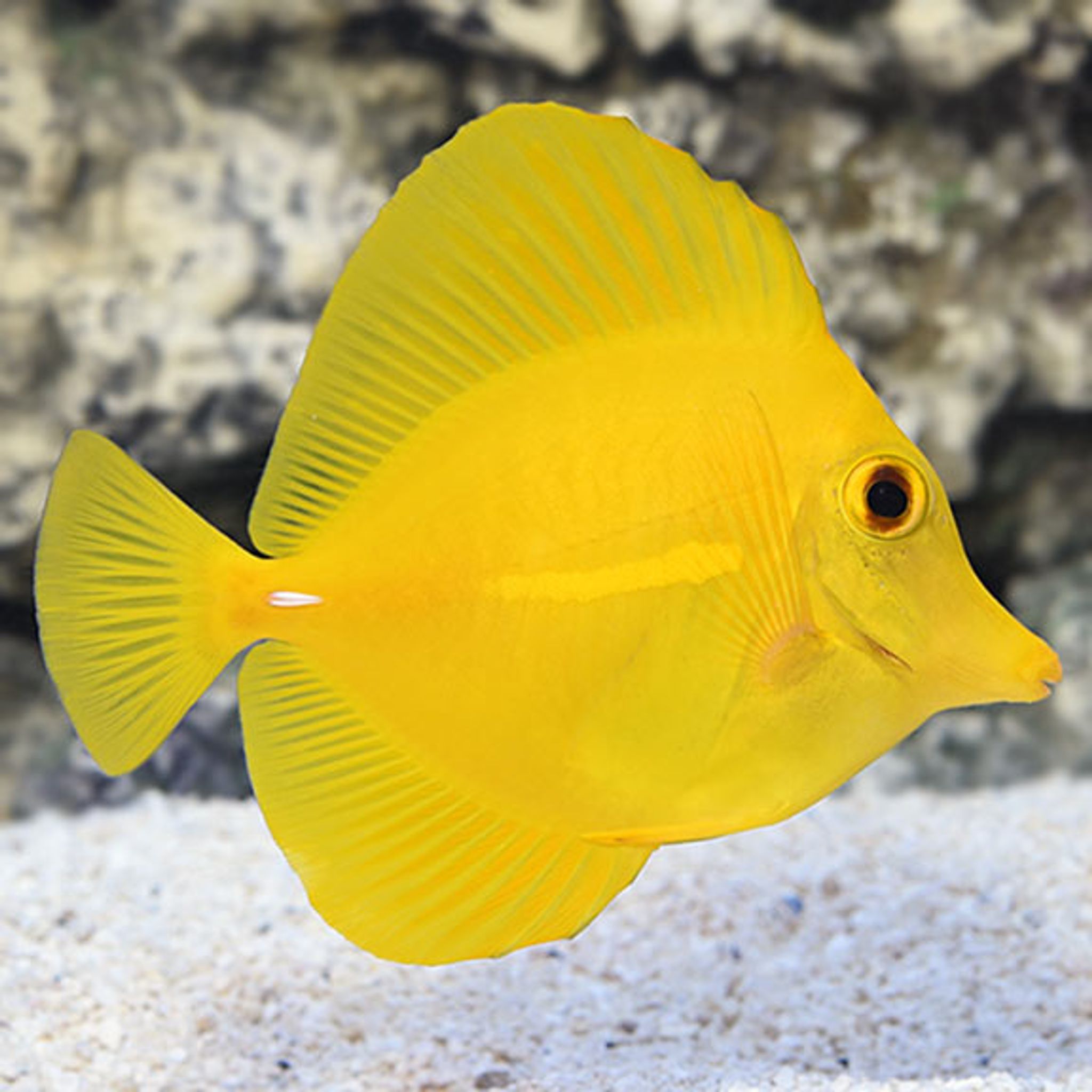

How to Feed Yellow Tang: Foods, Frequency and Common Feeding Problems
A yellow tang (Zebrasoma flavescens) is a grazer, not a meal-time fish, so the biggest feeding mistake is treating it like one. This guide breaks down exactly what to feed, how often, how much, and how to fix the two most common problems owners run into: a thin, pinched-looking tang and head-and-lateral-line erosion (HLLE).
Why Yellow Tangs Feed Differently Than Most Fish
In the wild, a yellow tang spends nearly all of its daylight hours picking at turf algae growing on reef rock. It isn't eating two big meals — it's grazing almost continuously in small bites. Replicating that pattern in a home aquarium matters more than any single food you buy.
This is also a fish that needs room. A minimum tank footprint of 6 feet long (about 125+ gallons / 475+ liters) is the standard recommendation, and it's not just about swimming space. In a cramped or high-stress tank, yellow tangs are more prone to feeding refusal and territorial aggression toward other grazers, which directly undermines any feeding schedule you set up.
Core Diet: What a Yellow Tang Should Eat
Dried Nori and Seaweed Sheets — the Backbone
Dried nori (green, red, or mixed seaweed sheets) clipped to a rock or a veggie clip should be the staple of the diet, offered daily. Ideally the sheet stays in the tank for several hours so the fish can graze on it the way it would graze on turf algae in the wild — a five-minute feeding and removal doesn't come close to meeting a tang's natural intake pattern.
Marine Macroalgae for Variety
Live or frozen macroalgae fed 2–4 times per week adds nutritional variety and vitamins beyond what dried sheets provide. Good choices include:
- Red macroalgae such as Red Ogo (Gracilaria)
- Sea lettuce (Ulva)
- Blue Hypnea
Chaetomorpha ("chaeto"), while a popular refugium algae, is stringy and not considered a food-grade choice — tangs generally won't eat it readily, so treat it as a nutrient-export tool rather than a food.
Frozen Herbivore and Algae-Blend Foods
A frozen mysis-based blend with spirulina or a dedicated herbivore formula, fed 2–3 times per week, supplies protein and carotenoids — the pigments that help maintain a tang's yellow coloration.
Spirulina Flake or Pellet
A spirulina-enriched dry food is a fine supplemental item but should never be the sole diet. It works best as one more piece of a rotation, not a replacement for algae sheets and macroalgae.
Vegetables — Occasional, Not Primary
Blanched zucchini, broccoli, and romaine can round out the diet as occasional variety. Spinach and other high-oxalate vegetables should be given only sparingly, since they can bind minerals. Sources disagree here: some treat vegetables as a solid staple, while others point out they lack the mineral and iodine profile of marine algae. The sensible middle ground is to use vegetables as a minor rotation item — one or two feedings a week — while keeping nori and macroalgae as the true backbone of the diet. Clip vegetables to a feeding station and pull any uneaten pieces within a few hours to keep them from fouling the water.
A Weekly Feeding Rotation
Beginners without a refugium can follow a simple rotation like this one. Adjust proportions if you're also running live rock with natural algae growth.
| Day | Morning / All-Day Grazing | Additional Feeding |
|---|---|---|
| Monday | Nori clip (left in several hours) | Frozen herbivore blend |
| Tuesday | Nori clip | Spirulina flake |
| Wednesday | Nori clip | Red macroalgae (Gracilaria or Ulva) |
| Thursday | Nori clip | Frozen herbivore blend |
| Friday | Nori clip | Blanched zucchini or broccoli |
| Saturday | Nori clip | Red macroalgae or sea lettuce |
| Sunday | Nori clip | Spirulina flake or frozen blend |
This gives a near-continuous grazing base every day, plus rotating protein, vitamin, and mineral sources through the week — more actionable than a general "feed algae often" instruction.
Feeding Frequency and Portion Size
Two schools of thought exist on frequency: some hobbyists leave a nori clip in the tank essentially all day, while others recommend discrete feedings 2–3 times daily and nothing in between. A practical default is to leave a nori clip in most of the day, refreshed and replaced daily, and add 1–2 additional feedings of frozen food, macroalgae, or vegetables. This mimics natural grazing behavior and reduces the territorial aggression that under-fed tangs often direct at other herbivores competing for the same algae.
For portion size, there's no universal gram measurement that fits every tank, but a reliable rule of thumb is: offer what gets consumed within 3–5 hours, and scale the amount up if you're keeping more than one grazing fish. Sinking foods like algae wafers are a poor fit for yellow tangs specifically — they're mid- to upper-water-column grazers and often won't go to the bottom for sinking tabs, so uneaten wafers should be pulled within a couple of hours to avoid an ammonia spike.
Never less than once daily, and never so little that the fish looks pinched behind the eyes or at the belly a few days later — see the troubleshooting section below.
Vitamin C: The Nutrition Detail Most Owners Miss
Vitamin C is essential to yellow tang health, and it's easy to under-supply because many dried and processed foods lose potency in storage. Commercial formulations aim for roughly 2,000 mg of vitamin C per kg of feed, which is difficult to hit with a single dry food alone. Practical ways to close the gap:
- Soak nori or frozen food in a vitamin supplement (vitamin C or Selcon-type soaks) before feeding
- Rotate in vitamin-rich live macroalgae regularly, not just occasionally
- Vary food sources overall — no single processed food should be a tang's only input for weeks at a time
Rotation is the fix, not a single "miracle" product.
Growing Your Own Food: The Refugium Option
For hobbyists ready to go a step further, a refugium — a separate lit chamber, often built into the sump — can grow macroalgae and pods that both export nitrate and phosphate and supply a renewable feeding source. This is optional infrastructure, not required to feed a yellow tang well, but it's a strong upgrade path for anyone already running or considering one.
Best Macroalgae to Grow and Feed
The "big four" refugium macroalgae species hobbyists commonly grow are Chaetomorpha, Gracilaria (red ogo), Ulva (sea lettuce), and Hypnea. Fast growers like Chaetomorpha and Ulva regrow quickly, which is useful for a steady harvest cycle, but growth speed and palatability aren't the same thing:
- Flat-bladed types (Ulva, Gracilaria) — tangs eat these readily
- Chaetomorpha — grows fast and exports nutrients well, but its stringy texture makes it a poor direct food
Surplus growth from a refugium can be harvested and hand-fed directly to a yellow tang, giving a fresh, renewable source that also does double duty as nutrient export.
Refugium Lighting Basics
Macroalgae grown for feeding does best under moderate-to-strong full-spectrum light run on a reverse photoperiod — lit while the display tank lights are off — which helps stabilize pH swings across the day. Red algae species like Gracilaria and Hypnea tolerate lower light levels than green species like Ulva and Chaetomorpha, which is useful to know if your refugium light is on the weaker side.
Phytoplankton vs. Macroalgae — Don't Confuse the Two
Phytoplankton feeds filter-feeders and copepods, supporting the food web indirectly. It is not what a yellow tang eats. Macroalgae is the direct grazing food tangs actually consume. If you're dosing phytoplankton for pod culture, that's a separate system from your tang's diet — don't count it as tang food.
DIY Feeding Tools
Keeping nori submerged and accessible (rather than floating to the surface or getting shredded in seconds) is worth solving with a simple build:
- A PVC clip mounted with suction cups
- A stainless veggie clip on a rod
- A small mesh bag or binder ring holding a folded, weighted nori sheet
Any of these keeps food in the water column longer, which supports the grazing pattern this fish actually needs. You can browse feeding accessories and dried algae options to put a simple feeding station together.
DIY Reef Food Cubes
Some hobbyists blend their own frozen food: chopped shrimp, nori, spirulina, a little garlic, and a vitamin supplement, set with unflavored gelatin, then cut into cubes and frozen. This is an optional variety item, not a replacement for algae-based staples, but it's a useful way to work vitamin soaking and protein variety into one feeding.
Common Feeding Problems and How to Fix Them
| Problem | Likely Cause | Fix |
|---|---|---|
| Concave belly / pinched look behind the head | Underfeeding, or being outcompeted by tankmates | Increase frequency, add a second feeding station |
| Faded color, gradual weight loss over months | Flake/pellet only, no algae sheet or macroalgae | Add daily nori and rotate in macroalgae |
| Bloating or digestive issues | Too much protein-heavy frozen food, not enough plant matter | Rebalance toward algae and vegetables |
| Pitting on head/lateral line (HLLE) | Nutritional gaps, possibly worsened by stress, carbon media, or stray voltage | Vary diet, add vitamin C, check water quality and carbon use |
| Clamped fins, hiding, refusing all food | Water quality issue, not necessarily a diet issue | Test ammonia/nitrite before changing the diet |
| New tang won't eat | Stress from transport/quarantine | Pre-soak nori in tank water, try garlic-scented additives, be patient |
Underfeeding and a Concave Profile
A healthy yellow tang should always look plump behind the eyes and at the belly. A concave or pinched profile is a clear sign of underfeeding, and it's often made worse in multi-tang or multi-herbivore systems where one fish is outcompeting another for the same algae. The fix is straightforward: feed more often, and add a second feeding station on the opposite side of the tank so a dominant fish can't guard the only food source.
HLLE: One Cause Rarely Explains It
Head and lateral line erosion shows up as pitting or erosion along the head and lateral line, and its cause is genuinely debated. Nutritional deficiency (vitamins and minerals) is the most consistently cited and most controllable factor, but activated carbon use, stray voltage, and general stress are also commonly reported contributors. Treating this as a single-cause problem oversimplifies it — the most reliable approach is to improve diet variety and vitamin C intake first, while also checking water quality, stray voltage, and whether carbon media has been running continuously.
A New Tang That Won't Eat
New arrivals, especially those fresh out of quarantine, are often shy feeders. This is usually stress, not pickiness. Offer nori or macroalgae on a piece of live rock with existing algae growth, try a garlic-scented soak on the food, dim the lights, and give it several days rather than assuming rejection after one meal. If you're setting up quarantine or a new arrival, you can browse marine fish and tangs and surgeonfish to plan tank size and tankmates before the fish arrives.
Frequently Asked Questions
How often should I feed a yellow tang?
Aim for near-continuous grazing access — a nori clip left in most of the day — plus 2–3 additional feedings of frozen food, macroalgae, or vegetables through the week. Never feed less than once daily; this fish's natural feeding pattern is closer to constant grazing than to scheduled meals.
What is the best staple food for yellow tang?
Dried nori or seaweed sheets are the best staple, supplemented with marine macroalgae like red ogo and sea lettuce, plus spirulina-based frozen or flake foods for variety.
Can yellow tangs eat meaty or frozen mysis foods?
Yes, in small amounts a couple of times a week for variety and protein. They should not replace algae-based staples, since yellow tangs are primarily herbivorous and too much protein-heavy food can lead to digestive issues.
Why is my yellow tang thin or losing weight?
This usually comes down to insufficient algae feeding frequency, competition from tankmates for the same food, or an underlying stress or water quality issue. Increase feeding frequency, add a second feeding station, and check water parameters before assuming it's purely a diet problem.
What causes HLLE in yellow tangs and how do I prevent it?
HLLE is linked to nutritional deficiency, particularly low vitamin C and mineral intake, and may be worsened by stress, activated carbon use, or stray voltage. Prevent it with a varied, vitamin-rich diet and stable water quality rather than relying on any single fix.
Do yellow tangs need vegetables like zucchini and broccoli?
They're a helpful occasional addition but not a replacement for marine algae and nori, which more closely match a yellow tang's natural diet and mineral needs. Use vegetables once or twice a week, not as the primary food.
Can I grow my own food for my yellow tang?
Yes. A lit refugium growing macroalgae such as Gracilaria, Ulva, or Chaetomorpha can be harvested regularly, giving you a fresh, renewable food source in addition to nutrient export benefits.
Once your feeding routine is dialed in, you can browse dried and freeze-dried foods on FishyHub to round out a nori-and-macroalgae rotation for your yellow tang.


