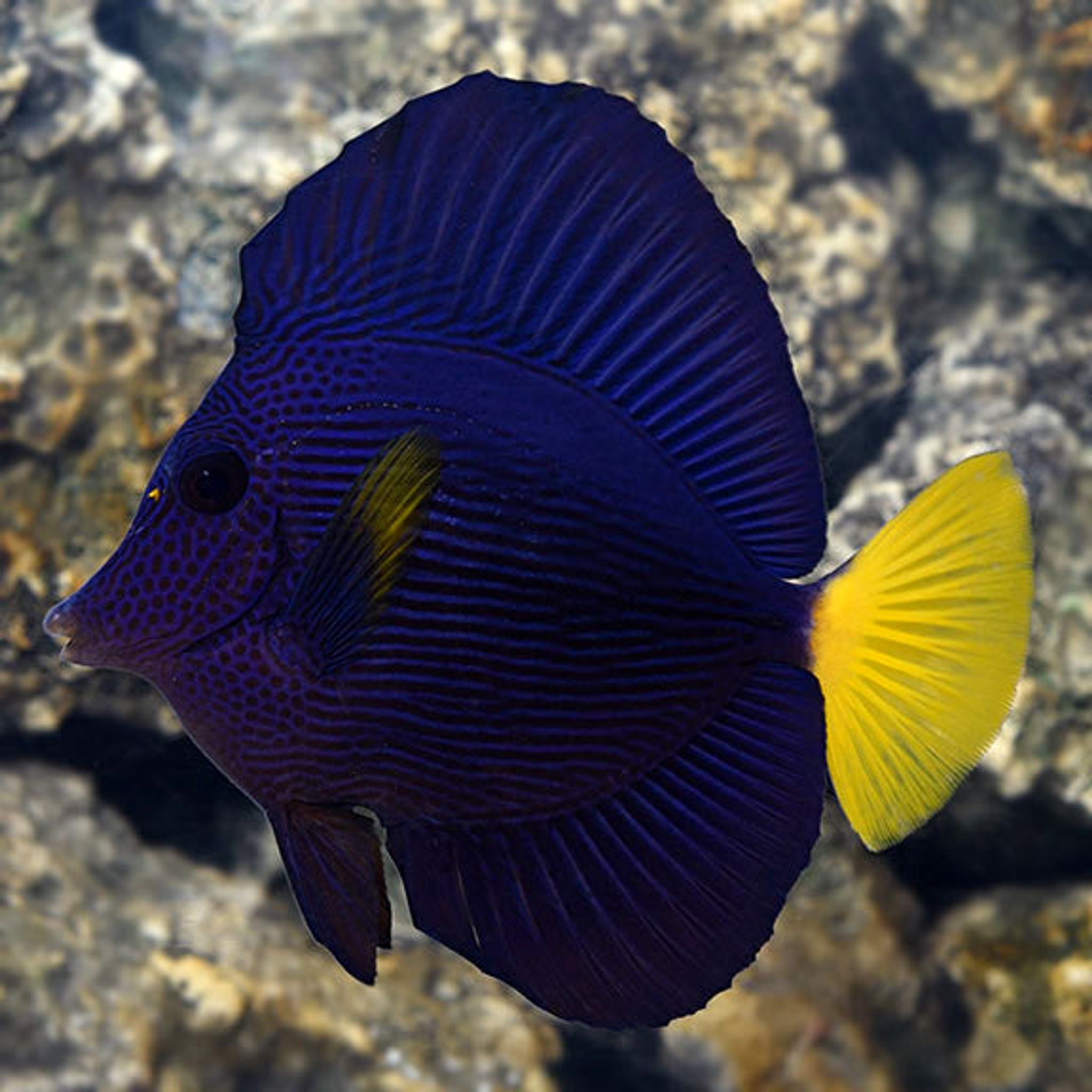
How to Feed Purple Tang: Foods, Frequency and Common Feeding Problems
A purple tang (Zebrasoma xanthurum) is a nonstop grazer in the wild, and a captive diet needs to imitate that pattern rather than rely on one or two big meals. This guide covers exactly what to feed, how often, how much, and how to troubleshoot the feeding problems that show up most in this species — from picky new arrivals to head and lateral line erosion (HLLE).
Why Feeding Strategy Matters for This Species
In reef habitat, a purple tang spends most of daylight hours picking at algae-covered rock in short, constant bites rather than eating in discrete meals. A tank setup that only offers food twice a day, with nothing to graze on in between, works against that natural rhythm. The fish is also an obligate herbivore first and a protein eater only occasionally, so the balance of foods matters as much as the schedule.
Feeding problems in this species are rarely just "the fish won't eat" — they usually connect back to water quality, tank size, or tankmate competition, so treat feeding as part of an overall husbandry plan rather than an isolated task.
Core Diet: What to Feed a Purple Tang
The bulk of the diet should be vegetable matter. Build a rotation from these categories:
- Dried seaweed sheets — nori (green), plus red and brown algae varieties, are the single most reliable staple.
- Spirulina-based flake or pellet — a dense, algae-forward prepared food that's easy to dose in small amounts.
- Frozen herbivore or algae blend — thawed and offered a few times a week for texture and nutrient variety.
- Marine algae, fresh or dried — beyond nori, other macroalgae varieties add diversity.
- Occasional meaty protein — small amounts of mysis or brine shrimp, offered as a minor supplement rather than a regular main course.
A well-established tank with healthy live rock also lets the fish graze on natural algae and diatom film between feedings, which supplements prepared foods and tends to reduce begging and food-driven aggression. You can browse live specimens and compatible tankmates in the Tangs & Surgeons category, and source staple foods and frozen blends from the Food & Supplements section.
How Much Meaty Food Is Too Much
This is a point where advice diverges. Some hobbyists treat purple tang as essentially algae-only; others include modest frozen mysis or brine shrimp as a regular part of the rotation. The practical middle ground: keep meaty foods to an occasional, small-portion supplement, and let vegetable matter make up the clear majority of feedings by both volume and frequency. Overfeeding meaty foods while skimping on vegetable matter is linked to digestive upset and dulled coloration over time in an obligate herbivore like this.
Feeding Frequency and the Grazing Clip Method
Two schools of thought show up in feeding guidance: some recommend letting the fish graze continuously off a clipped algae sheet left up most of the day, while others frame feeding as fixed sessions 2–3 times daily. The two aren't actually in conflict — combine them.
A practical routine:
- Clip a strip of nori or seaweed sheet to the glass with a veggie clip, sized to roughly a few square inches for an adult fish.
- Leave it up for 1 to 4 hours, long enough for grazing but not so long it fouls the water.
- Remove any uneaten portion before it breaks down.
- Offer one or two additional small feedings of frozen herbivore blend, spirulina pellet, or (occasionally) mysis/brine shrimp elsewhere in the day.
Juveniles and fish in smaller systems generally need more frequent, smaller feedings to support growth. Adults in large, mature systems with abundant live rock algae can often get by with less supplemental feeding, since they're grazing naturally between clip sessions.
Sample Weekly Feeding Schedule
| Day | Morning | Midday/Afternoon | Notes |
|---|---|---|---|
| Mon | Nori clip (1–2 hrs) | Spirulina pellet, small pinch | Remove nori clip promptly |
| Tue | Nori clip (1–2 hrs) | Frozen herbivore blend | |
| Wed | Nori clip (1–2 hrs) | Small mysis/brine portion | Meaty supplement day |
| Thu | Nori clip (1–2 hrs) | Spirulina pellet | |
| Fri | Nori clip (1–2 hrs) | Frozen herbivore blend | |
| Sat | Nori clip (2–3 hrs) | Spirulina pellet + garlic-soaked flake | Weekend, longer graze window |
| Sun | Nori clip (1–2 hrs) | Small mysis/brine portion | Meaty supplement day |
Adjust portions to what's consumed within the feeding window rather than a fixed amount — a good rule of thumb for a nori strip is only what the fish clears in that window, refilled rather than left to accumulate.
Vitamin Soaking and Appetite Support
Soaking dried foods in a garlic-based additive or a general vitamin supplement before feeding is a common way to boost appetite and support immune health, and it's especially useful for a new or visibly thin specimen. This isn't a substitute for dietary variety, but it's a low-cost habit that can help a stressed fish start eating again.
Tank Size, Flow, and Their Link to Feeding Problems
Cited minimum tank sizes for an adult purple tang (which reaches roughly 10 inches / 25 cm) range from about 100 to 180 gallons depending on the source. A practical working minimum is 125 gallons (about 470 liters), with larger strongly preferred given how active and territorial this species is. Strong water flow and high oxygenation matter too — inadequate swimming space and stagnant, low-oxygen water suppress appetite and create chronic stress that shows up as reduced feeding.
Two other environmental factors tie directly into appetite:
- Stable temperature, typically 75–80°F (24–27°C). Temperature swings stress fish and suppress feeding response. Use a reliable heater with a controller and verify the actual water temperature with a separate thermometer, since heater dial settings are often inaccurate.
- Moderate-to-high intensity reef lighting with a full spectrum, which supports coral and inhabitant health and also drives the growth of live rock algae and any macroalgae in the tank that the tang grazes on.
New Arrivals: Getting a Stressed Fish to Eat
Newly introduced purple tangs, especially wild-caught individuals, often refuse flake or pellet food entirely at first. Nori and live or fresh macroalgae are the most reliable first foods to offer a stressed specimen, since they closely match what the fish would encounter in the wild.
A few notes on transition:
- Wild-caught fish typically need more patience and a slower transition, often taking days to weeks to accept prepared pellet or flake foods, with nori as the bridge food throughout.
- Captive-bred or aquacultured individuals tend to accept prepared pellets and flake noticeably faster, since they're often raised on them from a young size.
- Dim the lights and minimize disturbance around feeding time for a skittish new fish.
- Confirm tankmates aren't outcompeting the new arrival at the feeding site — purple tangs can be bullied by other tangs, or can become the aggressor themselves once settled in.
- A sudden refusal to eat paired with flashing or scratching against rock points toward a parasite issue rather than a diet problem — that calls for a health check, not just a food change.
Signs of a Well-Fed vs. Underfed Tang
Body shape and color are the simplest self-diagnosis tools:
- Well-fed: full, rounded belly profile behind the gills, vivid purple body color, bright yellow tail, active grazing behavior throughout the day.
- Underfed or wasting: a pinched or sunken profile just behind the head, a visibly concave belly line, dulled or patchy color, and reduced activity or hiding.
Feeding too infrequently, or relying only on tank algae in a system that doesn't grow much of it, is a common cause of this gradual weight loss.
Common Feeding Problems and Fixes
| Problem | Likely Cause | Fix |
|---|---|---|
| Gradual weight loss, pinched profile | Infrequent feeding, insufficient tank algae | Add grazing clip sessions, increase feeding frequency |
| Poor coloration, digestive upset | Too much meaty food, not enough vegetable matter | Shift ratio back toward nori, spirulina, algae blends |
| Cloudy water, algae/nuisance growth after feeding | Uneaten nori clip left too long | Remove uneaten portions promptly, shorten grazing windows |
| Refuses food after introduction | Shipping stress, unfamiliar foods | Offer nori/live macroalgae first, dim lights, reduce disturbance |
| Subordinate fish not eating in mixed-tang tank | Feeding-time aggression/competition | Feed at multiple spots, stagger feeding times |
| Sudden appetite loss with scratching/flashing | Possible parasite outbreak | Address as a health issue, check water parameters and quarantine protocol |
HLLE (Head and Lateral Line Erosion)
HLLE shows up as pitting or lesions along the head and lateral line and is one of the two feeding-linked health issues purple tang keepers search for most. It's strongly associated with:
- Poor water quality and inconsistent water changes
- Overuse of activated carbon in filtration
- Vitamin deficiency, particularly vitamin C and HUFAs
- A diet lacking variety, especially vegetable matter
The fix addresses all four fronts at once: increase water change frequency, reduce or rotate off heavy carbon use, diversify the diet across multiple algae and prepared food types, and add a vitamin supplement to soaked foods. HLLE tends to improve slowly, over weeks, once the underlying causes are corrected rather than reversing overnight.
Feeding, Bioload, and Nutrient Export
How much you feed connects directly to how much waste your system has to process. A tang on a heavy feeding schedule in a tank with an undersized skimmer or infrequent water changes will push nutrients up faster than the system can export them, which circles back to appetite-suppressing poor water quality. Matching feeding volume to skimmer capacity and water-change frequency — rather than treating diet and nutrient export as separate topics — is part of keeping a herbivore's appetite and health stable long-term.
Macroalgae Reactors: An Optional Advanced Setup
A dedicated macroalgae reactor — growing chaetomorpha or a similar red macroalgae under its own lighting — is a nutrient-export tool separate from directly feeding the tang, but it's relevant to overall herbivore health. The reactor takes up nitrate, phosphate, CO2, and trace metals from the water column while producing a renewable, pesticide-free supply of algae.
Basic setup elements include:
- Dedicated LED lighting tuned toward red/blue spectrum for macroalgae growth
- A flow path (inlet/outlet) running water through the algae mass
- A compact reactor body — external canister-style in PVC or acrylic, or a simpler internal chamber
This is worth considering for reef keepers who want tighter nutrient control and a steady in-tank algae supply, but it supports the diet rather than replacing direct feeding of nori, pellets, and frozen blends.
A Note on Copper and Quarantine Feeding
If a purple tang needs quarantine treatment, be aware that tangs are sensitive to copper-based medications, which are a common treatment for external parasites in marine fish. Copper exposure can suppress appetite and slow recovery in this species, so confirm dosing carefully and watch feeding response closely during any copper-based treatment course. This is a separate issue from routine diet planning but matters for anyone treating a new or ailing purple tang.
Frequently Asked Questions
How often should I feed a purple tang?
Aim for multiple small feeding opportunities per day rather than one large meal: a clipped nori or seaweed sheet offered once or twice daily for grazing, plus one or two additional small feedings of pellet, spirulina flake, or frozen herbivore blend.
What is the best food for purple tang?
Dried seaweed sheets (nori and other algae varieties) should be the staple, rounded out with spirulina-based flake or pellet and frozen herbivore blends for variety.
Can purple tangs eat meaty foods like mysis or brine shrimp?
Yes, but only occasionally and in small amounts. Meaty protein should stay a minor supplement to an otherwise vegetable-heavy diet, not a regular main food.
Why is my purple tang not eating?
Common causes include new-arrival stress, poor water quality, competition or aggression from tankmates, and illness. Try nori or live macroalgae first, check water parameters, and watch for scratching or flashing that would point to a parasite issue instead of a diet problem.
What causes HLLE in purple tangs and how do I treat it?
HLLE is linked to poor water quality, activated-carbon overuse, and vitamin or dietary deficiency (particularly vitamin C and HUFAs). Treat it by increasing water change frequency, diversifying the diet, and adding vitamin supplementation to soaked foods.
Do purple tangs need live rock or algae growth in the tank?
It helps significantly, since ongoing algae growth gives the fish continuous grazing material that supplements prepared foods and reduces feeding-time begging or aggression. It isn't strictly required if the fish is fed a properly varied diet, but it makes feeding easier to manage.
What size tank does a purple tang need?
A practical minimum is around 125 gallons (about 470 liters) for an adult, given its adult size of roughly 10 inches (25 cm) and its active, territorial behavior. Larger is better, particularly in a mixed-tang system.
Is a macroalgae reactor useful for a purple tang tank?
It's an optional, advanced setup, mainly valuable for nutrient export and water-quality management, plus a renewable grazing supplement. It supports overall tank health but isn't a substitute for directly feeding nori, pellets, and frozen foods.
A stable feeding routine for a purple tang comes down to frequent grazing opportunities, an algae-forward diet, and a tank environment (size, flow, and stable water parameters) that supports a healthy appetite. For dried seaweed, spirulina pellets, and frozen herbivore blends to build your rotation, check the Freeze Dried Food selection on FishyHub.

