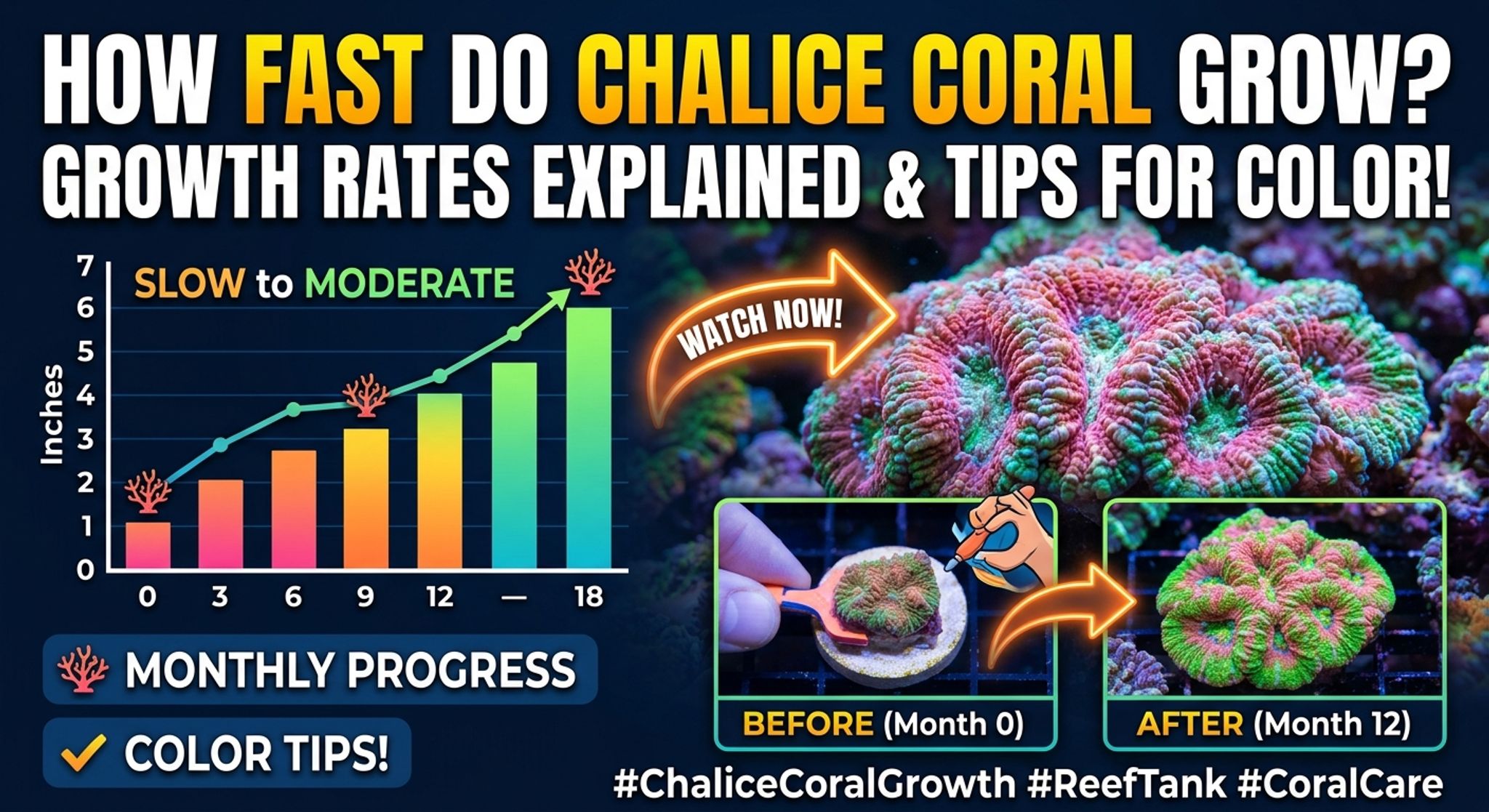
How Fast Do Chalice Coral Grow? Growth Rates and Tips for Better Color
Chalice coral growth is slow to moderate compared with most SPS and softies, and how fast a given piece grows depends heavily on which type of chalice it actually is. This guide breaks down realistic growth timelines, the lighting and flow settings that balance growth against color, and the most common reasons chalices stall out or fade.
What "Chalice" Actually Means
"Chalice" is a trade name, not a single species. It's used to describe large polyp stony (LPS) corals from several different genera — most commonly Echinophyllia, Oxypora, Mycedium, and Echinopora — that are sold under one umbrella term because they share a similar plating or encrusting growth habit and often carry vivid, patterned coloration.
This matters more than most care sheets admit: it's the actual root cause of why growth-rate numbers for "chalice coral" swing so wildly online. A thin-skeleton Echinophyllia and a dense-skeleton Echinopora are both called "chalice," but they grow at very different speeds. If you can identify which genus or growth form your coral belongs to, you'll have a far more realistic idea of what to expect than any single blanket number can give you.
How Chalice Coral Growth Actually Works
Chalices don't grow tall the way a branching Acropora does. Growth is measured as tissue spread across a surface — the encrusting or plating skeleton extends outward and thickens, rather than shooting up. A colony that's been established for years will still sit low and flat or gently domed, just wider.
That spreading habit is also why chalices are grouped with other slow-growing, color-focused LPS: they're not built to rapidly fill a tank the way a fast SPS or soft coral colony can.
Growth Rate by Type
Because "chalice" spans multiple genera with different skeletal densities, growth rate is really a spectrum rather than a fixed number:
| Skeleton type | Growth pattern | Approximate rate |
|---|---|---|
| Thin, fast-encrusting (e.g., "Miami Hurricane"-type morphs) | Rapid tissue spread over rock/plug | Can roughly double surface area in about 4 months under strong conditions |
| Thick, dense skeleton | Slow radial growth | Roughly 1/4 inch (about 0.5–0.6 cm) of outward growth per month |
| Typical/mixed density | Steady, moderate spread | Somewhere between the two extremes above |
Overall, chalices are considered slow-to-moderate growers relative to Montipora or soft corals. Patience is the norm here, not the exception, and a colony that seems to be "doing nothing" for a few weeks is usually just growing at its normal, gradual pace.
Realistic Size Timeline
A healthy frag — roughly quarter- to silver-dollar-sized when purchased — can become a 4–6 inch colony in about 1–2 years with consistent care. In captivity, mature colonies can eventually reach roughly 10–12 inches across, though that takes many years of stable conditions.
A practical way to track this at home: photograph the colony next to a fixed ruler or a grid background once a month. Chalice growth is gradual enough that it's genuinely hard to judge by memory alone, and a monthly photo series will show progress that's invisible day to day.
Chalice Color Morphs
Names like Jellybean, Red Lava, Mummy Eye, Watermelon, or Ludicrous describe color morphs, not distinct species. These are marketing and color labels applied to frags with a particular pattern or pigment combination, and two corals sold under the same morph name can still differ in growth speed and light tolerance if they come from different colonies or genera. Treat the morph name as a description of looks, not a guarantee of how the coral will behave in your tank.
Lighting for Growth and Color
Lighting is where growth and color goals can pull in opposite directions. More intensity often deepens color pop, but push too far and you risk bleaching or slower tissue growth instead.
- PAR target: roughly 75–150 PAR at the coral's placement depth. Reported ranges online run from 50 up to 200 PAR, but the sensible middle ground for most setups is 80–120 PAR.
- Start low, adjust slowly: place new frags at 75–120 PAR and watch color and polyp extension for 2–3 weeks before increasing anything.
- Treat 150+ PAR as an upper limit reserved for the hardiest, most established colonies — and remember that tolerance varies by specific morph.
- Spectrum: a blue-heavy spectrum, roughly 400–460nm actinic-leaning, intensifies the fluorescent pigments chalices are prized for. A pure white or daylight-heavy spectrum tends to wash out color even when PAR is technically adequate.
A Light-Ramp Schedule for New Frags
Sources gesture at "acclimate slowly" without giving numbers. A workable stepwise approach:
- Week 1: Start at roughly 40–50% of your target PAR.
- Weeks 2–4: Increase intensity by about 10% per week.
- After 4 weeks: You should be at or near the target range, with the coral showing full polyp extension and stable color.
If you're shopping for fixtures with dimmable intensity to make this kind of ramp practical, FishyHub's LED lighting selection covers a range of controllable options.
Flow and Placement
Flow: low-to-moderate, indirect — roughly 20–40x tank turnover per hour. Direct blasting meant for SPS causes tissue damage and recession. Too little flow lets detritus and mucus settle in the coral's cup-like surface, which can lead to infection.
Placement: lower to mid tank, on flat or gently sloped rock, out of direct powerhead flow and away from intense light. Two details matter more than they look:
- Self-shading: on uneven rock, an encrusting or plating chalice can shade its own growing edge, dulling color and slowing growth on the shadowed side. Mount frags on a flat plug or a flat section of rock so the whole disc receives even light.
- Spacing: chalices extend sweeper tentacles at night and will sting tankmates. Recommendations range from 1 inch to 3+ inches, but the safer bet is 3–4 inches minimum from neighbors, since sweeper reach is easy to underestimate and LPS aggression only escalates as colonies grow larger.
Once a chalice is placed and acclimated, avoid moving it to "find a better spot." Every relocation resets acclimation and risks recession — pick a stable position and give it weeks before judging whether it needs to move.
Water Parameters
Chalices do well within standard reef parameters, and — like most LPS — actually do better with some measurable nutrients rather than ultra-low, "sterile" water:
| Parameter | Target range |
|---|---|
| Temperature | 76–78°F (24–26°C), tolerated up to ~82°F (28°C) |
| pH | 8.1–8.4 |
| Salinity (SG) | 1.025–1.026 |
| Alkalinity | 8–9 dKH |
| Calcium | 400–450 ppm |
| Magnesium | 1250–1350 ppm |
| Nitrate | ~2–10 ppm |
| Phosphate | ~0.03–0.1 ppm |
Stability matters more than any single number. Chalices are sensitive to swings in light, flow, or chemistry, and they respond to instability with stress bleaching or tissue recession rather than a quick bounce-back.
Feeding for Growth and Color
Chalices are photosynthetic and get the majority of their energy from zooxanthellae, so feeding isn't strictly required to keep one alive. That said, supplemental target feeding 2–3 times per week measurably boosts both growth rate and color saturation.
Good options include mysis, chopped frozen meaty foods, coral pellets, and amino acid or phytoplankton blends — a rotation of a freeze-dried food alongside frozen meaty foods covers most of this. Target-feed with a turkey baster or pipette after the lights dim, since polyps often extend and feed more actively at night.
Coloration Troubleshooting
Chalice pigment response is slow, so change one variable at a time and give it at least 2 weeks before judging the result.
Browning out (the coral looks duller, more olive or brown):
- Usually caused by excess nutrients or too little light, both of which let the coral host more symbiotic algae than it needs for balanced coloration.
- Can also happen when a coral "reverts" after a stressful period, favoring algae density over pigment display.
Bleaching or paling (the coral looks washed out, pale, or stark white):
- Usually caused by excess light, heat stress, or nutrients that are too low.
- Running an otherwise healthy tank "too clean" — near-zero nitrate and phosphate — can starve LPS corals of nutrition pathways they rely on for full color.
Frag Mounting and Healing
Fragging a chalice is considered intermediate difficulty. Cut with a clean tool — bone shears, a tile saw, a Dremel with a diamond blade, or sharp snips — making sure each resulting frag keeps at least one polyp "eye" and enough tissue margin to heal.
Steps for a clean frag:
- Cut cleanly, preserving at least one eye per piece.
- Dip the cut edges in an iodine-based coral dip to prevent bacterial infection.
- Mount to a flat frag plug with reef-safe cyanoacrylate glue or epoxy.
- Rinse with tank water before returning the frag to the tank.
- Keep flow low during healing.
Expect tissue to fully spread over the plug's edge within a few weeks as the first clear sign of successful acclimation.
Acclimating New Frags
New arrivals deserve a quarantine period and a dip before joining the display tank. From there, follow the light-ramp schedule above rather than placing a frag straight under full display lighting — a sudden jump is one of the more common causes of early bleaching in new chalices.
While a frag is in quarantine, check it under a flashlight at night for Montipora-eating nudibranchs — tiny, translucent, nocturnal pests that will also attack some chalices and scrolls. They multiply quickly since they mature in a matter of days, so catching them early matters. Also watch for brown jelly disease, a rapid, usually bacterial breakdown of tissue into a gelatinous mass; it requires immediately cutting away and isolating the affected tissue to keep it from spreading to neighboring frags.
One more competitor worth watching for: cyanobacteria or nuisance algae can creep across bare rock and out-compete an encrusting chalice at its growing edge. This can look exactly like "no growth" when the coral is actually being crowded out of new substrate rather than failing to grow at all.
Common Mistakes
- Blasting a chalice with SPS-level flow — causes recession and tissue damage; redirect to indirect flow instead.
- Chasing color with intense lighting too fast — causes bleaching; ramp light gradually and judge by polyp extension, not color alone.
- Placing frags too close together — chalices sting neighbors and can stunt each other's growth; increase spacing.
- Skipping supplemental feeding — the coral survives but grows slowly with muted color.
- Repositioning frequently to "find the right spot" — each move resets acclimation and risks recession.
- Running the tank too clean — near-zero nutrients cause pale coloration in LPS corals.
- Missing early nudibranch or brown jelly signs — inspect new frags at night before adding them to the display.
When Slow Growth Is Actually Fine
It's worth saying plainly: chalices are a color-focused display coral, not a growth-farming coral. If a colony is holding steady color, extending polyps normally, and slowly widening month over month in your ruler photos, that's success — not a problem to fix. Slow growth only signals a real husbandry issue when it's paired with other symptoms: browning, paling, tissue recession, or polyps that stay retracted.
Frequently Asked Questions
How long does it take a chalice frag to become a full colony?
Roughly 1–2 years to reach a few inches across, depending on the variety and how consistent your care is. Faster-growing types can double in surface area in about 4 months, while denser, slower types add roughly a quarter inch of radial growth per month.
Why is my chalice coral not growing?
The usual culprits are too little or too much light, weak flow letting waste build up on the tissue, no supplemental feeding, unstable water parameters, or self-shading from uneven mounting. Check each variable individually rather than changing everything at once.
Why did my chalice lose its color or turn brown?
Browning is typically caused by low light or excess nutrients, which lets more symbiotic algae build up in the tissue. The opposite problem — high light, heat stress, or very low nutrients — causes bleaching or paling instead. Adjust one variable at a time and give it a couple of weeks to show results.
What PAR and lighting does a chalice coral need?
Roughly 75–150 PAR with a blue-leaning spectrum works for most chalices, with 80–120 PAR being a solid middle ground. Start new frags on the lower end and ramp up slowly rather than placing them straight into strong light.
How much flow does a chalice coral need?
Low to moderate, indirect flow equal to about 20–40x tank turnover per hour. That's enough to keep the coral's cup-shaped surface clean of detritus without buffeting or damaging the tissue.
Can you frag a chalice coral, and how?
Yes — it's considered intermediate difficulty. Cut cleanly with a sharp tool so each piece keeps at least one polyp "eye," dip the cut edges in an iodine-based dip, glue the frag to a flat plug, and keep flow low while it heals.
Do chalice corals need to be fed?
Not strictly, since they get most of their energy from photosynthesis, but supplemental feeding 2–3 times a week meaningfully improves both growth rate and color saturation over time.
Why do my chalice's neighbors look damaged?
Chalices extend sweeper tentacles at night and will sting nearby corals that are too close. Increase spacing to at least 3–4 inches to give neighboring colonies room as everything grows.
Ready to add one to your reef? Browse current frags and colonies in FishyHub's LPS coral selection to find a chalice that matches your lighting and experience level.