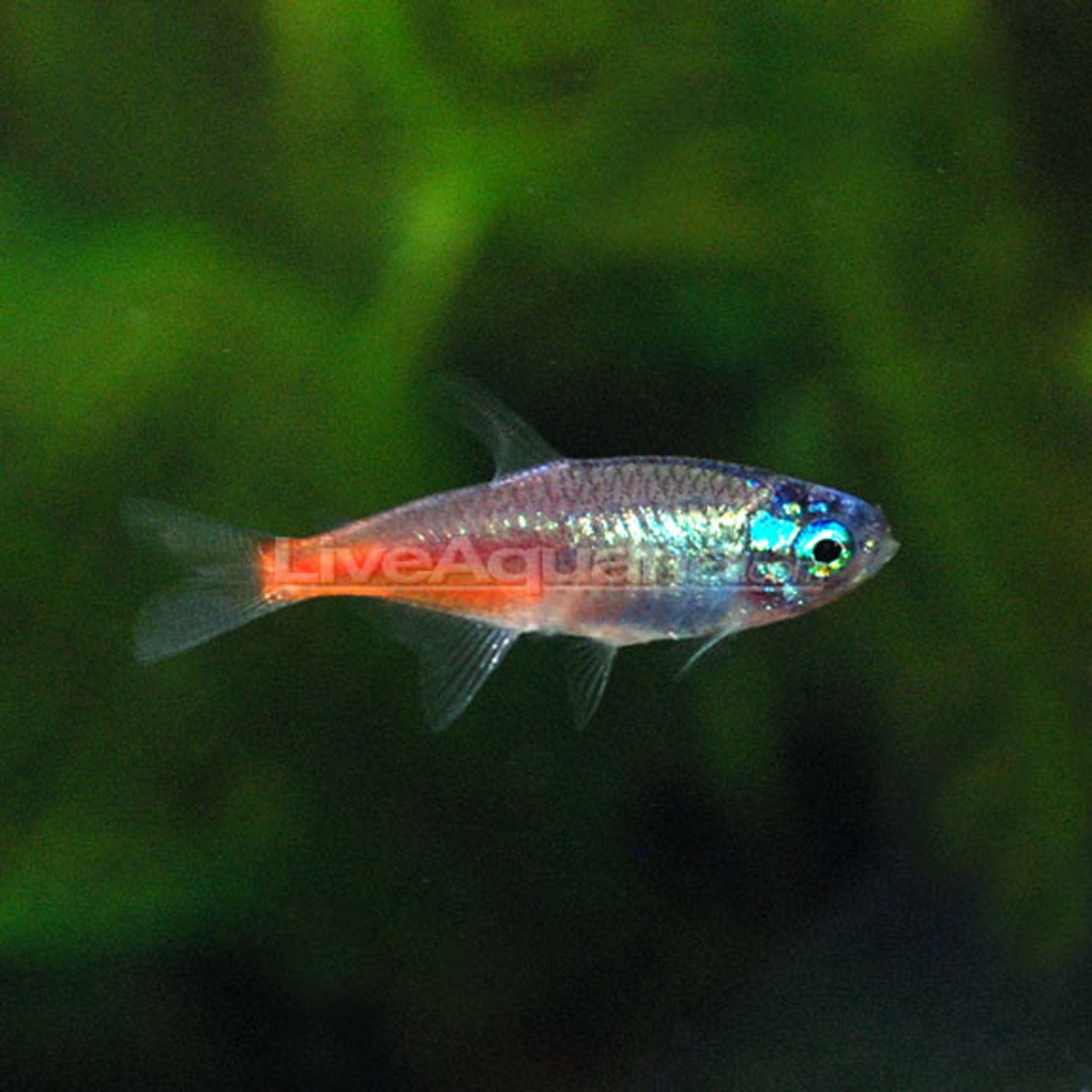
How Big Do Neon Tetra Get? Growth Rate, Adult Size and Tank Planning
A full-grown neon tetra (Paracheirodon innesi) tops out around 1 to 1.5 inches (2.5–4 cm) in total length, with 1.5 inches being a realistic ceiling for a healthy, well-fed fish in a home aquarium. That small footprint is exactly why the species works so well in schools — but it also means the real planning question isn't "how big does one fish get," it's "how many can I actually fit, and how fast will they get there."
Adult Neon Tetra Size
Most adult neon tetras land in the 1–1.5 inch range, measured nose to tail. Very occasionally, a specimen raised with excellent nutrition, low stress and stable warm water will push past 1.5 inches, and rare individuals approach 2 inches — but that's the exception, not something to plan a tank around.
Do males and females grow to different sizes?
Females run very slightly larger and rounder-bodied than males, since they carry eggs. Some references cite roughly 1.4 inches for males versus 1.6 inches for females, but treat that gap as approximate rather than a hard rule — the difference is subtle and hard to measure by eye. A more reliable cue is body shape: males stay slim with a straight, even red lateral stripe, while females look fuller and rounder, especially viewed from above. At normal viewing angles in a planted tank, most keepers can't tell males and females apart on length alone.
Growth Rate: How Fast Do Neon Tetras Reach Full Size?
Neon tetra fry hatch roughly 24 hours after spawning and are nearly invisible for the first few weeks. Here's the general timeline from hatching to adult size:
| Age | Approximate size / milestone |
|---|---|
| 24 hours | Fry hatch, translucent, not yet free-swimming |
| 3–4 weeks | Visible blue/red stripe starts developing |
| 1–3 months | Roughly half of adult size |
| 4–6 months | Roughly three-quarters of adult size |
| 6–12 months | Full adult size (growth trails off, often complete by ~6 months) |
During the active juvenile phase, growth averages around 1/4 inch per month, though this varies a lot between individuals. A tetra that isn't fully grown by 4–5 months isn't unusual — genetics, diet, and water quality all shift the exact timing. Growth effectively plateaus once the fish reaches sexual maturity, usually somewhere between 6 and 12 months old; size after that point is essentially fixed.
What Affects Final Size and Growth Speed
Several factors combine to determine how big an individual neon tetra ends up and how quickly it gets there:
- Diet quality — a varied diet with adequate protein (quality flake or micro-pellet plus occasional live or frozen foods) supports faster, healthier growth than a single dry-food diet.
- Water temperature stability — consistently warm water within the safe range supports steady growth; fluctuating temperatures stress fish and slow it down.
- Tank size and stocking density — crowded or undersized setups create chronic stress that can stunt growth.
- Water quality — ammonia and nitrite spikes are hard on this species and will slow or halt growth.
- Stress and aggression from tankmates — fish that are constantly harassed spend energy on stress response instead of growth.
- Genetics and line quality — wild-caught neons and different farm-raised lines can vary somewhat in adult size and hardiness.
A detail most care sheets skip: school size itself affects growth. Neon tetras kept in groups that are too small experience more stress hormones, which can measurably slow growth and dull color compared with fish kept in larger, calmer schools of six or more.
Neon Tetra Lifespan
Expect a typical lifespan of 3–5 years in a well-kept home aquarium — treat that as the realistic average rather than an outlier claim. Under excellent, stable conditions, 8–10 years has been reported, though it's not the norm. Wild populations may live closer to a decade, but that reflects different environmental pressures than a home tank, not a higher baseline for captive fish. Stress, poor water quality, and disease (including neon tetra disease, discussed below) are the main things that cut lifespan short.
Tank Size and Stocking Math for Neon Tetras
Neon tetras are strict shoaling fish — a single fish or a pair left alone shows visible stress and duller color. Plan for at least six as a starting school.
Minimum tank size
A 10-gallon (38 L) tank is the practical minimum for a starter school of six neon tetras in a planted, well-filtered setup.
Gallons-per-fish rule of thumb
Beyond that base school, a workable stocking guideline is roughly 1 additional gallon per extra neon tetra, assuming good filtration and live or fast-growing plants to buffer water quality. Longer, larger tanks (20+ gallons) let bigger schools of 10–15 or more swim naturally, spread out, and show less fin-nipping and aggression than the same number crammed into a shorter tank.
| Tank size | Reasonable neon tetra school size |
|---|---|
| 10 gal (38 L) | 6 (starter school) |
| 15 gal (57 L) | 8–10 |
| 20 gal long (76 L) | 10–15 |
| 29–40 gal (110–150 L) | 15–20+ |
For example, six neons comfortably fill a 10-gallon tank as a first school, while a 20-gallon long tank can support 12–15 neons plus a modest group of bottom dwellers — noticeably calmer schooling behavior than the same fish squeezed into a smaller footprint. You can browse tetras and appropriately sized glass tanks to match a school to its setup.
Tankmates That Fit a Neon Tetra Tank
Choose peaceful species in a similar 1–4 inch size range so nothing reads the neons as food or a target:
- Other small tetras
- Corydoras catfish and other calm bottom dwellers
- Dwarf gouramis
- Small rasboras
- Otocinclus
Avoid larger, nippy, or predatory fish — anything that sees a 1.5-inch fish as a snack, or that chases and stresses the school, will show up as faded color, hiding, and stunted growth over time.
Water Parameters for Healthy Growth
- Temperature: stable 72–78°F (22–26°C) as the safe target range for consistent health and color; neons can tolerate a wider 70–81°F (21–27°C) band short-term, but stability matters more than hitting an exact number.
- pH: 5.5–7.0, soft and slightly acidic to neutral.
- Hardness: roughly 1–10 dGH, with softer water toward the low end preferred, especially for breeding.
Neons are notably sensitive to ammonia and nitrite compared with hardier community fish, so they should never go into an uncycled tank.
Tank setup that supports growth and color
- Dense planting and driftwood for cover
- Subdued, low lighting
- Dark substrate, which enhances color and reduces stress
- Fully cycled, stable water before adding fish
Black Neon Tetra: A Related but Different Species
The black neon tetra (Hyphessobrycon herbertaxelrodi) is a distinct species, not a color variant of the common neon. It runs slightly larger, typically 1.2–1.5 inches, and shows a black-and-silver-white stripe instead of the classic neon blue and red. Care parameters and shoaling needs are essentially the same, so the two species can even be mixed in one school-friendly community tank.
Sexing and Breeding Neon Tetras
How to tell males and females apart
Females are rounder and fuller-bodied, most visible from above or once a female is gravid. Males stay slimmer with a straighter blue/red lateral line. These differences are easiest to spot once fish are fully adult and viewed side by side, since juveniles of both sexes look nearly identical.
What "gravid" means
A female carrying eggs is correctly called gravid, not pregnant — neon tetras are egg-scatterers, not livebearers, so there's no internal gestation of live young. Signs of a gravid female include a visibly swollen, rounded belly, especially after one to two weeks of conditioning on protein-rich foods like bloodworms and brine shrimp ahead of spawning.
Breeding setup basics
Breeding neon tetras successfully generally requires:
- A dedicated species tank, separate from the main community
- Dim lighting, since eggs and fry are light-sensitive
- Soft, acidic water (low dGH, pH around 5.5–6.5)
- Fine-leaved plants or spawning mops for egg-scattering
- Removing the adults after spawning, since they will eat their own eggs
Common Mistakes and Troubleshooting
- Keeping fewer than six neons — causes visible stress, hiding, faded color, and fin-nipping among the few fish present.
- Adding neons to an uncycled tank — they're more sensitive to ammonia and nitrite than many community fish and can die within days of "new tank syndrome."
- Assuming slow growth means illness — individual growth rate varies naturally; check water parameters and diet before jumping to disease.
- Housing with fin-nippers or larger fish — leads to injury, chronic stress, and stunted growth over time.
- Overfeeding or a poor diet — reduces both growth rate and color quality; rotate in occasional live or frozen foods alongside a quality staple.
- Confusing neon tetra disease with normal small size — neon tetra disease is a real, incurable parasitic (microsporidian) illness that causes color loss, a curved spine, and cysts. A naturally small or slow-growing but otherwise healthy, straight-bodied fish is not the same thing, so don't panic over size alone without those additional symptoms.
Frequently Asked Questions
How big do neon tetras get in a 10-gallon tank?
Tank size doesn't change individual fish length — a neon tetra in a 10-gallon tank still reaches the same 1–1.5 inch adult size as one in a 40-gallon tank. What tank size does affect is how large a school you can keep and how much stress and aggression the fish experience.
Do neon tetras stop growing?
Yes. Growth plateaus once the fish reaches sexual maturity, generally somewhere between 6 and 12 months old. After that, size is essentially fixed for the rest of its life.
Why is my neon tetra not growing?
The most common causes are diet, water quality, and stress from tankmates or too small a school, along with normal individual variation. If slow growth comes paired with color loss or a curved spine, rule out neon tetra disease rather than assuming it's just a slow grower.
How can you tell a neon tetra is female?
Look for a rounder, fuller belly, most visible from above or once she's gravid with eggs. The difference from the slimmer male profile is subtle and easiest to see in adult fish viewed side by side.
What is the biggest a neon tetra can get?
Rare individuals under ideal, low-stress, well-fed conditions approach 2 inches, but 1.5 inches is the realistic ceiling to plan a tank around.
How many neon tetras can I keep per gallon?
Plan on a 10-gallon minimum for a first school of six, then roughly one additional gallon per extra tetra in a planted, well-filtered setup. Larger, longer tanks let bigger schools of 10–15+ swim more naturally.
Is a black neon tetra the same species as a regular neon tetra?
No. It's a related but distinct species with a different scientific name, running slightly larger (1.2–1.5 inches) with a black-and-silver stripe pattern instead of neon blue, though care needs are nearly identical.
How long do neon tetras live?
Typically 3–5 years with good, stable care, with 8–10 years possible under excellent conditions. Stress, poor water quality, and disease are the main factors that shorten lifespan.
Ready to plan a school around these numbers? Browse available tetras on FishyHub to size up a group that fits your tank.

