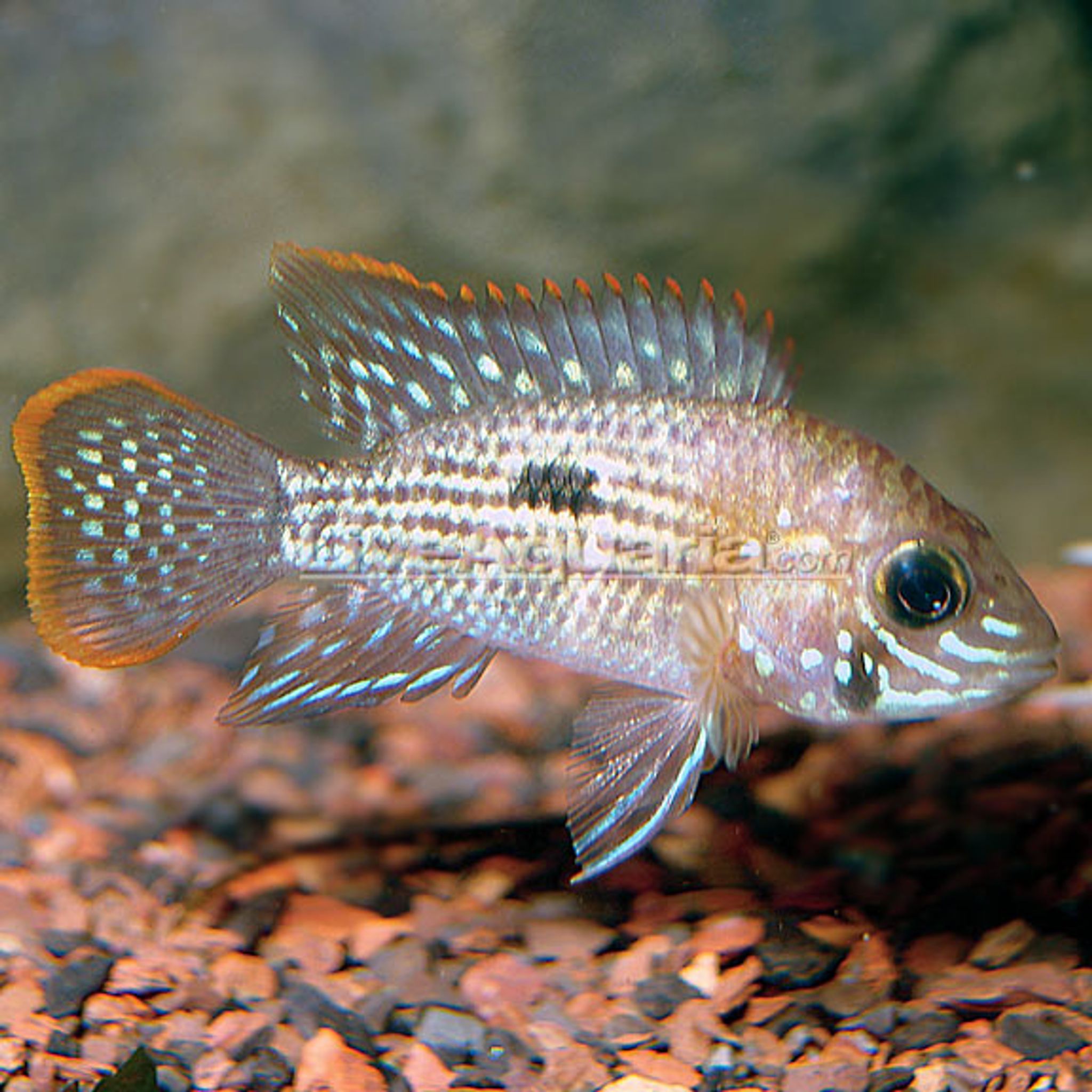
How Big Do Green Terror Get? Growth Rate, Adult Size and Tank Planning
A Green Terror cichlid typically settles at 6–8 inches in a home aquarium, with a rare, exceptionally well-fed male pushing toward 10 inches. What matters more than that single number is the pace of growth and how your tank plan keeps up with it, since a fish bought at 1.5 inches in a 10-gallon tank will look completely different — and need completely different housing — a year later.
Species Snapshot
The Green Terror, Andinoacara rivulatus, is a South American cichlid native to river drainages in coastal Ecuador and northern Peru. It's a mid-sized, robust, substrate-oriented cichlid that has become a staple in the US freshwater hobby thanks to its color and relatively manageable adult size compared to true giants like Oscars.
- Adult size (captive): 6–8 in (15–20 cm) is the realistic average; up to 10 in (25 cm) is possible in large, well-fed setups but is an outlier, not the norm.
- Adult size (wild): Wild-caught fish in native rivers can approach 10–12 in (25–30 cm); captive fish are usually smaller because tank space and diet are more limiting than in a river system.
- Lifespan: 7–10+ years with good care — plan your "final" tank around that whole timeframe, not just the first year.
How Fast Do Green Terrors Grow?
Growth isn't linear. Fry grow slowly for the first several weeks until they reach roughly 0.5–0.75 in, then growth accelerates noticeably through the first year. Juveniles can add visible size month over month, which is exactly the stretch where owners get caught with an undersized tank.
Size-by-Age Growth Table
| Age | Approximate length | Growth stage notes |
|---|---|---|
| 4–8 weeks | Under 1 in (2.5 cm) | Slow fry growth phase |
| 2–3 months | 1–2 in (2.5–5 cm) | Growth begins accelerating |
| 6 months | 3–4 in (7.5–10 cm) | Rapid juvenile growth, territorial behavior emerging |
| 12 months | 5–6 in (12.5–15 cm) | Fast growth continues, sexual differences becoming visible |
| 18–24 months | Near full size, 6–8 in (15–20 cm) | Approaching adult length |
| 2+ years | Full length reached | Males may keep adding girth and hump size for another 1–2 years |
These are approximate milestones, not guarantees — genetics, diet, and tank conditions all shift the timeline earlier or later. What's consistent is the pattern: slow start, fast middle, and a plateau after about two years, with males continuing to "fill out" even after they've stopped getting longer.
What Speeds Up or Slows Down Growth
Four factors drive most of the variation between a fish that hits 7 inches by 18 months and one that stalls at 4 inches:
- Water temperature: 76–80°F speeds metabolism and feeding response; colder water slows growth.
- Feeding frequency and quality: A protein-rich, varied diet fed multiple times daily as a juvenile supports faster, healthier growth.
- Water quality: Frequent water changes and low ammonia/nitrite/nitrate keep growth on track; poor water quality is one of the most common causes of stunting.
- Tank size: A cramped tank does more than just get dirty faster — space itself can suppress growth. Confined, stressed fish often show a physiological stunting response distinct from water-quality problems, staying permanently undersized even if water parameters are kept in check.
Male vs. Female Green Terror Size
Sexual dimorphism becomes obvious by the time a fish is nearing sexual maturity, and it directly affects how much space you need.
- Males: Grow larger, commonly reaching 8+ inches, and develop a pronounced nuchal (forehead) hump along with longer, more pointed dorsal and anal fin extensions as they mature.
- Females: Stay smaller and rounder, typically 5–6 inches, and often show more red or orange coloring along the dorsal fin edge rather than a hump.
A common planning mistake is assuming a male and female need the same footprint. A single male, because of his larger size and stronger territorial drive, can require noticeably more space than a female of the same age.
Tank Size by Life Stage
Because footprint — length and floor space — matters more than raw height for an active, territorial mid-water and bottom-dwelling cichlid, plan around a long tank (36–48+ in) rather than a tall, narrow one.
| Life stage | Fish size | Minimum tank size |
|---|---|---|
| Fry / young juvenile | Under 3 in (7.5 cm) | 20–29 gal (75–110 L) |
| Sub-adult | 3–5 in (7.5–12.5 cm) | 40–55 gal (150–210 L) |
| Single adult | 6–8 in (15–20 cm) | 40 gal absolute floor; 55–75 gal (210–285 L) is the responsible standard |
| Pair / breeding setup | Adult pair | 75–125 gal (285–475 L), to allow separate territories |
Recommendations for a single adult's minimum tank size vary widely across the hobby, from 30 to 55+ gallons. Treat 40 gallons as an absolute floor and 55–75 gallons as the standard to aim for — the extra volume reduces both stunting risk and the odds of serious aggression in a confined space.
A Phased Upgrade Plan
Rather than buying a tank sized for the fry stage and upgrading repeatedly, plan two moves at most:
- Start: A 20–29 gallon tank works for fry through early juveniles (under 3 in).
- Move once, deliberately: Around 3–4 inches, before growth accelerates further, transition directly to the 55–75 gallon tank you intend to keep long-term. This skips an intermediate "sub-adult" tank purchase and avoids the stress of multiple moves.
Buying only for the juvenile size the fish is today — a 10–20 gallon tank — is one of the most common and costly mistakes, since it either forces an expensive second upgrade or leaves the fish stunted and stressed in cramped quarters. Browse American Cichlids to compare Green Terrors and similar species before deciding on tank size, and check Glass Tanks for long-footprint options sized for the adult stage.
Water Parameters and Filtration
Green Terrors tolerate moderate variation better than more sensitive species, but staying within these ranges supports steady, healthy growth:
- Temperature: 72–78°F for everyday keeping; breeding pairs do better nearer 77–80°F. (Some sources cite a wider 68–80°F tolerance range overall.)
- pH: 6.5–7.8 is the practical target, though the species can handle a broader 6.5–8.0 in established water.
- Hardness: Roughly 5–20 dGH/dKH.
- Filtration: Strong biological filtration — a canister-style filter is commonly recommended for the bioload this species produces.
- Water changes: 15–20% weekly, more frequently in smaller or heavily stocked tanks. Keep ammonia and nitrite at 0 and nitrate under about 40 ppm.
Skipping regular water changes is one of the most common causes of stunted growth and disease in a fast-growing cichlid like this one — it's not just a cosmetic issue.
Diet for Healthy Growth
As an omnivore, a Green Terror does best on:
- A high-quality cichlid pellet as the daily staple
- Frozen or live bloodworms, brine shrimp, krill, and earthworms for protein
- Occasional vegetable matter
Feed juveniles small amounts 2–3 times a day to fuel the fast-growth window, and adults 1–2 times daily. Avoid mammal-based meats like beef heart — they're linked to fatty deposits and digestive problems in cichlids, and they don't offer any growth advantage over a varied, aquatic-protein diet. Underfeeding, or relying only on low-protein flakes, is the opposite mistake: it slows growth and dulls the fish's color.
Temperament Scales With Size
Aggression increases with both size and age, becoming much more noticeable from about 4–5 inches onward and increasing sharply at sexual maturity. Females can be just as aggressive as males, particularly when guarding fry, so don't assume a smaller female is automatically the easier tankmate.
A frequent surprise for new owners is a sudden jump in size and aggression around 5–6 months — the fish that seemed calm as a juvenile becomes territorial almost overnight as it matures.
Suitable Tankmates
Pair Green Terrors with similarly sized or larger, robust fish:
- Other Central/South American cichlids such as Oscars, Jack Dempseys, and Severums
- Large characins, silver dollars, pacus
- Larger plecos and gars
Avoid small fish, shrimp, and snails, which will simply be eaten, and avoid African rift lake cichlids — their water parameter and temperament needs don't match well with a South American species like this one.
Introducing small or timid tankmates while the Green Terror is still young, then being surprised by aggression once it matures, is a common and avoidable mistake — stock for the adult temperament, not the juvenile one.
Can You Keep Two Green Terrors Together?
Only in a large tank — 75 to 125+ gallons — with careful pairing and close monitoring. Same-sex pairs or mismatched individuals often fight, sometimes seriously, since this species is strongly territorial as it matures. If you're set on a pair, plan for the largest end of that tank range from the start rather than trying to combine two adults in undersized housing later.
A Smaller Alternative: The Butterfly Peacock Cichlid
If 55–75 gallons is more space than you want to commit, hobbyists sometimes look at peacock cichlids as a smaller alternative — but it's worth understanding the differences rather than treating them as interchangeable:
- Peacock cichlids belong to a different family entirely (Lake Malawi Aulonocara, not South American).
- They max out around 6 inches, noticeably smaller than a Green Terror, and grow more slowly — roughly 1 inch per year.
- Housing needs 55+ gallons for a single fish, 100+ gallons for a group.
- They prefer harder, more alkaline water (pH 7.8–8.6), the opposite end of the spectrum from a Green Terror's slightly acidic-to-neutral preference.
A peacock cichlid is a genuinely smaller commitment, but it is not a drop-in substitute for a Green Terror in terms of water chemistry or overall care — the two shouldn't be housed in the same tank.
A Note on Hybrids and Color Morphs
Not everything sold as a "Green Terror" is a pure Andinoacara rivulatus. Hybrids such as Blue Acara x Green Terror crosses, and color morphs marketed under trade names like "Gold Saum," circulate in the hobby and can grow to different final sizes than the species norm. If your fish's growth or coloration seems unusual compared to the milestones above, a hybrid or morph background is a reasonable explanation — it's worth asking about parentage when you buy, since it affects how much space you should plan for.
Frequently Asked Questions
How fast do Green Terrors grow?
Growth is fastest in the first 12–18 months when food, water quality, and temperature are all solid, taking a fish from roughly 1 inch to near-adult size. Growth then tapers off, though males often continue to fill out in girth and hump size for a while longer.
What size tank do I need for one Green Terror?
Forty gallons is the absolute minimum, but 55–75 gallons is the recommended long-term standard for a single adult. Prioritize a long, low-footprint tank over a tall one.
Do Green Terrors stop growing?
Growth in length slows sharply after 18–24 months, but males in particular can keep gaining bulk and hump size for another year or two after reaching what looks like "full" length.
Can I keep two Green Terrors together?
Only in a large tank of 75–125+ gallons or more, with careful pairing and ongoing monitoring. Same-sex pairs or poorly matched individuals frequently fight.
Are female Green Terrors smaller than males?
Yes. Females typically top out around 5–6 inches while males can reach 8 inches or more, and only males develop the pronounced forehead hump.
What causes stunted growth in Green Terrors?
A small tank, infrequent water changes, poor diet, and overcrowding are the main causes — tank size itself can suppress growth through stress even when water quality is managed. Consistent feeding, regular water changes, and adequate space are the fix.
How big do Green Terrors get compared to Oscars or Jack Dempseys?
Green Terrors are roughly similar in size to Jack Dempseys, both landing around 6–8 inches, but noticeably smaller than full-grown Oscars, which commonly reach 10–12+ inches. That size gap matters when choosing tankmates.
Is a Green Terror a good first cichlid?
Its adult size is manageable, but the aggression that develops with maturity and its real tank-size requirements make it more of an intermediate-level fish than a true beginner choice.
For hobbyists ready to plan a Green Terror's full grown-out setup, start with the right footprint and filtration by browsing External Filters alongside the American Cichlids category on FishyHub.

