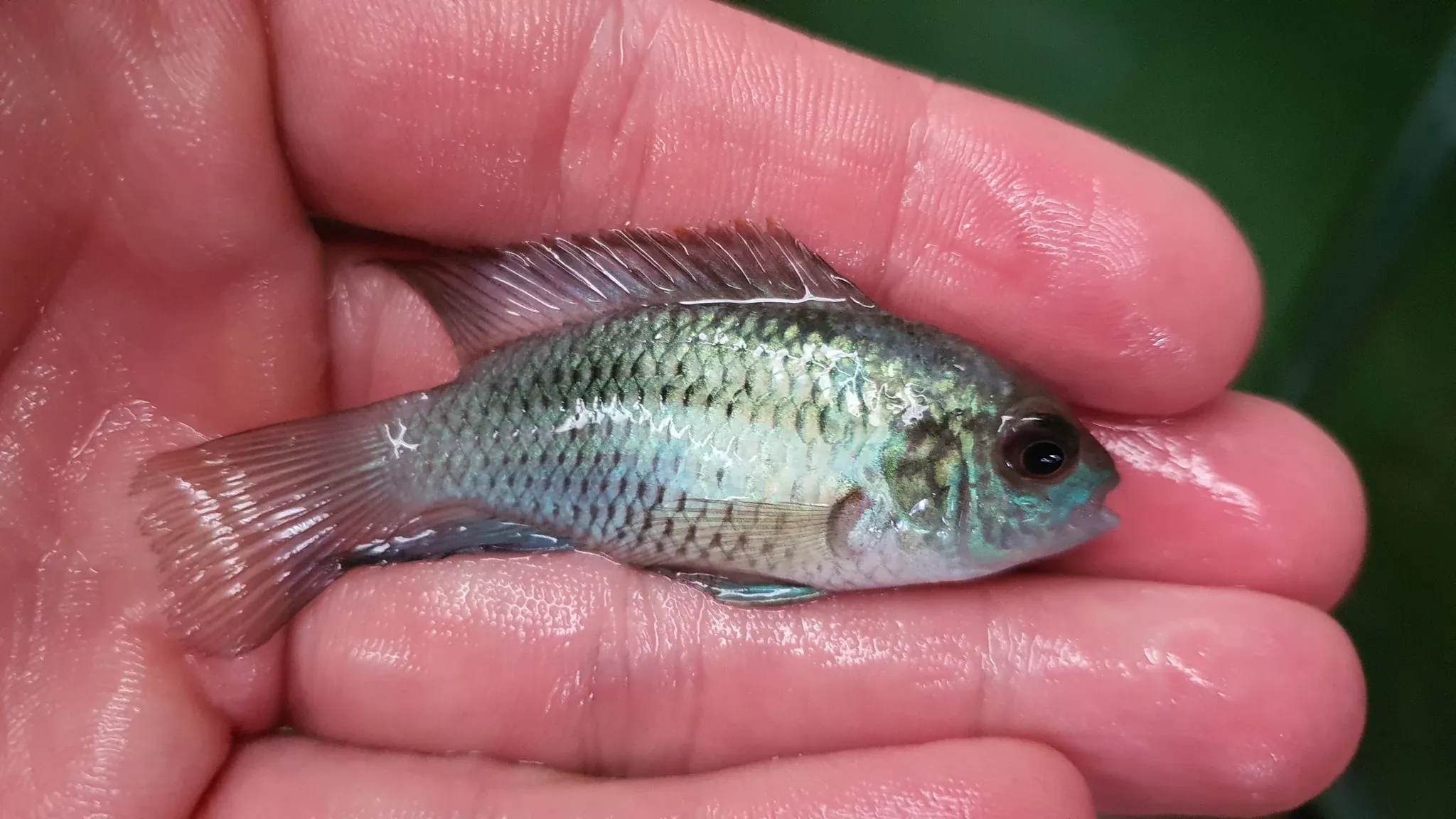
How Big Do Electric Blue Acara Get? Growth Rate, Adult Size and Tank Planning
Most Electric Blue Acara settle at 6–7 inches (15–18 cm) total length as adults, with well-cared-for males occasionally reaching 8 inches (20 cm). Full size isn't reached until 1.5–2 years of age, which means the fish you buy at 2 inches long will need considerably more room than it appears to need on day one.
Adult Size: What to Actually Expect
The Electric Blue Acara is a color morph of Andinoacara pulcher selectively bred for its solid, iridescent blue coloring rather than the wild-type's blue speckling on a tan-to-olive body. Size claims for this morph are inconsistent across the hobby — some sources describe fish topping out at 4–5 inches, while broader hobby experience puts the realistic adult range at 6–7 inches, with 8 inches as an achievable maximum for a well-fed male with strong genetics.
The smaller numbers usually describe young fish, or fish that were stunted by an undersized tank or poor diet — not a true genetic ceiling. Since you can't tell in advance which outcome you'll get, plan your tank around the higher end of the range rather than the optimistic low end.
As a color morph, the Electric Blue Acara tends to run slightly smaller on average than many wild-type Blue Acara populations, though the two overlap heavily in practice — see the comparison section below.
Male vs. Female Size
Sex has a real, visible effect on final size and body shape:
- Males: typically longer and more elongated, often reaching the top of the range (6.5–8 in / 16.5–20 cm), with more pointed dorsal and anal fin extensions as they mature.
- Females: generally stop growing sooner, commonly topping out around 5–6 inches (12.5–15 cm), with a fuller, rounder body profile.
If you're trying to sex a young fish by size alone, don't — body shape and fin development only become reliable indicators as the fish approaches maturity.
Growth Rate: A Month-by-Month Guide
Growth isn't linear. Juveniles grow quickly in their first year, then the rate tapers off substantially in year two before plateauing.
| Approximate Age | Expected Length | Growth Phase |
|---|---|---|
| 1–2 months (fry) | Under 1 in (2.5 cm) | Rapid early growth |
| 6 months | 2.5–3.5 in (6–9 cm) | Fast juvenile growth (~0.5 in/month) |
| 8–10 months | 4–5 in (10–12.5 cm) | Sexual maturity / breeding size reached |
| 12 months | 4.5–5.5 in (11.5–14 cm) | Growth begins slowing |
| 18 months | 5.5–6.5 in (14–16.5 cm) | Slower growth (~1 in per 2 months) |
| 2 years | 6–8 in (15–20 cm) | Near-final adult size |
Under optimal conditions — warm, stable water, a high-protein diet, and frequent small feedings — young fish can pack on roughly 0.5 inch of length per month. That rate slows to about 1 inch every two months by the second year. Most individuals reach their full adult size by 1.5 to 2 years old, with only slight filling-out afterward.
Notably, fish reach breeding readiness around 4–5 inches at roughly 8–10 months — well before they've finished growing. Don't assume a breeding-age fish is a fully grown one.
What Actually Drives Growth
Several factors interact to determine whether a given fish reaches the top or bottom of its size potential:
- Tank size and headroom — a cramped tank measurably suppresses growth.
- Water quality and temperature stability — fluctuations stress the fish even when the tank is otherwise adequate.
- Diet quality and protein content — flake-only or low-protein diets slow growth and dull coloration.
- Feeding frequency — one or two feedings a day support steadier growth than a single large meal.
- Genetics and lineage — some bloodlines simply run larger than others.
- Stress level — crowding, unstable parameters, and pushy tankmates can stunt growth even when food and space seem sufficient.
Tank Planning: Gallons, Footprint and Stocking
Minimum Tank Size
A single adult Electric Blue Acara needs a 30-gallon (113 L) tank minimum. For each additional acara housed in the same tank, add roughly 15 gallons (57 L). A pair is comfortably housed starting around 40–55 gallons (150–210 L).
Because acaras are active, ground-oriented swimmers, tank footprint matters more than height — a long, low tank offers more usable territory than a tall, narrow one holding the same volume. Two tanks with identical gallon capacity can differ significantly in the floor space a cichlid actually uses, so when comparing tanks, check the length and width dimensions, not just the volume rating printed on the box. You can browse suitable long-format setups among FishyHub's glass aquarium tanks.
Water Parameters for Healthy Growth
| Parameter | Safe Range | Notes |
|---|---|---|
| Temperature | 72–82°F (22–28°C) | Mid-70s°F (24°C) is optimal |
| pH | 6.5–7.5 | Wider tolerance to 6.0–8.0 exists but isn't ideal long-term |
| General Hardness | 6–20 dGH | Moderate hardness is well tolerated |
Consistency matters as much as the exact numbers. Temperature swings and irregular water changes stress the fish and can suppress growth even in a tank that's technically large enough.
Diet for Full Growth Potential
Electric Blue Acara are omnivorous and need more than a flake-only diet to reach their genetic size potential. A solid feeding routine includes:
- Quality pellets as a base diet
- Protein sources such as bloodworms or brine shrimp
- Occasional plant matter or a vegetable-based gel food
Feed 1–2 times daily, offering only what's consumed within a couple of minutes. Overfeeding fouls water quality; underfeeding or relying on low-protein flakes slows growth and dulls the signature blue coloration. Frozen and freeze-dried protein options are worth rotating in — you'll find a range in FishyHub's freeze-dried food category.
Tank Mates at Full Adult Size
Once grown, an Electric Blue Acara needs tankmates that won't be bullied and won't be eaten. Reasonable choices include:
- Other medium peaceful-to-semi-aggressive cichlids
- Larger tetras and rainbowfish
- Bristlenose plecos
- Corydoras and other bottom dwellers
Avoid nano fish and shrimp, which read as food to a full-grown acara, and avoid overly aggressive large cichlids that could injure it. If you're stocking a mixed American cichlid tank, it helps to review size and temperament for each species before combining them — FishyHub's American cichlid selection is a reasonable starting point for comparing options.
Electric Blue Acara vs. Standard Blue Acara Size
If you're not sure which fish you actually have, the size numbers won't help you distinguish them much — the two overlap heavily. The standard (wild-type) Blue Acara tends to run similar to, or very slightly larger than, the Electric Blue morph on average, but shares the same care needs and growth curve. Selective breeding for the solid electric-blue trait may correlate with subtly different growth patterns or hardiness compared to wild-type lines, though this isn't well documented and shouldn't be treated as settled fact — treat it as a minor consideration rather than a planning factor.
Quick Comparison Table
| Trait | Electric Blue Acara | Standard Blue Acara | Keyhole Cichlid |
|---|---|---|---|
| Typical adult length | 6–7 in (15–18 cm) | 6–8 in (15–20 cm) | 4–5 in (10–12.5 cm) |
| Max reported length | ~8 in (20 cm) | ~8 in (20 cm) | ~6 in (15 cm) |
| Temperament | Semi-aggressive | Semi-aggressive | Peaceful |
| Minimum tank size | 30 gal (113 L) | 30 gal (113 L) | 20 gal (76 L) |
Measuring Growth Accurately
When tracking your own fish's progress, measure total length — the distance from the tip of the mouth to the end of the tail fin — rather than standard length, which stops at the base of the tail. Total length is the figure used in most size ranges you'll see quoted, so measuring the same way keeps your tracking consistent. Measure along a straight line with the fish relaxed, not mid-swim, for the most accurate reading.
Common Mistakes That Stunt Growth
- Buying a juvenile into an undersized tank (under 20–30 gallons) on the assumption it will "stay small." This is the single most common cause of stunted growth, poor coloration, and crowding-driven aggression.
- Feeding a low-protein, flake-only diet, which slows growth and dulls the electric-blue coloration the fish is named for.
- Inconsistent water changes or temperature swings, which stress the fish and suppress growth even in an otherwise adequately sized tank.
- Housing acaras with fish small enough to become food once the acara reaches adult size, or with fish that consistently outcompete it at feeding time.
- Mistaking normal territorial or breeding behavior for illness. A mated pair guarding territory can look alarming, but this usually resolves by separating flustered tankmates or rearranging décor to break sightlines.
- Judging adult potential from a young juvenile. True final size isn't apparent until 1.5–2 years of age, so a small 3-month-old fish tells you very little about its eventual size.
Lifespan and Long-Term Size
In home aquariums, Electric Blue Acara typically live 8–10 years. Some keepers report exceptional individuals reaching 15–20 years, but that's the exception rather than the expectation, and it depends heavily on consistent water quality maintained over the fish's entire life. Since long-term health and final size are linked to the same consistent-care factors, a fish kept in stable conditions is more likely to both live longer and reach its full size potential.
Frequently Asked Questions
How big does an Electric Blue Acara get in a 20-gallon tank?
Growth will likely be stunted in a 20-gallon tank — it's undersized for an adult of this species. Plan for 30 gallons minimum, and ideally upgrade before the fish is fully grown rather than after.
Do male or female Electric Blue Acaras get bigger?
Males typically grow larger, reaching 6.5–8 inches with a longer, more slender body and more pointed fins. Females usually stay smaller, topping out around 5–6 inches with a fuller, rounder body shape.
How fast do Electric Blue Acaras grow?
Growth is fastest in the first year, around 0.5 inch per month under good conditions, then slows to roughly 1 inch every two months in year two. Most fish reach full adult size by 1.5–2 years old.
Is the Electric Blue Acara smaller than the regular Blue Acara?
Sizes overlap heavily between the two. The Electric Blue morph runs similar to, or slightly smaller than, the standard Blue Acara on average — not dramatically different.
What size tank do I need for two Electric Blue Acaras (a pair)?
Roughly 40–55 gallons, following the 30-gallon-plus-15-gallons-per-additional-fish guideline. Prioritize tank length over height, since a pair needs enough floor space to establish separate territories.
Can Electric Blue Acara live with bettas or neon tetras?
Not recommended long-term. Once the acara reaches adult size, it will likely view fish that small as food, or bully them relentlessly even if it doesn't eat them.
Why is my Electric Blue Acara not growing?
Check three things first: tank size, water quality and temperature stability, and diet quality and feeding frequency. These cover the most common causes of stunted growth in this species.
How can I tell if my Electric Blue Acara is fully grown?
Growth plateaus around 1.5–2 years of age. At that point, body shape — a slender profile in males versus a rounder one in females — and fin development are more reliable maturity cues than relying on a single length measurement.
Ready to plan your setup? Browse FishyHub's American cichlid livestock to compare Electric Blue Acara alongside compatible tankmates before you buy.

