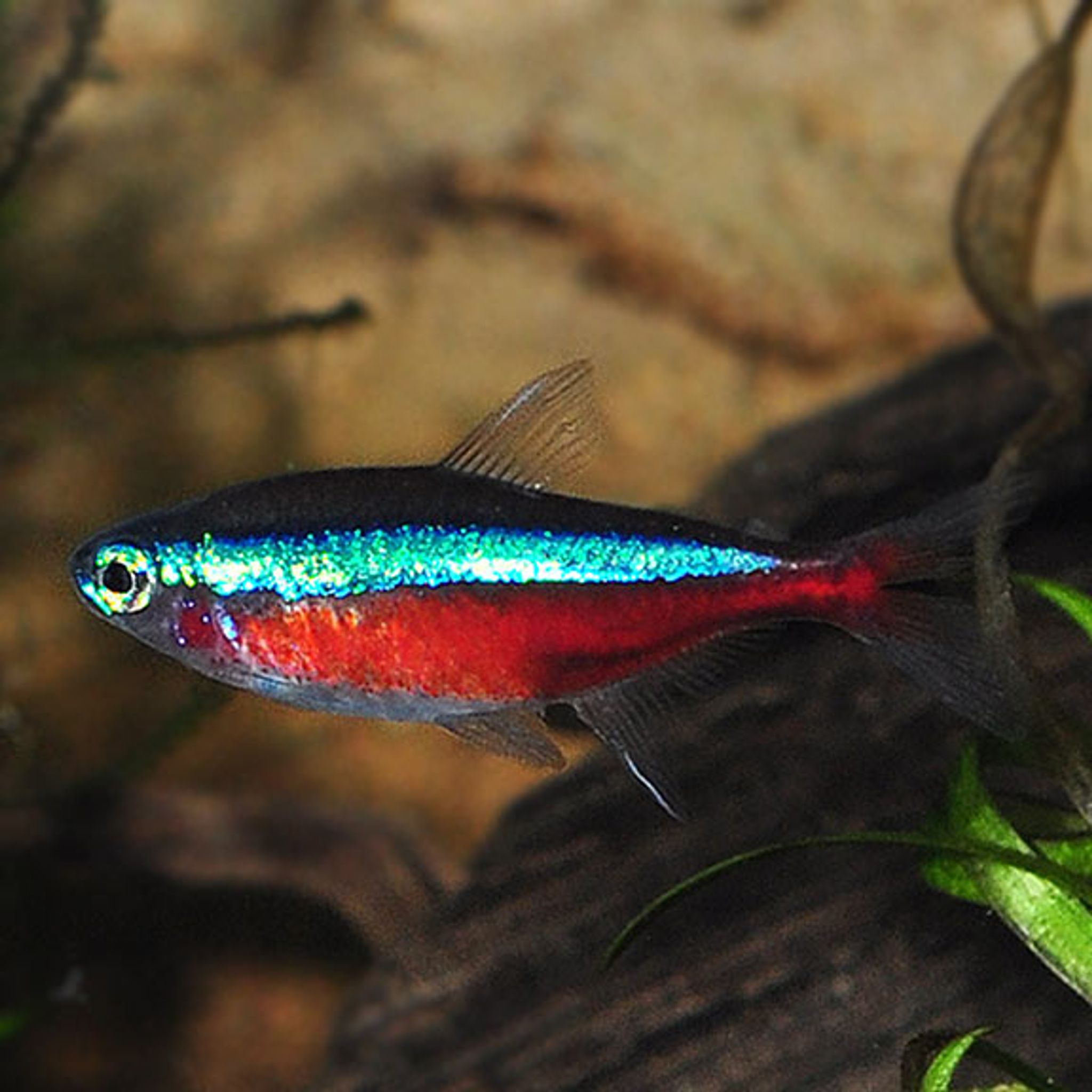
How Big Do Cardinal Tetra Get? Growth Rate, Adult Size and Tank Planning
A full-grown cardinal tetra tops out at roughly 2 inches (5 cm), reaching that size somewhere between 6 and 12 months of age. That single number, though, doesn't tell you much about tank size, schooling, or why your "baby" tetra might just be stressed rather than a permanent dwarf. This guide covers the full growth timeline, the size and water-quality caveats that actually matter, and the stocking math to plan a tank around a proper school.
Adult Size: What to Actually Expect
Cardinal tetras (Paracheirodon axelrodi) settle at about 2 inches (5 cm) in total length as adults. A handful of exceptional wild-caught specimens push closer to 2.25 inches, but treat 2 inches as the reliable planning number rather than an average of loosely reported "1-2 inch tetra" ranges you'll see elsewhere.
A few nuances worth knowing: females run slightly larger and rounder than males once mature, mainly due to egg mass; wild-caught fish from Amazon and Rio Negro tributaries sometimes size up a touch differently than tank-raised stock; and farmed stock can run marginally smaller, largely a function of diet and captive-breeding genetics rather than a health problem. None of this changes the practical takeaway: plan your tank around a 2-inch adult fish, not a permanently tiny one.
Growth Timeline: From Fry to Full Size
Cardinal tetra fry hatch out extremely small — around 1/4 inch (0.6 cm) — and are nearly transparent for their first few weeks. Growth from there follows a fairly predictable curve:
| Age | Approximate Size | Notes |
|---|---|---|
| Newly hatched | ~1/4 in (0.6 cm) | Free-swimming after a few days; needs infusoria or liquid fry food |
| 1 month | ~0.5 in (1.3 cm) | Color pattern starts to appear |
| 2-3 months | ~1-1.25 in (2.5-3.2 cm) | Fastest growth phase |
| 4-6 months | ~1.75-2 in (4.5-5 cm) | Near full length; color intensifying |
| 8-12 months | ~2 in (5 cm) | Sexually mature, full adult size |
This timeline is extrapolated responsibly from general Paracheirodon growth patterns, since documented month-by-month data specific to cardinals is thinner than for their close relative the neon tetra. Expect some individual variation based on diet and conditions rather than treating these numbers as fixed milestones.
Growth Factors: Why Some Cardinals Stay Small
Final size and how fast a fish gets there depend on a handful of variables shared by most freshwater fish: diet quality (varied, quality food drives growth and color saturation), tank size/space (cramped, overcrowded conditions slow growth and increase stress), stable water quality (ammonia/nitrite exposure stunts growth and causes lasting damage), low stress (a full school and adequate cover reduce the chasing that eats into growth energy), and genetics/lineage (long-established farmed lines can trend slightly smaller across generations than wild imports, though this is a minor effect next to diet and water quality).
The important mistake to avoid: assuming a small, "baby-sized" fish is a permanent dwarf morph. In cardinal tetras, undersized adults are almost always the result of poor early diet, a too-small tank, or chronic stress — not a distinct size variety you can shop for.
Lifespan: How Long Do Cardinal Tetras Live?
In a well-maintained home aquarium, expect 4-5 years as a realistic lifespan. Under especially stable, low-stress, consistently soft-water conditions, some individuals reach up to 10 years — treat that as an achievable ceiling, not the norm. In the wild, lifespan is far shorter, often around a single year, due to predation and a much harsher environment.
Tank Size and Stocking Math
Minimum Tank Size
Because cardinal tetras should never be kept in groups smaller than six, a 10-gallon tank is not a practical minimum even though a couple could technically survive in one short-term. The real-world minimum for a proper school is 20 gallons (76 liters), with a 20-40 gallon range considered ideal for a larger, more stable school of 8-12+.
Favor a long, low-footprint tank over a tall one — cardinals are horizontal swimmers that use length far more than height. A 20-long footprint gives a school more swimming room than a taller 20-high of the same volume.
Stocking Guideline
| School Size | Minimum Tank Size | Footprint Preference |
|---|---|---|
| 6 (bare minimum) | 20 gal (76 L) | Long, low |
| 8-10 | 20-29 gal (76-110 L) | Long, low |
| 12+ | 29-40 gal (110-150 L) | Long, low |
As a rough stocking heuristic, 1 inch of fish per gallon works as a reasonable starting floor for nano schoolers like cardinal tetras. Beyond six fish, adding roughly 2 gallons per additional cardinal keeps bioload manageable. Treat this rule as a minimum baseline, not a ceiling — real stocking capacity also depends on filtration strength, plant load, and how often you do water changes. A heavily planted, well-filtered tank can comfortably support more fish than the bare-minimum math suggests; a lightly filtered one should stay conservative.
Bigger volume also means more stable parameters overall, which matters more for cardinals than for hardier community fish since they're less forgiving of swings in temperature, pH, or ammonia.
Water Parameters
Cardinal tetras are noticeably stricter about soft, acidic water than their neon tetra cousins:
- Temperature: 73-81°F (23-27°C)
- pH: 4.6-6.2, ideally 5.0-6.0
- General hardness: up to about 4 dGH
Wild-caught cardinals need this range held tighter and lower, closer to 5.0-6.0 pH, reflecting the blackwater conditions of their native tributaries. Long-term tank-raised (farmed) stock can tolerate slightly higher pH, up to around 7.0, but softer and more stable is always the safer bet. Letting pH or hardness drift too high — above roughly 7.4 pH or 15 dGH — causes fading color, appetite loss, and a slow decline that's easy to mistake for old age rather than a water-quality problem.
This soft/acidic preference is shared broadly across the Paracheirodon genus. Neon tetras tolerate a somewhat wider 6.0-7.0 pH range, but cardinals sit at the stricter end, which is one more reason to match your source water (or blend with RO water) rather than relying on tap water straight out of the faucet, especially if you're aiming for good color and eventual breeding.
Do Cardinal Tetras Need a Heater?
Yes. Cardinal tetras are tropical fish and need a stable, heater-maintained temperature in the 73-81°F range. An unheated room swings too widely across a day-night cycle, and those fluctuations stress fish and suppress both growth and immune function — a slow, cumulative problem rather than an obvious one.
Diet and Feeding
Cardinal tetras are omnivorous. A solid feeding routine covers:
- Quality micro-pellets or flakes as a staple
- Occasional live or frozen foods — bloodworm, daphnia, brine shrimp, mosquito larvae
- Small portions 2-4 times daily, offering only what the school clears in about 3 minutes
Diet quality has a direct, visible effect on both growth rate and color intensity, which is part of why farmed fish on a thin diet can end up smaller and duller than well-fed wild imports.
Tank Mates
Cardinal tetras do best with other peaceful, similarly sized fish that won't outcompete them at feeding time or view them as food:
Good tank mates: neon and ember tetras, rasboras, small danios, corydoras, dwarf gourami, otocinclus, small peaceful loaches, dwarf shrimp, and snails.
Avoid: bettas (nipping/aggression risk), larger cichlids, goldfish, and any fish large enough to eat a 2-inch fish.
If you're building a mixed nano community, the small community fish and tetra selection is a useful starting point for compatible schooling species.
Cardinal vs. Neon Tetra: Telling Them Apart
These two are constantly confused at fish stores, which matters because they're not identical in size or water needs.
| Trait | Cardinal Tetra | Neon Tetra |
|---|---|---|
| Adult size | ~2 in (5 cm) | ~1.5 in (3.8 cm) |
| Red stripe | Runs the full body length | Covers only the rear half |
| pH preference | 4.6-6.2 (stricter) | 6.0-7.0 (more flexible) |
| Typical sourcing | Wild-caught common | Almost entirely farmed |
The quickest visual check at the store: look at the red stripe. If it runs the entire length of the body, it's a cardinal. If red only shows on the back half with blue up front, it's a neon. A third look-alike, the green neon tetra, is smaller still (around 1 inch) and lacks the red stripe almost entirely, showing mostly blue-green.
Cardinal and neon tetras can absolutely live together — they're compatible tank mates — but match your tank to the stricter cardinal's water requirements if you're keeping both.
Sourcing: Wild-Caught vs. Farmed
Unlike neon tetras, which are almost entirely farm-raised today, cardinal tetras are still commonly wild-caught from South American blackwater habitats. Wild-caught fish typically need a more gradual acclimation to tank water chemistry, carry somewhat higher parasite risk (making quarantine non-negotiable), and can show more size and color variation than uniform farmed batches.
Common Mistakes to Avoid
- Buying too few — 2-3 cardinals show stress, fading color, and constant hiding. Buy for a school of 6 minimum, ideally 8-12+.
- Undersized or uncycled tanks — ammonia spikes in a new tank stunt growth or kill fish outright.
- Assuming small size is permanent — a young, stressed, or underfed fish is not a dwarf variety; correct the conditions and growth typically resumes.
- Misidentifying the species at the store — confusing cardinals with neons leads to mismatched expectations on size and water hardiness.
- Letting pH or hardness drift high — especially risky for wild-caught stock, and easy to mistake for aging.
- Leaving the tank uncovered — cardinals can and do jump, particularly during stress events or water changes.
- Skipping quarantine — new stock can carry Ich or Neon Tetra Disease that spreads fast through an established school.
Common Cardinal Tetra Diseases
Two conditions account for most tetra health scares, and it's worth telling them apart:
- Ich (white spot disease): Small white dots across the body and fins; curable with a combination of raised temperature and an over-the-counter medication.
- Neon Tetra Disease: Caused by a microsporidian parasite; symptoms include color loss, restlessness, and muscle wasting. It is incurable — prevention through quarantine and careful handling of live feeder foods is the only real defense.
Keeping a dedicated quarantine tank and a basic medication supply on hand makes both conditions far easier to manage before they reach an established school; treatment and medication options are worth having ready before you need them.
Why Did My Tetra Disappear?
If a cardinal vanishes from an otherwise stable tank, the usual suspects are:
- Predation by a tank mate that's larger or more aggressive than expected
- Jumping out through a gap in an uncovered lid
- Death and decomposition hidden in dense décor or substrate
Rule these out in order: check for a secure, gap-free lid; review whether any tank mate has shown aggressive or predatory behavior; and test water quality, since a hidden ammonia spike can quietly kill fish that then decompose out of sight.
Setting Up for a New Community
New to tropical fish generally? Cardinal tetras fit the broader "tropical community fish" category: a heater, a fully cycled tank, appropriate substrate and moderate lighting, and a slow, drip-style acclimation when introducing new stock. Getting those basics right prevents most of the stress-related problems above. A glass tank suited to a long, low footprint is a good starting point for a proper cardinal school.
Frequently Asked Questions
How big do cardinal tetras get?
Adult cardinal tetras reach about 2 inches (5 cm) in total length, with exceptional wild specimens occasionally reaching closer to 2.25 inches.
How long does it take for a cardinal tetra to reach full size?
Roughly 6-12 months, with the fastest growth happening in the first 2-3 months of life and near-full size reached by 4-6 months.
What's the difference between a cardinal tetra and a neon tetra in size?
Cardinals average slightly larger at about 2 inches versus roughly 1.5 inches for neons, and cardinals also carry a longer red stripe running the full body length rather than just the rear half.
What tank size do I need for a school of cardinal tetras?
20 gallons minimum for a proper school of 6 or more, with a long, low-footprint tank preferred over a tall one since cardinals swim horizontally.
Do cardinal tetras need a heater?
Yes. They're tropical fish requiring a stable temperature of 73-81°F (23-27°C), and an unheated tank will swing too much for their health and growth.
How long do cardinal tetras live?
Typically 4-5 years in a well-maintained tank, with some individuals reaching up to 10 years under especially stable, ideal conditions.
Why is my cardinal tetra not growing or staying small?
Usually a poor diet, a cramped tank, ongoing stress, or inconsistent water quality — genetics alone rarely explains a stunted fish.
Can cardinal tetras live with neon tetras?
Yes, they're compatible tank mates, though their water parameter needs aren't identical — set up the tank around the stricter, more acid-sensitive cardinal.
Ready to plan a school of your own? Browse live cardinal and other tetra stock on FishyHub to get started.

