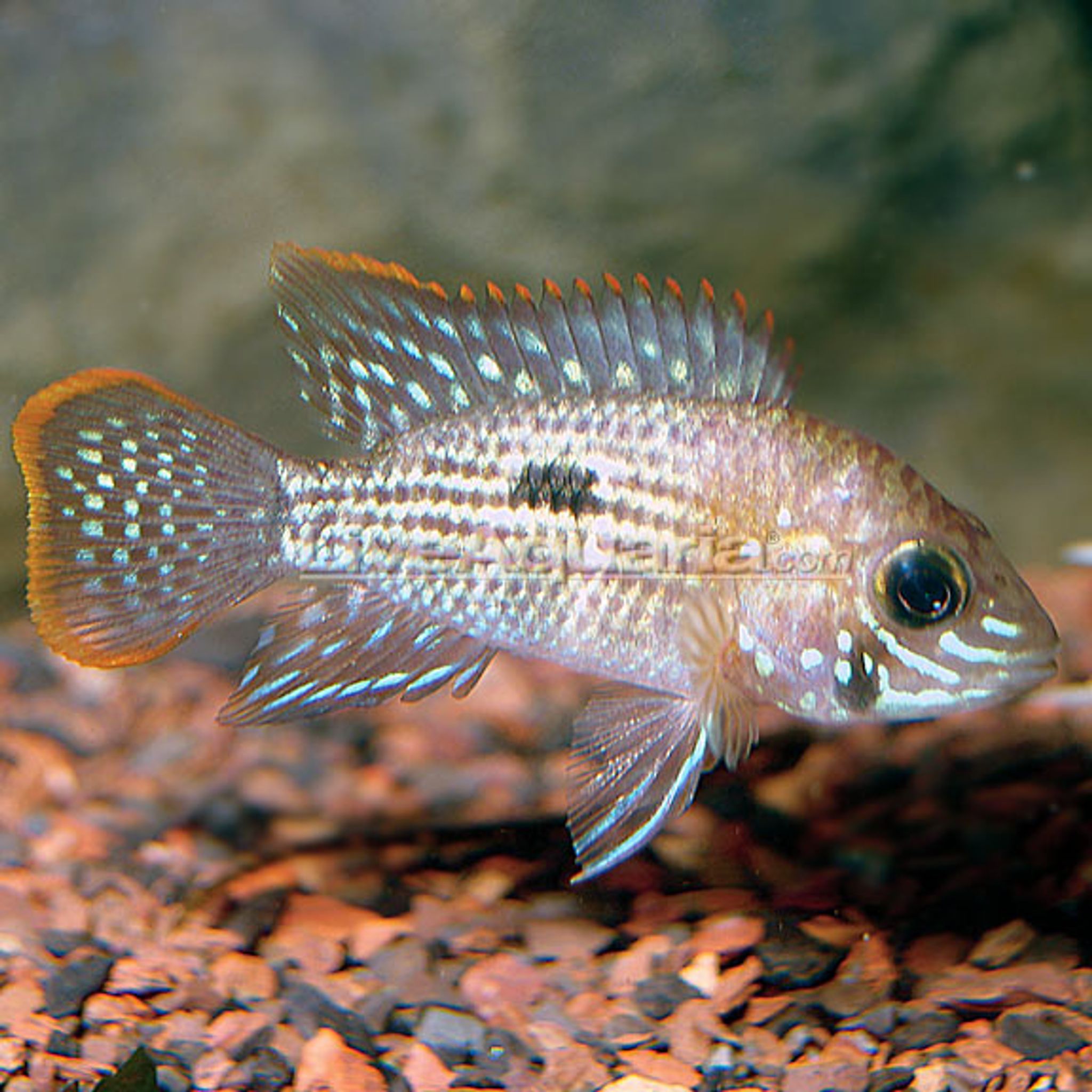
Green Terror Care Guide: Tank Size, Diet, Water Parameters and Temperament
A green terror looks like a peaceful 2-inch tetra-tank fish in the store and grows into an 8-inch cichlid with an attitude to match. This guide covers the tank size, water parameters, diet, and temperament facts you need before buying one, plus how it stacks up against lookalike species people mix it up with.
What Is a Green Terror?
The green terror's scientific name is Andinoacara rivulatus (formerly classified as Aequidens rivulatus). It's a South American cichlid native to Pacific-slope rivers of western Ecuador and northern Peru, not the Amazon basin.
Two trade names cause most of the confusion at fish stores:
- Gold saum and white saum both refer to green terrors — the names describe differences in fin-edge coloration between wild populations, not separate species or hybrids.
- Both color forms have the same adult size, temperament, and care needs. The name on the tag tells you about the fish's fin trim, not anything about how it will behave.
Don't confuse the green terror with the red terror (Mesoheros festae) — a completely different, much larger species from the same region. More on that below.
Adult Size and Lifespan
Green terrors are sold as small juveniles, and their eventual size surprises a lot of first-time buyers.
- Typical adult size: 6–8 in.
- Large males: up to 10–12 in. in a spacious, well-fed setup
- Females: noticeably smaller, often 5–6 in., sometimes only 1–3 in. shorter than the male in a pair
Lifespan is commonly cited at 7–10 years, and a well-kept fish in stable water can live longer.
Tank Size Requirements
Sources disagree on the bare minimum, with figures ranging from 30 to 55 gallons for a single adult. Treat the lower numbers as juvenile grow-out tanks only, not permanent homes.
| Setup | Recommended tank size |
|---|---|
| Juvenile (under 3 in.), temporary | 30–40 gal (114–151 L) |
| One adult, long-term | 55 gal (208 L) minimum, 48 in. long |
| Mated pair | 75 gal (284 L) or larger |
| Mixed cichlid community | Base tank plus ~30–35 gal (114–132 L) per additional large fish |
Footprint matters more than height. A long, 4-foot-plus tank gives a green terror room to establish territory and gives smaller fish room to retreat, which a tall, narrow tank cannot do. When shopping for glass tanks, prioritize length over depth for this species.
Water Parameters
Green terrors are forgiving compared to many South American cichlids, which is part of their appeal as a first "big cichlid."
- Temperature: 72–78°F (22–26°C) day-to-day; some keepers report success as low as 68°F and as high as 80°F. Raise toward 77–80°F (25–27°C) to encourage spawning.
- pH: 6.5–8.0
- General hardness: roughly 5–20 dGH; some sources list ceilings as high as 25 dGH. Most US tap water falls comfortably in range — don't chase a specific number unless your tap water is at an extreme.
- Stability matters more than precision. Swinging parameters stress the fish far more than a pH or hardness reading that's merely "off-ideal."
Filtration and Nitrate Control
Green terrors eat heavily and produce a lot of waste, so filtration needs to keep pace.
- Aim for 5–8x tank volume turnover per hour with moderate current (they don't need a torrent, but they do need real flow).
- Canister filters or a sump are preferred over hang-on-back units at this bioload.
- Keep nitrate under roughly 20–40 ppm. Higher, sustained nitrate is linked to fin and color problems (more on that in Common Mistakes below).
For a 55–75 gallon green terror tank, look for a canister rated well above the tank's volume — roughly 300–400+ GPH of real flow — and prioritize biological media capacity over brand name. Clean the media in removed tank water every 4–8 weeks to avoid crashing the bacteria colony. Some keepers pair a canister with a second, smaller filter for redundancy in case one needs servicing. FishyHub's external filters selection covers this range.
Weekly Maintenance
- 25–30% water change weekly for an adult in a single-fish tank. A lighter schedule (20% every two weeks) is too infrequent for the waste load of one 8-inch cichlid.
- Always dechlorinate and temperature-match new water before adding it.
- Vacuum substrate during changes — sand and fine gravel trap waste that gravel-diggers like this species kick up constantly.
Aquascape
Green terrors dig, and they dig with purpose.
- Substrate: sand or fine, smooth gravel. Sharp gravel can damage their mouths and gills as they sift through it.
- Hardscape: a few heavy caves and rock piles, stacked directly on the glass bottom (not on top of substrate) so digging doesn't collapse them onto the fish.
- Open swimming lane for the fish to patrol and display.
- Plants: sturdy, floating, or epiphyte species tied to driftwood or rock — anubias and java fern attach to hardscape instead of rooting in substrate, so they survive the excavation. Rooted stem plants generally get uprooted.
- Lid: tight-fitting. Cichlids this size can and do jump.
Diet and Feeding
Green terrors are best described as protein-heavy omnivores — some sources call them carnivores, others omnivores, and the truth sits in between with an emphasis on animal protein plus some plant matter.
Staple diet:
- A quality cichlid pellet or sinking stick as the everyday base
- Frozen bloodworms, brine shrimp, mysis shrimp, and krill
- Earthworms
- Occasional vegetable matter: blanched peas, zucchini, or a spirulina-based food
Feeding schedule:
- Juveniles: 2–3 small feedings per day
- Adults: 1–2 feedings per day, only as much as clears in about 2 minutes
- One fasting day per week is fine and helps prevent bloat
What to avoid:
- Beef heart or other mammal meat as a regular food — too fatty for a fish's digestive system as a diet staple
- Live feeder goldfish or rosy reds — disease risk and poor nutritional value outweigh any benefit; skip feeders entirely
Temperament and Tankmates
This is the part that catches new keepers off guard. Juvenile green terrors school peacefully in a store tank, and that behavior disappears with age.
- Territoriality increases with size and with spawning activity.
- Females can be as aggressive as males, sometimes more so — don't assume the smaller fish in a pair is the safe one.
- Newly formed pairs can turn violent before they settle, so any pairing needs close observation early on.
Suitable Tankmates (Large Tanks Only)
Stick to similarly robust, similarly sized fish in a tank large enough for everyone to claim territory:
- Jack Dempsey
- Firemouth cichlid (very large tanks only)
- Convict-sized or larger Central American cichlids
- Oscars
- Silver dollars
- Large barbs
- Plecos and other large armored catfish
Avoid: small community fish, shrimp, snails, crabs, and slow-moving or long-finned species — they read as food or targets. Most keepers also advise against mixing green terrors with Malawi or Tanganyikan African cichlids; the water chemistry and fighting styles don't match well.
Stocking Tactics That Reduce Fights
- Add all fish at roughly the same size at the same time when possible
- Add the green terror last, after tankmates have established territory
- Rearrange rocks and caves whenever you add a new fish, to break up existing territory claims
- Use plenty of line-of-sight breaks (rock piles, wood) so fish can retreat from view
- Keep a divider or backup tank on hand in case a pairing or grouping turns violent
Sexing a Green Terror
Reliable sexing only becomes possible once fish reach about 4–5 inches:
- Males grow larger, develop a pronounced nuchal hump on the forehead, and show bolder orange or red fin edging.
- Females stay smaller, show less hump development, and carry duller coloration.
Breeding Basics
Green terrors are open-substrate spawners that lay adhesive eggs on a cleaned, flat rock — not egg-scatterers, despite that label showing up in some places.
- Clutches commonly run 300–600 eggs
- Eggs hatch in about 3–4 days at breeding temperatures (77–80°F)
- Fry become free-swimming around day 8–11
- Both parents typically guard the brood
- Feed fry baby brine shrimp or crushed flake once free-swimming
- Remove fry after several weeks — parents often turn on their own brood before a re-spawn, or aggression escalates as fry grow
Common Mistakes and Troubleshooting
- Buying a juvenile for a 20–29 gallon tank "for now" and never upgrading — this stunts growth and worsens aggression as the fish outgrows its space.
- Mixing with small community fish — they disappear, often quickly.
- Under-filtering and infrequent water changes — sustained high nitrate is linked to hole-in-the-head disease (HLLE) and faded color.
- Ich outbreaks from rapid temperature swings or skipping quarantine on new fish — quarantine newcomers for 2–4 weeks before adding them to the main tank.
- Fin rot or bloat/swim-bladder issues from overfeeding combined with poor water quality — a weekly fast day and varied diet help prevent both.
- Lymphocystis (cauliflower-like growths on skin or fins) is viral and usually resolves on its own in clean, well-maintained water.
- Pair violence — if one fish is hiding, showing torn fins, and not eating, separate it immediately with a divider or a second tank. Waiting to "see if it works out" often ends badly.
- Uprooted plants and bulldozed décor — anchor rockwork on the glass bottom rather than on substrate, and rely on epiphyte plants tied to hardscape instead of rooted species.
A legal note: never release a green terror or any large cichlid into US waterways. Established invasive cichlid populations already exist in Florida, and releasing unwanted fish causes lasting ecological harm. Rehome through a local fish club, store, or another aquarist instead.
Look-Alikes and Bigger "Monster" Cousins
Green terrors get lumped in with several other large cichlids that are easy to confuse at a glance — but the space and care requirements diverge fast.
Red Terror
The red terror (Mesoheros festae) shares part of the range and a similar look as a juvenile, but it is not a color morph of the green terror — it's a distinct, much bigger and more aggressive species. Males reach 16–18 in., need roughly 150–180+ gallons, prefer warmer water (77–84°F), and can live 12–20 years. Don't buy one thinking it's just a color variant.
Wolf Cichlid
The wolf cichlid (Parachromis dovii) is a Central American predator that puts the green terror's size in perspective. It reaches 2 feet or more, needs a 180-gallon minimum (240+ ideal), is usually kept alone, and prefers 76–82°F water at pH 7–8. If a green terror is a "starter monster," the wolf cichlid is several tiers past it.
Umbee Cichlid
The umbee cichlid (Kronoheros umbrifer, formerly Cichlasoma umbriferum; also sold as the blue umbee) is another giant predator, with males approaching 2 feet and requiring roughly 250 gallons as adults. It digs constantly and is not a realistic substitute for anyone thinking a green terror is already "a lot."
Blue Texas Cichlid
The blue Texas cichlid is a more comparable alternative — a selectively bred, hybrid-line Texas-type cichlid reaching 8–10 in., kept in a 40-breeder to 55-gallon tank solo or in a pair, and 55–75 gallons with tankmates. Like the green terror, it's a digger with a real aggressive streak, making it a reasonable size-for-size comparison rather than a step up or down.
Pike Cichlids (Sidebar)
Argentine and Uruguayan pike cichlids (Crenicichla species from the Uruguay, Paraná, and Iguazú drainages) are elongated ambush predators. Many species are difficult to tell apart, availability is sporadic, and they generally prefer cooler, subtropical water — a poor match for a green terror's tropical setup and temperament. Worth knowing about, but not a tankmate option.
If you're weighing a green terror against these species and browsing options, FishyHub's American cichlids and monster fishes categories cover this size range.
Frequently Asked Questions
How big does a green terror get?
Most reach 6–8 inches in a home aquarium, with large males occasionally hitting 10–12 inches. Females typically stay a bit smaller, often 5–6 inches.
Can a green terror live in a 40-gallon tank?
Only as a juvenile, and only temporarily. Plan to move to a 55-gallon or larger tank before the fish reaches 4–5 inches — cramped adult housing drives stunted growth and worse aggression.
Are green terrors good for beginners?
They're a reasonable choice for someone comfortable with basic water chemistry, since their parameter needs are forgiving. They're a poor choice for anyone unprepared for a large, territorial adult fish and the tank size and filtration it requires.
Green terror vs. electric blue acara — what's the difference?
They're related genera, but the electric blue acara stays around 6 inches and is considerably calmer, making it a better fit for smaller tanks and more mixed communities.
How do I tell male from female green terrors?
Look for a pronounced nuchal hump and bolder orange or red fin edging on males, along with larger overall size. These traits become reliable once fish reach about 4–5 inches; younger fish are hard to sex accurately.
Can green terrors live with oscars or Jack Dempseys?
Often yes, but only in a 125-gallon-or-larger tank with generous hiding spaces, line-of-sight breaks, and a backup plan (divider or spare tank) if aggression escalates.
Why is my green terror losing color?
Faded color usually points to stress, poor water quality, ongoing bullying from a tankmate, or a bland diet lacking variety. Check nitrate levels and feeding variety first, then evaluate tankmate dynamics.
How long do green terrors live?
Typically 7–10 years, with well-maintained fish sometimes living longer.
Ready to plan a green terror setup or compare it against other large cichlids? Browse FishyHub's freshwater livestock selection to see what's currently available.

